Toward standardized behavioral analysis in IntelliCage experiments
Published in: bioRxiv , 2026
Type: preprint
Citation
Fabrizio Musacchio, Martin Fuhrmann, "Toward standardized behavioral analysis in IntelliCage experiments" (2026). bioRxiv , bioRxiv 2026.09.06.749703 https://doi.org/10.64898/2026.09.06.749703















Abstract
Automated home-cage systems measure individual behavior in social groups for days to months. Among these systems, the IntelliCage has become a widely used platform for longitudinal and socially embedded behavioral phenotyping. Yet the analysis layer often remains less standardized than the experiment itself: raw exports, phase definitions, exclusion rules, time alignment, and derived behavioral metrics are transformed by lab-specific scripts that are difficult to audit, compare, or reuse.
We present ic-analysis, an open-source Python toolkit for standardized, scriptable, and shareable IntelliCage workflows. The toolkit separates user-defined experiment metadata and workflow scripts from a reusable analysis core with modular analysis and plotting functions, allowing users to flexibly assemble experiment-specific pipelines without editing package internals. Due to its modular design, the analysis core can be applied to a broad range of experimental paradigms, including general activity, exploratory, motivational, cognitive, and social readouts, rather than being limited to a single fixed protocol. It aligns biological phase windows across staggered cage runs and exports plots together with quantitative result tables, applied settings, and audit files that support reproducible and FAIR reporting.
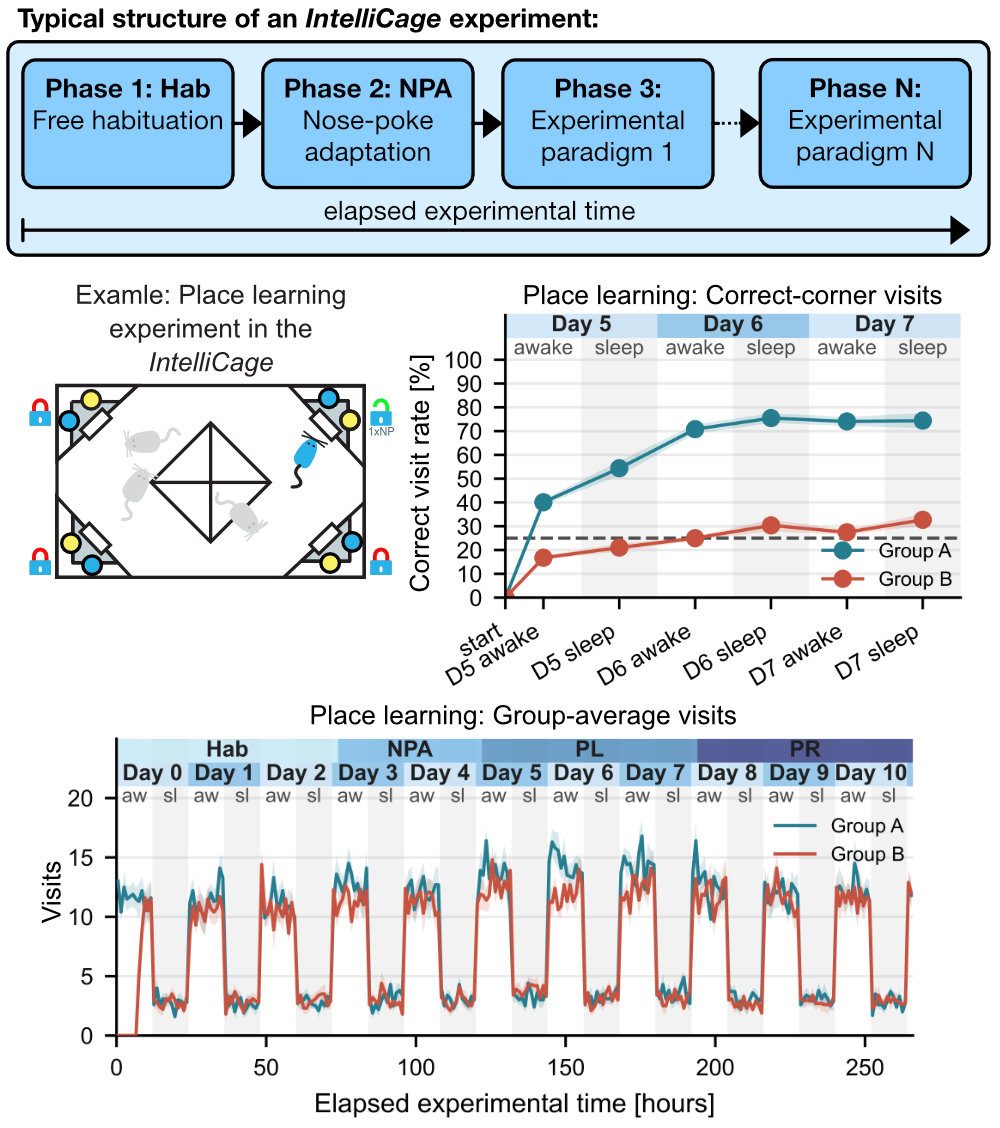
Here, we demonstrate this flexible design in a realistic synthetic place-learning/place-reversal experiment with two mouse groups and deliberately offset cage starts. The workflow recovered the implanted behavioral differences while preserving the required experimental-time alignment. Group A showed stronger endpoint saccharin preference (81.7 $\pm$ 1.7% vs. 27.4 $\pm$ 3.4%, $p = 1.9 \times 10^{-9}$), higher liquid uptake, faster place-learning onset (56.6 $\pm$ 8.1 vs. 278.3 $\pm$ 33.2 visits), and better reversal performance (64.1 $\pm$ 1.3% vs. 25.6 $\pm$ 1.7% rewarded correct-corner visits) compared to group B.
This demonstration shows how standardized, explicitly defined readouts can turn complex IntelliCage exports into interpretable behavioral profiles while preserving the analysis history needed for inspection and reuse. ic-analysis therefore provides both a working analysis scaffold and an extensible, community-friendly route toward IntelliCage workflows that are easier to reproduce, compare, extend, and share.
comments