Microglia-glioblastoma crosstalk mediates glioblastoma invasion at the far infiltration zone
Published in: Immunity, 2026
Type: Journal Article
Citation
Felix C. Nebeling, Falko Fuhrmann, Manuel Mittag, Fabrizio Musacchio, Henrike Antony, Nala Gockel, Lea L. Friker, Sonia Leonardelli, Severin Filser, Deli A., Miriam Stork, Daniele Bano, Torsten Pietsch, Frank A. Giordano, Qihui Zhou, Simona Parrinello, Michael Hölzel, Ulrich Herrlinger, Paolo Salomoni, Martin Fuhrmann, "Microglia-glioblastoma crosstalk mediates glioblastoma invasion at the far infiltration zone" (2026). Immunity, Immunity, 0 (t.b.a.) https://doi.org/10.1016/j.immuni.2026.03.010
Abstract
Glioblastoma (GB) cells infiltrate the brain parenchyma and colonize distant regions, driving recurrence and therapy resistance. Here, we examined dynamic microglial responses to infiltrating tumor cells during GB progression. Three-photon imaging in an autochthonous, immunocompetent GB mouse model enabled visualization of microglia-GB interactions at the far infiltration zone (FIZ) in the corpus callosum (CC). GB infiltration speed varied by anatomical location and tumor microtube (TM) number. Microglia increased surveillance in sparsely infiltrated areas but reduced it with higher GB density, revealing a biphasic response. Directional migration toward GB cells was restricted to microglial subsets within a defined spatial range, indicating heterogeneous reactivity. CX3CR1 deficiency enhanced microglial reactivity while limiting GB cell migration. Microglia depletion with the CSF1R inhibitor PLX5622 reduced GB cell migration and constrained TM plasticity. Thus, microglia respond to GB cell infiltration in a stage-dependent manner and critically modulate dissemination at the FIZ.
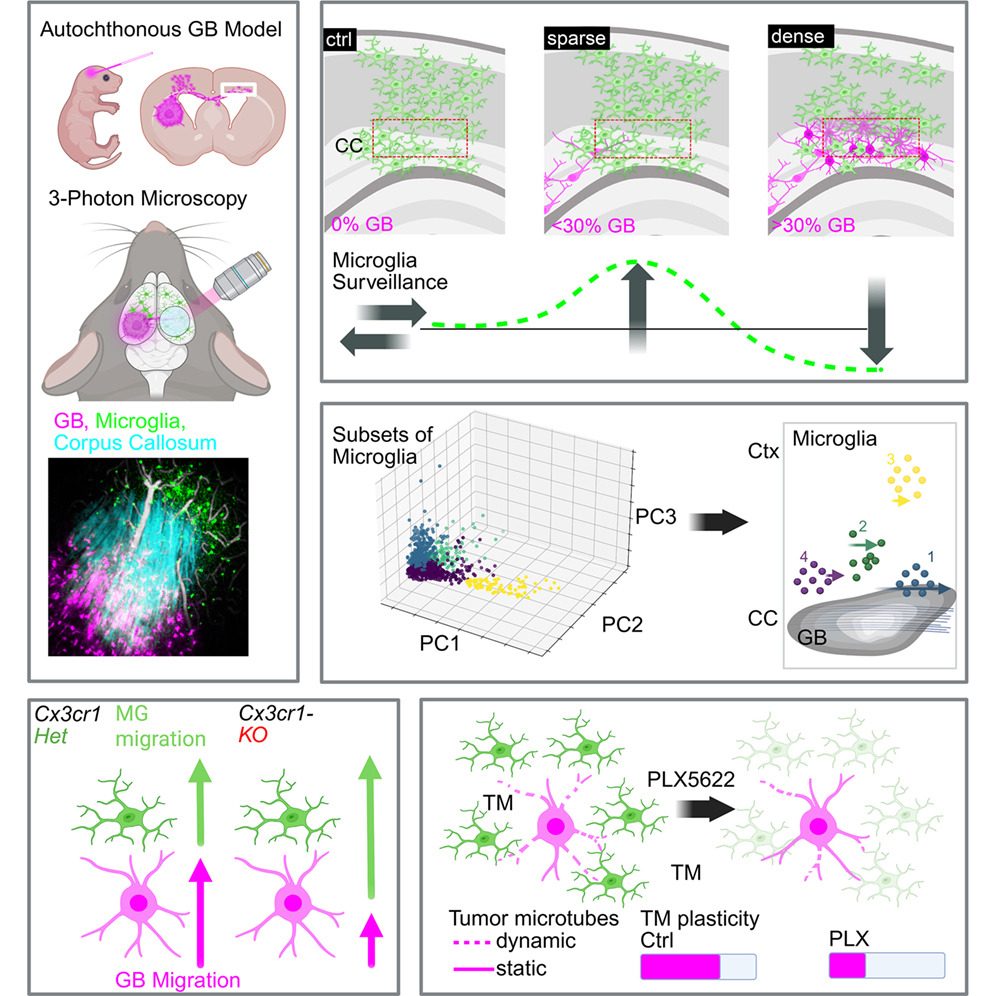
Graphical abstract. In brief: Infiltration of glioblastoma (GB) cells into the brain parenchyma and colonization of distant regions are associated with disease recurrence and therapy resistance. Using 3-photon intravital microscopy in an autochthonous GB model, Nebeling et al. identify structured, stage-dependent microglial responses at the far infiltration zone and show that microglial manipulation modulates tumor microtube plasticity and invasion. Source: Immunityꜛ (license: CC BY-NC-ND 4.0).

comments