Schizophrenia-associated complement C4 impairs synaptic connectivity and decreases microglia-synapse interactions through CR3 signaling
Published in: Cell Reports, 2026
Type: Journal Article
Citation
Nala Gockel*, Nayadoleni Nieves-Rivera*, Mélanie Druart, Külli Jaako, Falko Fuhrmann, Fabrizio Musacchio, Henrike Antony, Manuel Mittag, Sophie Crux-Daseking, Stefanie Poll, Baiba Jansone, Martin Fuhrmann, Corentin Le Magueresse, "Schizophrenia-associated complement C4 impairs synaptic connectivity and decreases microglia-synapse interactions through CR3 signaling" (2026). Cell Reports, 45(4), Elsevier https://doi.org/10.1016/j.celrep.2026.117161
* These authors contributed equally to this work.
Abstract
High-expression variants of the complement C4 gene increase schizophrenia (SZ) risk. C4 overexpression (C4-OE) in the mouse frontal cortex recapitulates SZ-associated phenotypes, including lower synapse density, but the underlying mechanisms remain unclear. In the complement cascade, C4 is upstream of C3, whose cleavage fragments can bind complement receptors, including CR3, selectively expressed by microglia in the brain parenchyma. Therefore, we hypothesize that microglial CR3 mediates C4-OE effects. We show that C4-OE alters synapse density and function and that these effects are rescued in CR3-deficient mice. Contrary to the models of excessive microglia-mediated synaptic elimination, our previous results indicate that C4-OE reduces spine formation and elimination. Here, using in vivo two-photon imaging, we find that C4-OE decreases microglial surveilled volume, motility, and the frequency of microglial contacts with pre- and postsynaptic structures. These changes are abolished by CR3 deficiency. Our findings suggest that CR3-mediated modulation of microglia-synapse interactions underlies C4-OE effects relevant to SZ.
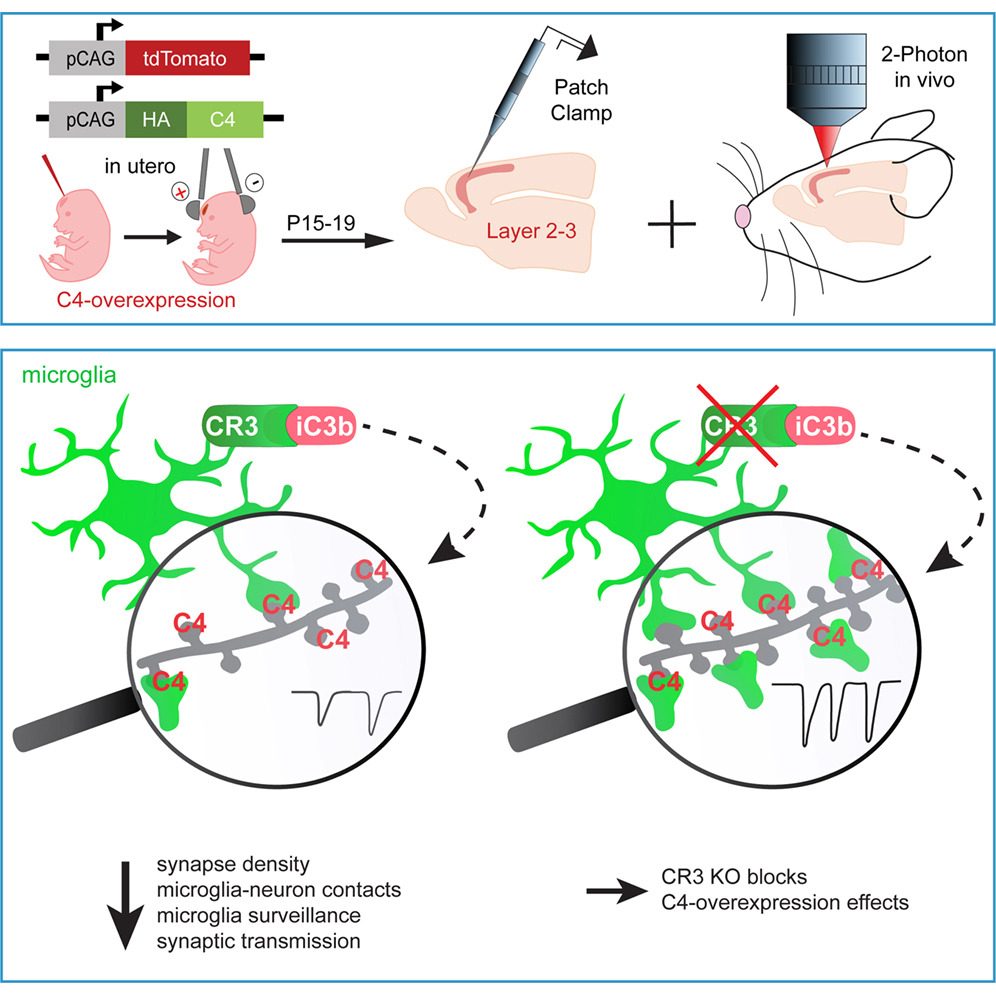
Graphical abstract. In brief: Genetic risk for schizophrenia has been linked to high expression of complement C4, but the mechanism remained unclear. Gockel et al. show that microglial CR3 receptors mediate the effects of elevated C4 expression in the mouse cortex, including altered synapse density and function, decreased microglial motility, and reduced microglia-neuron contacts. Source: Cell Reportsꜛ (license: CC BY-NC-ND 4.0).
comments