Astropeiler Stockert
After rediscovering the photographs from our 2013 excursion to Effelsberg, I also found the images from another institute trip, this time to the Astropeiler Stockertꜛ in 2014. They too had originally been part of an earlier post on my website, and that post had also disappeared during the cleanup and restructuring of the site. I thought it was worth bringing it back as well, just as a way to preserve the memory of that day.

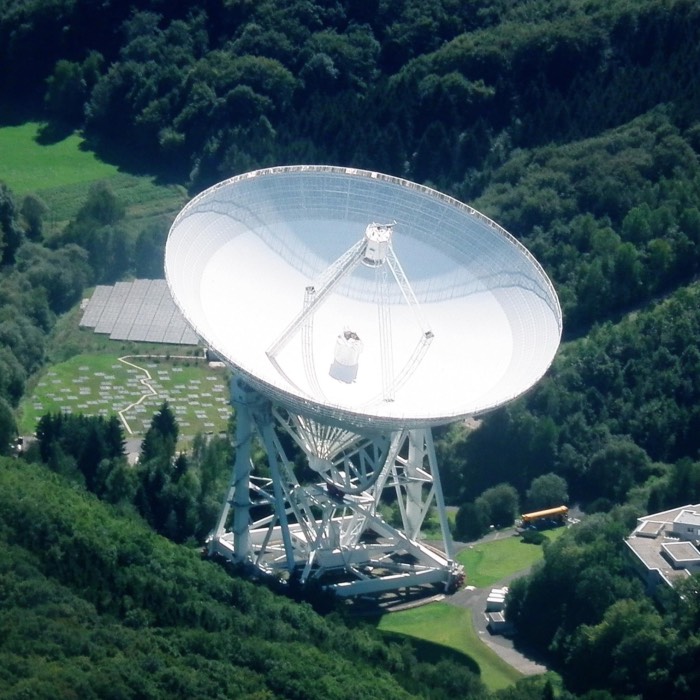
Areal view of the Astropeiler Stockert, showing the 25 m dish and the surrounding buildings. Taken in 2015. Source: Wikimedia Commonsꜛ (license: CC BY-SA 4.0).
A pioneer of German radio astronomy
The Astropeiler Stockert is located on the Stockert near Bad Münstereifel, not far from Effelsberg, but it belongs to an earlier chapter in the history of radio astronomy. Built between 1955 and 1956 and inaugurated on 17 September 1956, it is generally regarded as the first fully steerable radio telescope in Germany. With its 25 m dish, weighing about 90 tons, it was in its time one of the country’s most ambitious scientific instruments, and for a period also the largest radio telescope in Germany. Where Effelsberg represents the later maturity and international scale of the field, Stockert represents the pioneering phase in which radio astronomy in postwar Germany was still establishing its technical and institutional foundations.

Apart from the 25 m dish, the Astropeiler Stockert also includes a smaller telescopes such as the 10 m radio telescope in the foreground of this image. Taken in 2013. Source: Wikimedia Commonsꜛ (license: CC BY-SA 3.0).
That is what gives the site its particular importance. Stockert is not simply a smaller predecessor to Effelsberg. It stands for the moment in which radio astronomy became a concrete scientific enterprise in West Germany, requiring new instruments, new methods, and new forms of collaboration between engineering and astronomy. Seen in that light, it is one of the places where the later strength of German radio astronomy first took shape.
How the Stockert telescope works and why its size mattered
Like other radio telescopes, the Astropeiler Stockert does not observe the sky in visible light. It detects radio waves from astronomical sources and concentrates them with a parabolic dish onto receivers, where the incoming signals are converted into electrical data that can be amplified, recorded, and analyzed. The basic principle is the same as at Effelsberg, but the scale is different. Stockert’s main instrument is a 25 m dish, which is much smaller than the 100 m telescope at Effelsberg, yet still large enough to carry out meaningful scientific observations.
Here too, size matters. A larger collecting area means higher sensitivity, which makes it easier to detect weaker sources or to measure known sources with greater precision. In the 1950s, a fully steerable 25 m instrument was therefore a major technical achievement. It allowed astronomers not only to receive radio emission from the sky, but to point accurately at selected objects, scan regions systematically, and begin building up a more detailed radio view of the Milky Way and other sources. What seems modest in comparison with later instruments was, in its own time, a serious and advanced research facility.
Early research and scientific significance
The early scientific work at Stockert was closely tied to one of the central foundations of radio astronomy: The observation of the 21 cm line of neutral hydrogen. This spectral line made it possible to investigate the large scale structure of the Milky Way in a way optical astronomy could not, since radio waves can penetrate regions obscured by interstellar dust. Stockert was used extensively for work in both the 21 cm and 11 cm bands, including surveys, continuum measurements, and studies of spectral line profiles. In other words, it contributed to a radio based understanding of the Galaxy at a time when this field was still developing.
The observatory also played a role in the development and testing of new receiver technology. That is an important point, because radio astronomy depends not only on large dishes, but also on increasingly sensitive and reliable instrumentation. Stockert was therefore not just a site for collecting data, but also part of the technical development that made later radio astronomical progress possible.
The observatory was additionally used for observations of the Moon and solar eclipses. These activities may sound narrower than the broad multiwavelength programs of later observatories, but historically they were part of the core work through which radio astronomy established itself as a precise observational science. They helped develop instrumental techniques, receiver technology, and observational routines that would become essential for later generations of instruments.
For that reason, Stockert matters scientifically not only because of any single headline discovery, but because it belongs to the formative infrastructure of the discipline. Sites like this create the technical and intellectual conditions from which later flagship observatories emerge. Without instruments such as Stockert, the later history of German radio astronomy, including places like Effelsberg, would be harder to understand in full.
A historical observatory that is still alive
For several decades, the Astropeiler Stockert was used by the University of Bonn and the Max Planck Institute for Radio Astronomyꜛ. Until 1993, the site remained in academic use, although from 1979 onward it served no longer primarily as a research facility, but mainly for the training of students. This already marks an important transition in the life of the observatory: From cutting edge research instrument to educational site, while still remaining part of the scientific world.
Its later history is unusually eventful. In 1997, the facility was taken over by the digital audio company Creamware and temporarily entered a very different cultural context. Since 1999, the Astropeiler has been protected as an industrial monument. Ownership passed to the NRW Foundation in 2005, and after several years of intensive volunteer restoration by members of Astropeiler Stockert e. V., the telescope was officially reopened in May 2010.
One of the most interesting things about the Astropeiler Stockert is therefore that it did not remain a museum piece. The site was preserved, reactivated, and equipped with modern technology, and it continues to be used for scientific observing, university practical courses, and educational outreach. It thus connects two very different periods: the early institutional history of German radio astronomy and its continued life in the present. Teachers and students, but also amateur astronomers and visitors can still encounter radio astronomy there directly, and the observatory remains a place where scientific heritage is actively maintained rather than just nostalgically preserved.
Looking back at the 2014 visit
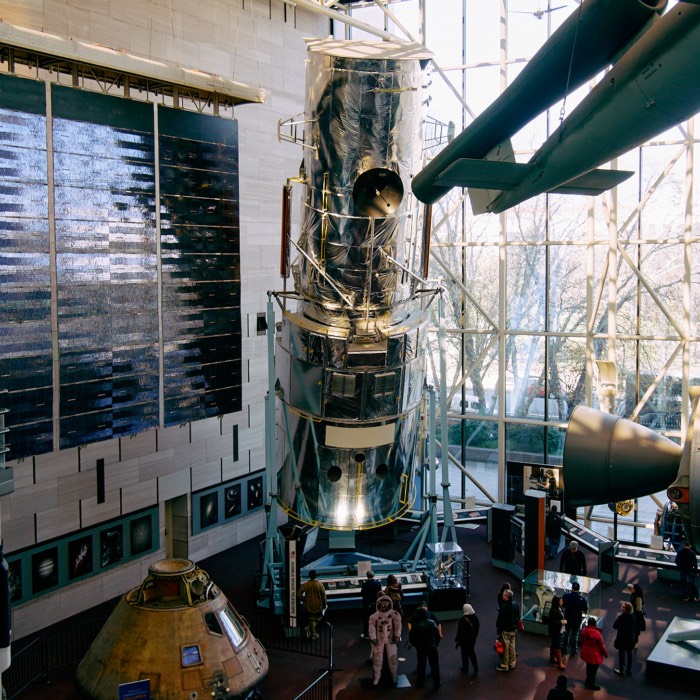
The photographs below were taken during our institute excursion to the Astropeiler Stockert in 2014. They document the visit itself, but they also bring back memories of that time at the Institute of Geophysics and Meteorology in Cologne and the people I shared my time with for many years.


References and further reading
- Website of the Astropeiler Stockertꜛ
- Astropeiler Stockert, history of the observatoryꜛ
- Astropeiler Stockert, early researchꜛ
- Astropeiler Stockert, instrumentsꜛ
- Astropeiler Stockert, observations with the 25 m dishꜛ
- Wikipedia article on the Astropeiler Stockertꜛ
- The first scientific publication since the recomissioning: Spitler et al. 2018ꜛ, Detection of Bursts from FRB 121102 with the Effelsberg 100-m Radio Telescope at 5 GHz and the Role of Scintillation


comments