The Three Worlds: The Buddhist cosmos in the Thai Royal Illuminated Manuscript Traiphum (1776)
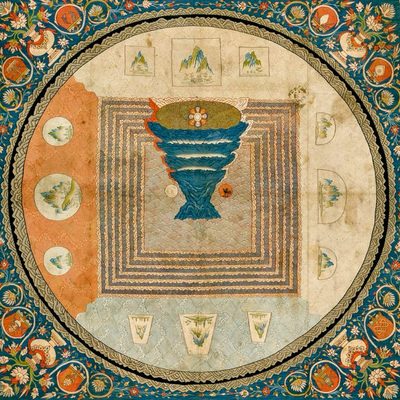
On a recent visit to the Humboldt Forum in Berlin, I had the chance to see parts of the Royal illuminated manuscript Traiphum (Three Worlds), one of the most remarkable surviving examples of Thai manuscript art. Created in Thonburi, today part of Bangkok, in 1776, the manuscript illustrates a map of the Buddhist cosmos as understood in the Thai tradition. It is a work of extraordinary artistic quality, executed in opaque colours and gold on paper, and bound in a wooden book cover. After returning from the exhibition, I wanted to learn more about the manuscript’s historical context and made some research. Here is a brief overview of what I found, along with some images of the manuscript.
 Royal illuminated manuscript Traiphum (‘Three Worlds’), Thailand, Bangkok, 1776, opaque colours and gold on paper.
Rebuilding a kingdom after Ayutthaya
The manuscript was created during a period of major political change in what was called Siam at the time. For more than four centuries, Ayutthaya had been the centre of one of the major kingdoms of mainland Southeast Asia. In 1767, Burmese forces captured and largely destroyed the city, bringing the Ayutthaya Kingdom to an end. Large parts of its courtly, religious, and literary culture were lost or dispersed in the process. From the political fragmentation that followed emerged the general Taksin, who succeeded in reunifying much of the former kingdom. He established a new capital at Thonburi, on the Chao Phraya River opposite what would later become the historical centre of Bangkok, and was crowned king. His reign from 1767 to 1782 thus forms a relatively short but crucial bridge between the Ayutthaya period and the establishment of the Chakri dynasty and the Rattanakosin kingdom in Bangkok in 1782.
The restoration of the kingdom also involved the restoration of its Buddhist institutions and intellectual traditions. In 1776, King Taksin commissioned an elaborate illustrated manuscript of the Traiphum, the “Three Worlds”. The manuscript therefore belongs to a broader reconstruction of religious and courtly culture after the destruction of Ayutthaya.
This context gives the work indeed a significance beyond its extraordinary artistic quality. In premodern Southeast Asian kingship, political and cosmological order were closely related. Supporting the Buddhist saṅgha, restoring temples and preserving religious texts were not activities detached from kingship. They were among the ways in which royal authority and the restoration of an ordered Buddhist cosmos could be expressed. A manuscript depicting the ordered structure of the entire cosmos was therefore a particularly meaningful object to produce at a time when the political order of Siam itself was being reconstructed.
Mapping the Buddhist cosmos
“Traiphum” literally means “three worlds” or “three realms” and derives from the Pali tebhūmi and Sanskrit traibhūmi. The concept refers to a cosmic order deeply rooted in Indian and Buddhist cosmology. The “three worlds” should not be understood as three planets or three separate universes. They are three broad classes of existence within saṃsāra, the cycle of birth, death and rebirth:
- Kāma-bhūmi, the realm of sensual desire, encompasses the hells, the animal and human worlds and several heavenly realms. Despite their enormous differences, beings in all of these worlds remain subject to sensual desire.
- Rūpa-bhūmi, the realm of form, consists of higher celestial worlds associated with progressively deeper meditative states. Their inhabitants are free from ordinary sensual desire but still possess form.
- Arūpa-bhūmi, the formless realm, contains the highest states of conditioned existence, corresponding to the formless meditative attainments.
Even these highest realms, however, remain part of saṃsāra. They should therefore not be equated with nirvāṇa. A being may remain in such a realm for an almost inconceivably long period, but eventually that existence also ends. Liberation in Buddhism lies not at the top of the cosmological hierarchy but beyond conditioned existence altogether.
The Traiphum does not simply depict a staircase leading from hell to heaven and finally to salvation. It maps the enormous variety of possible forms of existence generated by karma while simultaneously showing that all of them remain impermanent.
Mount Meru and the geography of existence
Within this vertical hierarchy lies an elaborate cosmological geography. At its centre stands Mount Meru, the immense cosmic mountain inherited from older Indian cosmological traditions and adapted within Buddhism.
Around Meru are arranged oceans, mountain ranges and continents. The human world belongs to Jambudvīpa, the southern of the great continents surrounding the mountain. Above and around Meru lie the realms of various classes of devas; below the human world extend increasingly unpleasant forms of existence, including the Buddhist hells. The resulting universe is simultaneously spatial, moral and temporal. Where a being is reborn depends on its karma. Virtuous and harmful actions therefore have consequences that are quite literally cosmographical: They determine the kind of world in which a being may subsequently exist.
 Detail from the royal illuminated Traiphum, with parts of the Buddhist cosmos represented pictorially.
This makes the Traiphum much more than a fantastic geography. Its mountains, palaces, heavens, hells and mythical beings form a visual representation of the Buddhist understanding of karma and saṃsāra. Cosmology becomes a way of illustrating an ethical system.
A 33-metre-long book
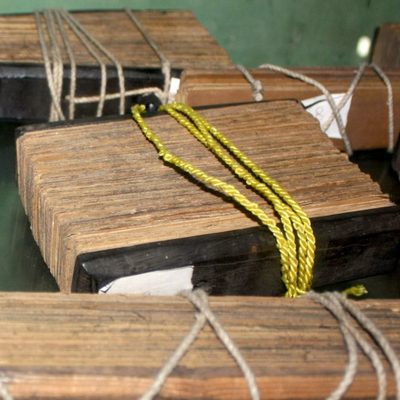
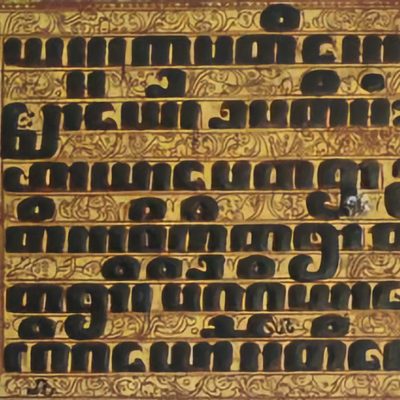
The physical form of the Berlin Traiphum is itself remarkable. Rather than a bound codex in the European tradition, it is a long concertina or leporello manuscript. Fully unfolded, it extends for approximately 33 metres. Both sides of the manuscript are richly illustrated. The cosmological representations are interwoven with Buddhist narratives and accompanied by extensive inscriptions. These are written in both Thai and Pali and employ two scripts: Thai script for Thai and Khom script for Pali. The handwriting belongs to the royal scribal tradition of the 18th century.
 Another section of the Traiphum. The complete folding manuscript extends for approximately 33 metres and is illustrated on both sides.
The folding format allows the Buddhist cosmos to be represented as an extended visual sequence rather than compressed into a single diagram. As the manuscript is unfolded, cosmological regions, narratives, and figures follow one another across a continuous visual field.
Only a fraction of those 33 metres can naturally be displayed at once. The Museum für Asiatische Kunst has therefore presented changing sections of the manuscript in a six-metre-long display case. What I saw at the Humboldt Forum was consequently quite literally only part of this much larger visual cosmos.
Which manuscript did King Taksin commission?
There is another aspect of the Berlin manuscript that I found particularly interesting: Its identity as the Traiphum of 1776 is itself part of an unresolved historical problem.
Several surviving Traiphum manuscripts claim a connection to King Taksin’s commission. Two are preserved in the National Library of Thailand in Bangkok, while another is the manuscript now held by the Museum für Asiatische Kunst in Berlin as inventory no. II 650. They cannot all simply be the same “original”. The manuscripts differ in their writing, orthography, illustrations and execution despite sharing material that attributes their production to Taksin’s commission.
Barend Jan Terwiel examined this problem in detail in a 2014 study in the Journal of the Siam Society (linkꜛ). His comparison of the manuscripts suggests that the Berlin manuscript has a considerably stronger claim to being associated directly with the original production of 1776 than the versions preserved in Bangkok. Among other things, its orthography and handwriting correspond more closely to eighteenth-century practice, while one of the Bangkok manuscripts can be identified as a later copy. Yet even this does not completely solve the mystery.
When Prince Damrong Rajanubhab examined the Berlin manuscript in 1930, he recalled having seen another version that was very similar in artistic execution but possessed particularly fine covers. In his view, the Berlin manuscript was therefore probably not the actual copy that had been formally presented to King Taksin. This leaves the possibility that the surviving Berlin manuscript is closely connected with the royal production of 1776, perhaps even produced by the same workshop, while the actual presentation copy made for Taksin has disappeared. A fourth manuscript of exceptional quality may once have existed and could, at least in principle, still survive unidentified somewhere today.
More recent scholarship has continued to investigate the relationship between the surviving manuscripts through their artistic styles and decorative motifs. The Berlin manuscript remains particularly important because its style preserves strong connections with late Ayutthaya painting and the transitional artistic culture of the Thonburi period.
From Thonburi to Berlin
By the 19th century, the manuscript was apparently still in Siam. The German ethnologist and traveler Adolf Bastian encountered a Traiphum manuscript associated with Taksin while visiting Bangkok in 1863, and details in his description correspond strikingly with scenes in the present Berlin manuscript.
The manuscript later belonged to a descendant of King Taksin. In 1893 it was acquired by the Italian-born scholar and military officer Gerolamo Emilio Gerini, who spent much of his career in Siam and became an important scholar of its history, languages and culture. From there the manuscript eventually entered the Berlin collection.
A surviving fragment of the Thonburi period
For me, this historical context makes the manuscript considerably more interesting than viewing it simply as a beautiful representation of Buddhist mythology. Artistically, it still preserves traditions associated with the world of late Ayutthaya. Politically, however, it belongs to the new kingdom that emerged after Ayutthaya’s destruction. And only six years after its production, Taksin’s reign itself would end and the Chakri dynasty would establish its capital across the river at Bangkok. The manuscript is therefore not merely an 18-century illustration of a much older Buddhist cosmology. It is also a material survivor of a remarkably short historical period, produced while Siam was rebuilding its political, religious and cultural order after the catastrophe of 1767.
The Traiphum is currently held by the Museum für Asiatische Kunst in the Humboldt Forum in Berlin. Because of its enormous size, only sections of the manuscript can be exhibited at any one time. If parts of it are on display during a visit, it is certainly worth taking a closer look: What appears at first to be an elaborate sequence of fantastic landscapes is, in fact, an attempt to put an entire Buddhist universe onto paper alongside a testimony to the political and cultural reconstruction of Siam after a crucial historical rupture.
References and further reading
- Martina Stoye, Peera Panarut, 2026, In the Serenity of the Himavanta Forest, Staatliche Museen zu Berlin, Michael Imhof Verlag, ISBN: 978-3-7319-1581-2
- Museum für Asiatische Kunst: Six Metres of Traiphum – The Collaborative Decoding of a Magnificent Illuminated Manuscript from Thailandꜛ
- Humboldt Forum: How much world fits into one book? The 33-meter-long magnificent manuscript of the Siamese King Taksin (1776)ꜛ
- Terwiel, B. J., 2014, On the Trail of King Taksin’s Samutphāp Traiphūm. Journal of the Siam Society, 102, 41–66. linkꜛ
- Areelertrat, R., 2024, Thonburi Traiphum Manuscripts: Dating by Artistic Styles and Decorative Motifs. Damrong Journal of the Faculty of Archaeology Silpakorn University, 23(1). linkꜛ
- Chotpradit, T., 2024, Mapping the ‘Three Worlds’: A Preliminary Exploration of the Formation and Iconography of Buddhist Cosmological Paintings in Central Siam. Religions, 15, 1464. linkꜛ



comments