Meeting modern art in the Ruhr Area: A visit to the Folkwang Museum
In May this year, we spent a day in my hometown and we used the opportunity to visit Museum Folkwang nearby. The museum sits right in the center of Essen and, thus, in the middle of the Ruhr area. Even though one might not expect a museum of modern art to be so important in a formerly industrial region like the Ruhr, the Folkwang Museum is an outstanding example of how art and culture can flourish even in such contexts. The museum actually has a long history that is closely linked to the development of the Ruhr region, but also to modern art. In this post, I recap some of the highlights of our visit and illuminate the museum’s historical significance I have researched meanwhile.
 One of the spacious corridors in the Folkwang Museum in Essen.
The Folkwang Museum
In my research, I learned that the Folkwang Museum holds indeed a notable position in the history of modern art. Founded in 1902 by Karl Ernst Osthaus in Hagen, it was one of the first museums dedicated to modern art and design in the world. Osthaus’s vision was to create a place where art, crafts, and nature could be experienced together, fostering an understanding of contemporary artistic movements. After Osthaus’s death, the collection was sold to the city of Essen in 1922, leading to the establishment of the present-day Folkwang Museum.

 Ferdinand Hodler (1853 Bern - 1918 Genf), Der Frühling, 1901, Öl auf Leinwand.
What I had not realized before our visit is how active the museum was, and still is, in promoting modern art. From early on, it acquired works by avant-garde artists at a time when many of them were far from widely accepted. The collection now includes central works from Expressionism, Surrealism, and other early twentieth century movements. This acquisition policy turned the museum into a place where ideas of modern art were not only preserved, but actively developed and communicated.
 A sculpture in one of the exhibition rooms.
Beyond its artistic contributions, the museum also holds considerable significance for the Ruhr region. As a major cultural institution in Essen, it serves as a central point for artistic engagement and education within this historically industrial area. The museum’s presence contributes to the cultural diversification of the Ruhr, playing a role in its transformation from a coal and steel hub to a region increasingly recognized for its cultural landscape. It provides access to world-class art. For local residents, it means that works which are usually known from textbooks or large capital cities can be seen only a short train ride away.
 Exhibition room.
Our visit
During our visit, we were particularly impressed by the museum’s architecture. The present building was created between 1956 and 1960 and it’s remarkable that its avant-garde architecture with its clear volumes, open courtyards, and generous light still appears modern, fresh, and open today. It functions as a neutral but precise stage for the collection: rooms are bright without overwhelming the works, and sight lines connect different sections of the museum without making the layout confusing. Even without the collection, the building would be worth a visit as an example of postwar museum architecture in Germany.
Architectural impressions
Here are some impressions from the architecture and the interior of the museum, which significantly contributes to the overall experience of visiting the museum:
 One of the light-flooded courtyards.
 Another courtyard. The architecture of the museum manages to create spaces that contribute the overall atmosphere of openness and lightness.
 Another view of a courtyard.
 The long and spacious corridors are light-flooded by large windows, so that, together with jalousies which filter direct sunlight, the artworks inside are well lit in natural light.
 View outside from one of the large windows, with some shadow-play caused by the bright jalousies.
 There are trees in the courtyards which contrast nicely with the clear geometry of the building.
 The museum also holds a photography collection. Unfortunately, photography exhibition was closed during our visit.
 Further impressions from the inside.
 Further impressions from the inside.
Artworks
Here are some of the artworks we saw during our visit. Among them are some of the most important pieces of modern art, such as works by Max Beckmann, Otto Dix, Vincent van Gogh, Paul Gauguin, and others.
 Kiki Smith (geb. 1954 Nürnberg), Gold Siren, 2001, Bronze, Blattgold.
 Christian Rohlfs (1849 Groß Niendorf- 1938 Hagen), Angel Carrying Light into the Graves, Tempera auf Leinwand, around 1925.

 Christian Ernst Bernhard Morgenstern (1805 Hamburg - 1867 München), Staffelsee bei Murnau, 1847, Öl auf Leinwand.
 Max Beckmann (1884 Leipzig - 1950 New York), Vampir, 1947 - 1948, Öl auf Leinwand.
 Otto Dix (1891 Untermhaus/Gera - 1969Singen/Hohentwiel), Bildnis Frau Martha Dix, 1928, Mischtechnik auf Holz.
 Armin Boehm (geb. Aachen 1972), Sils Maria (Friedrich Nietzsche), 2022, Öl und Stoff auf Leinwand.
 Armin Boehm (geb. Aachen 1972), Climate change (Greta Thunberg), 2022, Öl und Stoff auf Leinwand.

 Vincent van Gogh (1853 Groot-Zundert - 1890 Auvers-sur-Oise), Portrait d’Armand Roulin, 1888, Öl auf Leinwand.


 Paul Gauguin (1848 Paris - 1903 Atuona, Hiva Oa), Contes barbares, 1902, Öl auf Leinwand.

 Paul Signac (1863 Paris - 1935 Paris), The Seine near Saint-Cloud, 1900, Öl auf Leinwand.
 Camille Pissarro (1830 St. Thomas - 1903 Paris), Louveciennes, Chemin de Creux, Louveciennes, neige, 1872, (Schneelandschaft in Louveciennes), Öl auf Leinwand.
 Vincent van Gogh (1853 Groot-Zundert - 1890 Auvers-sur-Oise), Les bateaux amarrés, 1888 (Quay with Men Unloading Sand Barges), Öl auf Leinwand.


 Max Ernst (1891 Brühl - 1976 Paris), Les dieux obscurs, 1957, Öl auf Leinwand.

 Theo van Rysselberghe (1862 Gent - 1926 Saint-Clair), Clair de lune à Boulogne-sur-Mer, 1900, Öl auf Leinwand.
 Sculpture. Unfortunately, I forgot to note down the artist and the title.
 Moissey (Moishe) Kogan (1879 Orhei (Orgiejeff) - 1943 ermordet im KZ Auschwitz), Maske, um 1910, Gips.

 François Morellet (Cholet, Frankreich 1926–2016), Sphère-trames, most-likely 1960s, Edelstahl.

 The cool thing about modern art is that it often invites interaction. Here’s some fun with a set of tilted, concave mirrors (I did not note down the artist and title, sorry).

 Otto Dix (1891 Untermhaus/Gera - 1969 Singen (Hohentwiel)), Nelly in Blumen, 1924, Öl auf Leinwand.


 Phung-Tien Phan (geb. 1983 Essen), Volkswagen (Saigon), 2019, Pressspan, Holzfurnier, Multiplexplatte, Rollen, Puppenhausmöbel, Acrylfarbe, Lampe, Andachtsbild, Teekanne, Topf mit Stäbchen und Untersetzer, Schale mit Reis, Löffel, Bier, Zahnstocher, Weihrauch, Siebträger-Espressomaschine, Pflanze. – Volkswagen (Longevity), 2019 Eichenholz, Rollen, Edelstahlplatte, Puppenhausmöbel, Acrylfarbe, Lampe, Teller, Milchkonserve, Räucher-stäbchenhalter, Räucherstäbchen, Siebträger-Espressomaschine, Pflanze.


 Vincent van Gogh 1853 Groot-Zundert - 1890 Auvers-sur-Oise), La moisson, 1889 (Die Ernte, Kornfeld mit Schnitter), Öl auf Leinwand.
 Sculupture. Unfortunately, I forgot to note down the artist and the title.
 Jim Dine (geb. 1935 Cincinnati, Ohio), Two Thieves, One Liar, 2006 Holz, gebrannt und bemalt.
 Mark Fox (geb. 1961) and Angie Wang (geb. 1970), Trump (Moloch) (Motiv: Orange), 2017, Siebdruck.
 Armin Boehm (geb. Aachen 1972), Monetozän, 2017, Öl und Stoff auf Leinwand.

 Rene François Ghislain Magritte (1898 Lessines - 1967 Brüssel), La présence d’esprit, 1960, (Öl auf Leinwand).
 Rachel Goodyear (geb. 1978 Oldham, Lancashire), Dawn Chorus, 2011, Serie von vier Radierungen, handkoloriert: Boy with Net, Catching the Hairy, Broken Branch, Macramé.
 Ursula Schultze-Bluhm (1921 Mittenwald - 1999 Köln), Zeltgeschichte, 1981, Öl auf Leinwand.
 Set of sculptures, which are part of a fountain. Unfortunately, I forgot to note down the artist and the title.
 Oskar Kokoschka (1886 Pöchlarn - 1980 Montreux), Porträt Alma Mahler, 1912, Öl auf Leinwand.
 Oskar Kokoschka (1886 Pöchlarn - 1980 Montreux), Frau in Blau, 1919, Öl auf Leinwand.
 Denis Savary (geb. 1981 Granges-Marnand), Alma, 2007, Kunstpelz, Kunsthaar, Kapok, Metallarmierungen.
 Ceramic sculpture. Again, I did not note down the artist and the title, sorry.

 Nam June Paik, Celtic Memmory, 1991-1992
 A. R. Penck (1939 Dresden - 2017 Zürich), Ohne Titel, 1974, Acryl auf Leinwand.


 Mischa Kuball (1959 Düsseldorf), five planets, 2015, Spiegelkugeln, Drehmotoren, Gobo-strahler, Objektive, Goboschablonen.
 Cover-design of the Münchner Illustrierte Zeitung.
 Thailand, Anonym, Stehender Buddha, 16. Jh. (vermutlich), Bronze, vergoldet.
 Art installation with various sculptures and objects. Unfortunately, I missed the description of this work.


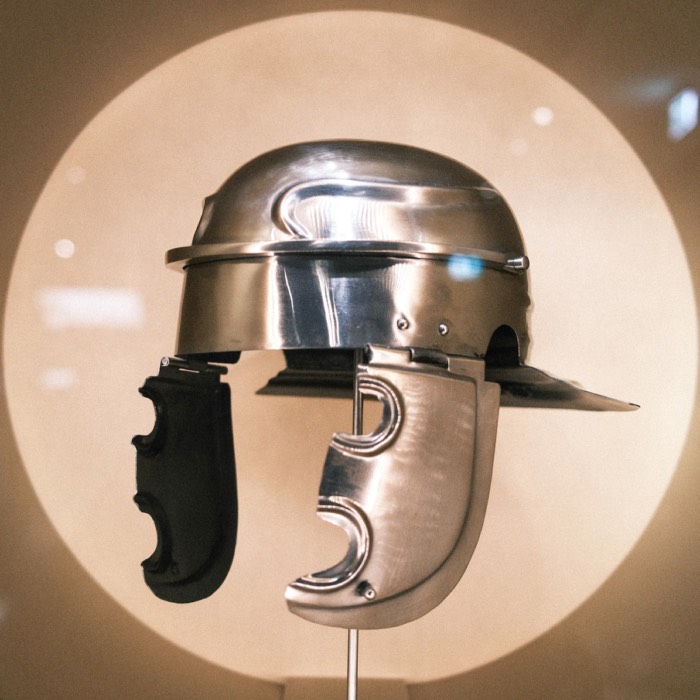
 Walk-in display case architecture Helm/Helmet/Yelmo by Cuban artist duo Los Carpinteros, which reinterprets and stages the collection and exhibition principle of the Kunstkammer.
 Bastian Muhr (geb. 1981), Ŝablono (Esperanto für ‘Muster’).


 Nancy Spero, Maypole: Take No Prisoners.
Conclusion
Before the visit I only had a vague idea of Museum Folkwang as “the” modern art museum in Essen. Looking into its history afterwards, it became clear how much is concentrated in this one institution: a collection that spans key phases of modern art, a building that still works very well architecturally, and a clear connection to the history of the Ruhr area. For anyone who spends time in Essen or elsewhere in the Ruhr region and is interested in modern art, architecture, or cultural history, Museum Folkwang is indeed a very good place to start.
 Another light installation. I liked the light and shadow this installation created in relation to the other architectural and art elements of the room.
References and further reading
- Museum Websiteꜛ
- Wikipedia article on the Folkwang Museumꜛ
- Museum Folkwang (Herausgeber), Tobias Burg (Mitwirkende), Florian Ebner (Mitwirkende), René Grohnert (Mitwirkende), Mario von Lüttichau (Mitwirkende), Marcel Schumacher (Mitwirkende), Museum Folkwang: Meisterwerke der Sammlung, 2015, Sieveking Verlag, ISBN: 978-3944874111
comments