Effelsberg radio telescope
I recently came across a few old photographs I took during an institute excursion to the Effelsberg radio telescopeꜛ in 2013. They were originally part of an earlier post on my website, but during the cleanup and restructuring of the site, that article disappeared. I thought it was worth bringing it back. Looking at the images again brought back the impression the place made on me at the time, not only because of the telescope’s sheer scale, but also because it reminded me of that period at the institute. This is therefore not only a post about the Effelsberg radio telescope, but also a small personal reflection.

The 100m radio-telescope in Effelsberg, Germany, aerial image from 2011. Source: Wikimedia Commonsꜛ (license: CC BY-SA 3.0).
A giant instrument for radio astronomy
The Effelsberg telescope is the 100 m radio telescope of the Max Planck Institute for Radio Astronomyꜛ near Bad Münstereifel. It was officially inaugurated in 1971 and began full astronomical observations in 1972. For many years, it was the largest fully steerable radio telescope in the world, and even today it remains one of the major instruments of European radio astronomy. It is used both as a single dish telescope and as part of international very long baseline interferometry networks, in which widely separated radio telescopes observe the same source together in order to achieve much higher angular resolution than any one instrument could provide on its own.


State visit by the Belgian royal couple on April 28, 1971, to the Effelsberg radio telescope. Among those pictured are King Baudouin I of Belgium and Heinz Kühn, Minister-President of North Rhine-Westphalia.. Source: Wikimedia Commonsꜛ (top) and Wikimedia Commonsꜛ (bottom) (license: CC BY-SA 3.0).
How Effelsberg works and why its size matters
Unlike optical telescopes, radio telescopes do not collect visible light. They detect radio waves emitted by astronomical objects such as cold gas clouds, pulsars, supernova remnants, active galactic nuclei, and the environments of black holes. These radio signals are extremely weak by the time they reach Earth, so the collecting area of the telescope matters enormously. A larger dish intercepts more incoming radiation, which increases sensitivity and allows fainter sources to be detected or measured more precisely. This is one of the reasons why the sheer size of Effelsberg is not only visually striking, but scientifically essential.

Window of radio waves observable from Earth, on rough plot of Earth’s atmospheric absorption and scattering (or opacity) of various wavelengths of electromagnetic radiation. The radio window is the range of wavelengths that can be observed from the ground, and it includes the frequencies that Effelsberg is designed to observe. Source: Wikimedia Commonsꜛ (license: public domain).
The dish surface reflects the incoming radio waves toward a receiver, where they are converted into measurable electrical signals. From there, the data can be amplified, digitized, and analyzed spectroscopically, temporally, or interferometrically, depending on the scientific question. Radio astronomy is especially important because many astrophysical processes are either invisible in optical light or much easier to study at radio wavelengths. Cold hydrogen gas, molecular clouds, magnetic fields, synchrotron emission from jets, and the precise timing signals of pulsars are all examples where radio observations reveal structures and processes that would otherwise remain hidden.

The Effelsberg radio telescope. Aerial image from 2015. Source: Wikimedia Commonsꜛ (license: CC BY-SA 4.0).
Radio astronomy on a 100 m scale
Effelsberg has contributed to a broad range of astrophysical research over more than five decades. It has been used to study pulsars and millisecond pulsars, including timing observations that became important for international collaborations and for probing the distribution of ionized matter and magnetic fields in our Galaxy. It has also been central to work on cold gas and dust clouds, star forming regions, magnetic fields in the Milky Way and nearby galaxies, and the radio emission from active galactic nuclei and relativistic jets. What distinguishes Effelsberg is therefore not one single spectacular discovery alone, but its long-term role as a highly precise and repeatedly upgraded instrument that has remained scientifically productive across very different areas of astronomy.
One important example is its role in the study of cosmic magnetic fields. Radio observations, especially polarization measurements, make it possible to reconstruct the orientation and structure of magnetic fields in interstellar clouds and external galaxies. Work associated with Effelsberg has shown how strongly magnetized gas clouds are and how closely cloud structure and magnetic field geometry can be linked, which is directly relevant for understanding star formation.
Another major field is pulsar research. Effelsberg has long been used for pulsar surveys and timing observations, and these data have helped characterize pulsar populations while also turning pulsars into astrophysical probes. Because pulsar signals are extraordinarily regular, they can be used to study the interstellar medium, Galactic electron density, and magnetic field structure with exceptional precision.

The Event Horizon Telescope (EHT)ꜛ, a planet-scale array of eight ground-based radio telescopes forged through international collaboration, was designed to capture images of a black hole. In coordinated press conferences across the globe, EHT researchers revealed that they succeeded, unveiling the first direct visual evidence of the supermassive black hole in the centre of Messier 87 and its shadow. The Effelsberg radio telescope was one of the participating instruments in the EHT network, and its data contributed to this groundbreaking result. Source: Wikimedia Commonsꜛ (license: CC BY-SA 4.0).
Effelsberg also belongs to the larger observing ecosystem of very long baseline interferometry (VLBI)ꜛ. In such networks, telescopes at widely separated locations observe the same source simultaneously, and their data are later combined. This effectively creates a telescope with an aperture comparable to the distance between the participating observatories. That is the observational logic behind some of the highest-resolution results in modern astronomy. In this broader sense, Effelsberg is part of the technical and institutional framework from which results such as the Event Horizon Telescope imaging of M87* emerged, even though no single telescope in the network can be said to have produced such an image on its own.
A unique combination of science and setting
What makes Effelsberg special is the combination of scientific importance and location. The telescope stands in a relatively quiet part of the Eifel, and precisely this setting gives it a particular presence. It links a rural landscape with front line astrophysical research. For the region, it is more than an observatory. It is one of the most visible symbols of scientific work in the area and has made Effelsberg internationally recognizable far beyond its immediate surroundings. The visitor site and its astronomy trails also give the place a public dimension that extends beyond the research community.
Our 2013 visit to Effelsberg
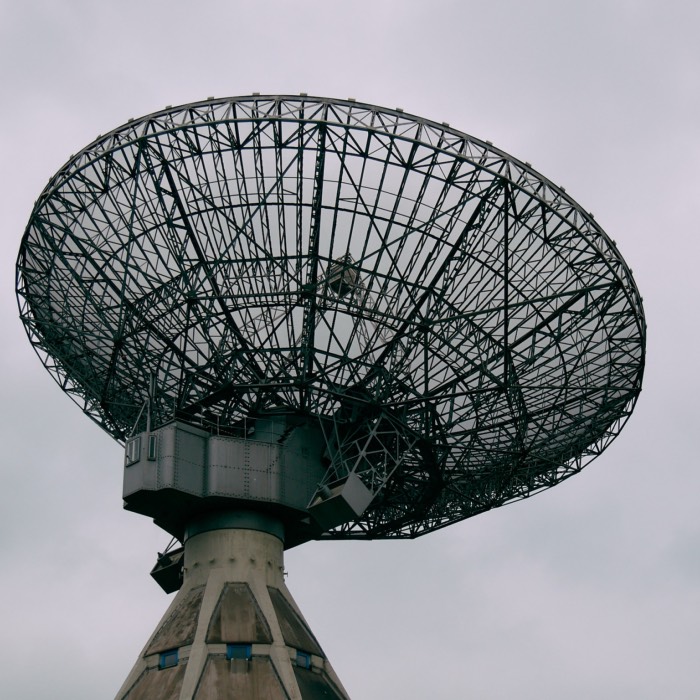
The photographs below were taken during our institute excursion to Effelsberg in 2013. They show a visit to an extraordinary scientific instrument, but for me they also preserve the memory of that day itself. Looking at them now brings back not only the telescope, but also that period at the Institute of Geophysics and Meteorology in Cologne, the colleagues I was there with, and the scientific work that shaped those years.


References and further reading
- Website of the Effelsberg radio telescopeꜛ
- MPIFR Bonn, technical data on the Effelsberg telescopeꜛ
- MPIFR Bonn, announcement on the M87* observationsꜛ
- MPIFR Bonn, announcement on the Effelsberg radio telescope turning 50ꜛ
- Wikipedia article on the Effelsberg radio telescopeꜛ
- Wikipedia article on the Event Horizon Telescope (EHT)ꜛ
- Wikipedia article on very long baseline interferometry (VLBI)ꜛ

comments