The Bimaran reliquary: The so-far earliest securely datable anthropomorphic image of the Buddha
I was really a little surprised when I first learned about the Bimaran reliquary just a few weeks ago. It was almost an accidental discovery. I had been zapping through some Youtube videos on early Buddhist art, suggested by the algorithm, when I came across a short documentaryꜛ about the reliquary by the British Museum. I really did not know that this small gold casket from eastern Afghanistan, now in the British Museumꜛ, was considered by many scholars to be the earliest securely datable anthropomorphic image of the Buddha. I had heard of already posted about the Helgö Buddha and the Berenike Buddha, but I had not connected them to this object. And you may have noticed, that my recent interest in early Buddhist art has been focused on zones of encounter, especially Gandhāra, where Hellenistic, Iranian, Central Asian, and South Asian traditions intersected. Therefore, let’s explore this fascinating artifact and its significance for the history of Buddhist art together.
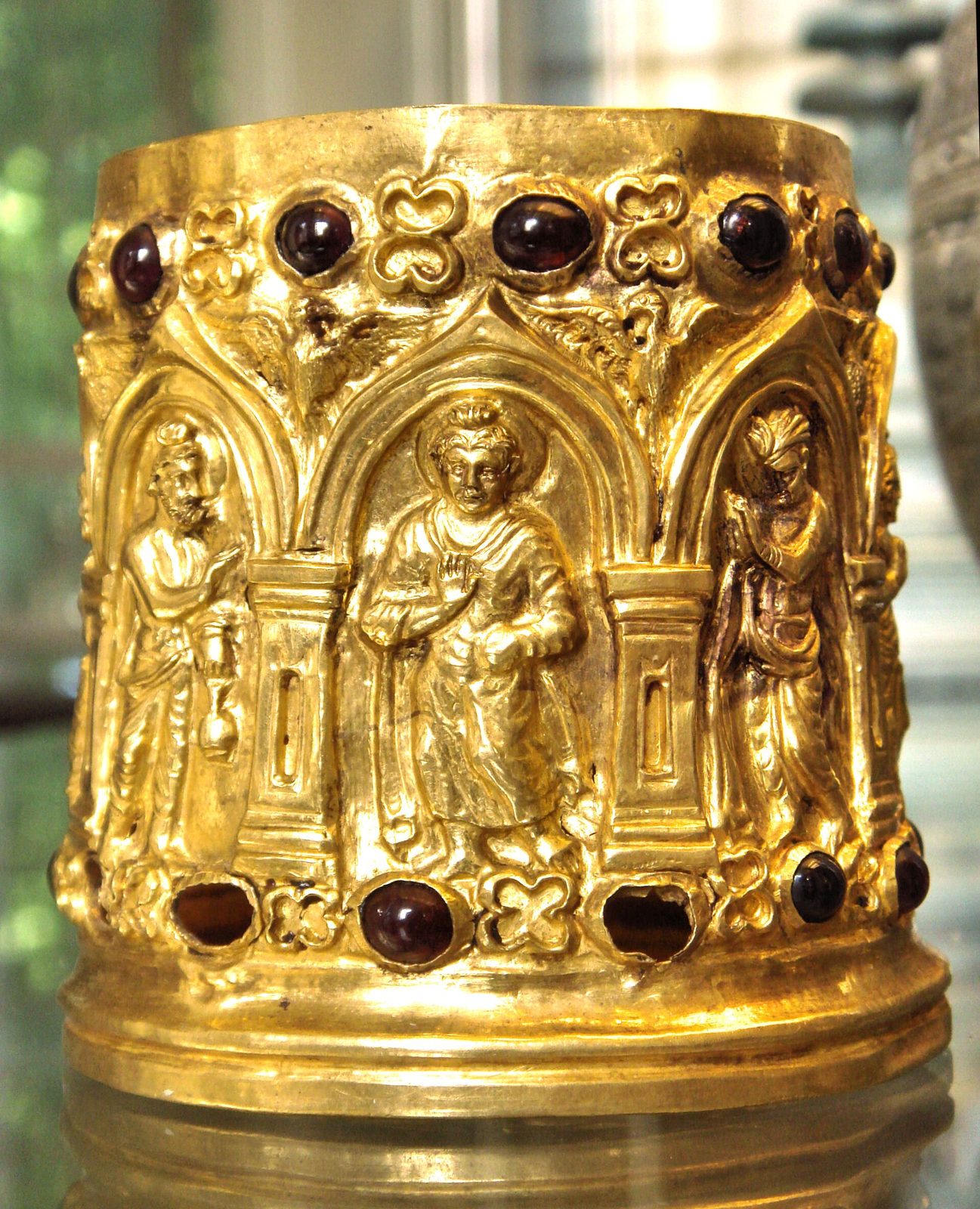
Bimaran Casket, mid-1st century CE, British Museum. The Bimaran reliquary is a small cylindrical gold casket, approximately 7 cm high, crafted in repoussé and set with gemstones. It is decorated with a series of arched niches containing figures, including a central depiction of the Buddha flanked by Brahmā and Śakra (Indra). The base of the casket takes the form of a fully opened lotus with eight petals. The object is considered one of the earliest securely datable anthropomorphic images of the Buddha, and its sophisticated iconography suggests that the visual language of the Buddha image was already established by the time it was produced. Source: Wikimedia Commonsꜛ (license: CC BY-SA 3.0).
Discovery and archaeological context
So, what’s the story of the Bimaran reliquary?
The Bimaran reliquary was discovered in the 19th century by Charles Masson during his explorations in Afghanistan, probably in 1834, within the broader period of his work in the region between 1833 and 1838. Masson was not a modern archaeologist in the strict sense. His work belongs to an earlier phase of exploration, collecting, documentation, and excavation, before the development of controlled archaeological field methods. This matters, because the Bimaran find is exceptionally important, but its excavation context is not documented with the precision one would expect today. Even so, the basic context is clear: The reliquary came from Stupa no. 2 at Bimaran, near Jalalabad, in the Darunta region of eastern Afghanistan.
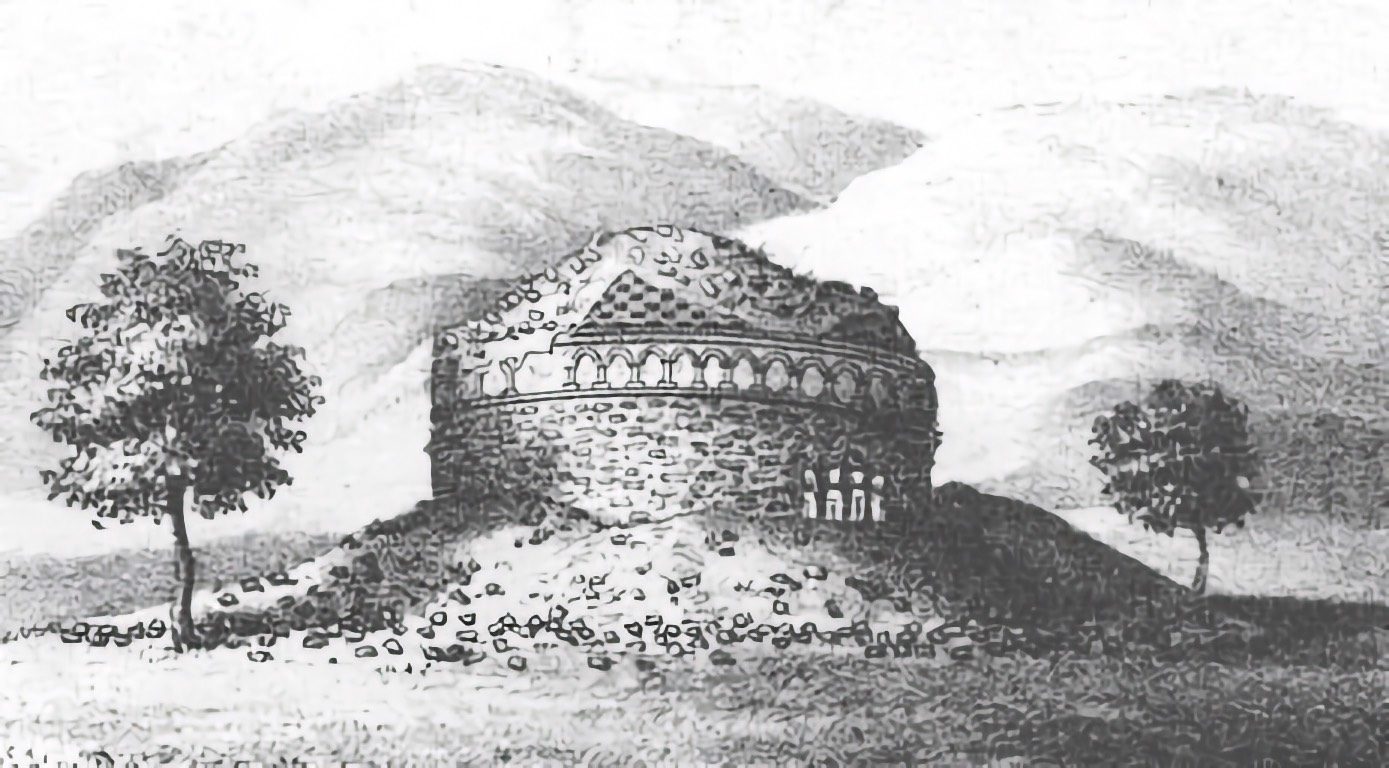
Stupa number 2 at Bimaran, eastern Afghanistan (near Jalalabad). Drawing by Charles Masson, 1841. Source: Wikimedia Commonsꜛ (license: public domain).
Bimaran lay within the wider Gandhāran cultural zone, one of the most important regions for the early development of Buddhist art. This was not a marginal landscape. Eastern Afghanistan and the northwestern regions of the Indian subcontinent were crossed by routes linking South Asia, Central Asia, Iran, and the Hellenistic successor worlds. The area had seen Indo-Greek, Indo-Scythian, Indo-Parthian, and eventually Kushan political formations. Buddhist communities existed here in a world shaped by movement, patronage, trade, and artistic exchange. The Bimaran reliquary therefore comes from precisely the kind of contact zone in which one would expect a complex object of early Buddhist visual culture to emerge.
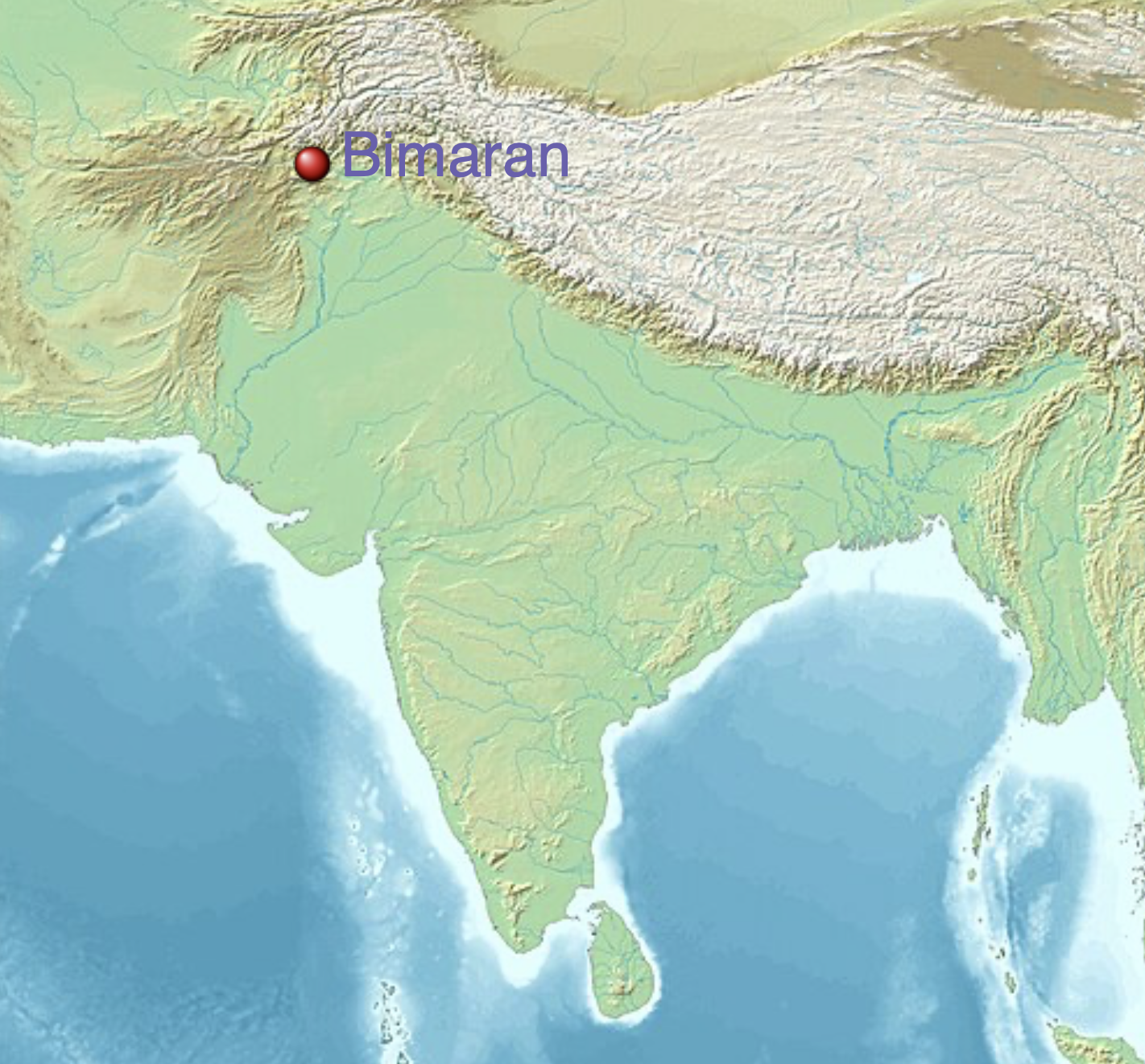
Map of the Indian subcontinent, with the location of Bimaran indicated by the red dot. Source: Wikimedia Commonsꜛ (license: public domain).
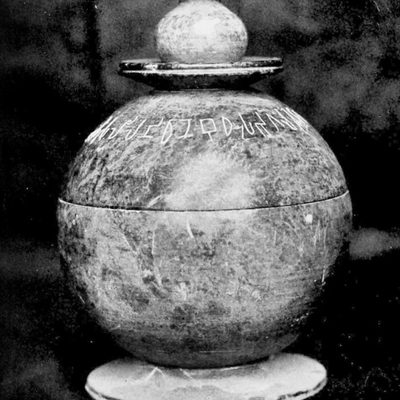
The object was found inside a steatite container placed within the stupa deposit. This outer container was inscribed and contained the small gold reliquary, four coins, burnt pearls, beads of precious and semi-precious stones, and other small deposit materials. The inscription identifies the deposit as a donation by Śivarakṣita, son of Mujavada, connected with relics of the Buddha and offered in honor of all Buddhas. The language of the inscription places the object firmly within Buddhist relic devotion. This was not simply a precious container. It was part of a ritual act.
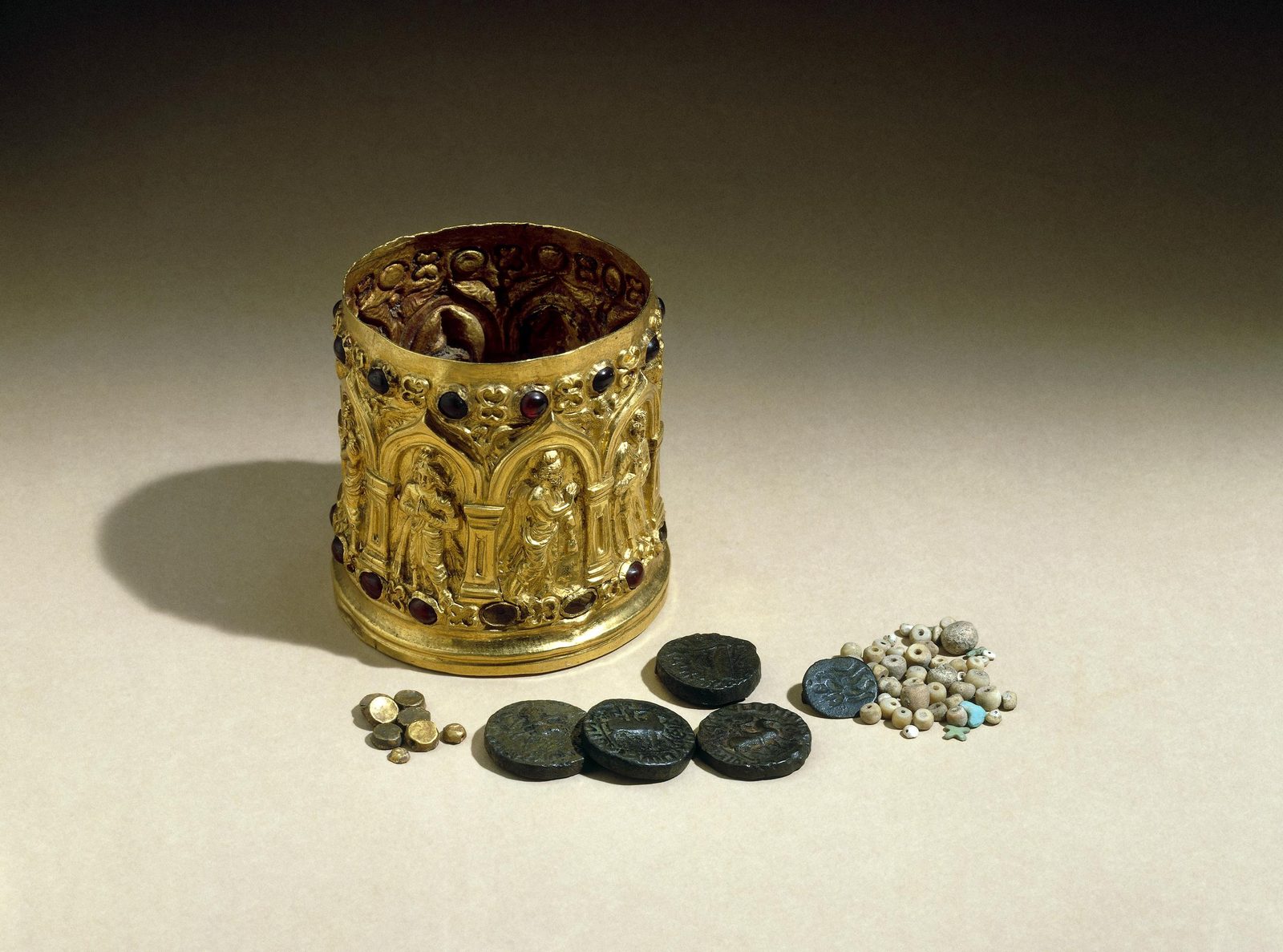
The Bimaran reliquary along with the found coins, beads, and other materials. Source: The British Museum (license: CC BY-NC-SA 4.0)
This context distinguishes the Bimaran reliquary sharply from objects like the Helgö Buddha and the Berenike Buddha. Those finds are fascinating because Buddhist images appeared in places where no stable Buddhist community is known. The Bimaran reliquary is different. It was not a displaced image or an exotic object in a foreign environment. It belonged to the inner devotional world of early Buddhism: stupa worship, relic deposition, donor piety, and the accumulation of merit through offerings.
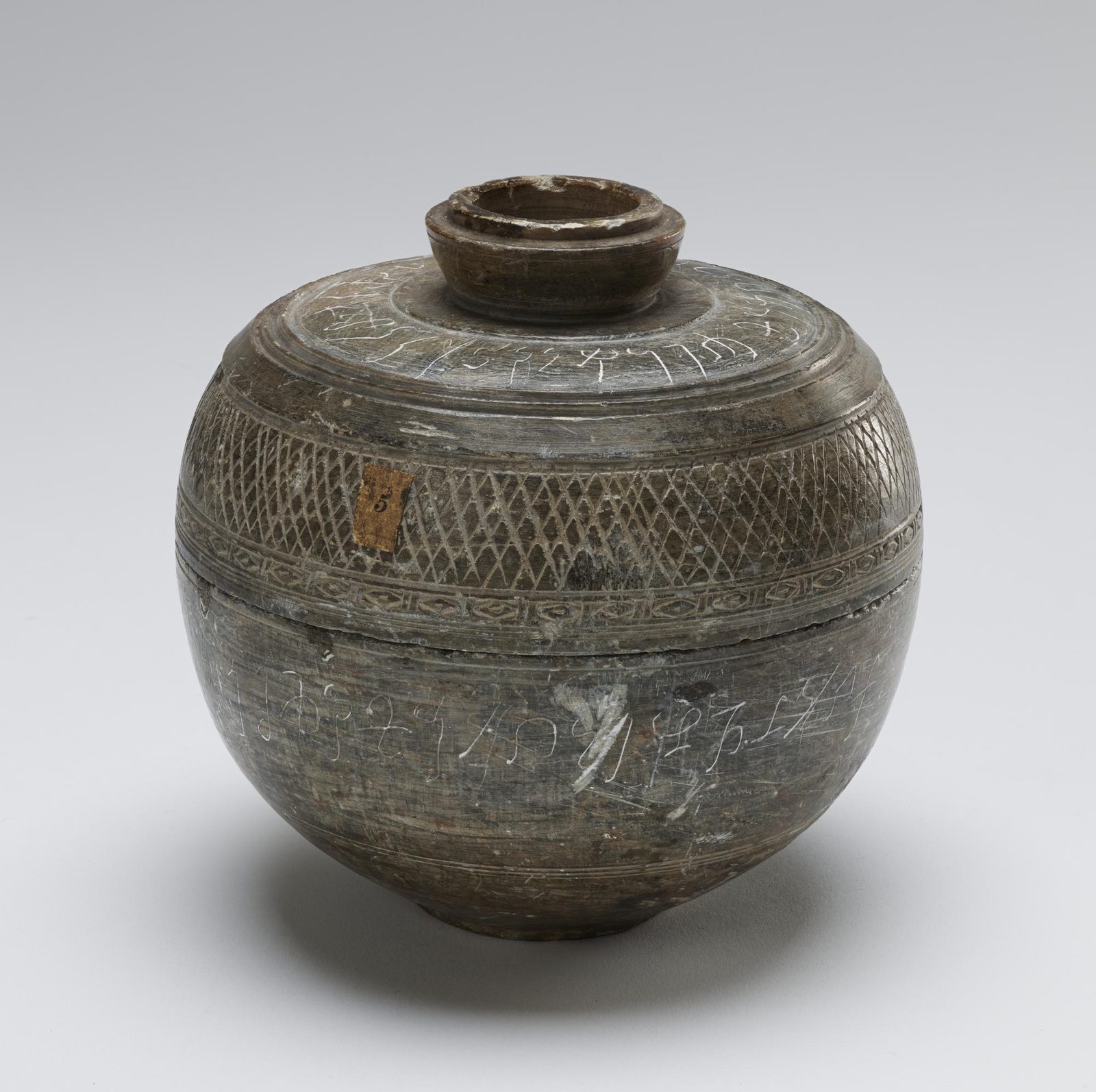
The Bimaran reliquary casket, globular in shape with a lid; made of grey steatite, ca. 1st c. CE. The container is decorated with inscriptions in Kharoshthi script, which provide valuable information about the donor and the context of the relic deposit. The inscriptions mention the name of the donor, Śivarakṣita, and his father, Mujavada, as well as the dedication of the relics to the Buddha. The container itself is a significant artifact that sheds light on the practices of relic veneration and the role of donors in early Buddhist communities. It also provides important context for understanding the Bimaran reliquary casket and its place within Buddhist devotional culture. Source: The British Museum (license: CC BY-NC-SA 4.0)
That is precisely why the find is so important. The reliquary combines relic veneration with one of the earliest anthropomorphic representations of Siddhartha Gautama. A relic deposit normally works through physical presence: The remains of the awakened one, or objects associated with him, make the stupa a sacred site. The Bimaran reliquary adds visual presence to this physical presence. The Buddha is not only implied by the relics. He is shown in human form on the surface of the container itself – which was revolutionary for its time as before this, the Buddha was typically represented through symbols like the stupa, the wheel, or the footprint. The Bimaran reliquary therefore represents a key moment in the history of Buddhist art: The emergence of the anthropomorphic Buddha image within a core devotional context.
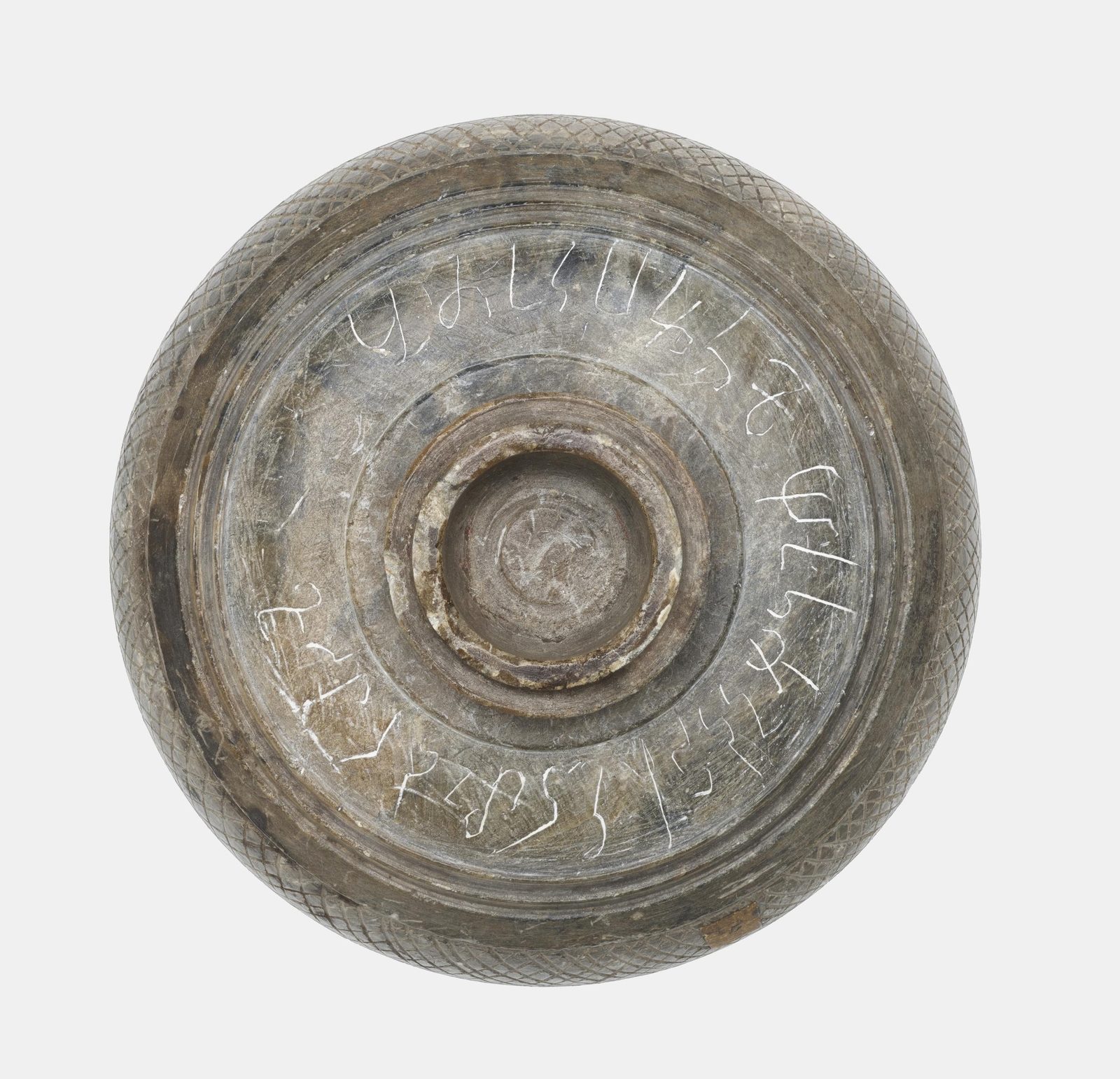
Detail view of the container’s lid with the inscriptions. Source: The British Museum (license: CC BY-NC-SA 4.0)
After its discovery, the reliquary entered the British collections through the dispersal and acquisition of material excavated or collected by Masson in Afghanistan. Masson’s Afghan finds were eventually absorbed into British institutional collections, especially through the India Museum and later the British Museum. The gold reliquary is now held by the British Museum under registration number 1900,0209.1ꜛ, while the associated steatite container and other related materials are also preserved in the same broader collection context. This modern museum history is of course inseparable from the colonial history of 19th-century collecting. The object now appears in London as a masterpiece of Gandhāran art, but its original meaning was not that of an isolated artwork. It was a relic container, buried inside a stupa, donated by a named individual, and embedded in a Buddhist ritual landscape in eastern Afghanistan.
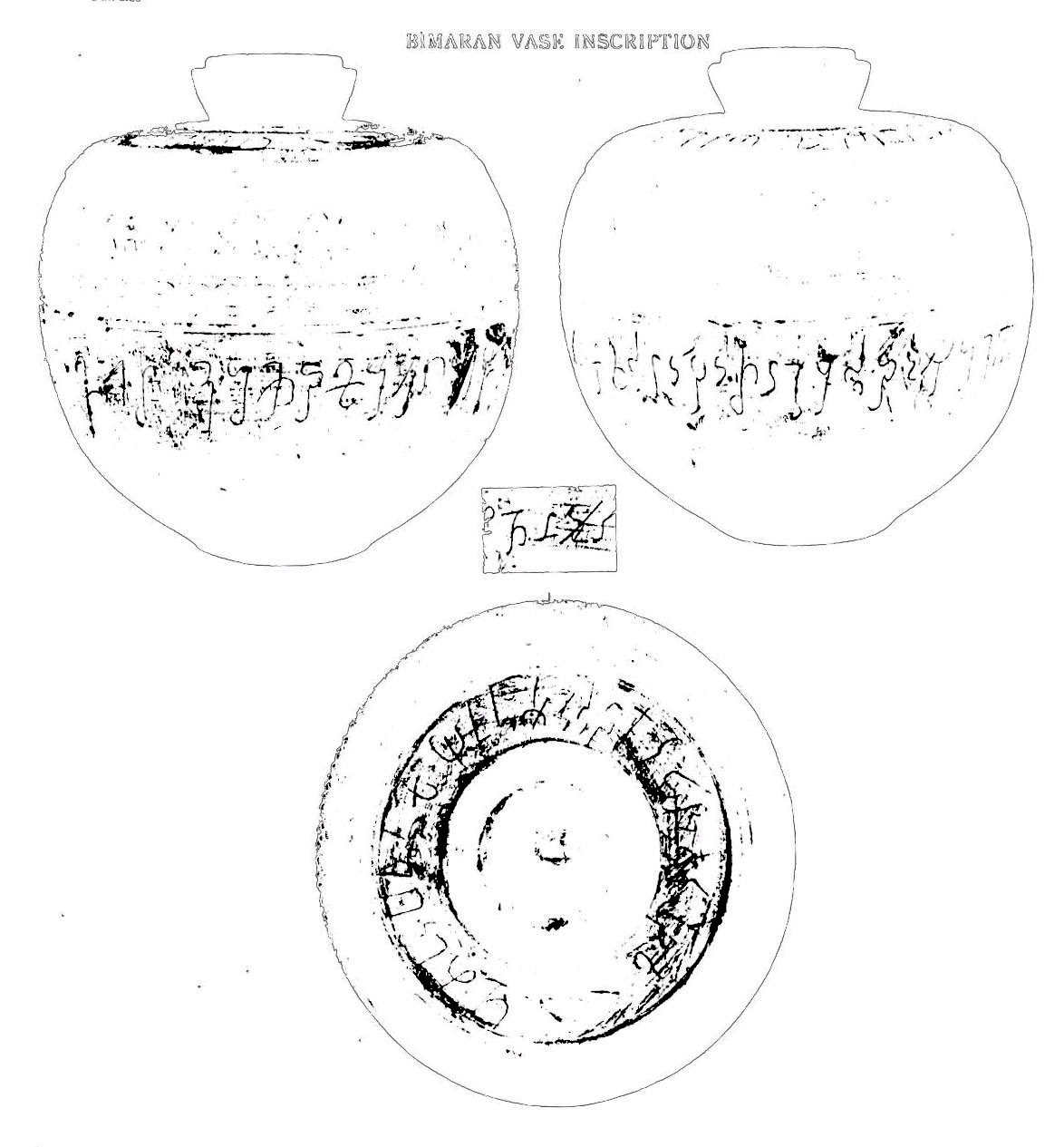
The limestone container’s inscriptions, which provide valuable information about the donor and the context of the relic deposit. The inscriptions mention the name of the donor, Śivarakṣita, and his father, Mujavada, as well as the dedication of the relics to the Buddha. The container itself is a significant artifact that sheds light on the practices of relic veneration and the role of donors in early Buddhist communities. It also provides important context for understanding the Bimaran reliquary casket and its place within Buddhist devotional culture. Source: Wikimedia Commonsꜛ (license: CC BY-SA 3.0).
The reliquary as a devotional object
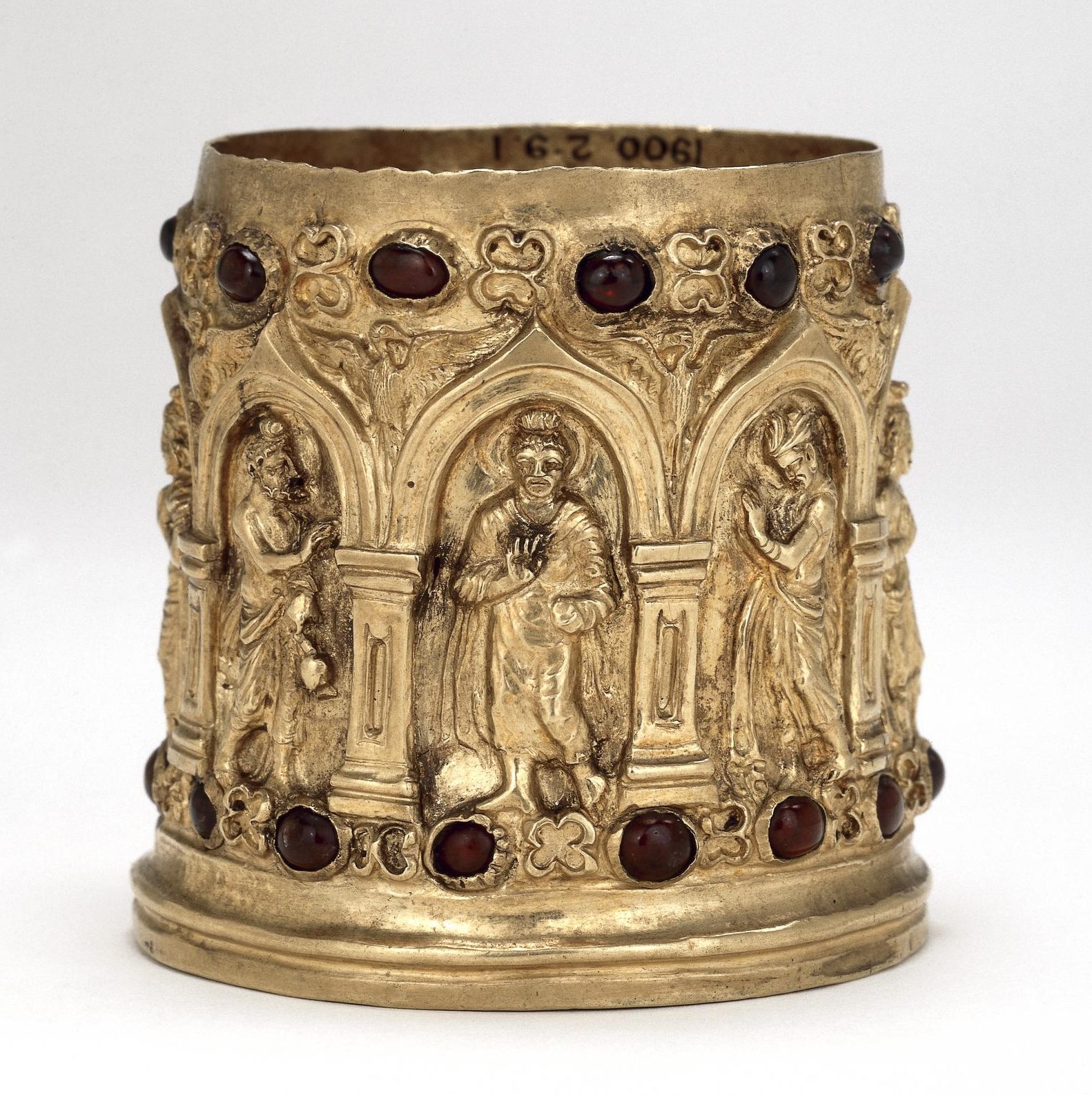
The Bimaran reliquary, detail view with Buddha figure in the center, flanked by Brahmā (left) and Śakra/Indra (right). Source: The British Museum (license: CC BY-NC-SA 4.0)
Material and form
The reliquary is a small cylindrical gold casket, approximately 7 cm high, crafted in repoussé (a technique of hammering metal from the reverse side to create a design in low relief) and set with gemstones. It lacks its original lid. Around its surface runs a series of arched niches, often described as caitya arches (a reference to the architectural form of Buddhist shrines), although their framing also recalls architectural conventions familiar from Greco-Roman and Gandhāran visual culture.
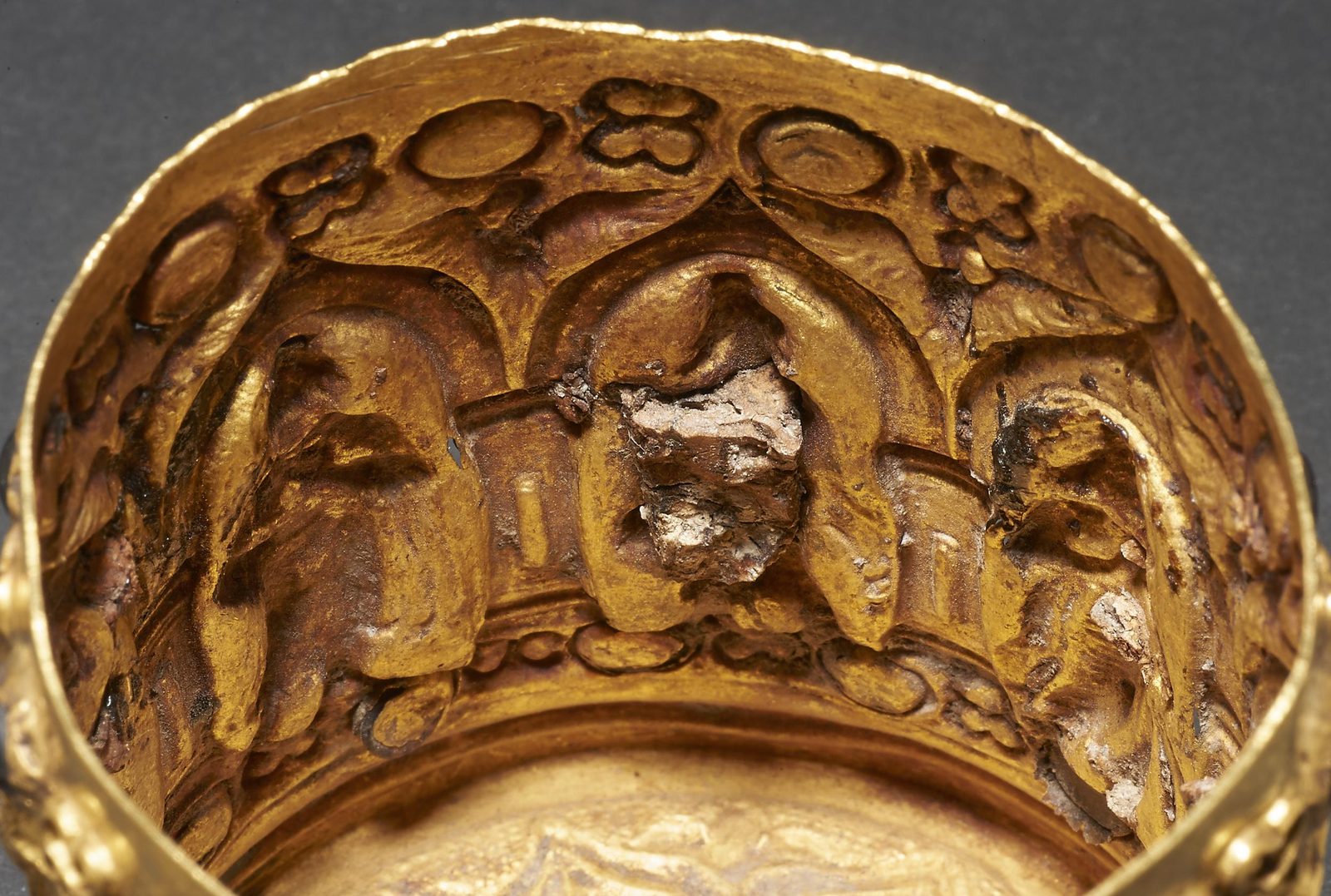
Detail view of the inside of the Bimaran reliquary, revealing details of the repoussé work and the arrangement of the figures. Source: The British Museum (license: CC BY-NC-SA 4.0)
What immediately sets this object apart is not just its size, but its density and level of elaboration. While Gandhāran reliquaries range from very small and simple to more substantial examples, this piece stands out even within the latter group. At around 7 cm in height, it is relatively large for a gold reliquary, and its surface is densely worked and iconographically structured. It is not simply a container, but a carefully constructed visual field.
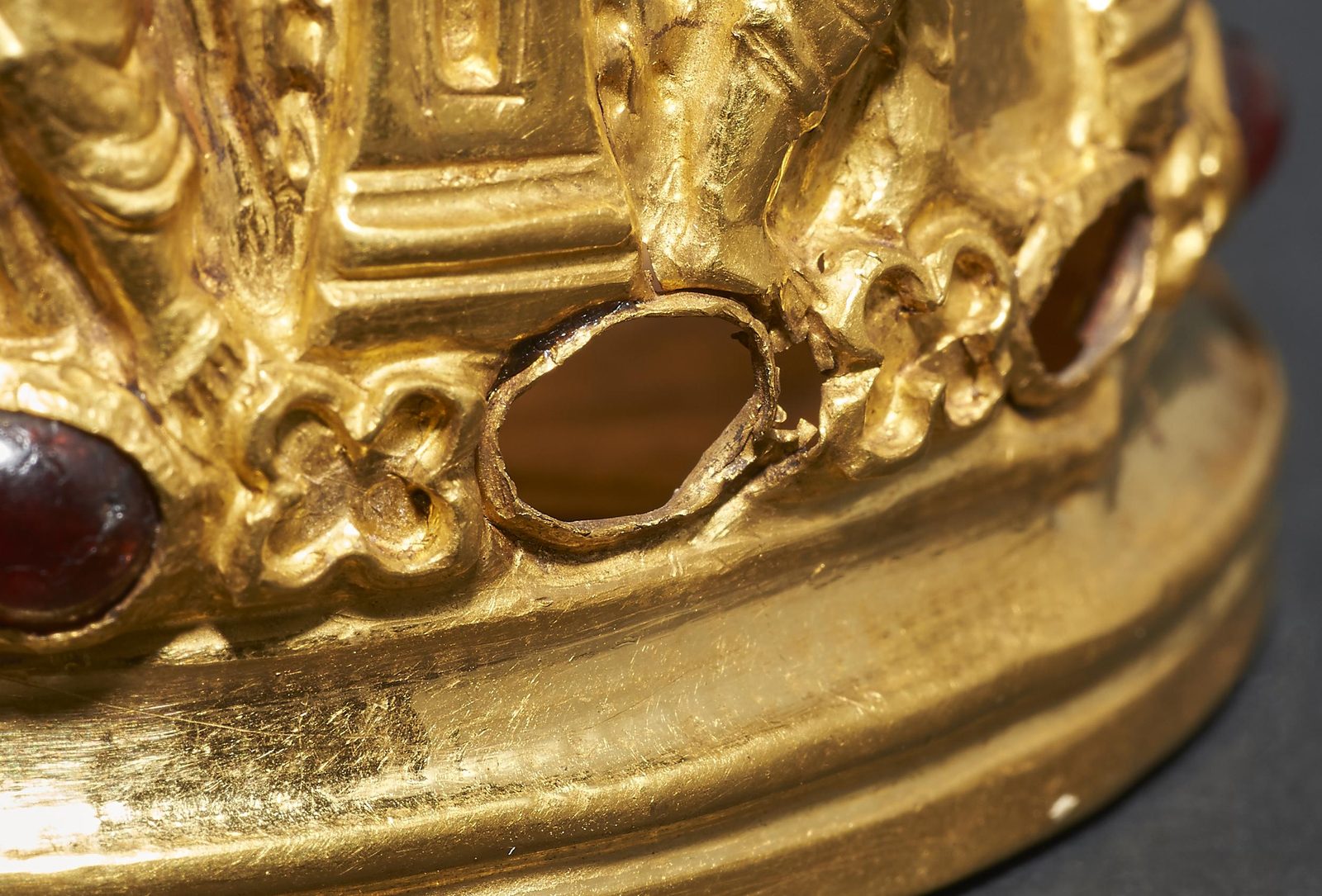
Detail view of the bottom row of gemstones, with some of the missing (perhaps temporarily for restoration purposes) and revealing the bare repoussé work underneath.Source: The British Museum (license: CC BY-NC-SA 4.0)
The decoration is organized in repeated figural groupings. At the center stands the Buddha, flanked by Brahmā (left) and Śakra (right). Between these groupings appear additional figures, usually interpreted as devotees or bodhisattvas. One of these figures is shown with hands in añjali mudrā, the gesture of reverence, and is often tentatively identified as a bodhisattva, possibly Maitreya, although this remains uncertain.
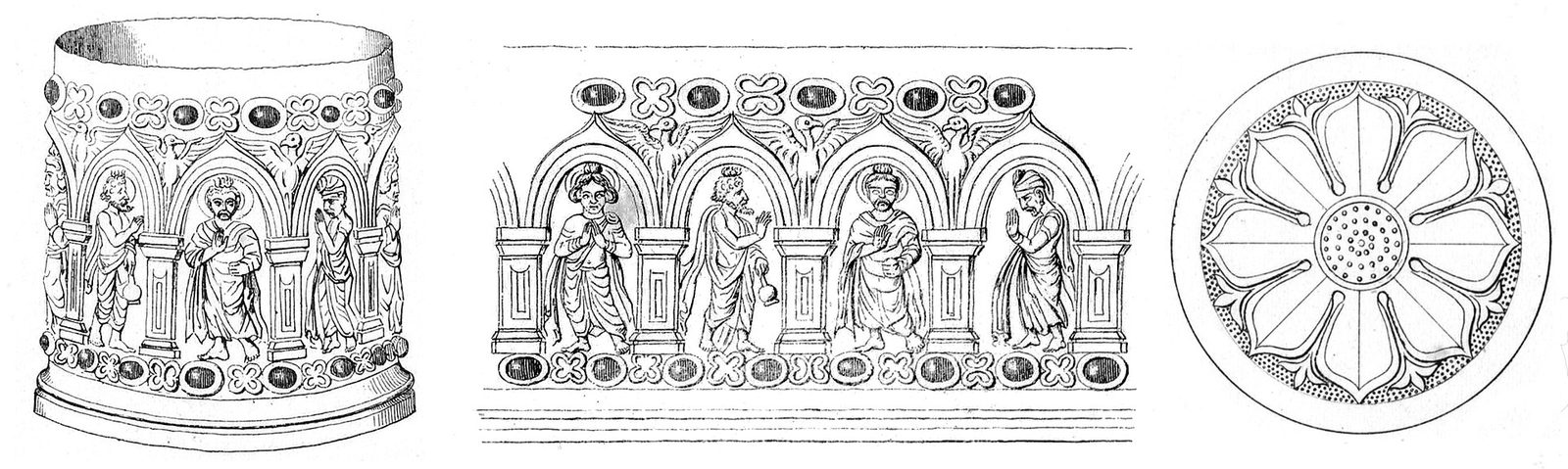
Bimaran casket illustrated by Charles Masson (volume, flattened view, and bottom), 1841. Source: Wikimedia Commonsꜛ (license: CC BY-SA 3.0).
A detail that is often overlooked, but materially and symbolically important, is the base of the reliquary. It takes the form of a fully opened lotus with eight petals. The lotus is not decorative in a superficial sense. It is a central symbol in Buddhist visual language, associated with purity, emergence, and awakening. Here, it quite literally supports the entire object. The reliquary rests on a symbolic foundation.
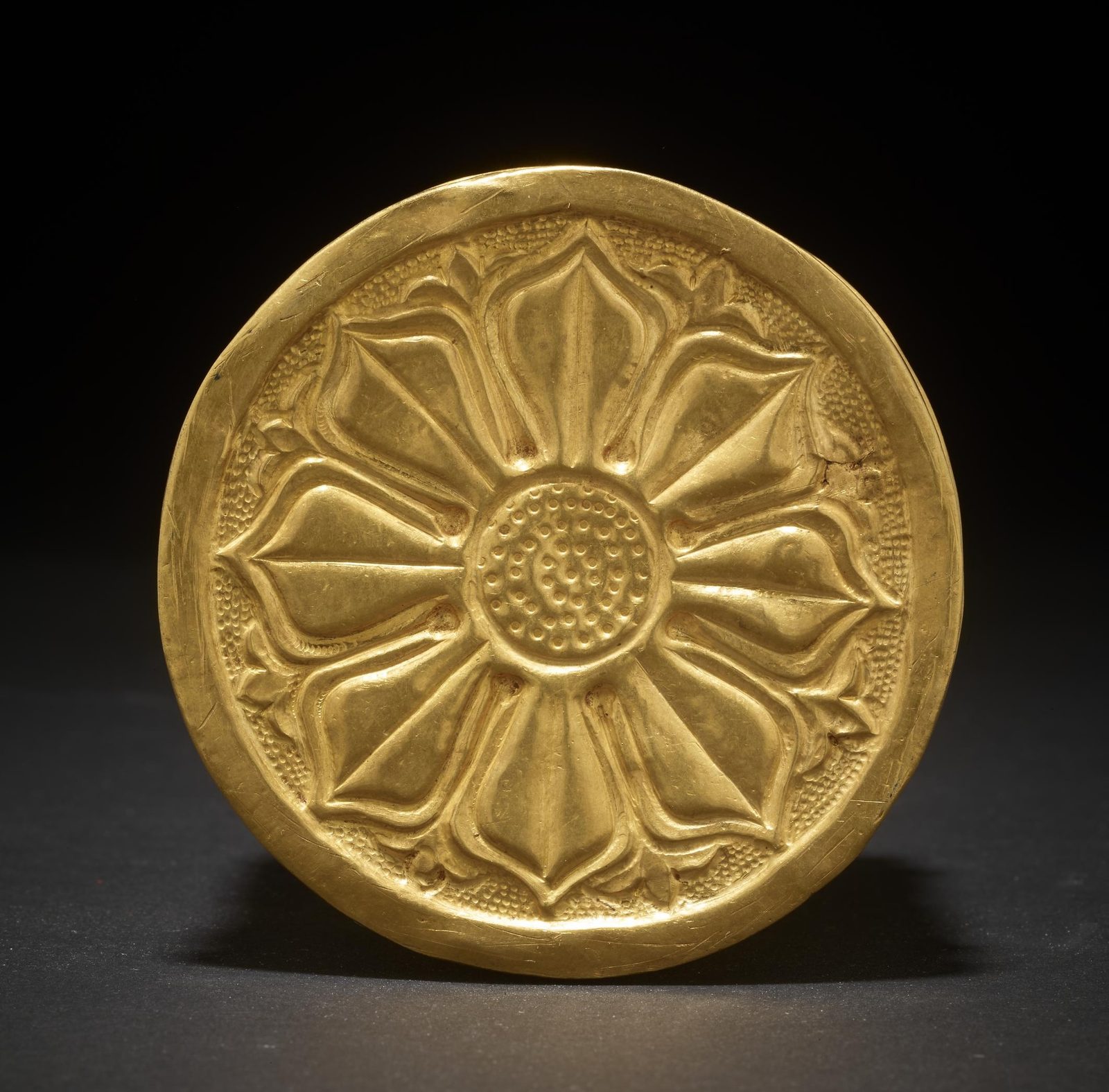
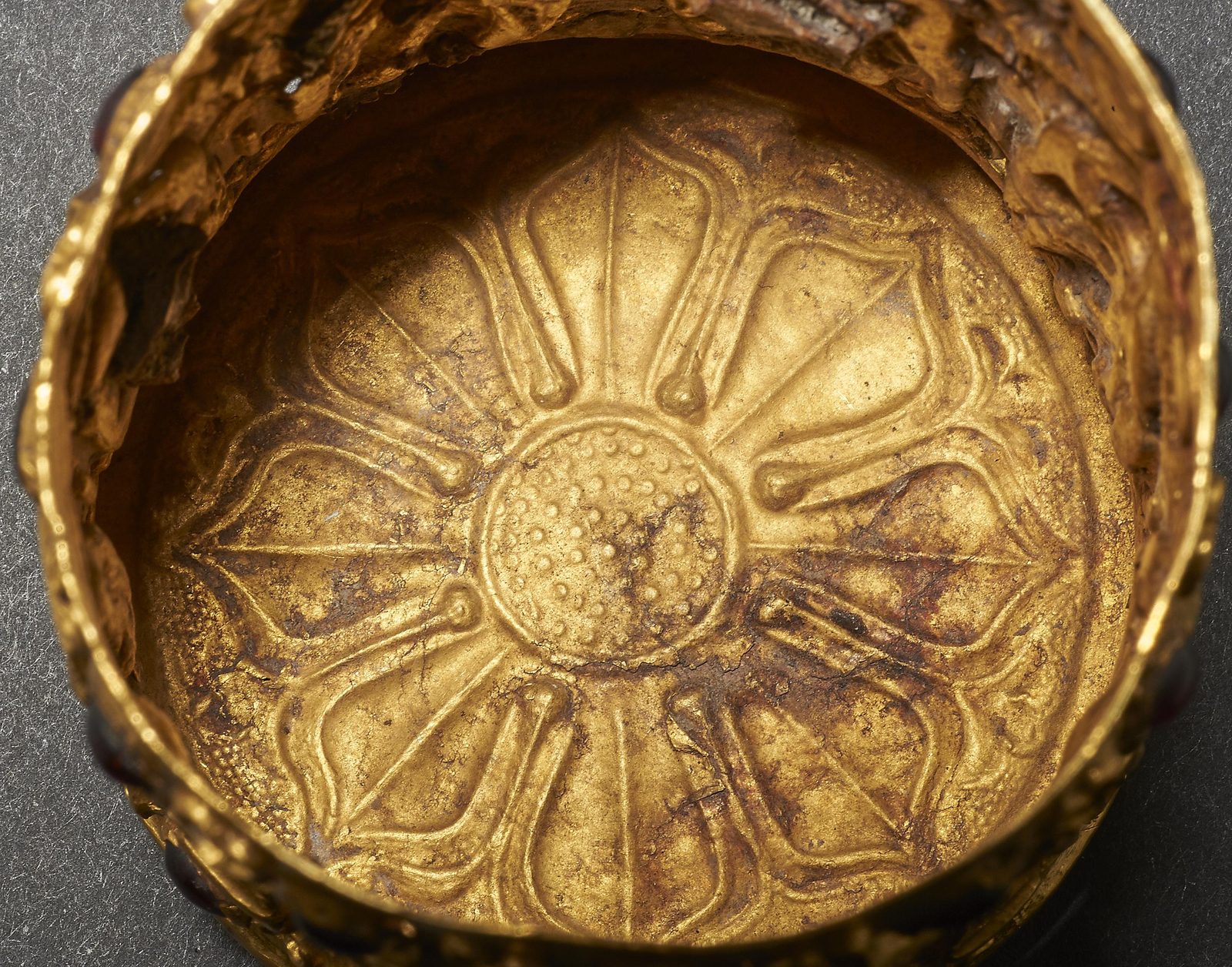
Detail views of the bottom of the Bimaran reliquary, which takes the form of a fully opened lotus with eight petals. Top: view from below; bottom: view from the inside. Source: The British Museum 1 and 2 (license: CC BY-NC-SA 4.0)
What is particularly striking is that this is not an experimental or transitional object. The iconography is fully formed. The Buddha is not implied through symbols, but clearly depicted in human form, embedded within a structured cosmological framework. This strongly suggests that the visual language of the Buddha image was already established by the time this object was produced.
The Buddha image and Gandhāran style
Siddhartha on the reliquary is shown standing, with one arm raised across the body in a gesture related to the abhaya mudrā, the gesture of reassurance or protection. The identification of the figure as the Buddha is supported by several features that later become standard: The raised hand gesture, the flanking deities, and the cranial protuberance (uṣṇīṣa), which signals spiritual attainment.
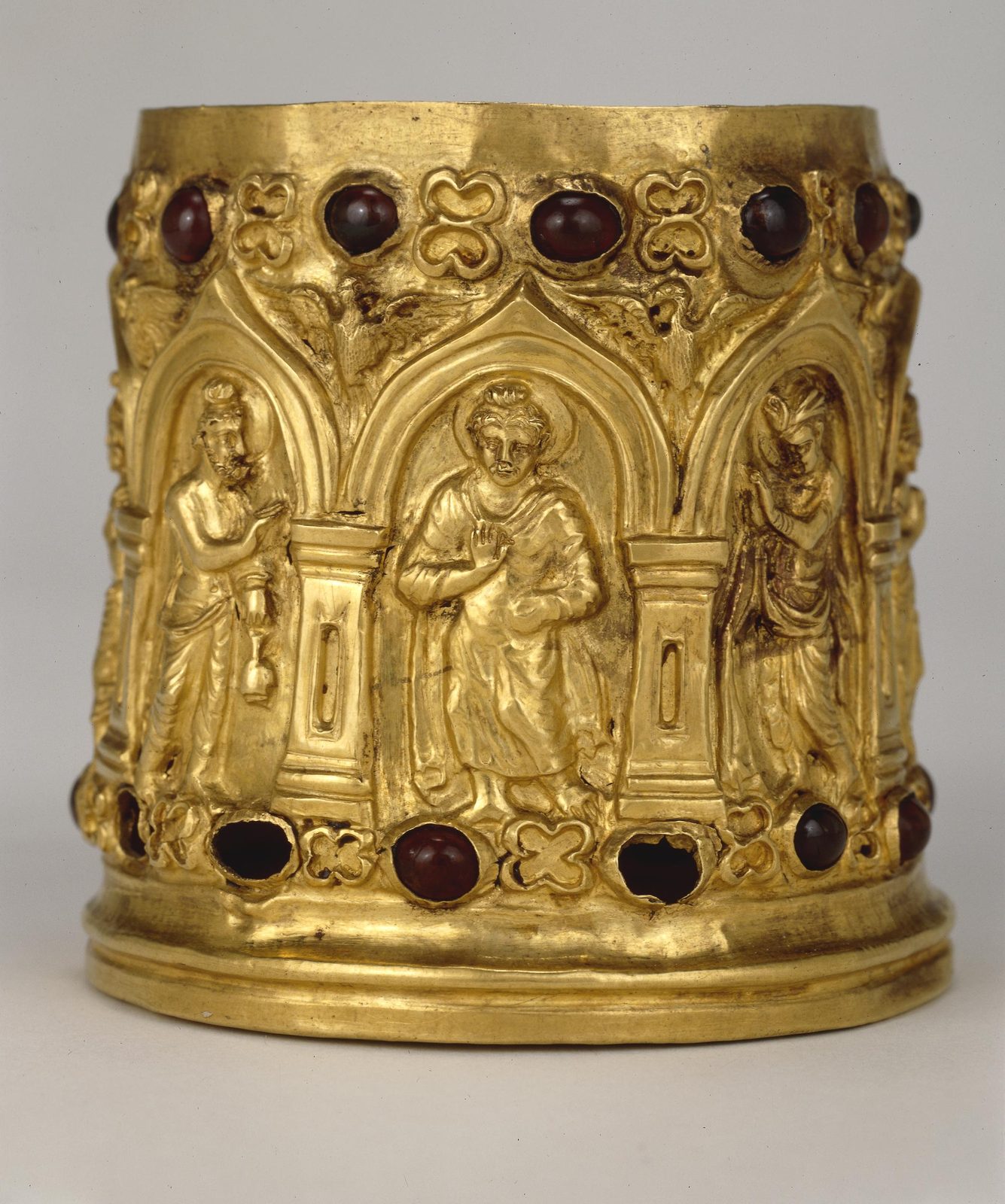
Detail view of the Bimaran reliquary with the Buddha in the center. Source: The British Museum (license: CC BY-NC-SA 4.0)
The robe is rendered in a relatively light and body-following manner. It does not obscure the form, but traces it. This treatment differs from later, heavier drapery styles and aligns more closely with early Gandhāran sculptural conventions.
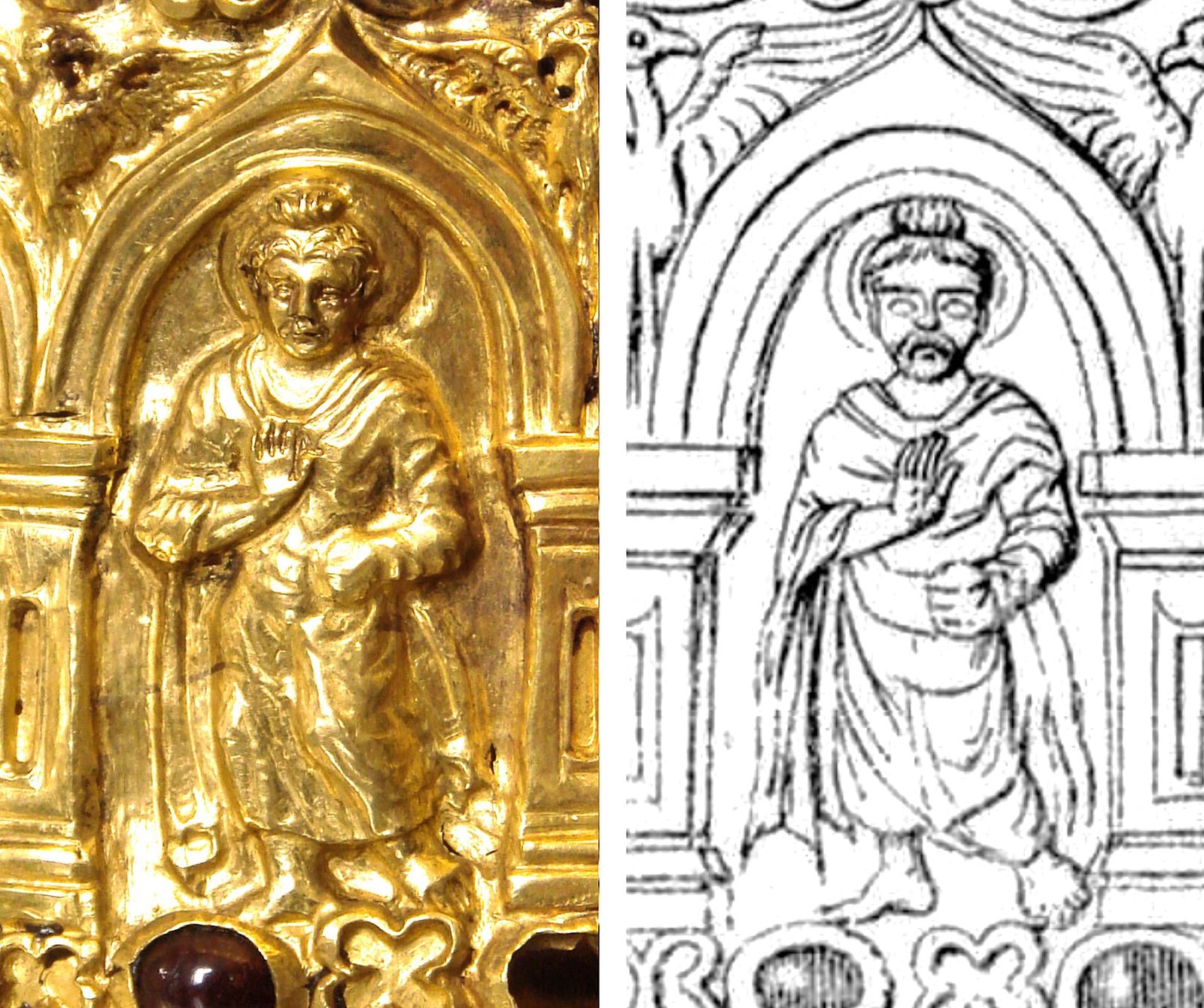
Detail of the Buddha on the Bimaran Casket along with a sketch. Source: Wikimedia Commonsꜛ (license: CC BY-SA 3.0).
Gandhāra was not simply a passive recipient of artistic influence. It functioned as a contact zone in which multiple visual languages were actively reconfigured. Hellenistic naturalism, Iranian elite aesthetics, and Indian religious symbolism were combined into a new visual grammar suited to Buddhist themes.
This becomes particularly evident in the Bimaran reliquary. The Buddha is not only an Indian religious figure, but one shaped through a transregional artistic vocabulary. The object reflects a world in which visual forms moved as much as ideas did.
From a chronological perspective, this has important implications. If the reliquary dates to the early 1st century CE, then the anthropomorphic representation of the Buddha must have developed earlier in my view. The level of iconographic and stylistic refinement visible here does not suggest a beginning, but a continuation of an already established tradition.
Brahmā, Śakra (Indra), and the cosmological framing
The presence of Brahmā and Śakra is not incidental. Their identification follows established iconographic conventions. Brahmā is typically shown in ascetic form, with a topknot and simple draped garment, sometimes holding a water vessel. Śakra, by contrast, the Buddhist form of the Vedic god Indra, appears in princely attire, with jewelry, a turban, and a more elaborate presentation. On the reliquary, these distinctions are preserved in a condensed but recognizable way.
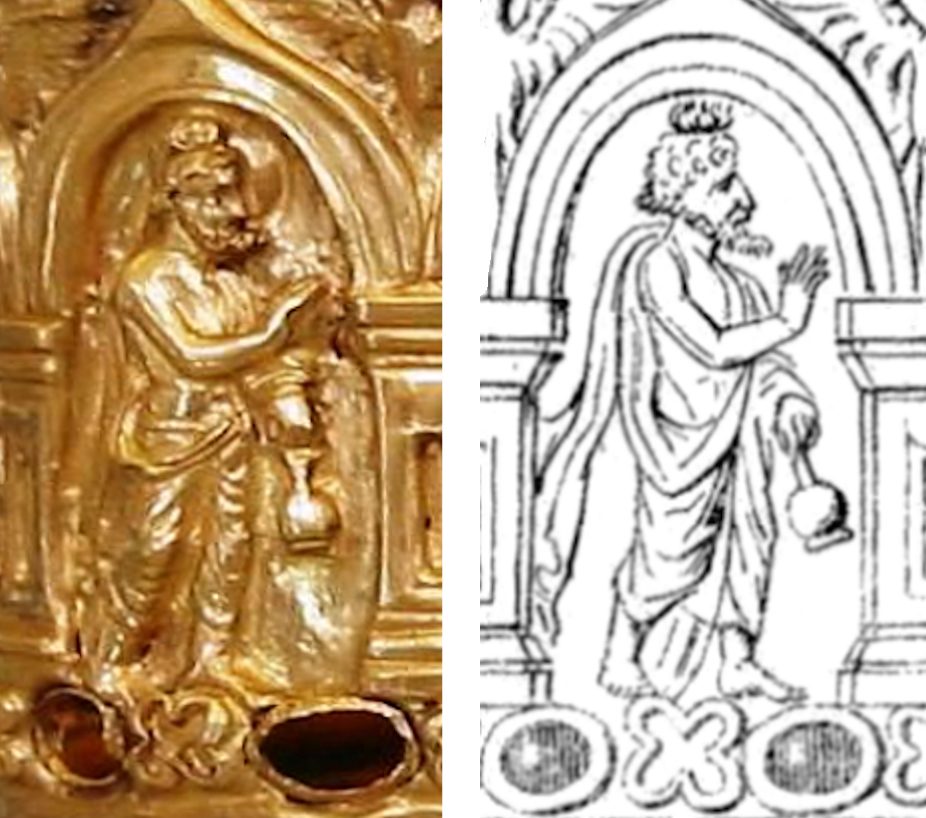
Detail of Brahmā on the Bimaran Casket along with a sketch. Source: Wikimedia Commonsꜛ (license: CC BY-SA 3.0).
Their presence reflects a key doctrinal idea: The Buddha’s superiority within a cosmos populated by powerful deities. In early Buddhist texts, Brahmā and Śakra are among those who recognize the Buddha’s awakening and request the teaching of the Dharma.
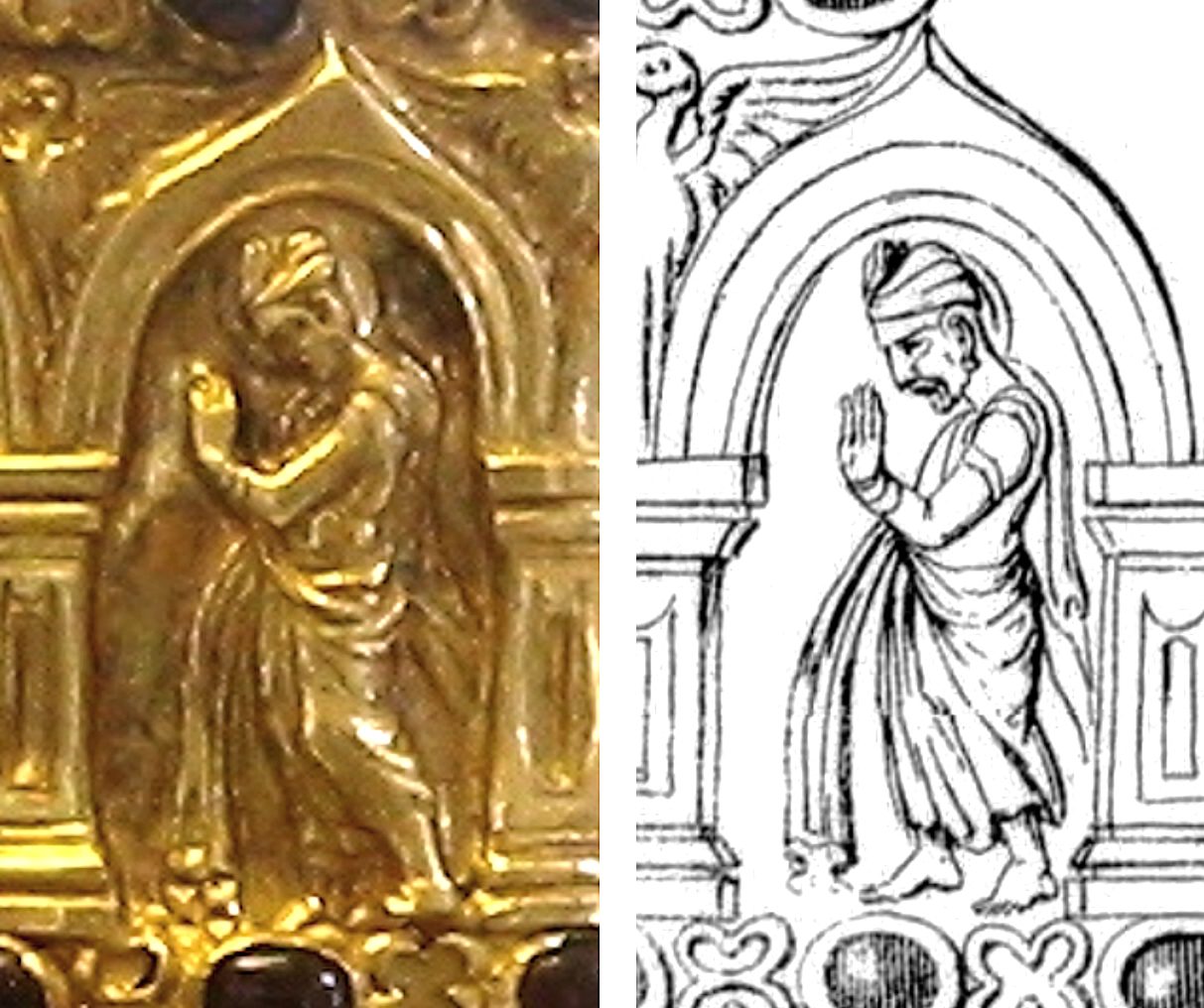
Detail of Śakra (Indra) on the Bimaran Casket along with a sketch. Source: Wikimedia Commonsꜛ (license: CC BY-SA 3.0).
On the reliquary, this narrative is transformed into a static but highly structured visual arrangement. The Buddha occupies the central axis, while the deities flank him in positions of acknowledgment and reverence. The additional figure in añjali mudrā reinforces this dynamic of recognition.
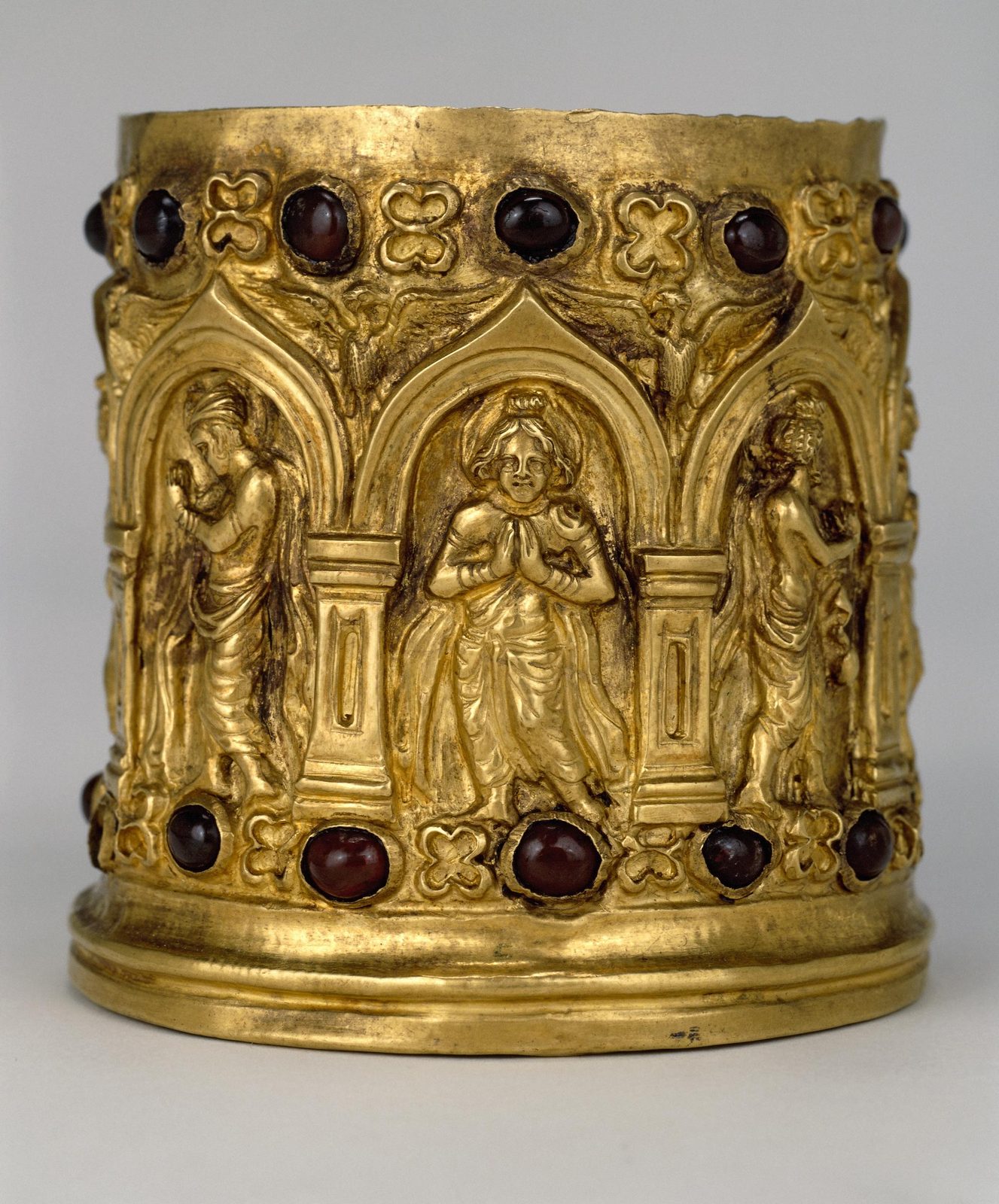
The Bimaran reliquary, detail view with a devotee in the center (most-likely a bodhisattva). Source: The British Museum (license: CC BY-NC-SA 4.0)
What emerges is not simply a decorative composition, but a compressed cosmology. The object stages a hierarchy: Gods attend, the Buddha stands at the center, and devotees respond. For me, this is where the object becomes particularly precise. It does not merely depict figures. It encodes relationships. It makes a doctrinal structure visible in material form and offers us a glimpse into how early Buddhism was visually and philosophically conceptualized.
The coins and the problem of dating
The dating of the Bimaran reliquary remains contested. The deposit contained coins in the name of Azes, originally attributed to Azes II. Later scholarship has questioned this attribution, suggesting that the coins may instead be posthumous issues associated with Kharahostes or Mujatria.
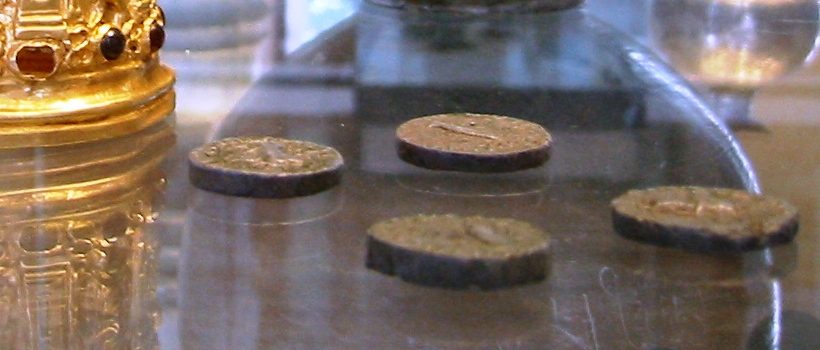
The coins of Azes II found inside the Bimaran reliquary. Source: Wikimedia Commonsꜛ (license: CC BY-SA 3.0).
This is not just a technical note. It directly affects the chronology of early Buddhist art. The presence of the coins is in fact what makes this object so central: it allows, for the first time, a relatively secure chronological anchor for an anthropomorphic image of the Buddha. Earlier representations were predominantly symbolic, and it is only through finds like this that the transition to fully human depiction becomes historically traceable.
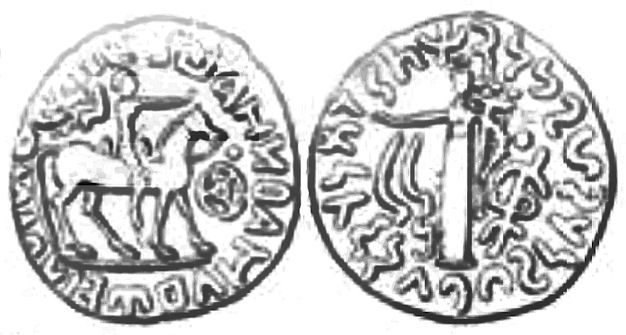
One of the coins of the Bimaran casket, illustrated by Charles Masson, 1841. Obv. Azes riding, Buddhist Triratna symbol behind the head of the king. Rev. City goddess Tyche standing left holding cornucopia and raised right hand. Source: Wikimedia Commonsꜛ (license: CC BY-SA 3.0).
If the coins were newly minted at the time of deposition, the reliquary could date to around the beginning of the Common Era. Some scholars propose dates around 0–15 CE. Others, including the British Museum, suggest a slightly later date around 60 CE. Still others argue for a 2nd-century date based on stylistic considerations.
What is clear, however, is that even the later proposed dates place the object very early in the history of anthropomorphic Buddha imagery. The sophistication of the iconography suggests that it cannot represent the beginning of the tradition. It must belong to a phase in which the Buddha image was already established.
Indo-Scythian context and donation
The political context of the reliquary reflects the complexity of the region. Gandhāra and eastern Afghanistan were shaped by Indo-Greek, Indo-Scythian, Indo-Parthian, and later Kushan rule. These were not isolated regimes, but interconnected systems linked by trade, migration, and cultural exchange.
Gandhāra in particular functioned as a major corridor along the Silk Roads, connecting South Asia with Central Asia and further west. Pilgrims, merchants, and artisans moved through the region, carrying not only goods but also religious ideas and visual forms. The Bimaran reliquary should be understood within this dynamic environment rather than as a purely local product.
The reliquary reflects this environment. Its craftsmanship aligns with Central Asian luxury traditions. Its iconography is Buddhist. Its coinage ties it to Indo-Scythian political history. Its inscription records an individual act of donation.
The donor, Śivarakṣita, bears a name associated with Śaivite traditions. This is not an anomaly, but rather characteristic of the period. Religious identities were not rigidly separated, and individuals could participate in multiple traditions. The act of donating a reliquary was therefore not only a religious gesture, but also a social one: It expressed piety, status, and participation in a shared cultural and ritual landscape.
All together, this shows that Buddhist devotional practice was embedded within broader social and economic structures. Religious objects were not produced in isolation. They were part of networks of patronage, exchange, and identity.
Bimaran and the emergence of the Buddha image
The Bimaran reliquary calls into question the common narrative of a clean transition from an “aniconic” to an “iconic” phase in Buddhist art. The object does not fit into a model of gradual artistic experimentation culminating in the eventual appearance of the Buddha in human form. Instead, it suggests that once the anthropomorphic image emerges in the archaeological record, it does so already as a fully integrated and functional element of Buddhist practice.
What is decisive here is not simply that the Buddha is shown in human form, but how this image is embedded. The reliquary combines three modes of presence: Relic, inscription, and representation. The Buddha is present physically through relics, textually through dedicatory inscription, and visually through the figure on the casket. This triadic structure is not incidental. It reflects a reconfiguration of devotional access. The Buddha is no longer mediated primarily through absence and symbolic reference, but through layered forms of presence that reinforce one another.
This has a clear implication. The anthropomorphic Buddha image was not introduced as a secondary or purely decorative development. It emerges here as part of a coherent ritual system. The image does not replace the relic, nor does it merely illustrate doctrine. It operates alongside relic and inscription as an additional, stabilizing mode of access to the Buddha.
The internal structure of the deposit further reinforces this interpretation in my view. The reliquary was enclosed within a stone container (similar to the stone container found in Piprahwa), originally divided into compartments, later modified to accommodate the gold casket and its contents. This arrangement creates a nested system: Relics within container, container within stupa, image on the surface. The visual field of the reliquary is therefore not external to the ritual, but structurally integrated into it.
From this perspective, the Bimaran reliquary marks not the beginning of the Buddha image, but the point at which it becomes fully operational. The iconography is already standardized. The figure is identifiable through gesture, posture, and attributes. The composition includes deities and attendants. The image functions within a defined cosmological and ritual framework. None of this suggests experimentation. It suggests consolidation.
And this has a consequence for how we understand the origins of the Buddha image. If the earliest datable anthropomorphic representation of the Buddha already appears in such a developed form, then the origins of the Buddha image must lie earlier than the current archaeological record can securely document. The Bimaran reliquary therefore does not resolve the question of origins. It sharpens it. It points to a phase of development that remains largely invisible, but whose results are already fully present here.
In this sense, the object captures in my view a threshold. Not the invention of the image, but the moment at which the image, relic, and ritual form a stable and reproducible system of Buddhist representation.
Relation to broader patterns of contact
Let’s now place the Bimaran reliquary in a broader context. Compared to objects like the Berenike Buddha or the Helgö Buddha, the Bimaran reliquary was not found in a geographically unexpected location. However, it is deeply connected to the same broader phenomenon: The movement and transformation of Buddhist material culture across interconnected regions.
In fact, it helps explain those later phenomena. Before Buddhist objects appeared in Roman Egypt or Viking-age Scandinavia, they were already being shaped in regions like Gandhāra, where cultural boundaries were fluid. The visual form of the Buddha that could later travel across Afro-Eurasia was not created in isolation, but in precisely such contact zones.
What I find particularly striking in this context is the formal resemblance between the Bimaran reliquary and later objects from entirely different religious traditions. Its cylindrical form, its function as a container for sacred contents, and its finely worked decorative surface invite comparison with the pyxis, a type of container already present in the Hellenistic world and later widely adopted in early Christianity for the storage of relics or consecrated substances.
 Pyxis with Christ between the apostles and Abraham’s sacrifice, place of manufacture unknown, around 400, ivory. Bode Museum, Berlin. See more from this exhibition here.
Please don’t get me wrong. I am not suggesting that the Bimaran reliquary was directly influenced by Hellenistic or Christian pyxides. The chronological and cultural contexts do not support a direct line of influence. However, the formal and functional similarities are striking and suggest that there may be shared underlying principles in how different cultures materialize the sacred. Let’s think about this for a moment. Both the Bimaran reliquary and the Christian pyxis are small, portable containers designed to hold sacred contents. They are crafted with care, often in precious materials, and decorated with iconography that signals their religious significance. They function as focal points for devotion, objects through which the sacred can be accessed and mediated. And: Their material, form, and iconography actively construct the meaning of what they hold. In the Bimaran reliquary, this logic is already fully developed: relic, image, and ornament are integrated into a single object. Later Christian pyxides operate within a comparable framework, even if the theological context differs.
Seen in this light, the Bimaran reliquary is not only an early Buddhist object. It belongs to a broader Afro-Eurasian tradition of sacred containers. Its craftsmanship, density, and conceptual clarity place it on the same level as the finest examples of later reliquary traditions. What appears at first as a surprising similarity instead reflects a deeper structural convergence in how different cultures materialize the sacred.
In this sense, the Bimaran reliquary represents an early stage in a wider process. It shows the formation of a portable, recognizable, and conceptually dense visual language that could be transmitted, adapted, and reinterpreted across regions and traditions.
For more context, I recommend to read our previous posts From Gothic to Zen: Comparing medieval Western and Eastern wooden sculptures and On the Hellenistic heritage in Christian culture and Buddhist art, where we explore similar themes of cross-cultural influence and shared visual vocabularies in different religious contexts.
Interpretative challenges
The Bimaran reliquary also illustrates the limits of our knowledge. The archaeological record is fragmentary, and the conditions of its discovery, shaped by early 19th-century exploration rather than modern excavation, leave important gaps. The dating remains debated, and the relationship between style, chronology, and historical context is not straightforward.
There is a strong tendency to focus on whether this is “the earliest Buddha image”. While understandable, this question risks, however, oversimplifying the object’s significance. It reduces a complex artifact to a single chronological marker. More importantly, it assumes that the emergence of the Buddha image can be captured by a single point of origin.
I think, the Bimaran reliquary should be seen under a different light. It is not just an early example of a Buddha image. It is a fully formed example of a particular kind of Buddhist visual culture. Its iconography is already highly developed, its composition structured, and its integration into a ritual context fully realized. This does not look like an experimental beginning, as mentioned in the previous sections. For me, this looks like the visible outcome of an earlier phase that has left little direct trace.
And this is where the methodological problem begins. From my recent research I learned, that scholars often treat the Bimaran reliquary as evidence for the beginning of anthropomorphic Buddha imagery because it is among the earliest examples that can be linked to a datable deposit. But the object itself does not look like a beginning. It looks like a developed form. This means that the earliest securely datable evidence is probably not the earliest historical stage. It is only the earliest stage that has survived in a form we can still date. And this is of course no surprise. However, I think it is important to acknowledge this gap between the archaeological record and the historical reality. The Bimaran reliquary does not show us the origin of the Buddha image. It shows us a moment in which the Buddha image has already become a stable and sophisticated element of Buddhist visual culture. The origins of that image must lie earlier, but they remain invisible to us.
The real challenge is therefore not only to ask how old the reliquary is. The more important question is what its refinement implies. If an object from this early period already shows Siddhartha in a stable iconographic form, accompanied by deities, framed architecturally, and integrated into relic devotion, then earlier stages of Buddha imagery must have existed before it. The Bimaran reliquary does not solve the origin problem. It makes the missing earlier development visible precisely through its own sophistication.
Conclusion
The Bimaran reliquary is one of those objects that I now find difficult to look at without thinking about its broader implications. I came to it almost by accidentꜛ, but it immediately changed how I think about the early history of Buddhist images. At first, it fascinated me because it looked so unexpectedly familiar: A small, precious, cylindrical container for sacred contents, worked with extraordinary care, almost comparable in form and function to later reliquaries or Christian pyxides. But the more important point is not the resemblance itself. The more important point is what this resemblance reveals: Across different religious traditions, sacred presence is often materialized through carefully crafted containers, images, inscriptions, and ritual deposits.
For Buddhist art history, I think that the Bimaran reliquary is especially important because it stands at a critical threshold. It is not simply an early Buddha image. It is an early Buddha image already embedded in a complete ritual system. Relic, inscription, donor, stupa, image, deities, and architectural framing all belong together. This makes the object far more significant than a single chronological marker. It does not merely tell us that anthropomorphic representations of Siddhartha existed by the early centuries of the Common Era. It shows that such representations had already become meaningful, stable, and ritually functional.
This is also why the object fits so well into the broader theme of Buddhist contact across Afro-Eurasia. The Bimaran reliquary was not found in an unexpected distant place like the Berenike Buddha or the Helgö Buddha. Yet it belongs to the same larger history. It comes from Gandhāra, a region where Buddhism developed in constant interaction with Hellenistic, Iranian, Central Asian, and South Asian visual traditions. The object therefore does not show Buddhism spreading from a closed center into passive peripheries. It shows Buddhism being shaped in contact zones from the beginning of its visual history.
The most cautious conclusion is therefore also the most interesting one. The Bimaran reliquary should not be treated simply as “the first Buddha image”. It is better understood as the earliest securely datable witness to a tradition that must already have existed before it. And its sophistication is precisely the clue. The beginning itself remains hidden, but this object shows that by the time it entered the stupa deposit at Bimaran, the human image of Siddhartha had already become a powerful form of Buddhist presence. That is what makes the reliquary so remarkable: It does not close the question of origins. It actually opens it.
References and further reading
- YouTube documentary on the Bimaran reliquary by the British Museumꜛ
- British Museum, Reliquary casket, collection object OA 1900.2-9.1ꜛ
- Cribb, Joe, Dating the Bimaran Casket – its Conflicted Role in the Chronology of Gandharan Art, 2017, Gandharan Studies 10 (2017): 57-91, doi: zenodo.3492002ꜛ
- Cribb, Joe, The Bimaran Casket: The Problem of Its Date and Significance, 2018, academia.eduꜛ
- Elizabeth Errington, Charles Masson and the Buddhist sites of Afghanistan - explorations, excavations, excavations, collections 1832-1835, 2017, The British Museum, ISBN: 9780861592159
- Errington, Elizabeth, Cribb, Joe, and Claringbull, Maggie, The Crossroads of Asia, 1992, Ancient India and Iran Trust, ISBN: 978-0951839911
- Foucher, Alfred A., The Beginnings of Buddhist Art, 1917, Paris, P. Geuthne, archive.orgꜛ
- Huntington, Susan L., Early Buddhist Art and the Theory of Aniconism, 1990, Art Journal, 49(4), 401–408. doi: 10.1080/00043249.1990.10792724ꜛ
- Stoneman, Richard, The Greek Experience of India, 2019, Princeton University Press, ISBN: 978-0691154039
- Kurt A. Behrendt, The art of Gandhara in the Metropolitan Museum Of Art, 2007, Metropolitan Museum of Art New York, ISBN: 9780300120271
- Kurt Behrendt, How To Read Buddhist Art, 2019, Metropolitan Museum of Art, ISBN: 9781588396730








comments