Frankfurt Archaeological Museum
On my second visit to the Archaeological Museum of the City of Frankfurt in October 2025, I also spent more time in the permanent exhibition on the ancient world. While this exhibition makes up only a part of the museum, what is in particular fascinating is its density of covered epochs, from early Iron Age Italy to Etruria, from Attic and South Italian vase painting to the bronze cultures of western Iran and the ceramic traditions of Tepe Sialk, Giyan, Amlash, Luristan, and the wider Iranian highlands. It’s not the monumental pieces you get presented in other larger antiquities museums, but rather a selection of objects of use, which show the material culture of the ancient world through vessels, tools, weapons, jewelry, horse gear, and funerary containers. It showcases tools of daily use, which provide a more concrete access to the ancient world than the more monumental, but also more abstract art. The exhibition therefore offers both a rare opportunity to follow several major strands of ancient material culture across the Mediterranean, Anatolia, and western Asia in one place, and it offers a glimpse into the everyday lives of people in these regions. In this post, I’d like to summarize my impressions during that visit.
 Archaeologisches Museum Frankfurt. Medieval artefacts of the former monastery, which is now the museum’s home.
The permanent antiquities exhibition
During the research for this post I learned, that the antiquities collection of the Archaeological Museum Frankfurt belongs to a longer Frankfurt collecting history. The museum developed out of the archaeological department of the Historical Museum Frankfurt (German: Historisches Museum Frankfurt) and became an independent institution in 1937. Its first home was the Dominican monastery (German: Dominikanerkloster) in Frankfurt. During the Second World War, the museum had to close, and the Dominican monastery was largely destroyed in 1944. After several postwar relocations, the museum eventually moved into its present location in the former Carmelite monastery.
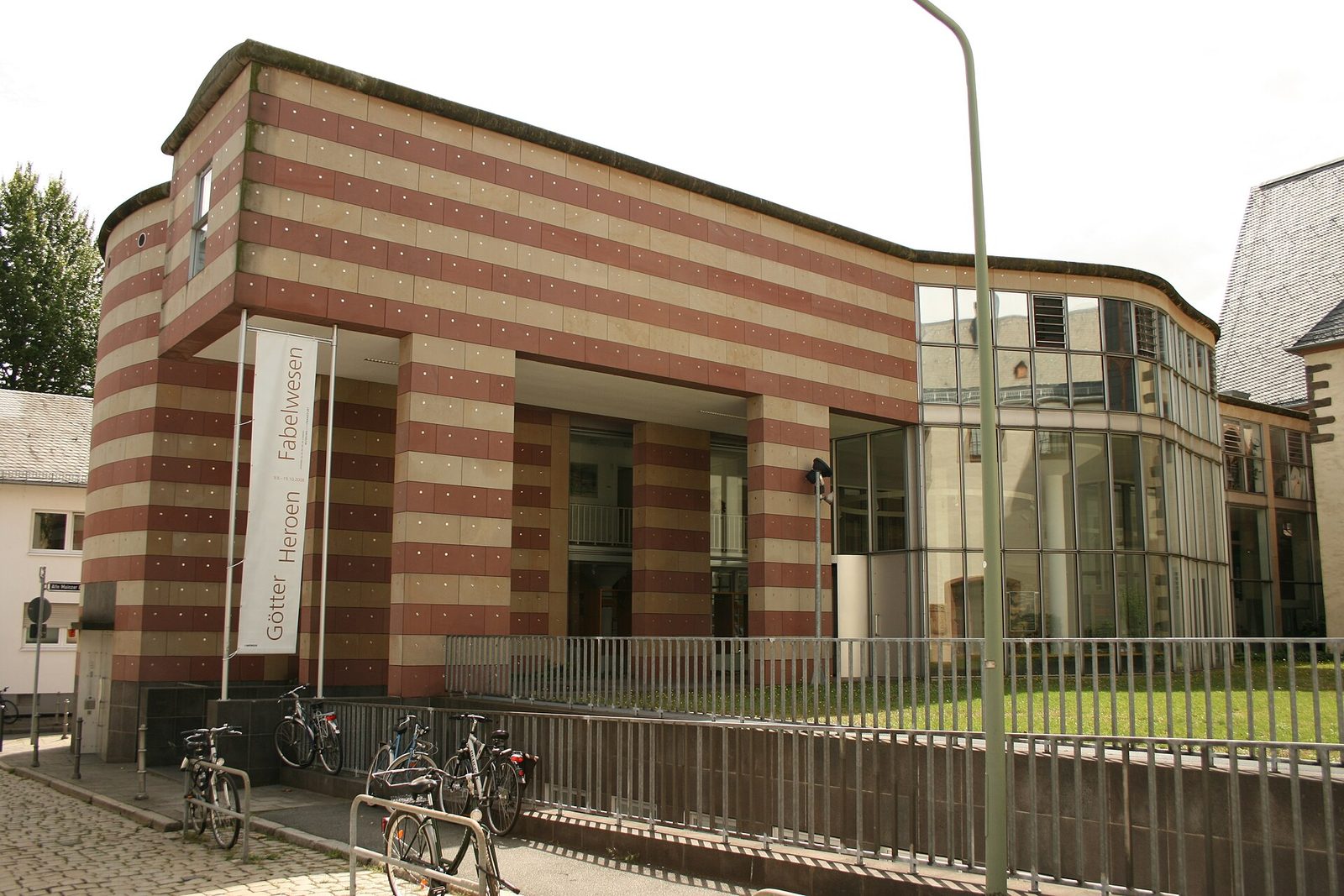 Archaeological Museum Frankfurt: New Building and Entrance Area. On the right, parts of the former Carmelite monastery can be seen. Source: Wikimedia Commonsꜛ (license: CC BY-SA 3.0).
Although the museum is primarily responsible for the archaeology of Frankfurt and its surrounding region, it also preserves important collections of Classical Antiquity (e.g., ancient Greece and Rome/Italy, Minoan civilization, Phoenicia) and the Ancient Near East (e.g., Mesopotamia, Assyria, Sumerians, Akkadian Empire, Elam, Babylonians, Canaanites). The classical antiquities collection has its roots in Frankfurt’s older private and civic collecting traditions. Many objects entered the museum through donations, purchases, and long term loans. This explains why a museum focused on Frankfurt’s archaeology also contains artefacts from Greece, Italy, Asia Minor, Iran, and other ancient regions.
The strength of the permanent antiquities exhibition lies in its focus on objects of use. The display includes vessels, weapons, jewelry, bronze objects, terracottas, funerary containers, horse gear, and ritual or symbolic objects. These artefacts show how people stored, poured, drank, cooked, perfumed, armed, adorned, buried, represented, and remembered. They give access to concrete practices rather than to antiquity as an abstract historical category.
The classical section shows this through Greek, Etruscan, Italic, and South Italian ceramics and bronzes. Kraters, cups, lekythoi, aryballoi, urns, ash chests, wine strainers, and bronze vessels point to drinking culture, bodily care, burial customs, elite display, and workshop traditions. The Iranian and Ancient Near Eastern section extends this perspective through Luristan bronzes, Amlash vessels, Tepe Sialk ceramics, Giyan pottery, weapons, standards, and horse equipment. Together, these objects show ancient societies through the material forms of everyday life, ritual practice, status, exchange, and death.
Early Iron Age Italy and the Villanova horizon
The Villanova culture belongs to early Iron Age Italy and is usually dated from the 10th to the 8th century BCE, with later developments continuing into the 7th century BCE. It was especially important in central Italy, including regions that later became part of historical Etruria. Archaeologically, it is known above all through cemeteries, cremation burials, impasto pottery, bronze objects, and grave goods. For that reason, Villanova material is often treated as one of the main foundations from which Etruscan culture developed.
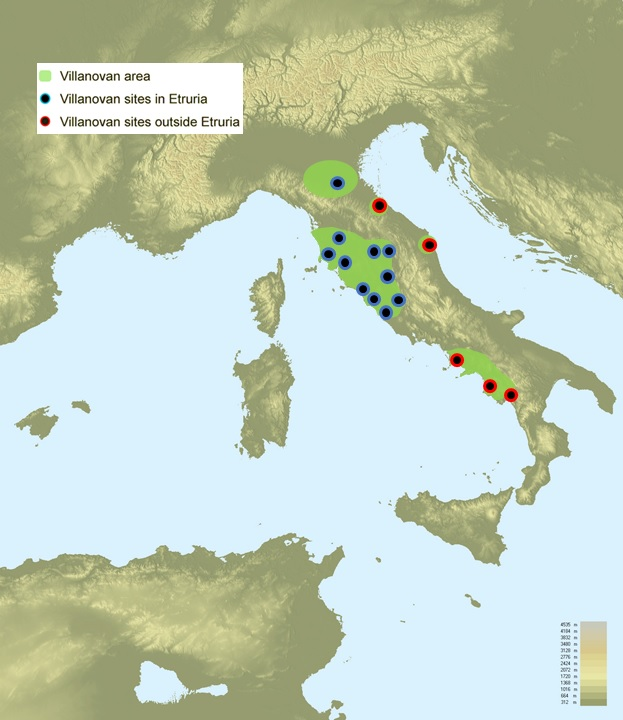
Map of the Villanovan Culture, 10th to 8th century BCE. Source: Wikimedia Commonsꜛ (license: CC BY-SA 4.0).
The objects in the exhibition make this funerary and domestic aspect of the culture very accessible. The exhibited hut urn for instance is a funerary container, but its form refers to domestic architecture. The dead are placed in a vessel shaped like a house. Burial, household identity, and the symbolic meaning of dwelling are therefore connected in one object.
 Hut urn, findspot unknown, possibly Latium, impasto, Villanova IA; 10th/9th century BCE. Archaeological Museum Frankfurt
The urn with a helmet as cover adds another layer. The helmet gives the container a martial and personal character. Even if the original context is uncertain, the combination of urn and helmet points to a burial culture in which social identity could be expressed through objects.
 Urn with helmet as cover and incised decoration, with tin inlay on the helmet, from the surroundings of Veii; urn and helmet allegedly found together. Impasto; Villanova (Veii I), 9th century BCE. Archaeological Museum Frankfurt
The impasto vessels, including the spouted pitcher with abstract water birds, the kantharos (old Greek cup), the animal shaped ring vessel, and the tripod vessel with horse handle, show a visual language based on incised decoration, abstraction, animal symbolism, and vessel form. These objects are not narrative in the later Greek sense. Their meaning lies in shape, surface, material, and use.
 Spouted jug, brown impasto; incised decoration on the shoulder: abstracted water birds. Findspot unknown; formerly Bourguignon Collection, central Italy, late Villanova; early 7th century BCE. Archaeological Museum Frankfurt
 Kantharos, black impasto, findspot unknown, northern Etruria (Vetulonia?); late Villanova; early 7th century BCE. Archaeological Museum Frankfurt
 Ring vessel in animal form, impasto with remains of white paint, findspot unknown, Bisenzio (?); second half of the 8th century BCE. Archaeological Museum Frankfurt
 Four leaf spiral fibula, bronze, findspot unknown, southern Italy; second half of the 8th century BCE. Archaeological Museum Frankfurt
 So called chalkophon, musical instrument, findspot unknown, southern Italian or Phoenician, 8th century BCE. Archaeological Museum Frankfurt
 Skyphos, bucchero like brown impasto, from Santa Maria Capua Vetere; formerly Bourguignon Collection, Campania; 7th century BCE. Archaeological Museum Frankfurt
 Tripod vessel with horse handle from central Italy, Bisenzio (?), ca. 700 BCE. Archaeological Museum Frankfurt
 Amphora with spiked handles, part of a rich grave assemblage, rest not exhibited, findspot unknown, Latium; mid 7th century BCE. Archaeological Museum Frankfurt
Italic, Corinthian, and Etruscan ceramics in the Orientalizing period
From the 8th to the 6th century BCE, central and southern Italy became increasingly connected with the wider Mediterranean. Greek colonies in southern Italy, Phoenician trade, Etruscan maritime networks, and contacts with the eastern Mediterranean changed local material culture. This period is often described as the Orientalizing period, because Near Eastern and Greek motifs entered Italy through trade, migration, imitation, and elite consumption.
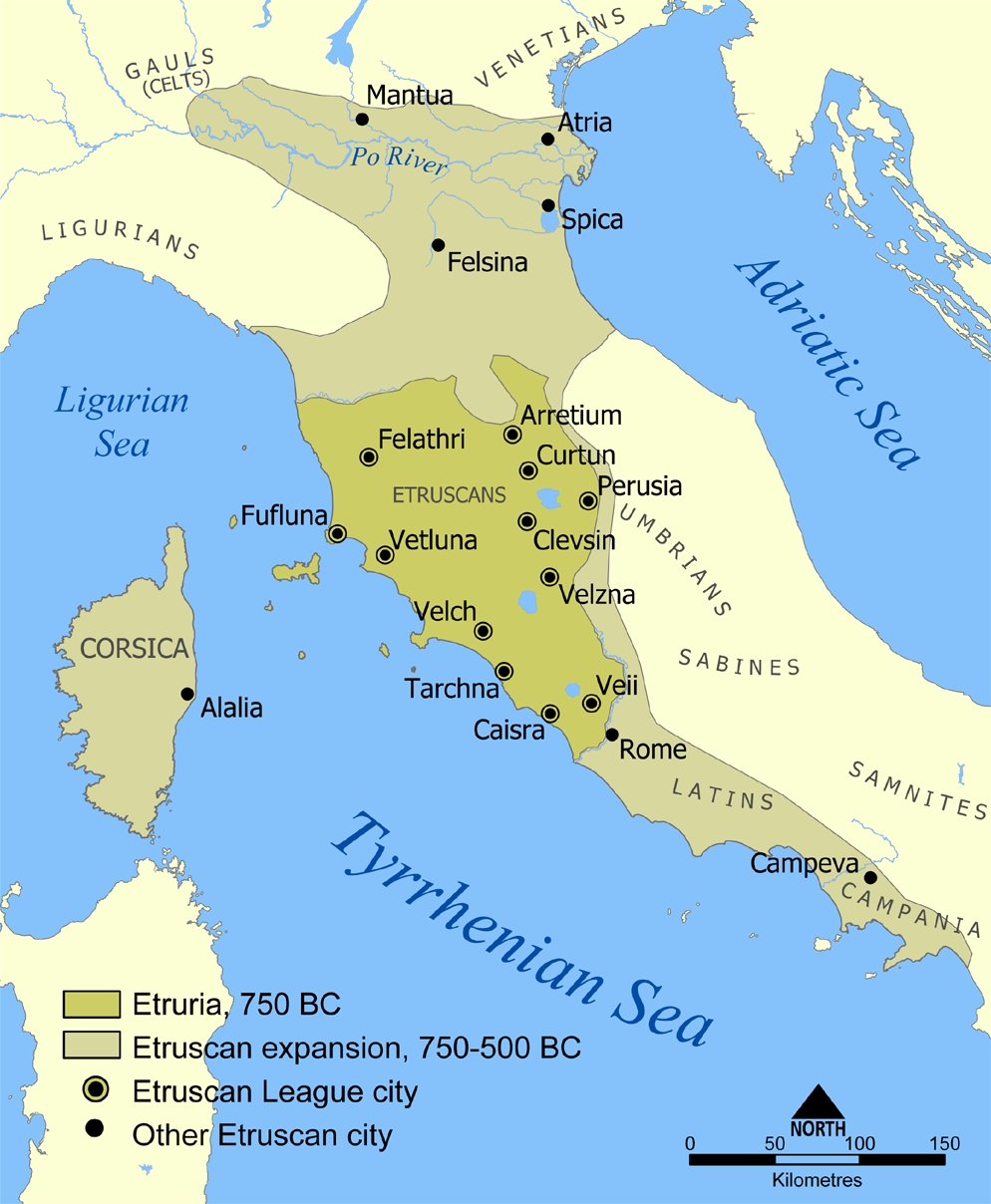
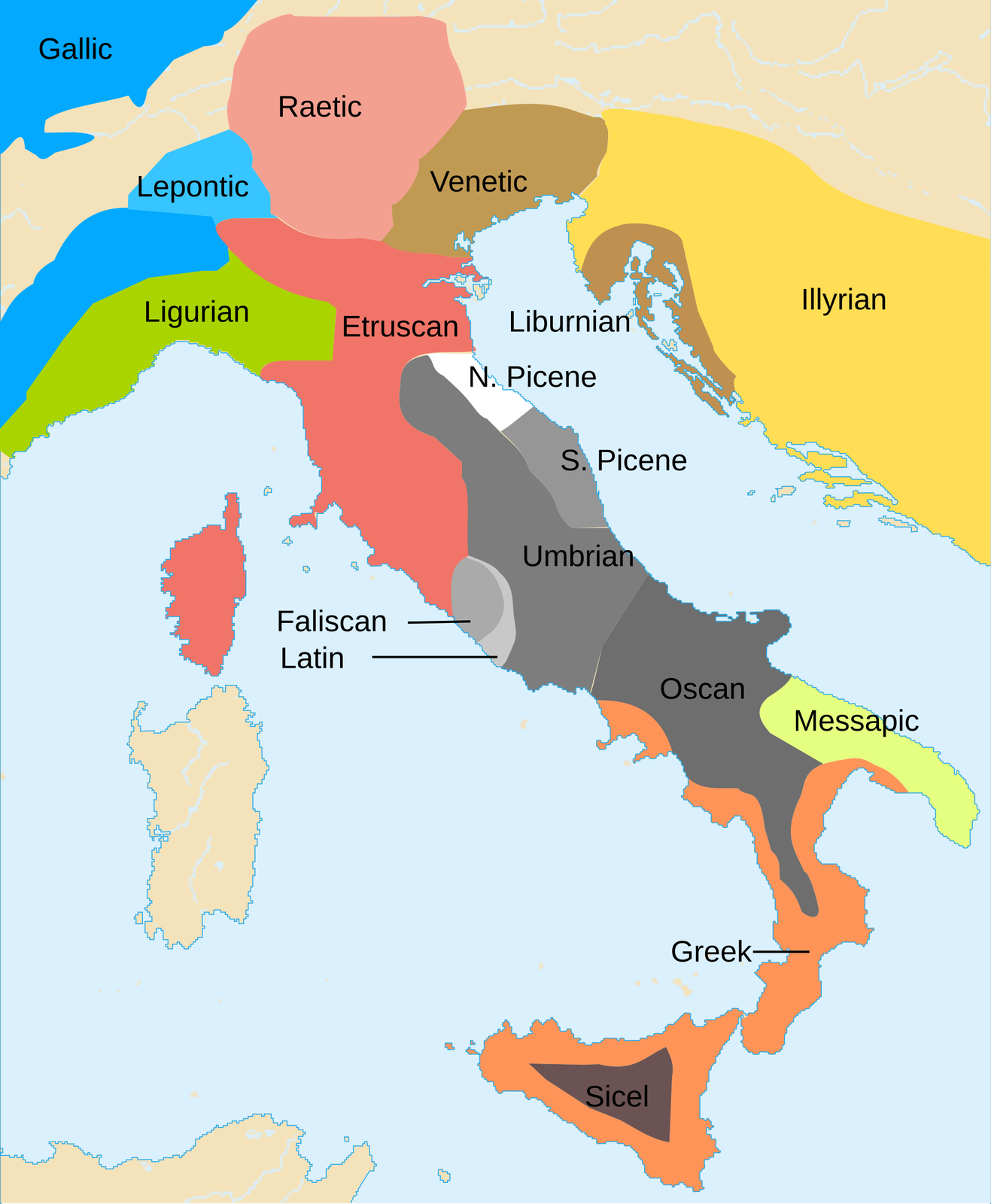
Left: Extent of Etruscan civilization and the twelve Etruscan League cities. Source: Wikimedia Commonsꜛ (license: CC BY-SA 3.0). – Right: Ethnolinguistic map of Italy (Italic people) in the Iron Age, before the Roman expansion and conquest of Italy. Source: Wikimedia Commonsꜛ (license: CC BY-SA 3.0).
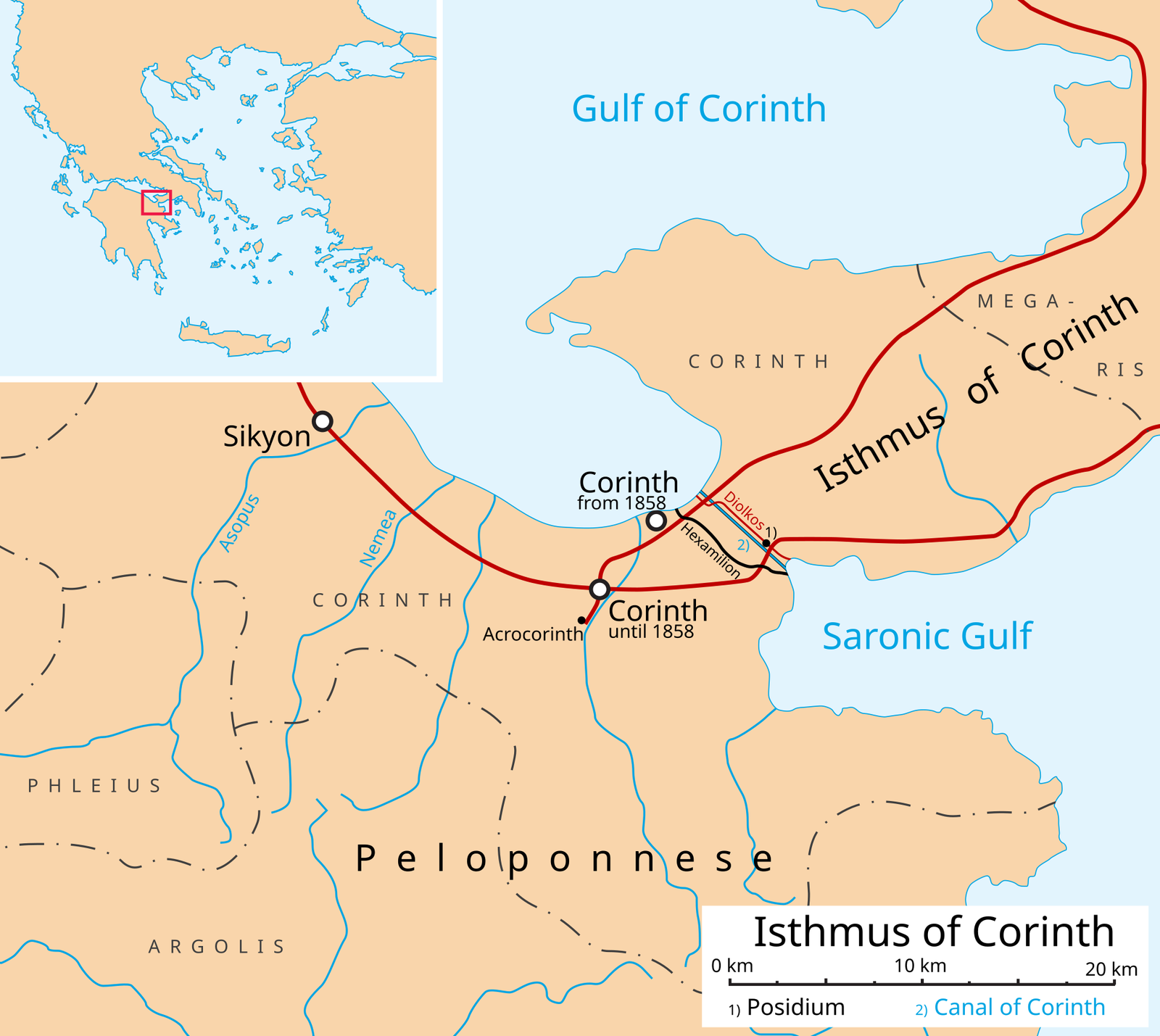
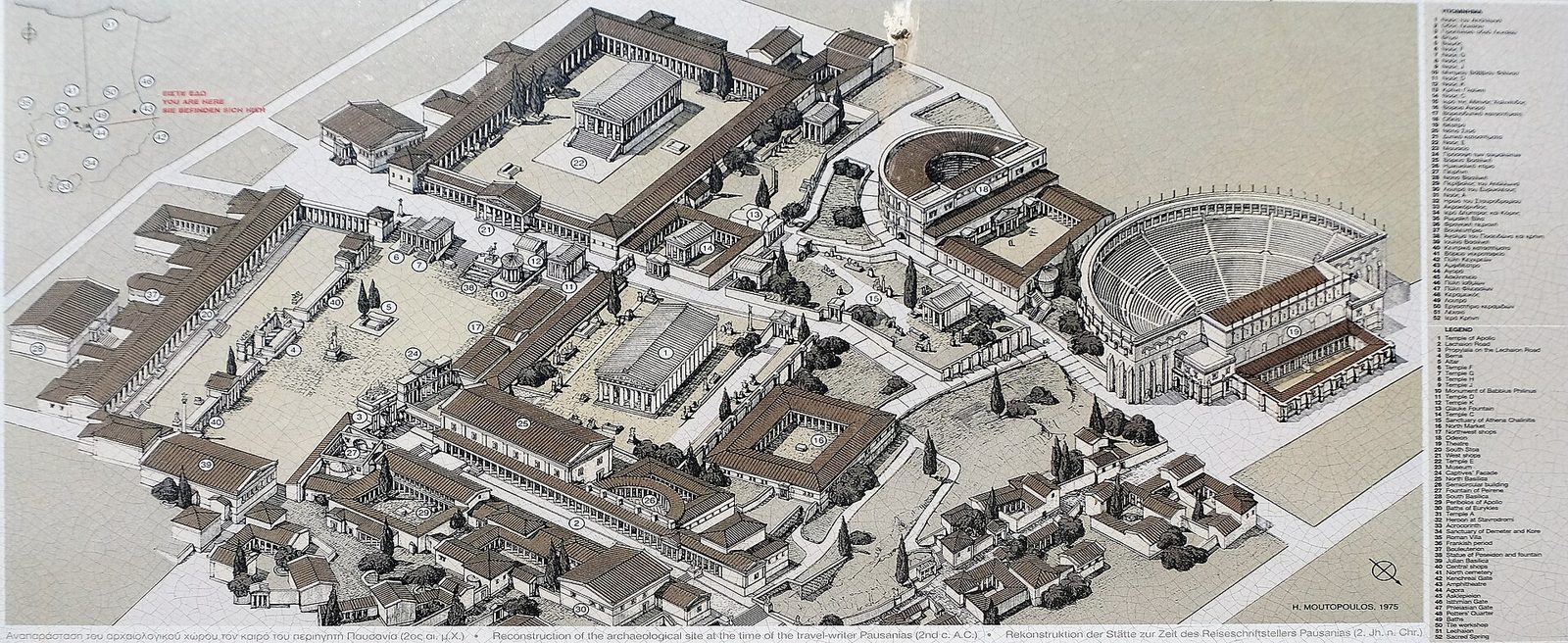
Top: Map of ancient Corinth: Isthmus of Corinth and the cities of Corinth and Sikyon in Greece. Source: Wikimedia Commonsꜛ (license: CC BY-SA 3.0). – Bottom: Reconstruction of ancient Corinth during the 2nd century CE. Source: Wikimedia Commonsꜛ (license: CC BY-SA 4.0).
The objects from the late 7th and early 6th centuries BCE show this process at the level of pottery and small vessels. Corinthian pottery and its animal friezes became important models for Italic and Etruscan workshops. These workshops did not simply copy Greek objects. They adapted foreign forms and motifs to local production, taste, and use.
The footed cup, the globular aryballoi (a small Greek spherical container), the salve vessels, and the rotelle jug belong to this Corinthianizing visual world. Small perfume and oil containers are especially useful here, because they connect artistic imitation with bodily practice, grooming, and elite display. The animal frieze becomes a decorative form that travels between regions and is then reworked in local workshops.
 Seven salve flasks of different forms, mostly from Santa Maria Capua Vetere and Cumae, Italo Corinthian; turn of the 7th to 6th century BCE. Archaeological Museum Frankfurt
 Lower left: Footed cup, findspot unknown; formerly Haeberlin Collection, Italo Corinthian; turn of the 7th to 6th century BCE. Rest of the bottom row: Three globular aryballoi with imitation Corinthian animal friezes, findspots unknown, Italo Corinthian; two from the same workshop; early 6th century BCE. Archaeological Museum Frankfurt
The Olla or amphora with bird decoration belongs to a more subgeometric tradition. It keeps a stronger emphasis on repeated ornamental forms, while the Corinthianizing vessels move toward denser figural decoration. Together, these objects show a transitional period in which Italic and Etruscan material culture absorbed Mediterranean influences without losing its own regional forms.
 Olla (amphora) with bird decoration, findspot unknown, Italic subgeometric, central Etruria; early 7th century BCE. Archaeological Museum Frankfurt


 Rotelle jug with imitation Corinthian animal friezes, findspot unknown, Italo Corinthian, probably Vulci, Pescia Romana Painter; early 6th century BCE, loan from the Historisch Archäologische Gesellschaft, Frankfurt am Main. Archaeological Museum Frankfurt
Etruscan black figure, red figure, bronze vessels, and funerary culture
The Etruscans were one of the major cultures of pre Roman Italy. Their core region was Etruria, roughly corresponding to parts of modern Tuscany, northern Lazio, and western Umbria, but their influence extended more widely across central Italy and the western Mediterranean. From the 8th to the 3rd century BCE, Etruscan cities developed complex urban societies, extensive trade networks, rich funerary traditions, and a strong culture of metalwork and painted pottery. Much of what is known archaeologically about the Etruscans comes from tombs and grave goods.
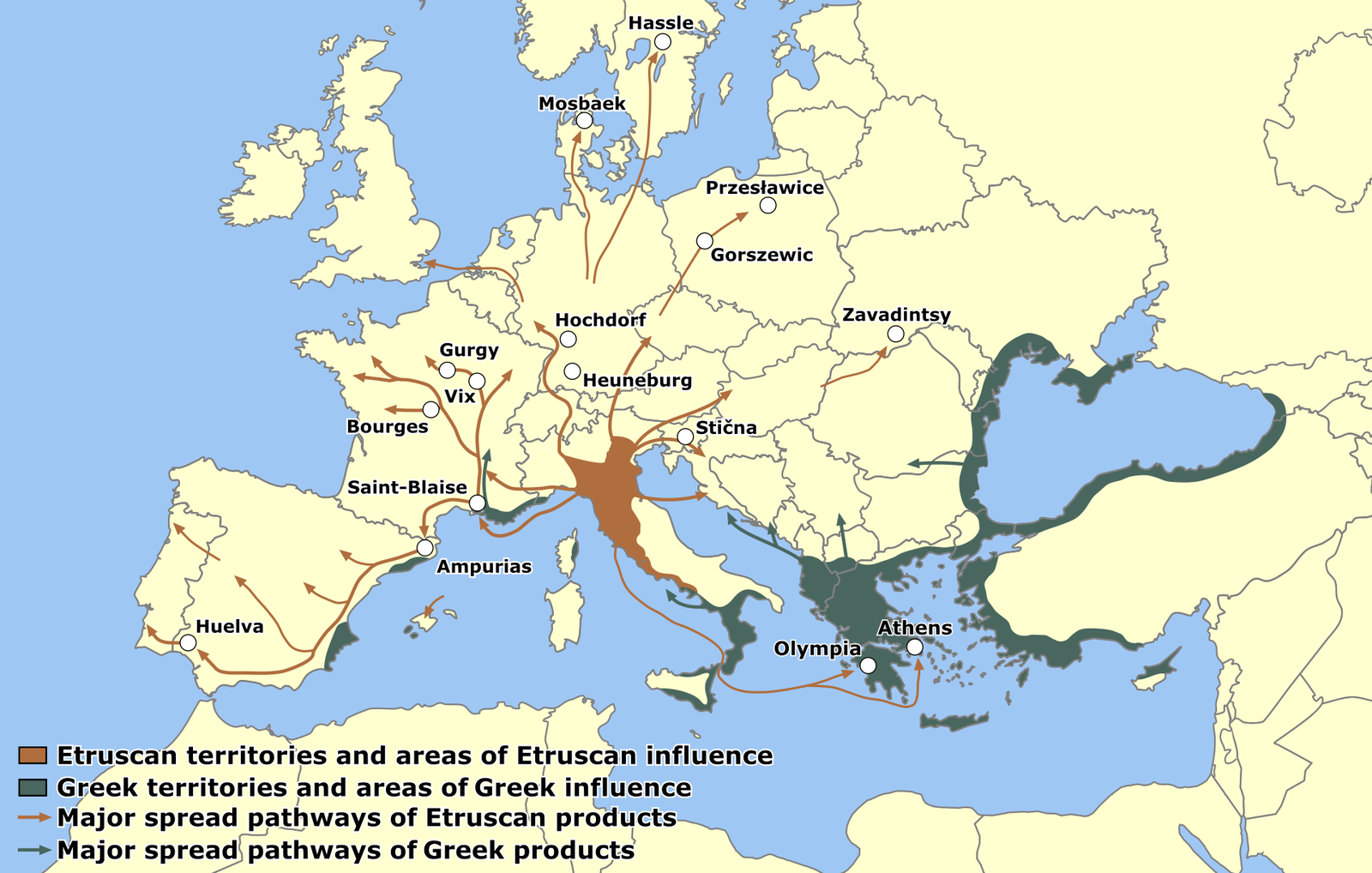 Etruscan territories and major spread pathways of Etruscan products. Source: Wikimedia Commonsꜛ (license: CC BY-SA 4.0).
The Etruscan objects in the exhibition cover a long period, from the 6th century BCE into the 1st century BCE. They show several important aspects of Etruscan material culture: Painted pottery, bronze vessels, drinking equipment, personal display, and burial practice.
The black figure cups show Etruscan workshops working within a Mediterranean visual language. The one handled cup with cattle and bird frieze stands under eastern Greek influence. The two handled cup with predator groups is related to Pontic vase painting. Both objects show how Etruscan craftsmen used Greek and eastern Greek models while producing objects for local contexts.
 One handled cup with cattle and bird frieze, findspot unknown, Etruscan black figure, under East Greek influence, ca. 530 BCE. Archaeological Museum Frankfurt
The later Etruscan objects are closer to dining, pouring, bodily care, and display. Wine strainers and ladles point to the preparation and serving of wine. The female head vessel and the hammered bronze bottles show the importance of decorated containers in elite settings. The duck askos (a flat bulbous vessel) combines vessel form, animal shape, and painted decoration.
 Painted amphora. Unfortunately, I did not record any further information on this object. Archaeological Museum Frankfurt
The ash chests from Chiusi bring the funerary context into focus. The ash chest of the freedwoman Hasti Velthuria preserves social identity through inscription and burial form. The chest with a Gorgoneion uses a protective image that was well suited to a funerary context. These objects show how Etruscan burial culture combined cremation, image, inscription, mythological motifs, and social memory.
 Two handled cup, obverse and reverse: Group of predators, findspot unknown, Etruscan black figure, related to Pontic vases; last third of the 6th century BCE. Archaeological Museum Frankfurt
 Duck askos, with rich red figure painting, findspot unknown, Etruscan, Chiusi; advanced 4th century BCE. Archaeological Museum Frankfurt
 Wine strainers and wine ladles, findspot unknown, Etruscan; 5th and 4th centuries BCE. Archaeological Museum Frankfurt
 Vessel in the form of a female head, findspot unknown, Etruscan; 3rd century BCE. Archaeological Museum Frankfurt
 Two hammered bronze flasks with chased ornamental bands, from Italy and Tarquinia respectively, Etruscan; 3rd to 2nd century BCE. Archaeological Museum Frankfurt

 Ash chest of the freedwoman Hasti Velthuria, with depiction of the hero fighting with a ploughshare, remains of the cremated bones preserved, findspot unknown, Chiusi; second quarter of the 1st century BCE. Archaeological Museum Frankfurt
 Ash chest with depiction of a Gorgoneion, findspot unknown, Chiusi; first half of the 1st century BCE. Archaeological Museum Frankfurt
Italic warriors, armor, and regional identities
Before Roman expansion unified the peninsula politically, ancient Italy consisted of many different peoples, cities, and regional cultures. Etruscans, Latins, Umbrians, Samnites, Apulians, Campanians, Greeks in southern Italy, and other groups lived in close contact, but they did not form one cultural unit. Weapons, armor, warrior figures, and military equipment therefore also belong to regional identities, not only to warfare.
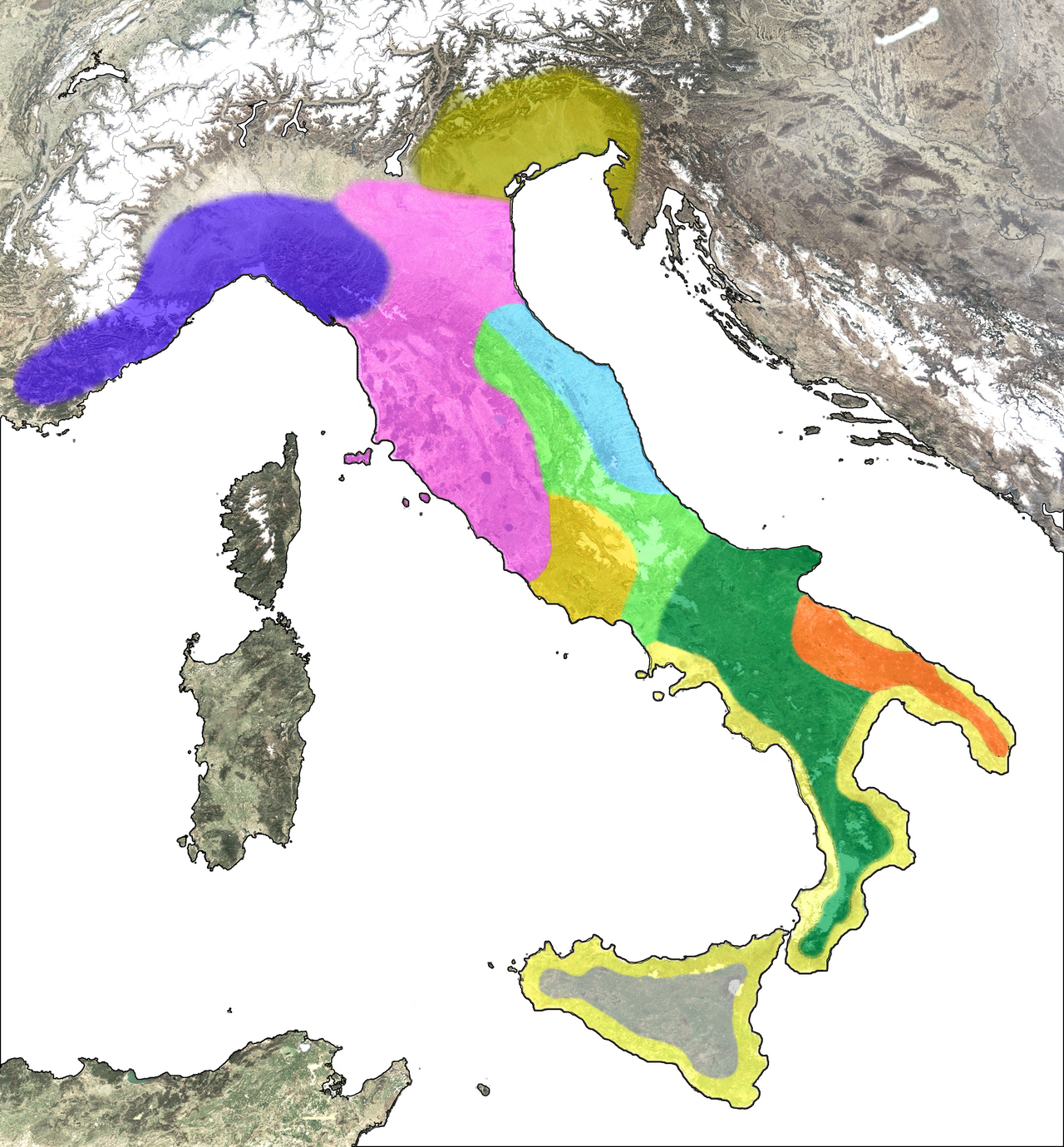 Peoples of the Apennine Peninsula at the beginning of the Iron Age. Blue: Ligurians; Ochre: Veneti; Magenta: Etruscans; Cyan: Piceni; Light-Green: Umbrians; Brown: Latins; Dark-Green: Osco-Umbrians; Orange: Messapians; Yellow: West-Greeks. Source: Wikimedia Commonsꜛ (license: CC BY-SA 3.0).
The warrior figures and armor elements in the exhibition point to this diversity. They show traditions in Umbria, Apulia, and central Italy, where weapons and martial imagery were part of status, ritual, and social identity.
The exhibited terracotta rider from Canosa belongs to southern Italy. Although the lance and horse are lost, the rider in helmet and armor still conveys a clear martial identity. Canosan terracottas are often connected with funerary contexts, so the object should be read not only as a military image, but also as part of elite representation.
 Terracotta statuette, rider in helmet and armor, lance and horse lost, findspot unknown, Canosan; 3rd century BCE. Archaeological Museum Frankfurt
The Umbrian bronze warrior statuettes and the cardiophylakes show armed male bodies and protective equipment in small scale form. A cardiophylax protected the chest, but in a display case it also becomes evidence for how armor could serve as a visible marker of rank and regional identity.
 Two bronze statuettes: armed warriors, findspots unknown, Umbrian; ca. 520 to 470 BCE. Above: two so called cardiophylakes, chest armor, findspots unknown, central Italy, Umbria (?); 6th/5th century BCE. Archaeological Museum Frankfurt
The two gutti from Apulia add a more practical vessel type. A guttus was used for controlled pouring. The example with a lion head spout shows how use and ornament could be combined even in a functional object.
 Two gutti, one of them with a lion head spout, findspots unknown, South Italian, probably Apulian; first half of the 4th century BCE. Archaeological Museum Frankfurt
Terracotta figurines and small scale representation
Terracotta figurines formed an important part of ancient material culture across the Greek, Etruscan, and South Italian world. They were inexpensive compared with bronze or marble, could be produced in molds, and circulated widely in domestic, votive, funerary, and sanctuary contexts. Their subjects often include women, children, riders, animals, deities, mythological figures, actors, and masks.
 Display case with terracotta figurines, including female figures, heads, seated figures, and a winged figure. Archaeological Museum Frankfurt.
The two display cases in the exhibition show this small scale world particularly well. The figures are portable and repeatable images rather than monumental cult statues. They bring ancient representation closer to everyday practice, devotion, burial customs, and household display. Female figures, seated women, heads, riders, and winged figures such as Eros point to the same visual world that also appears on South Italian pottery: body, status, beauty, myth, theater, and funerary symbolism.
 Display case with terracotta figurines, including standing female figures, small riders or animal figures, heads, and architectural or mask-like fragments. Archaeological Museum Frankfurt.
These objects also show why terracotta was such an important medium. It allowed ancient workshops to reproduce recognizable figure types in large numbers, while still leaving room for local styles, painted details, and variation in gesture or posture.
Attic red figure pottery and the Greek visual language of myth, symposium, and ritual
Attic red figure pottery developed in Athens in the late 6th century BCE and became one of the most important ceramic traditions of the classical Greek world. Athens exported large quantities of painted pottery across the Mediterranean, including to Etruria and southern Italy. These vessels were therefore not only Athenian products. They also became part of non Greek contexts of drinking, burial, collecting, and display.
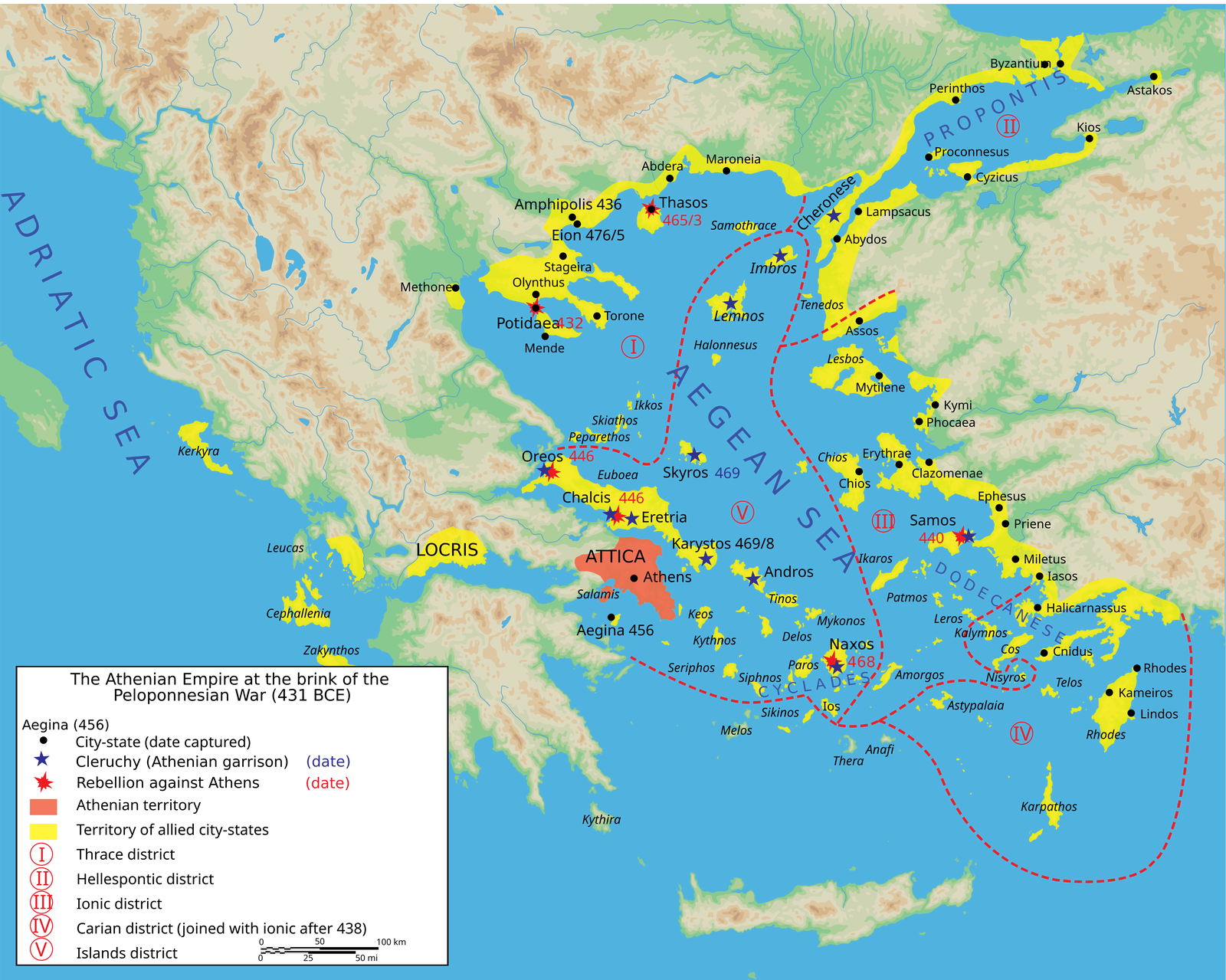 Delian League, under the leadership of Athens before the Peloponnesian War in 431 BC. Attica is shown in red. Source: Wikimedia Commonsꜛ (license: CC BY-SA 2.5).
The Attic red figure vessels in the exhibition show Greek vase painting of the late 6th and 5th centuries BCE. Their presence in Frankfurt’s collection reflects both Greek production and Mediterranean circulation.
The bowl with the dancing reveler belongs to the early period of red figure technique. Red figure painting allowed more flexible internal drawing than black figure painting, especially for bodies, gestures, clothing, and movement. The dancing drinker belongs to the world of wine, performance, and the symposium.
 Bowl. In the tondo: Dancing reveler, from Santa Maria Capua Vetere; formerly Bourguignon Collection, Attic red figure, Bowdoin Eye Painter; ca. 520 BCE. Archaeological Museum Frankfurt
The lekythos with Eos pursuing Tithonos introduces mythological subject matter. The stamnos with men and youths conversing, the owl skyphos, the krug, and the kraters show other parts of Greek social and ritual life. They point to conversation, drinking, sacrifice, youth, music, and public religious practice.
 Lekythos, Eos pursuing Tithonos. Findspot unknown, Attic red figure, Painter of the Paris Gigantomachy; ca. 490/80 BCE. Loan from the Museum für Kunsthandwerk. Archaeological Museum Frankfurt
The kraters are especially useful because their function and imagery belong together. A krater was used to mix wine and water. The kolonette krater with a banquet and flute player shows the social setting of wine drinking. The bell krater with a sacrifice to Apollo places ritual action at the center. These vessels are therefore both objects of use and carriers of imagery.
 Stamnos. Obverse and reverse: men and youths conversing, from Pozzuoli; formerly Haeberlin Collection, Attic red figure, Syriskos Painter or Copenhagen Painter; ca. 480/70 BCE. Archaeological Museum Frankfurt
 Owl skyphos, findspot unknown, Attic red figure, first half of the 5th century BCE. Archaeological Museum Frankfurt
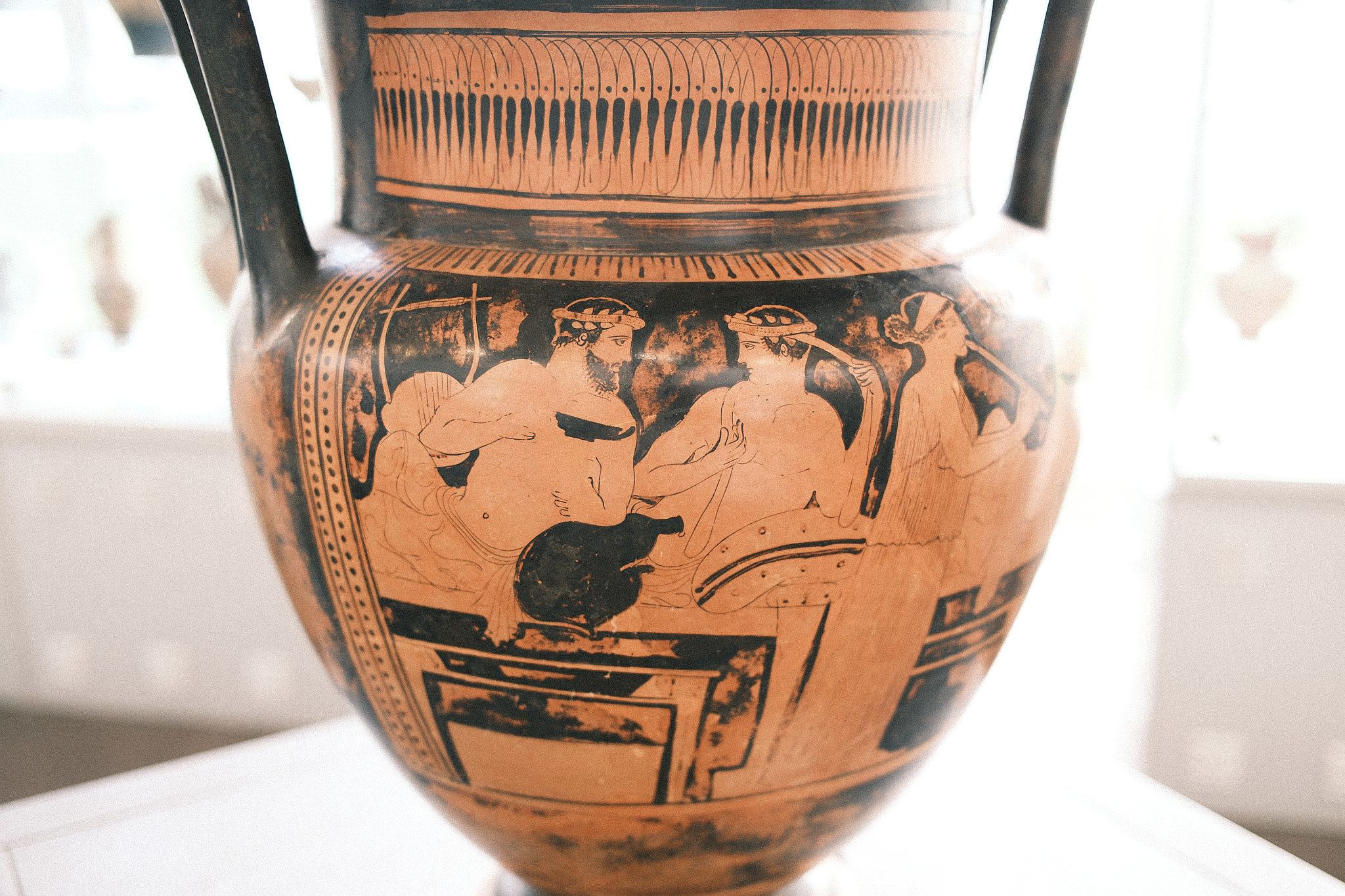 Column krater. Obverse: banquet with flute player, reverse: young men conversing. Misfired, findspot unknown, Attic red figure, Hephaistos Painter; 450/40 BCE. Archaeological Museum Frankfurt
 Jug, Attic red figure, Camucia Painter, ca. 460/50 BCE. Archaeological Museum Frankfurt
 Column krater. Obverse: banquet with flute player, reverse: young men conversing. Misfired, findspot unknown, Attic red figure, Hephaistos Painter; 450/40 BCE. Archaeological Museum Frankfurt
 Bell krater. Obverse: sacrifice to Apollo, reverse: three mantle youths; allegedly from Nola; formerly Haeberlin Collection, Attic red figure, Hephaistos Painter; ca. 450/40 BCE. Archaeological Museum Frankfurt
South Italian red figure pottery: Apulia, Campania, Paestum, and theatrical imagery
Southern Italy and Sicily had been part of the Greek colonial world since the 8th century BCE. Greek cities such as Taras, Sybaris, Kroton, Syracuse, and many others created a strongly Greek cultural zone in the central Mediterranean, but this world always stood in contact with Italic populations. By the 4th century BCE, local workshops in Apulia, Campania, Paestum, Lucania, and Sicily produced their own red figure pottery.
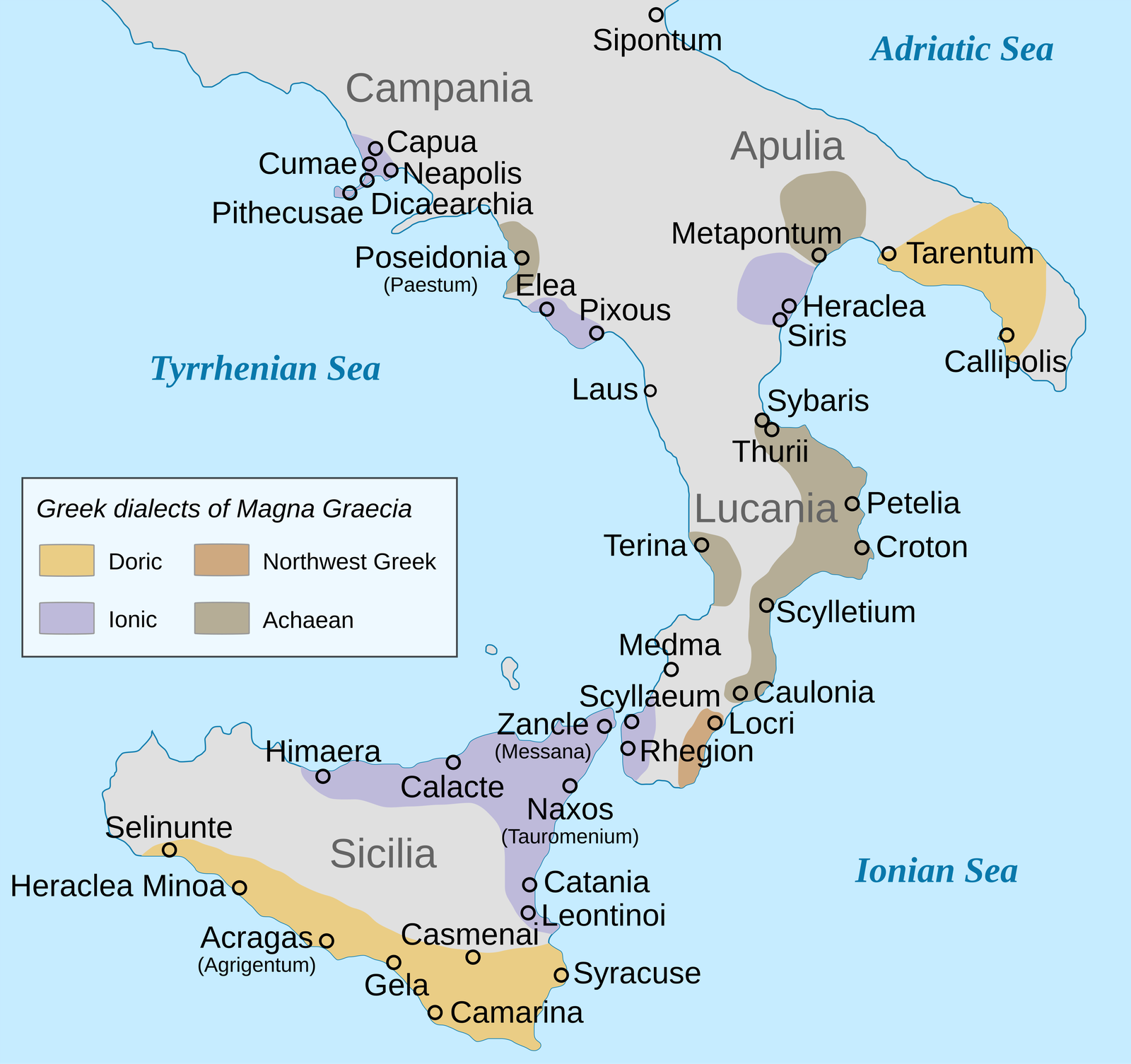 Ancient Greek colonies and their dialect groupings in Magna Graecia. Source: Wikimedia Commonsꜛ (license: public domain).
The South Italian red figure vessels in the exhibition come from this historical setting. They do not simply continue Attic vase painting. They develop regional styles, themes, and workshop traditions, especially in relation to funerary display, mythological imagery, women, Eros, Dionysian motifs, and theater.
The Apulian objects show a strong interest in female heads, Eros, ornament, luxury, and funerary symbolism. The pilgrim flask, the lekanis lid, the bowl with Eros, and the kantharos with a seated woman and Eros belong to a visual world in which beauty, desire, status, and burial culture overlap. These motifs are decorative, but not only decorative. They belong to a social language of display and transition.
 So called pilgrim flask, obverse and reverse each with a female head, perhaps Aphrodite, findspot unknown, late Apulian, circle of the Stoke on Trent Painter, Painter of the Macinagrossa Stand; ca. 320/10 BCE. Archaeological Museum Frankfurt
The Campanian lekythos with Menelaos, Helen, and Aphrodite brings mythological drama into the section. The scene refers to the power of Aphrodite over heroic violence and human intention. The Paestan bowl with Eros and possibly Dionysos adds a Dionysian theme, which is common in South Italian vase painting and often connected with wine, theater, transformation, and funerary expectation.
 Lekythos, Menelaos threatens Helen and is overcome by Aphrodite. Findspot unknown, Campanian, Capua, Aigisthos Group, Spotted Rock Group, circle of the Cassandra Painter; third quarter of the 4th century BCE. Archaeological Museum Frankfurt
The Campanian bell krater with a phlyax and flute player is especially interesting because it points to comic performance in southern Italy. It shows that vase painting can preserve traces of theater and staged performance, not only myth and ritual.
 Bell krater. Obverse: phlyax and flute player, reverse: two mantle youths. Findspot unknown; Donner and von Richter estate, Campanian, probably Capua, AV II, Libation Painter; ca. 340/20 BCE. Archaeological Museum Frankfurt
 Lid of a lekanis, two female heads between palmettes, inside a female head sketched in outline drawing, findspot unknown, late Apulian, successor of the Patera Painter and Baltimore Painter, Frontal Head Group; end of the 4th century BCE. Archaeological Museum Frankfurt
 Bowl. In the tondo: floating Eros, outside: seated Eros or richly adorned female head. Findspot unknown, late Apulian, circle of the Darius Painter and the Patera Ganymede workshop, Group of the Trieste Askoi; ca. 340/20 BCE. Archaeological Museum Frankfurt
 Bowl. In the tondo: Eros and Dionysos (?), in the lower field: quail, outside: laurel branch. Findspot unknown, Paestan, circle of Asteas; third quarter of the 4th century BCE. Archaeological Museum Frankfurt
 Kantharos, obverse: seated woman with box and wreath, reverse: seated Eros with box. Findspot unknown, late Apulian, workshop of the Baltimore Painter; fourth quarter of the 4th century BCE. Archaeological Museum Frankfurt
Ancient Iran: Bronzes, animal symbolism, weapons, and horse gear
Luristan lies in the western Iranian highlands, in a region that connected Mesopotamia, the Iranian plateau, and the Zagros mountain zone. The bronze objects usually grouped under the term Luristan bronzes belong mainly to the late 2nd and early 1st millennium BCE. Many of them are known from burial contexts, although the exact archaeological provenance of older collection pieces is often uncertain. They reflect a world of metalworking, mounted elites, animal symbolism, weapons, and grave goods.
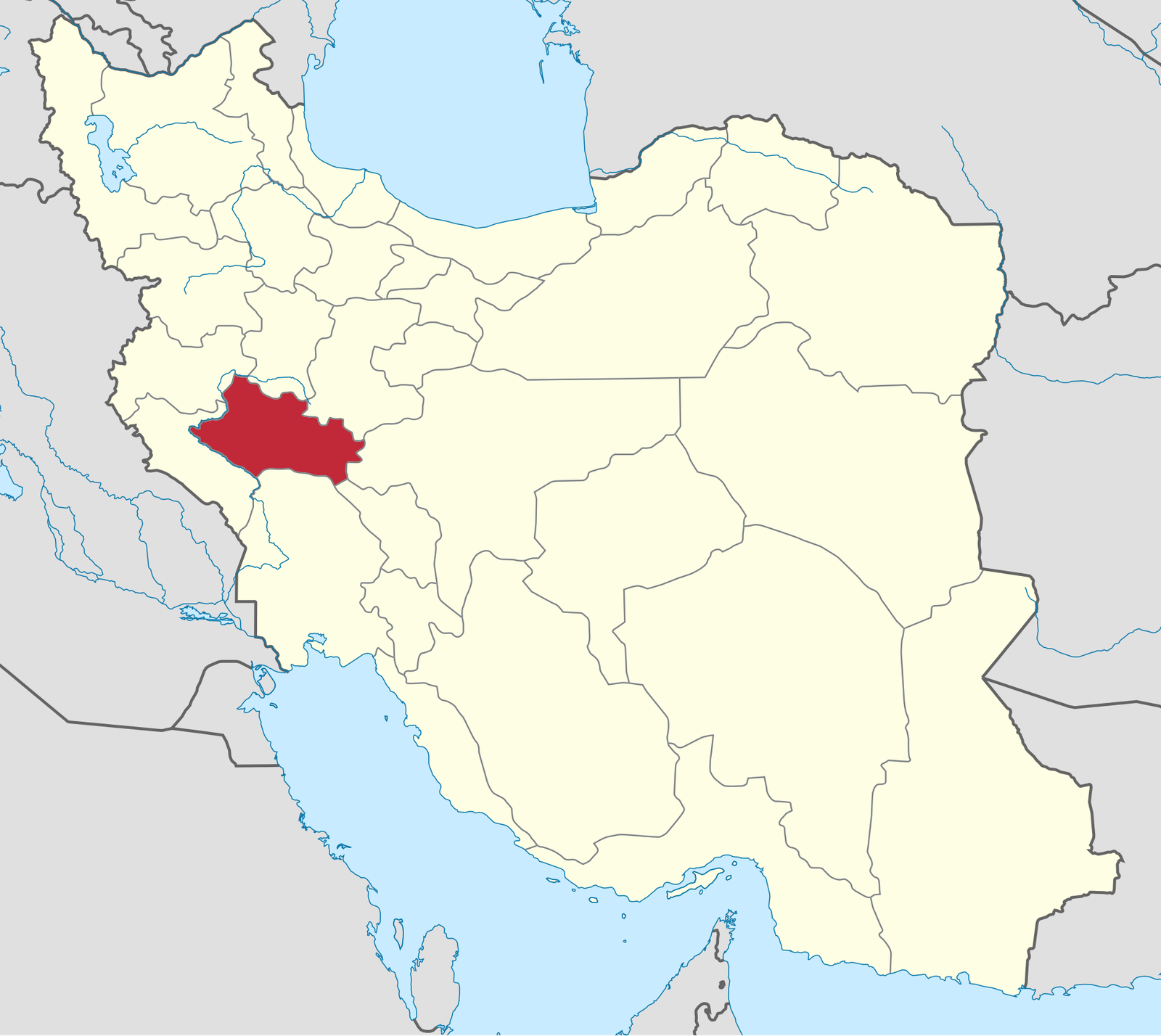 Today’s location of the Iranian province of Lorestan, where many Luristan bronzes were found. Source: Wikimedia Commonsꜛ (license: CC BY-SA 3.0).
The Iranian bronze objects in the exhibition shift the perspective away from the Mediterranean. They include standards, weapons, horse gear, bracelets, animal figures, vessels, and fittings. This material shows that western Iran had its own highly developed object traditions, while also participating in wider Near Eastern motifs and technologies.
The standards are the most striking objects in this part of the exhibition. Their exact meaning remains uncertain, but they were used as grave goods and were mounted on narrow or bell shaped stands. Many show animals, human figures, or the motif of a figure mastering wild beasts. This motif was known in Mesopotamia since the late 4th millennium BCE, but Luristan bronzes gave it a distinctive local form.
 Standards. The so called standards are among the typical Luristan bronzes. The older standards show two or three animals facing one another, such as ibexes, big cats, and similar animals. The later examples are worked in the form of a man stylized into the shaft, grasping two predators by the neck with his hands. At the lower end, the hindquarters of the predators are visible, while their bodies merge with the shaft. Additional faces and rooster heads may also be attached. The meaning of these standards remains completely uncertain. It is certain only that such objects were used as grave goods and that they were mounted on narrow high or bell shaped stands. The depicted motif of the “master of wild animals” was known in Mesopotamia since the end of the 4th millennium BCE and was represented in Luristan in a form not previously produced. The motif also recurs on disk headed pins and cheek pieces. Standard upper right: ca. 900 BCE. All others: 9th/8th century BCE. Lower right: two standard bases. Archaeological Museum Frankfurt
Animal imagery appears throughout the section. Deer figures, goat pendants, bird shaped vessels, bat shaped vessels or lamps, and rhyta in the form of cattle or horses show how animals were used as symbolic forms. These objects are not simple representations of animals. They transform vessels, fittings, and ornaments into animal bodies.
 Two bronze deer figures, “Amlash”, around 1000 BCE. Archaeological Museum Frankfurt
The horse gear points to mounted elites and the social value of horses. Bits, cheek pieces, rein rings, and bells were practical equipment, but their animal and figure decoration also made them visible status objects. Weapons such as full grip swords and bronze daggers add another dimension. Some dagger types connect Luristan with Mesopotamian weapon traditions and show that western Iran was part of wider technological and cultural networks.
 Horse gear. The equipment of the horse includes bits, rein rings, and bells. Bits with cheek pieces in the form of animals and figure groups are especially characteristic. Such bits are so far known only from the region of Pish i Kuh and are dated to the 8th and 7th centuries BCE. Bits and bit parts; rein ring; hanging: basket bells; bronze, Luristan, beginning of the 1st millennium to 8th/7th century BCE. Archaeological Museum Frankfurt
 Fork with two long prongs, bronze, Luristan, beginning of the 1st millennium BCE. Archaeological Museum Frankfurt
 Bronze ladle and two bronze cups, Luristan, first quarter of the 1st millennium BCE. Archaeological Museum Frankfurt
 Pendant in the form of a goat, bronze, Luristan, beginning of the 1st millennium BCE. Archaeological Museum Frankfurt
 Bracelets and bracelet fragments with figurally decorated terminals, bronze; iron, Luristan, 11th to 7th century BCE. Archaeological Museum Frankfurt
 Full grip swords from northern Iran, left: Amlash; right: Mazandaran, end of the 2nd millennium BCE. Archaeological Museum Frankfurt
 Bronze daggers. The dagger types exhibited here were known not only in Luristan, but also in Mesopotamia. The laurel leaf dagger, far right, is a typical weapon of the Early Dynastic III period in Mesopotamia, 2600 to 2350 BCE. The flange hilt daggers, center, can be dated well through comparable examples inscribed with the names of Mesopotamian rulers. The dagger on the left, for example, corresponds to an example of King Ninurta nadin šumi, who ruled in Babylonia in the second half of the 12th century BCE. The fan hilt dagger, whose stone inlays are still preserved, is dated to the same period. Somewhat later, by contrast, is the second fan hilt dagger, whose hilt decoration is already worked in one piece. Archaeological Museum Frankfurt
 Handle with feline figure, bronze, “Hasanlu”, 9th to 8th century BCE. Archaeological Museum Frankfurt
 Gold ornament disk with depiction of a male head. Findspot unknown, northeastern Iran, Marlik culture; late 2nd millennium/early 1st millennium BCE. Archaeological Museum Frankfurt
Painted ceramics and regional traditions of western and northern Iran
The Iranian ceramic objects cover a much longer period than the classical Mediterranean material. They range from the 4th millennium BCE to the 1st millennium BCE and come from regions such as Tepe Sialk, Giyan, Nihavand, Amlash, Luristan, Gilan, Mazandaran, Urmia, and northwestern Iran. These regions were not one uniform culture. They represent different local traditions within the broader Iranian highlands and adjacent zones.
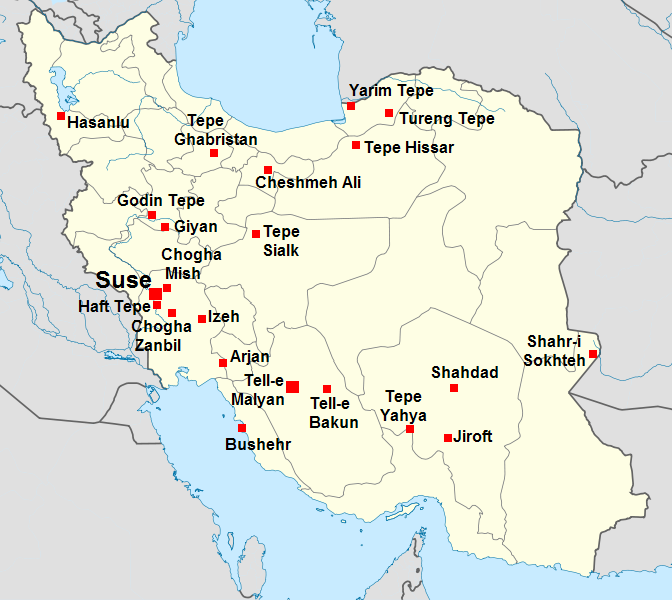 Map showing archaeological sites in Iran.. Source: Wikimedia Commonsꜛ (license: CC BY-SA 3.0).
The earliest vessels belong to the Sialk horizon. Tepe Sialk, near Kashan, is one of the important archaeological sites for prehistoric and early historic Iran. The vessels from Sialk II and Sialk III show painted ceramic traditions around 4000 BCE and the late 4th millennium BCE. They belong to a world of early settlement, craft production, and geometric decoration long before the historical cultures of classical antiquity.
The material from Giyan, Sialk V, and Luristan shifts the chronology into the 2nd and early 1st millennium BCE. These vessels show later regional developments in painted pottery, vessel shape, and ceramic decoration. The broad painted pot, the painted jug, and the group of spouted vessels show that western Iran cannot be reduced to bronze objects alone. Ceramic forms were equally important for storage, pouring, burial, and display.
 Vessels from the period of Giyan II, “Nihavand”, middle of the 2nd millennium BCE. Archaeological Museum Frankfurt
Several objects use animal shaped forms. The bird shaped spouted jug, the jug with bird head stylization, the bovine rhyton, the horse or rider rhyton, and the camel figure turn animals into vessels or small sculptural objects. This creates a close connection between use, image, and symbolic form.
 Bird shaped spouted jug, “Amlash”, around 1000 BCE. Archaeological Museum Frankfurt
The northwestern Iranian material adds another regional perspective. The Urmia culture pot with painted triangles, animals, and human figures, the painted jug from northern or western Azerbaijan, the triangle ware bowl, the double vessel, and the bat shaped bowl or lamp show a strong interest in geometry, compact symbolic fields, and unusual vessel shapes.
 Left: bulbous pot painted with hatched triangles and inserted animal and human figures, findspot unknown, Urmia culture; ca. 1900 to 1550 BCE. Right: painted jug, northern or western Azerbaijan, second half of the 2nd millennium BCE. Archaeological Museum Frankfurt


Vessels from the period of Sialk III, “Tepe Sialk”, end of the 4th millennium BCE. Archaeological Museum Frankfurt
 Left: large chalice, area of Tehran, beginning of the 4th millennium BCE, period of Sialk III, 2. Right: bowl on a high foot from Ismailabad near Tehran, around 4000 BCE, period of Sialk II. Archaeological Museum Frankfurt
 Broad painted pot, “Luristan”, end of the 2nd millennium BCE. Archaeological Museum Frankfurt
 Painted jug from the period of Giyan I and Sialk VI, “Luristan”, beginning of the 1st millennium BCE. Archaeological Museum Frankfurt
 Spouted jug, pilgrim flask, and three other small vessels from the period of Giyan I, so called Luristan ceramics, 9th to 8th century BCE. The spouted jug and one of the small vessels are permanent loans from the Adolf and Luisa Haeuser Foundation. Archaeological Museum Frankfurt
 Chalice shaped pot on three feet with five image fields: hunting, herding, and agricultural scenes, findspot unknown, northwestern Iran; ca. 1900 to 1500 BCE. Archaeological Museum Frankfurt
 Spouted jug with incised decoration and bird head stylization, Gilan, beginning of the 1st millennium BCE. Archaeological Museum Frankfurt
 Left: rhyton in the form of a bovine, “Mazandaran”, end of the 2nd millennium BCE. Center: camel figure, terracotta, “Amlash”, beginning of the 1st millennium BCE. Right: rhyton in the form of a horse (?) with rider, “Amlash”, beginning of the 1st millennium BCE. Archaeological Museum Frankfurt


Vessels made from two or three individual small flasks, “Amlash”, beginning of the 1st millennium BCE. Archaeological Museum Frankfurt
 Double vessel of triangle ware, northwestern Persia, 5th to 3rd century BCE. Archaeological Museum Frankfurt
 Vessels from the period of Sialk V, Necropolis A, “Ajin Dujin”, end of the 2nd millennium BCE. The flask and the painted bowl may be later, around 1000 BCE. Archaeological Museum Frankfurt
 Bowl of triangle ware, northwestern Persia, 6th to 4th century BCE. Archaeological Museum Frankfurt
 Bowl or lamp (?) in the form of a bat, northwestern Iran; 1st millennium BCE. Archaeological Museum Frankfurt
Achaemenid and western Anatolian objects
The Achaemenid Empire was the first large Persian empire and ruled from the late 6th to the late 4th century BCE. At its height, it connected Iran, Mesopotamia, Anatolia, Egypt, the Levant, and parts of Central Asia within one imperial system. Western Anatolia was one of the important contact zones of this empire, linking Persian imperial structures with Greek cities, local Anatolian traditions, and Mediterranean exchange.
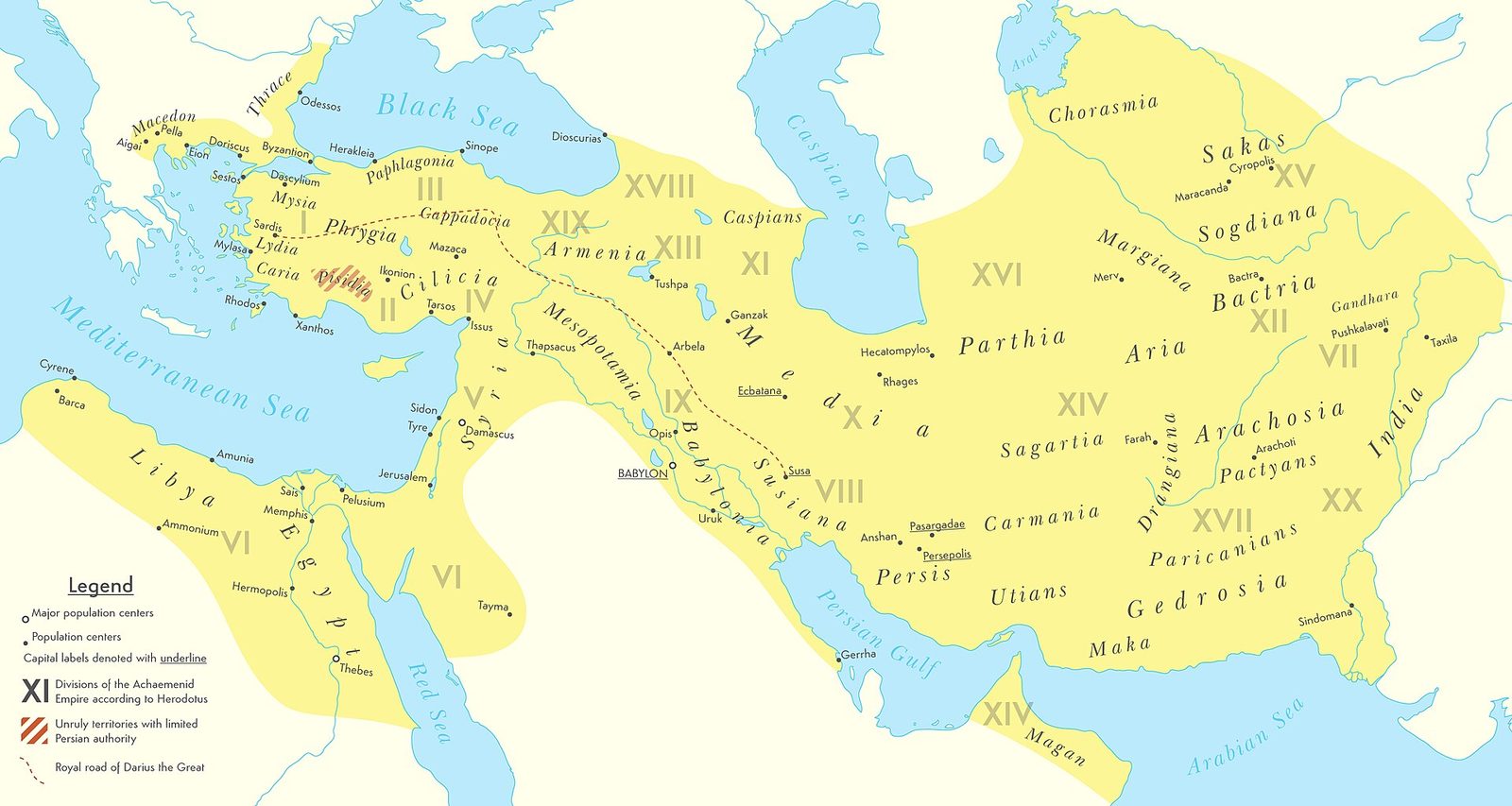 Map of the Achaemenid Empire’s greatest territorial extent, achieved during the reign of Darius the Great (522–486 BCE). Source: Wikimedia Commonsꜛ (license: CC BY-SA 4.0).
The western Anatolian and Achaemenid objects in the exhibition include gold earrings, bronze bowls, and silver bowls with leaf decoration. These objects belong to elite metalwork and bodily display rather than to everyday ceramic use.
Metal vessels and jewelry could move within the Achaemenid world as prestige objects, gifts, possessions, or grave goods. Their value lay not only in their material, but also in their association with rank and cultivated elite taste.

 Bronze bowl, “western Anatolia”, 8th to 6th century BCE. Archaeological Museum Frankfurt
The silver bowls with leaf decoration show a restrained ornamental style. The gold disk earrings show how precious metalwork was used on the body. The bronze bowls from western Anatolia add a more practical vessel form, but still belong to the wider field of elite consumption and display.
 Gold disk earrings, “western Anatolia”, Achaemenid; 5th to 4th century BCE, loan from the A. and L. Haeuser Foundation. Archaeological Museum Frankfurt
 Two bowls with leaf decoration, silver, Achaemenid; 5th/4th century BCE. Archaeological Museum Frankfurt
Conclusion
I really enjoyed the visit to the Archaeological Museum Frankfurt. Its permanent antiquities exhibition shows ancient history not through grand narratives, but through objects of actual daily use: Vessels, weapons, jewelry, horse gear, burial containers, bronze fittings, and ritual or symbolic forms. These objects show how people drank, poured, stored, adorned, armed, buried, remembered, and represented status or belief. By doing so, the distance, that usually separates us from the objects seen in museums, gets reduced. By looking at these objects one can imagine how they were used, how they felt in the hand, and how the people who used them lived. The “subjects” of history books suddenly become real people, who lived in real places and had real experiences. Any conceptually perceived temporal distance gets reduced and brings ancient life for a short moment into the present. Thus, the objects are not just things to look at, but they are traces of human life and practice.
But the exhibition also highlights another aspect: The interconnectedness of the ancient world. The objects show that the Mediterranean and Near Eastern worlds were not isolated. They were connected through trade, migration, and cultural interaction and exchange. This also accounts on smaller scales, such as the connections between ancient Greece, Etruria, and Italy. Corinthian motifs were adapted in Italy. Attic pottery circulated into Etruscan and Italic contexts. South Italian vase painting developed its own regional language. Luristan bronzes combined local forms with wider Near Eastern motifs. Iranian ceramics preserve long regional traditions from the 4th to the 1st millennium BCE.
For me, this made the permanent antiquities exhibition one of the most rewarding parts of the visit. It does not present antiquity as one unified story. It shows several ancient worlds through the material traces of practice, exchange, status, ritual, and death, which all had their own local forms, but were also connected to wider networks of cultural interaction and adaptation.
References and further reading
- Website of the Archäologisches Museum Frankfurtꜛ
- Website of the Archäologisches Museum Frankfurt on Klassische Antikeꜛ
- Website of the Archäologisches Museum Frankfurt on Griechen, Etrusker und Römerꜛ
- Dagmar Stutzinger, Zum Wohle der Stadt? Erwerbungen 1933–1945, 2018, Schnell & Steiner, ISBN: 978-3795433444
- Larissa Bonfante, Etruscan Life and Afterlife: A Handbook of Etruscan Studies, 1986, Wayne State University Press, ISBN: 978-0814318133
- Nancy Thomson de Grummond, Etruscan Myth, Sacred History, and Legend, 2006, ISD International - IPSUK, ISBN: 978-1931707862
- John Boardman, Early Greek Vase Painting: 11th–6th Centuries BC, 1998, Thames & Hudson, ISBN: 978-0500203095
- John Boardman, Athenian Red Figure Vases: The Classical Period, 1989, Thames & Hudson, ISBN: 978-0500202449
- A. D. Trendall, Red Figure Vases of South Italy and Sicily: A Handbook, 1989, Thames & Hudson, ISBN: 978-0500202258
- Oscar White Muscarella, Bronze and Iron: Ancient Near Eastern Artifacts in the Metropolitan Museum of Art, 1988, Metropolitan Museum of Art and Yale University Press, ISBN: 978-0300195651
- John Curtis and Nigel Tallis, Forgotten Empire: The World of Ancient Persia, 2005, British Museum Press, ISBN: 978-0714111575

comments