Blog
Articles about computational science and data science, neuroscience, and open source solutions. Personal stories are filed under Weekend Stories. Browse all topics here. All posts are CC BY-NC-SA licensed unless otherwise stated. Feel free to share, remix, and adapt the content as long as you give appropriate credit and distribute your contributions under the same license.
tags · RSS · Mastodon · simple view · page 18/20
Solving the Lorenz system using Runge-Kutta methods
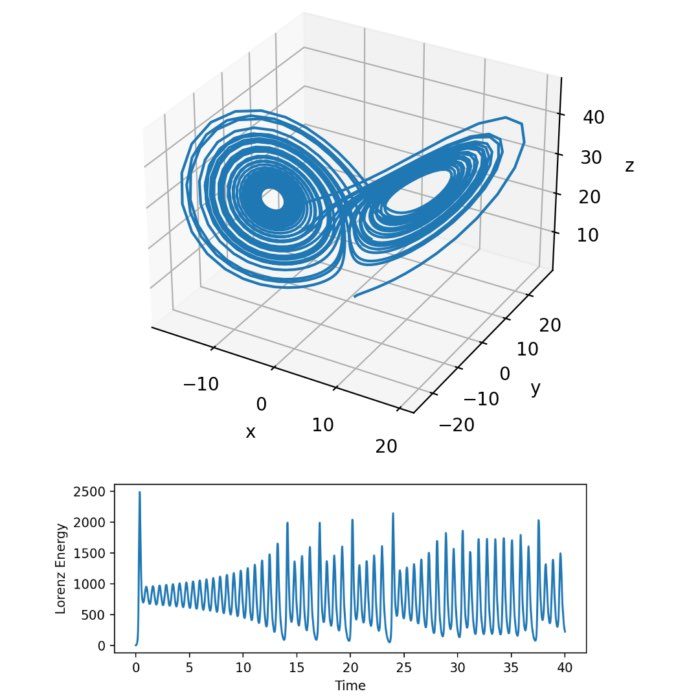
In my previous post, I introduced the Runge-Kutta methods for numerically solving ordinary differential equations (ODEs), that are challenging to solve analytically. In this post, we apply the Runge-Kutta methods to solve the Lorenz system. The Lorenz system is a set of differential equations known for its chaotic behavior and non-linear dynamics. By utilizing the Runge-Kutta methods, we can effectively simulate and analyze the intricate dynamics of this system.
The two-body problem
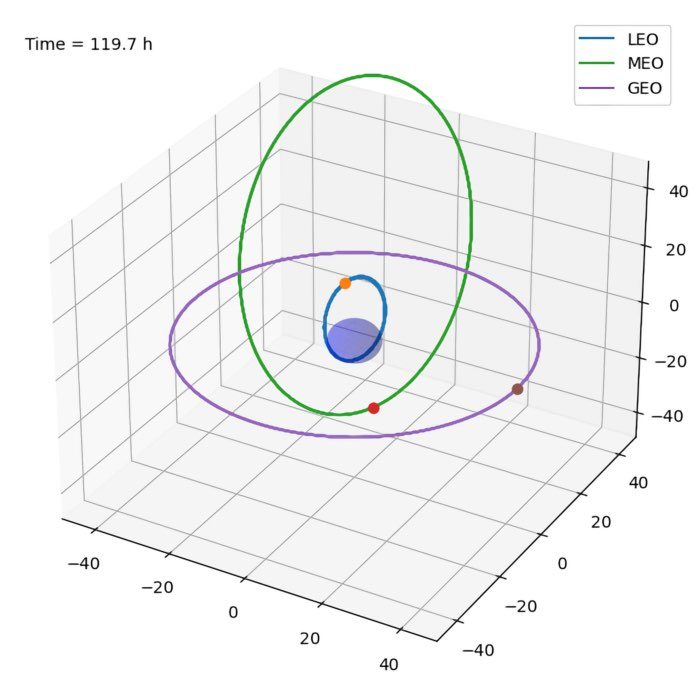
The two-body system is a classical problem in physics. It describes the motion of two massive objects that are influenced by their mutual gravitational attraction. The two-body problem is a special case of the n-body problem, which describes the motion of two objects that are influenced by their mutual gravitational attraction. In this post, we make use of Runge-Kutta methods to solve the according equations of motion and simulate the trajectories of artificial satellites around the Earth.
Runge-Kutta methods for solving ODEs
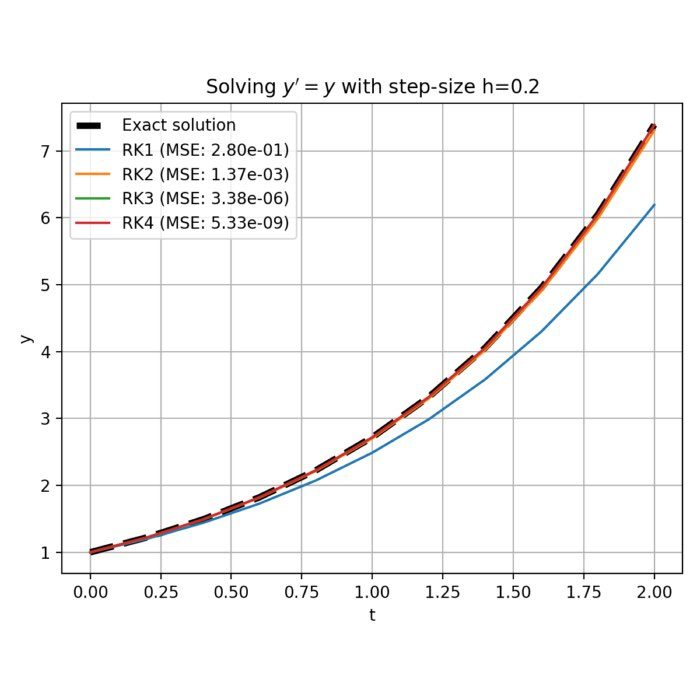
In physics and computational mathematics, numerical methods for solving ordinary differential equations (ODEs) are of central importance. Among these, the family of Runge-Kutta methods stands out due to its versatility and robustness. In this post we compare the first four orders of the Runge-Kutta methods, namely RK1 (Euler’s method), RK2, RK3, and RK4.
A spectral (FFT) Poisson solver for 1D electrostatic PIC
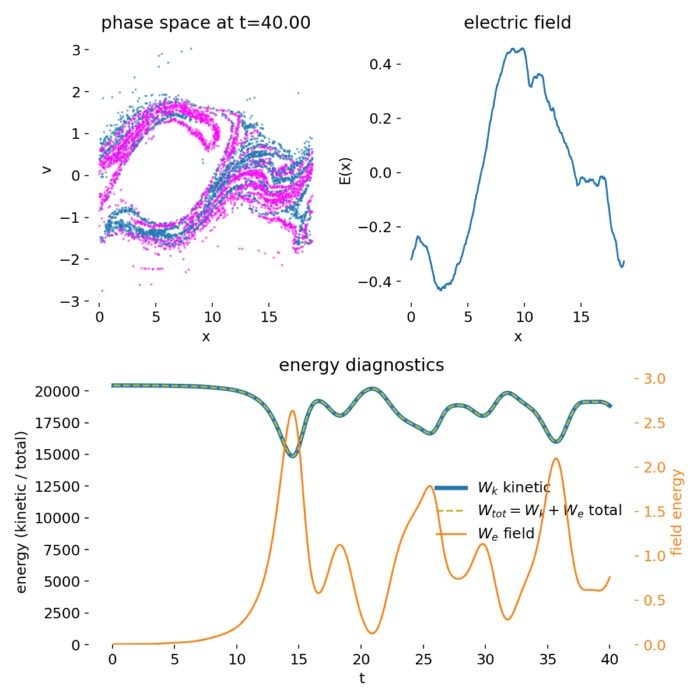
In our previous post on Particle-in-Cell methods, we implemented a minimal 1D electrostatic PIC code using a finite difference Poisson solver. Here, we present an alternative implementation that uses a spectral Poisson solver based on FFTs, highlighting the differences and advantages of this approach.
Particle-in-Cell methods in kinetic plasma simulations
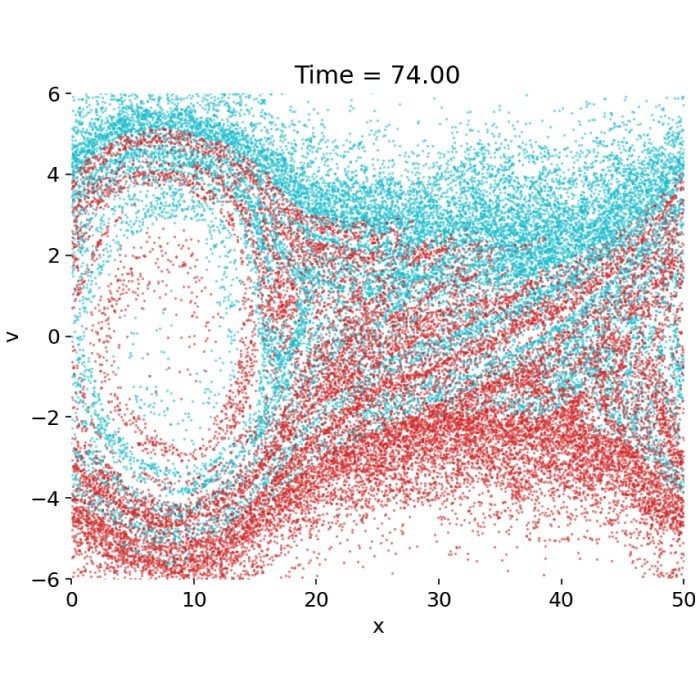
The Particle-in-Cell (PIC) method is a powerful numerical technique for simulating kinetic plasmas by combining particle dynamics with grid-based field solvers. In this post, we explore the fundamental principles of PIC, its mathematical formulation, and its applications in space plasma physics.
Krook collision operator as velocity-space relaxation
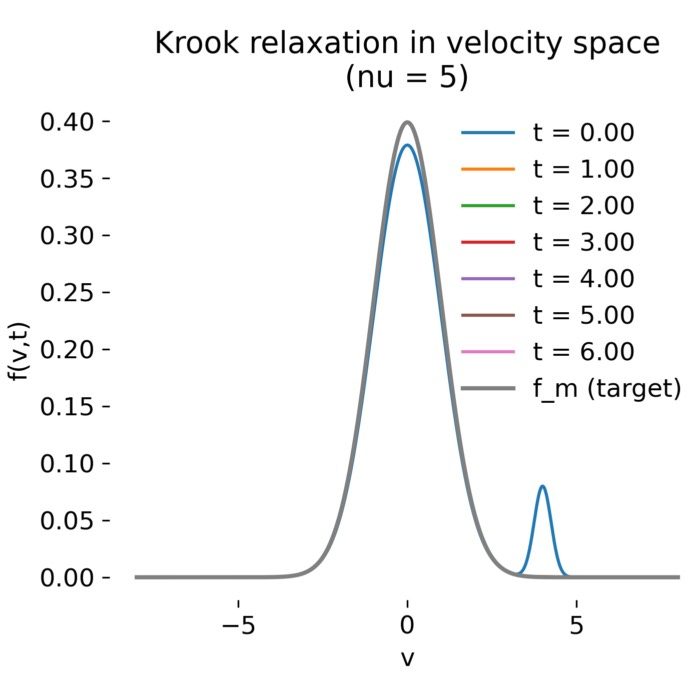
The Krook collision operator provides a minimal model for velocity-space relaxation in kinetic plasma theory. In this post, we explore its properties and physical interpretation.
Kappa versus Maxwell distributions: Suprathermal tails in collisionless plasmas
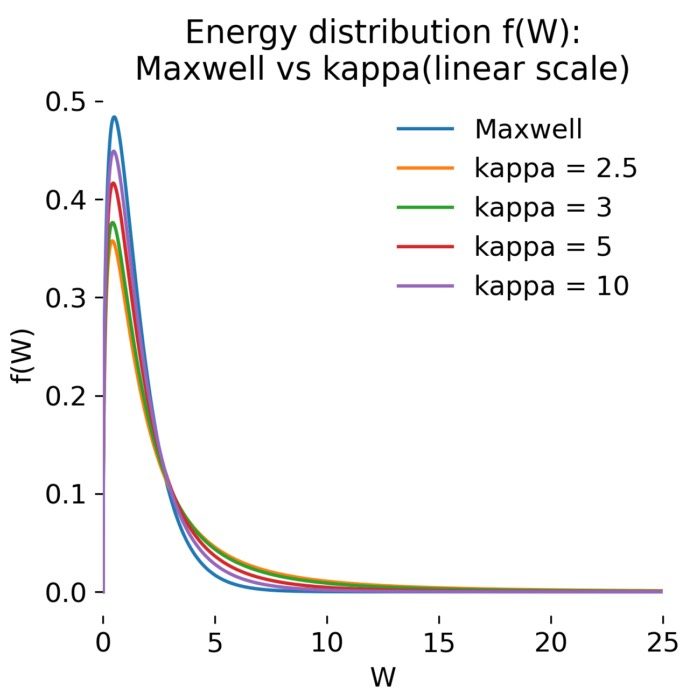
In many space plasmas, particle velocity distributions deviate from the Maxwellian form due to weak collisionality. Kappa distributions, characterized by suprathermal tails, provide a more accurate description of these environments. In this post, we compare Maxwellian and kappa energy distributions, highlighting the emergence of suprathermal populations and their significance in space plasma physics.
Bi-Maxwellian distributions and anisotropic pressure
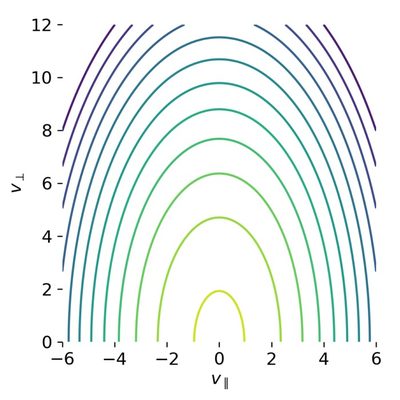
In many space and laboratory plasmas, velocity distributions are anisotropic with respect to the magnetic field direction. This leads to anisotropic pressure components that cannot be captured by fluid models assuming a scalar pressure. In this post, we construct bi-Maxwellian velocity distributions with prescribed temperature anisotropies and demonstrate explicitly how they give rise to anisotropic pressure tensors. The numerical results reproduce known analytic relations while providing an intuitive geometric interpretation in velocity space.
What velocity moments miss: Core plus beam distributions
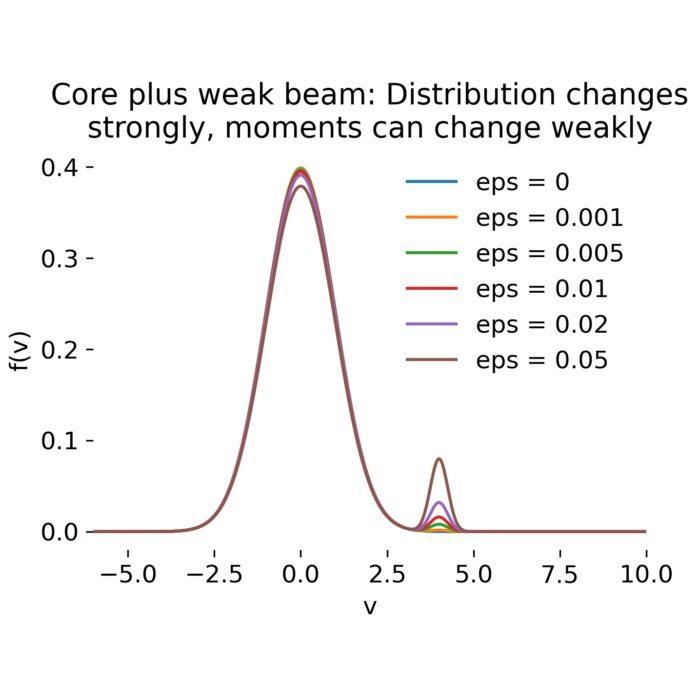
In this post, we explore how different initial velocity distributions lead to qualitatively distinct macroscopic dynamics, illustrating the inherently kinetic nature of these processes.
Vlasov–Poisson dynamics: Landau damping and the two-stream instability
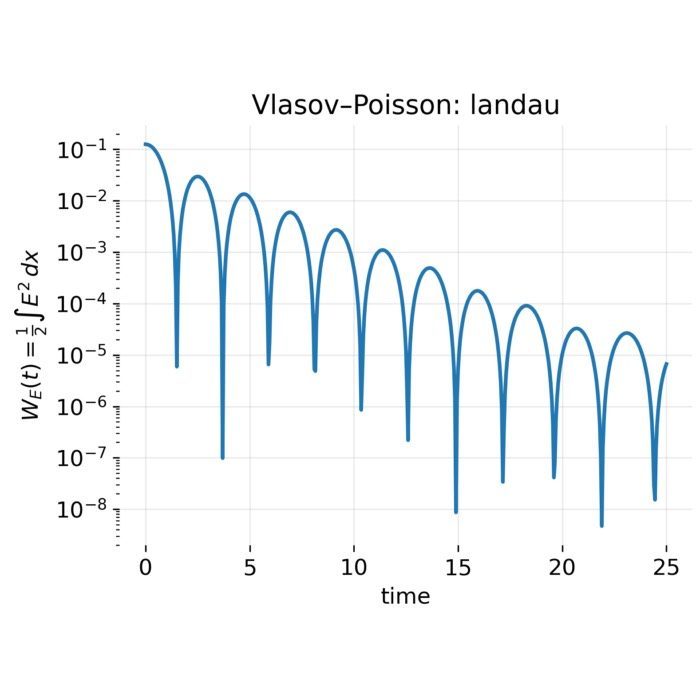
The Vlasov–Poisson system provides a minimal kinetic framework to illustrate fundamental plasma processes such as Landau damping and the two-stream instability. By varying the initial velocity distribution, we explore in this post how these inherently kinetic phenomena arise from the same collisionless equations yet lead to qualitatively different macroscopic dynamics.