Blog
Articles about computational science and data science, neuroscience, and open source solutions. Personal stories are filed under Weekend Stories. Browse all topics here. All posts are CC BY-NC-SA licensed unless otherwise stated. Feel free to share, remix, and adapt the content as long as you give appropriate credit and distribute your contributions under the same license.
tags · RSS · Mastodon · simple view · page 19/20
Kinetic plasma theory: From distribution functions to the Vlasov equation
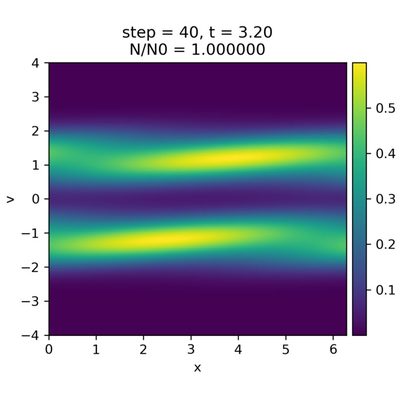
Kinetic plasma theory describes a plasma as an ensemble of particles represented by a distribution function in phase space. This framework captures velocity space structure, non Maxwellian populations, temperature anisotropies, drifts, beams, loss cones, weak collisionality, resonances, and wave particle interactions. In collisionless space plasmas, the Vlasov equation governs the evolution of the distribution function, providing a self consistent description of plasma dynamics beyond fluid models like magnetohydrodynamics (MHD). In this post, we explore the foundations of kinetic plasma theory, starting from the definition of the distribution function and leading to the Vlasov equation.
Plasma instabilities as dynamical departures from equilibrium
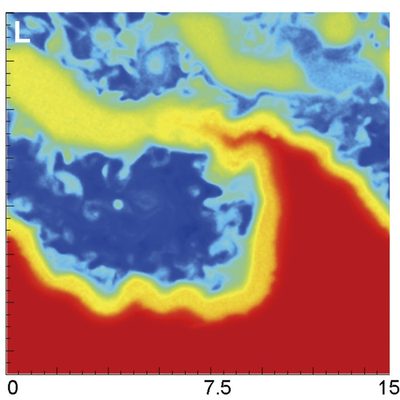
Plasma instabilities mark the transition from passive wave propagation to active energy conversion. While plasma waves describe small amplitude perturbations of a stable equilibrium, instabilities arise when the equilibrium itself is unable to support certain perturbations, leading to exponential growth in time. In mathematical terms, this corresponds to dispersion relations whose solutions acquire a positive imaginary part of the frequency. Physically, instabilities tap free energy stored in gradients, relative flows, or anisotropic particle distributions and convert it into electromagnetic fields and particle motion.
The Alfvén wave as a fundamental mode of magnetized plasmas
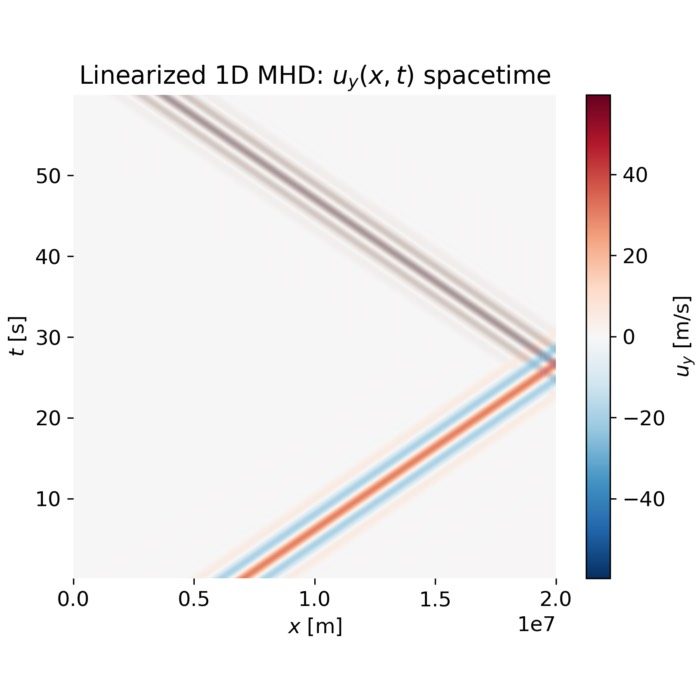
Among all plasma waves, the Alfvén wave occupies a special conceptual position. It is the simplest genuinely magnetized plasma mode, arising directly from the coupling between magnetic field line tension and plasma inertia. At the same time, it provides a concrete and analytically tractable example of how collective plasma dynamics interpolate between fluid and kinetic descriptions. In space plasmas, Alfvén waves dominate large scale fluctuations in the solar wind, control energy transport along magnetic field lines, and form the backbone of magnetosphere ionosphere coupling. In this post, we derive the Alfvén wave from first principles, explore its fundamental properties, and discuss its physical interpretation.
Plasma waves in space plasmas
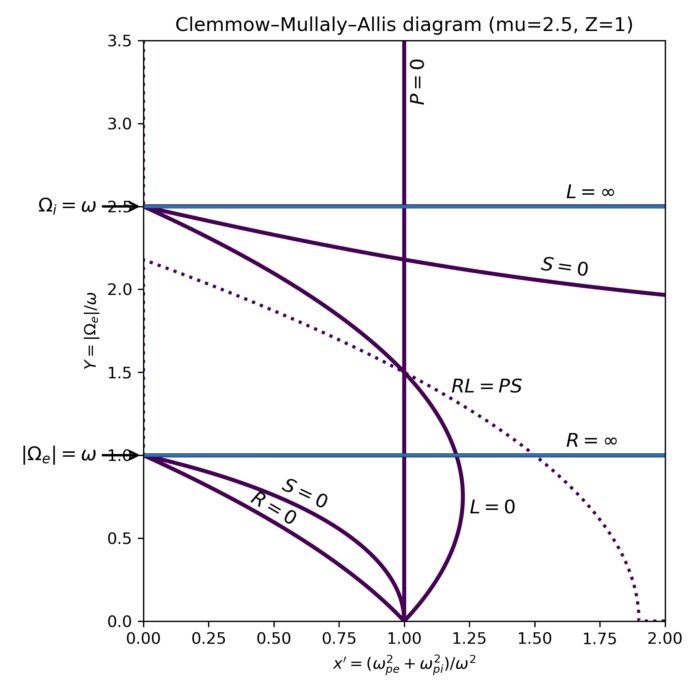
Space plasmas support a rich spectrum of collective wave phenomena that have no direct analogue in neutral fluids. These waves arise from the self consistent coupling between charged particles and electromagnetic fields and therefore occupy a conceptual boundary between fluid descriptions and fully kinetic theory. On sufficiently large spatial and temporal scales, plasma waves can often be understood as perturbations of a conducting fluid governed by magnetohydrodynamics. On smaller scales, or whenever resonant interactions between particles and fields become important, a kinetic description in terms of distribution functions and phase space dynamics is unavoidable. Plasma waves thus provide a natural bridge between macroscopic magnetofluid behavior and microscopic particle physics. In this post, we introduce the fundamental concepts of plasma wave theory, including linear dispersion relations, common wave modes in magnetized plasmas, and the transition from fluid to kinetic descriptions.
Planetary aurorae

Planetary aurorae are luminous phenomena that occur in the upper atmospheres of magnetized planets, resulting from the interaction between energetic charged particles and atmospheric constituents. They serve as visible manifestations of complex plasma processes within planetary magnetospheres, linking solar wind dynamics, magnetospheric circulation, and atmospheric excitation. In this post, we explore their physical origin, mathematical description, and diverse manifestations across the Solar System.
Space Physics: A definitional perspective
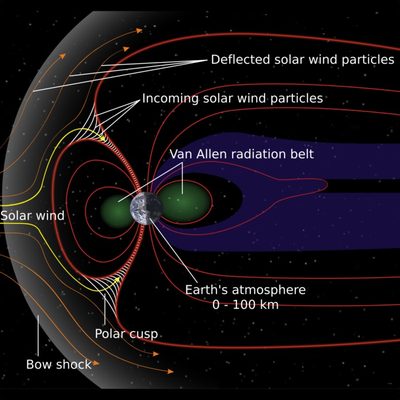
Space physics is more than plasma physics. It is an extension of geophysics into space, applying physical thinking to coupled plasma–field systems around Earth and other planetary bodies. In this post, I outline how my training in space physics shaped my perspective on physical systems more generally.
Magnetic reconnection via X-point collapse
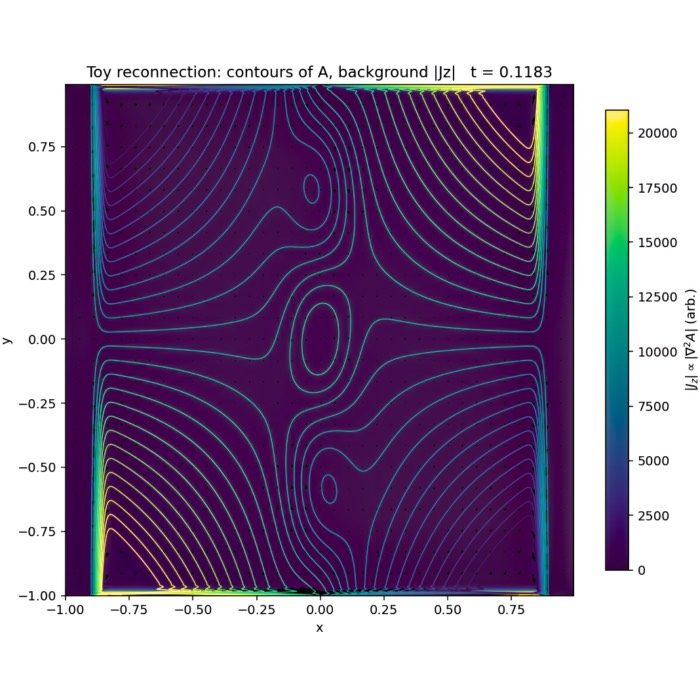
In this post, we explore a complementary toy model of magnetic reconnection based on the collapse of an X-point under a prescribed stagnation flow. This model highlights how different geometries and driving conditions can shape reconnection dynamics, while still governed by the same underlying resistive induction physics.
Magnetic reconnection: Theory and a simple numerical model
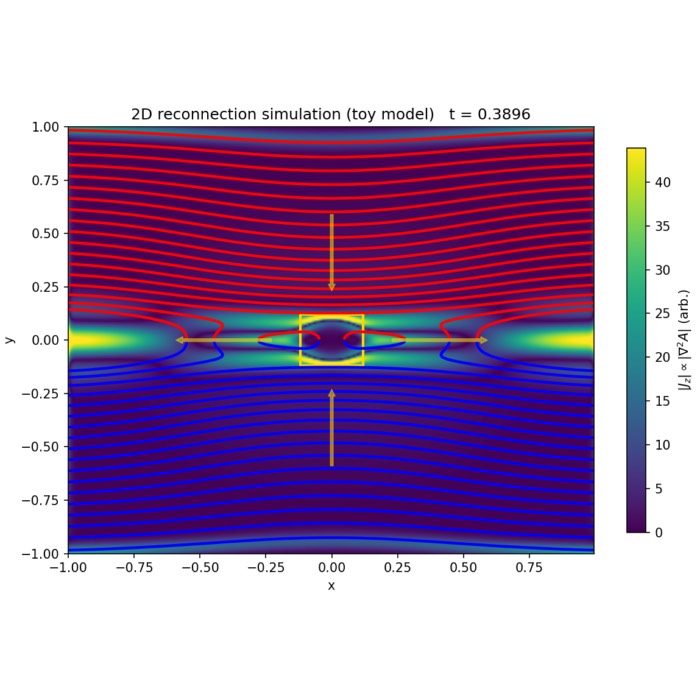
Magnetic reconnection is a fundamental plasma process that changes magnetic field topology and converts magnetic energy into kinetic and thermal energy. It lies between idealized frozen-in behavior and complex plasma dynamics, governing explosive phenomena in space and laboratory plasmas. In this post, we explore the physical principles and apply a simple numerical model to illustrate reconnection dynamics.
The solar wind and the Parker model
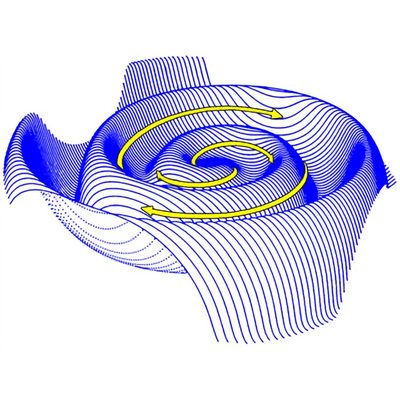
The solar wind is a continuous, supersonic outflow of ionized plasma from the solar corona into interplanetary space. Its existence and basic properties are now observationally well established, yet its theoretical understanding originates from a remarkably simple hydrodynamic argument developed in the late 1950s by Eugene Parker. Parker’s model not only explains why the corona cannot remain static but also predicts the large scale structure of the interplanetary magnetic field, now known as the Parker spiral. In this post, we present a compact introduction to the Parker solar wind model and the resulting spiral geometry of the heliospheric magnetic field. We complete this brief theoretical overview with a simple numerical experiment that simulates the Parker spiral structure with a simple Python code.
Magnetohydrodynamics (MHD): A theoretical overview with a numerical toy example
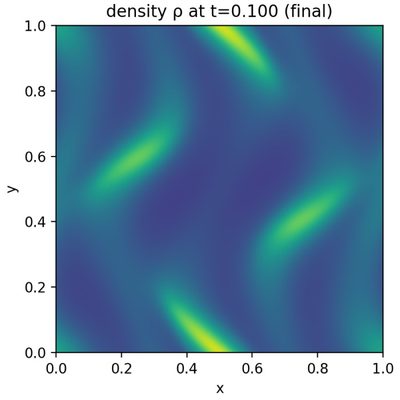
Magnetohydrodynamics (MHD) describes the coupled dynamics of a conducting fluid and electromagnetic fields. In this post, we summarize the standard MHD equations, explain ideal and Hall MHD, discuss key qualitative properties, and present a compact numerical experiment in Python illustrating complex structure arising from MHD nonlinearity.