Borobudur: A Buddhist mandala in stone
Rising out of the Kedu Plain in Central Java, Borobudur stands as one of the most remarkable achievements in Buddhist architecture and religious art. Built in the 8th to 9th centuries CE during the reign of the Sailendra dynasty, the monument emerged within a richly diverse religious landscape shaped by interactions between Mahāyāna Buddhism, Hindu traditions, and local animist practices. Java during this time was a center of political power and cultural production, connected by maritime routes to other prominent Buddhist centers across the Indian Ocean world.
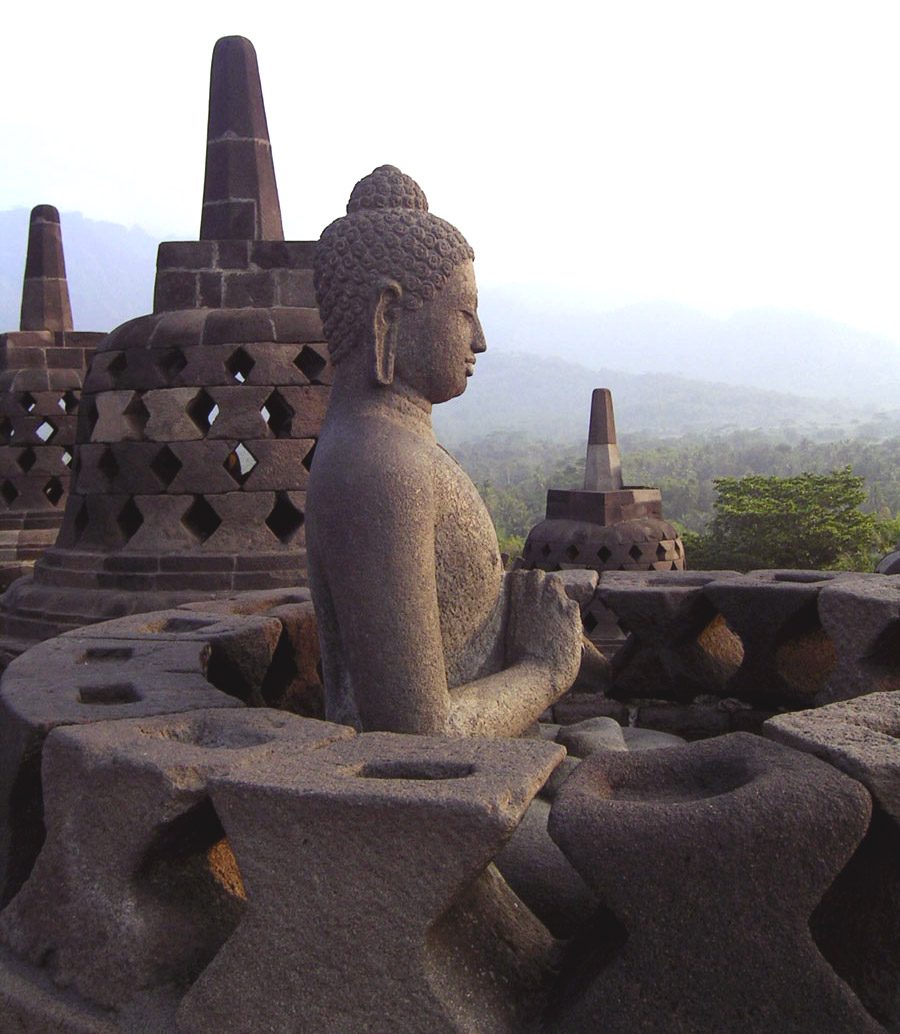
Buddha statue at Borobudur, Indonesia. Borobudur is a 9th-century Mahāyāna Buddhist temple in Magelang, Central Java, Indonesia. It is the world’s largest Buddhist temple and one of the greatest Buddhist monuments in the world. The monument consists of nine stacked platforms, six square and three circular, topped by a central dome. The temple is decorated with 2,672 relief panels and 504 Buddha statues. Source: Wikimedia Commonsꜛ (license: CC BY-SA 3.0).
Borobudur is exceptional not only for its size and complexity but also for its integration of symbolic, artistic, and spatial elements that embody Buddhist cosmology and ritual practice. With over 2,600 relief panels and 500 Buddha statues arranged across its ascending platforms, the monument is a three-dimensional mandala representing the path to awakening. It has drawn scholarly attention from archaeologists, art historians, and religious studies scholars alike for its intricate iconographic program and unique architectural design.
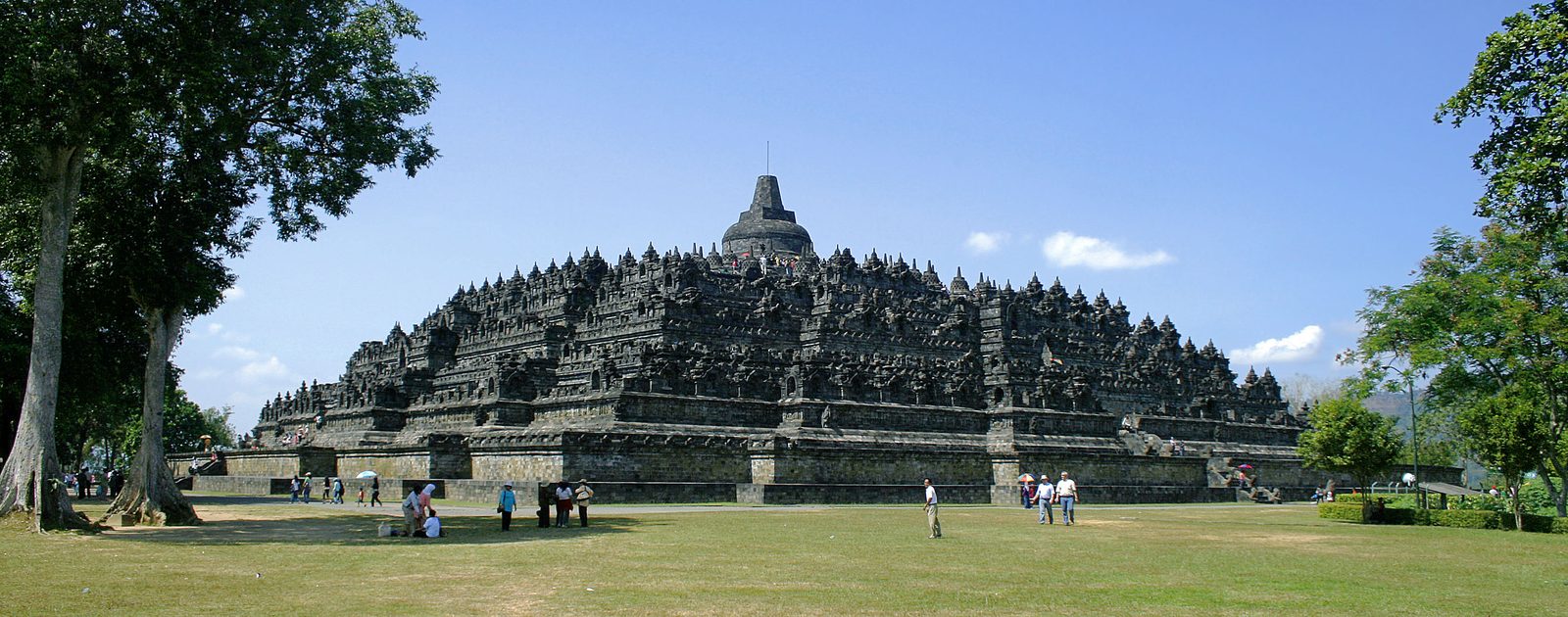
Borobudur viewed from the northwest. Source: Wikimedia Commonsꜛ (license: CC BY-SA 3.0).
In this post, we explore Borobudur’s historical context, architectural symbolism, iconographic programs, ritual use, and transregional connections. Our aim is to situate the monument within the broader network of Buddhist institutions in Southeast Asia and demonstrate its significance as both a sacred site and a testament to the cosmopolitanism of early medieval Java.
Historical background
The construction of Borobudur took place during a period of significant political and cultural transformation in Java. The Sailendra dynasty, which ruled from the late 8th to the early 9th centuries, was instrumental in promoting Mahāyāna Buddhism as a state religion. This period saw the emergence of large-scale temple complexes, reflecting the integration of religious authority with political power.
The sailendra dynasty
The Sailendra dynasty, which ruled parts of Central Java between the 8th and 9th centuries CE, was a powerful maritime-oriented polity that played a key role in the promotion of Mahāyāna Buddhism in Southeast Asia. Although the origins of the Sailendras remain debated — some linking them to Sumatra or even India — their reign coincided with a period of artistic flourishing, regional consolidation, and cultural exchange across the Indonesian archipelago. The dynasty is most closely associated with the construction of Borobudur, as well as other nearby Buddhist monuments such as Mendut and Pawon.
Sailendra rulers employed monumental religious architecture as a means of legitimizing their rule and displaying dynastic prestige. By sponsoring large-scale Buddhist projects, they integrated religious authority with political sovereignty, linking the Buddhist path of merit accumulation with the glory of kingship. Inscriptions from the period refer to royal endowments and the patronage of monastic communities, suggesting close ties between the court and the saṅgha.
Their reign unfolded within a complex landscape of religious pluralism and political rivalry. The Śailendras competed with the Śaiva-oriented Sanjaya dynasty, which controlled nearby regions and sponsored Hindu monuments such as Prambanan. Rather than straightforward opposition, this period was marked by overlapping patronage and shifting alliances. The coexistence of Buddhist and Hindu religious complexes within a relatively small geographic area underscores the ideological flexibility and diplomatic pragmatism of early Javanese rulers.
Buddhist landscape of Java
Borobudur was not built in isolation but was part of a broader sacred and architectural landscape in Central Java. Nearby Buddhist temples such as Mendut and Pawon, aligned along a straight axis with Borobudur, are believed to have formed a ritual triad, possibly related to ceremonial processions or calendrical festivals. These smaller shrines feature their own narrative reliefs and statues, indicating their integration into the larger Mahāyāna ritual network.
Simultaneously, major Hindu temple complexes such as Prambanan rose within close proximity, reflecting a rich intermingling of religious traditions. Javanese religious practice in this period was characterized by syncretism, where Śaivism, Vaishnavism, Mahāyāna Buddhism, and indigenous beliefs coexisted and influenced one another. Artistic and architectural motifs were often shared or adapted across religious boundaries, resulting in stylistic convergence and symbolic cross-fertilization.
This pluralistic landscape points to a model of religious patronage that was less about rigid sectarian identities and more about balancing courtly prestige, regional integration, and cosmological legitimacy. The architectural legacy of this era reveals not just devotion, but the strategic use of sacred space as a form of political communication and cultural synthesis.
Architecture and symbolism
Borobudur is a monumental stūpa, a type of Buddhist shrine, that embodies the principles of Mahāyāna and Vajrayāna cosmology. Its design reflects a sophisticated understanding of space, geometry, and symbolism, creating a physical manifestation of the Buddhist path to enlightenment.
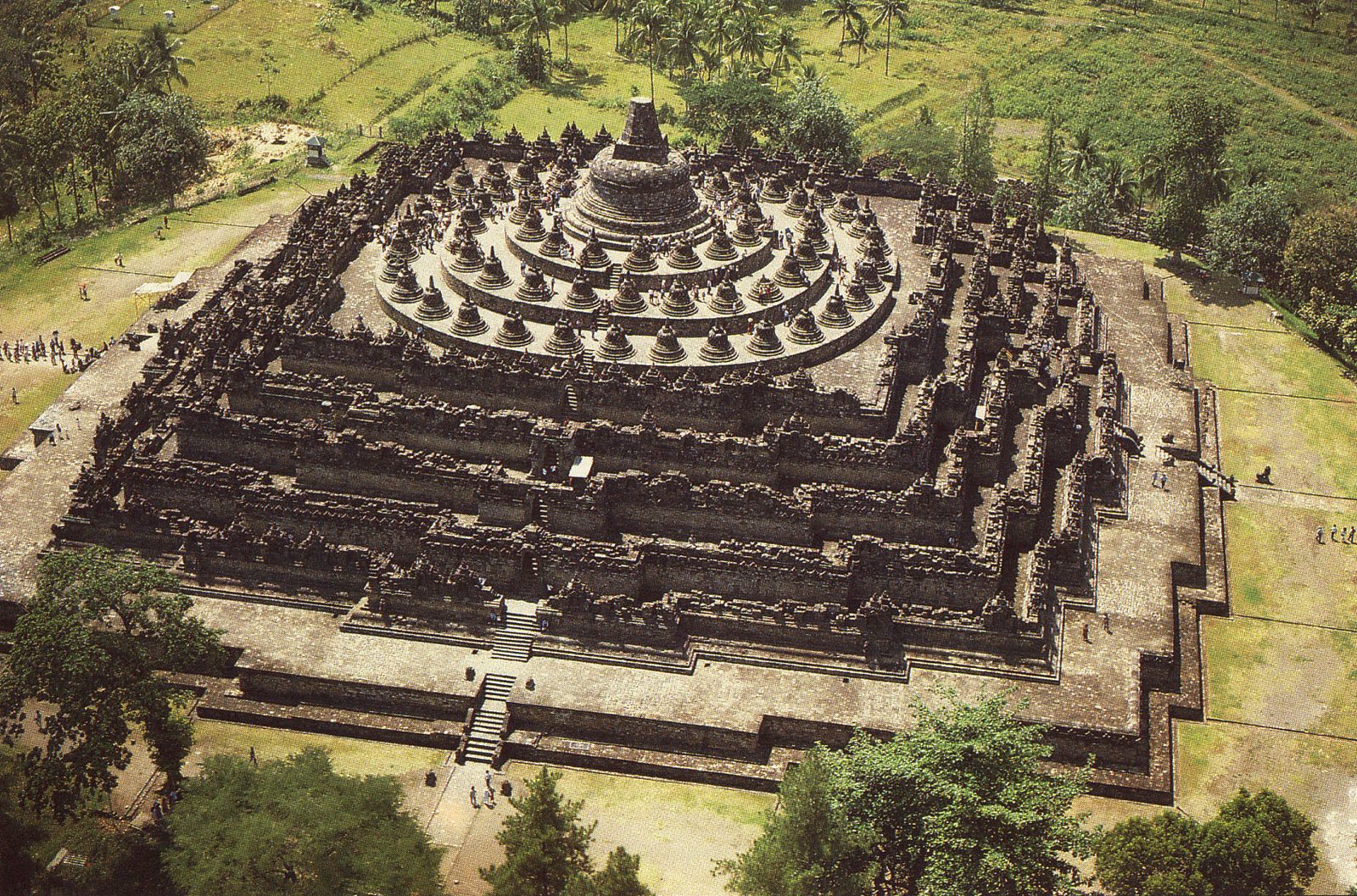
Aerial view of Borobudur shows the step pyramid and mandala plan (see below). Source: Wikimedia Commonsꜛ (license: CC BY-SA 1.0).
Mandala structure and vertical cosmology
The architectural layout of Borobudur is designed as a mandala — a sacred diagram of the Buddhist cosmos — built in stone. The monument consists of nine superimposed platforms: six square terraces at the base and three circular terraces at the top, culminating in a central stūpa. This vertical arrangement is a three-dimensional expression of Mahāyāna and Vajrayāna cosmology, symbolizing the progressive path of spiritual purification and awakening.
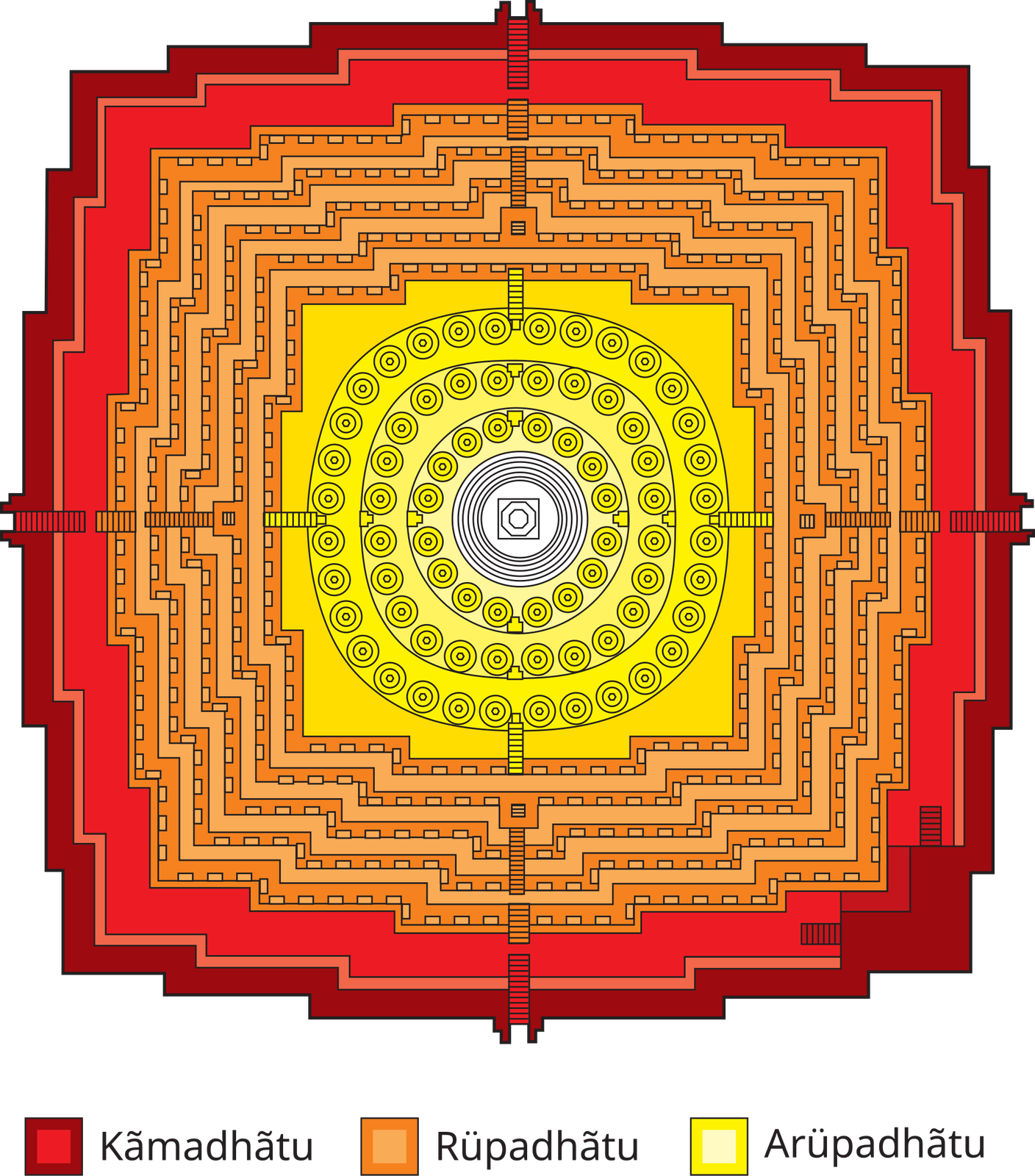
Borobudur floor plan in the shape of a mandala. The monument is a three-dimensional mandala, representing the path to enlightenment. It consists of nine stacked platforms, six square and three circular, topped by a central dome, resembling the Hindu-Buddhist cosmology and its model of the universe, with three ascending realms, Kāmadhātu (the realm of desire; red), Rūpadhātu (the realm of form; orange), and Arūpadhātu (the realm of formlessness; yellow). Source: Wikimedia Commonsꜛ (license: CC BY-SA 3.0).
The base of the monument represents the realm of Kāmadhātu, or the world of desire. This level was once adorned with explicit narrative reliefs, now largely hidden behind an encasement platform, which depict the consequences of karma and samsāric entanglement. The six square terraces above this base correspond to the Rūpadhātu, the realm of form, where spiritual practice refines the mind but form is still present. These terraces are lined with hundreds of narrative and didactic panels depicting the life of the Buddha, Jātaka tales, and Avataṃsaka-themed cosmology. The highest three circular terraces symbolize the Arūpadhātu, the formless realm. Here, the walls are bare of reliefs, and the spatial experience becomes increasingly open and contemplative. The visitor, ascending clockwise through these stages, moves symbolically through levels of spiritual progress, culminating in the empty central stūpa that may evoke śūnyatā, or ultimate emptiness.
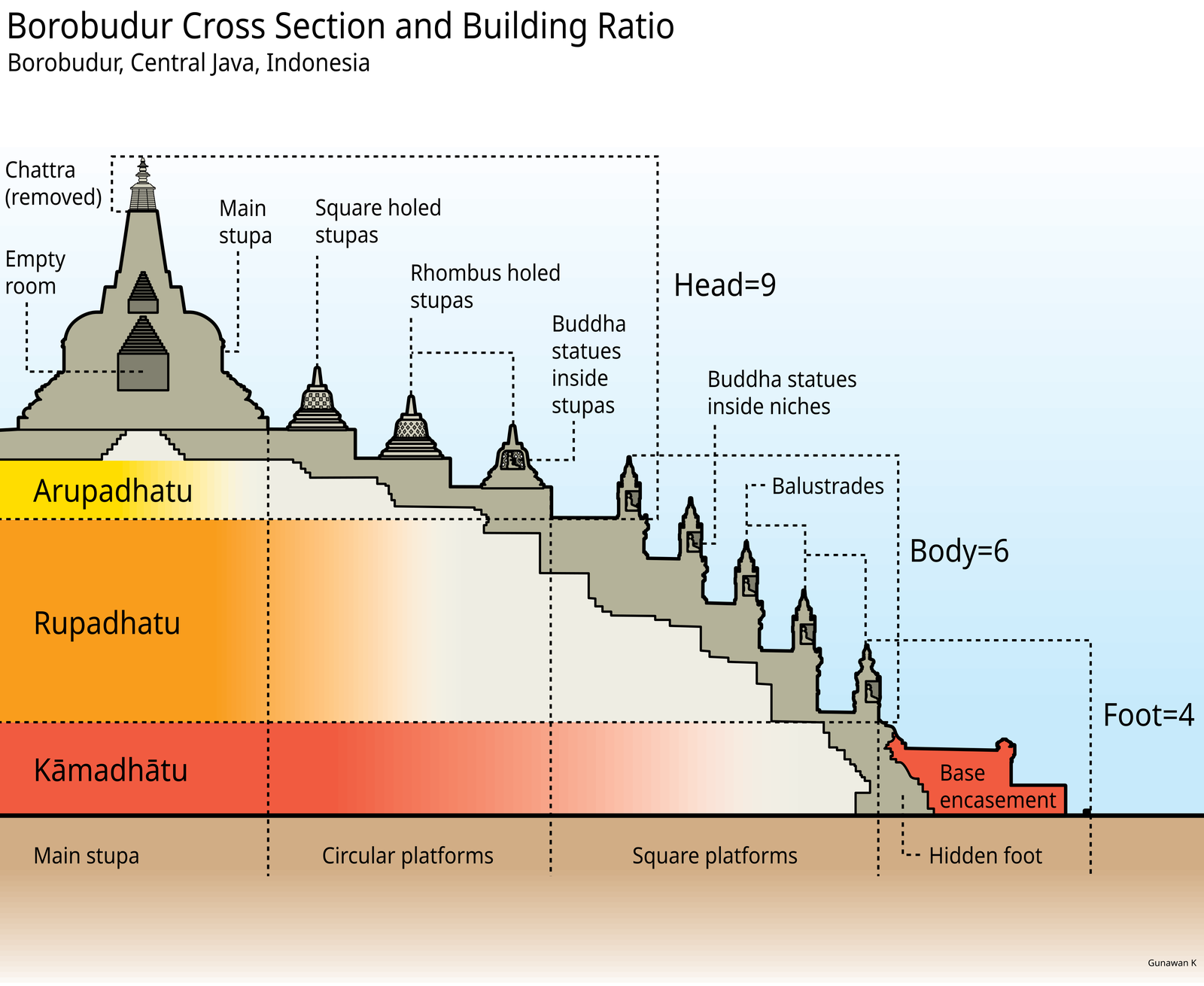
Cross-section with 4:6:9 height ratio of foot, body and head. Source: Wikimedia Commonsꜛ (license: CC BY-SA 3.0).
Architectural design and construction
Borobudur was constructed entirely of interlocking andesite stone blocks, totaling over a million stones. These were laid without the use of mortar, using a system of joints and gravity to secure the structure. Drainage spouts and internal water channels were carefully engineered to manage the tropical rainfall and protect the monument from erosion.
The entire monument is aligned to the cardinal directions and rests atop a natural hill that was shaped to support the structure. Its placement in the Kedu Plain, surrounded by volcanoes and rivers, appears to reflect geomantic principles, embedding the monument in a sacred landscape believed to mirror cosmic order. Some scholars suggest the orientation and design of Borobudur may also correspond to solstitial events or calendrical observances.
The monument’s scale, technical sophistication, and symbolic architecture reveal an exceptional integration of religious vision, political ambition, and engineering capability. Borobudur was not merely a place of worship, but a constructed cosmos in stone — a space meant to be inhabited ritually, interpreted doctrinally, and experienced meditatively.
Iconography and narrative programs
Borobudur’s iconographic program is a complex interplay of narrative, symbolism, and doctrinal themes. The monument’s reliefs and sculptures are not merely decorative; they serve as visual texts that convey the teachings of Mahāyāna Buddhism and guide practitioners along the path to enlightenment.
Relief panels and inscriptions
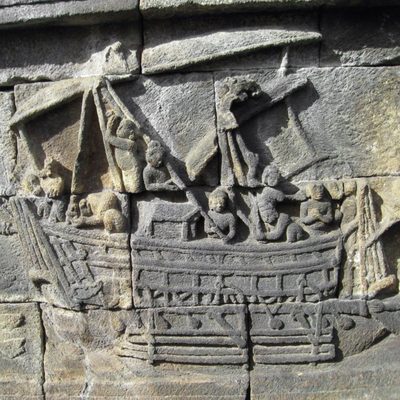
Borobudur contains more than 2,600 intricately carved relief panels, making it one of the largest collections of narrative art in the Buddhist world. These panels are arranged in sequential registers along the galleries of the monument’s square terraces, especially in the Rūpadhātu level, and serve both a decorative and a didactic function. They visually encode sacred texts and stories central to Mahāyāna Buddhism, offering a sophisticated fusion of scripture, narrative, and moral instruction.
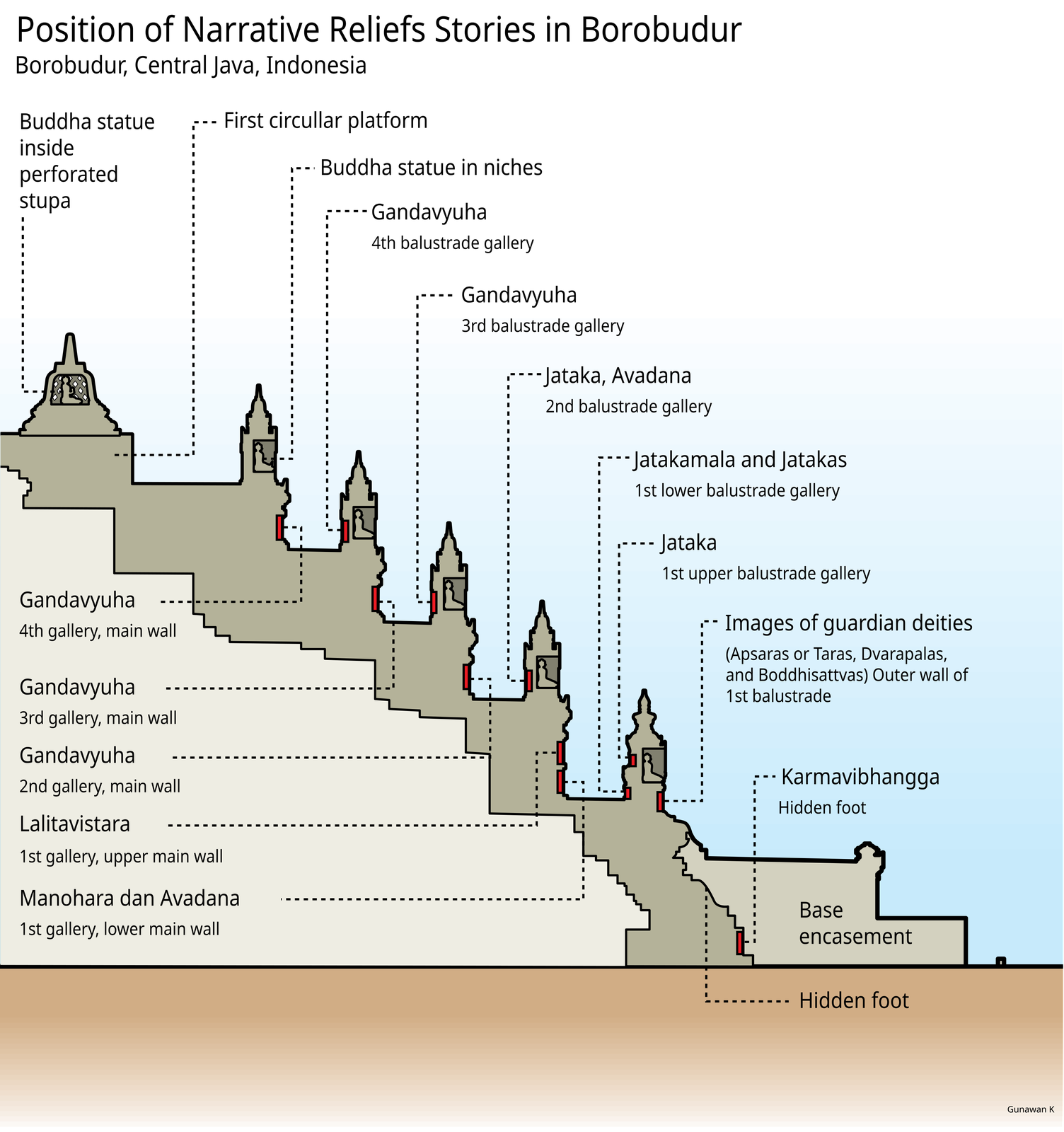
Position of narrative bas-reliefs on Borobudur wall. Source: Wikimedia Commonsꜛ (license: CC BY-SA 3.0).
The reliefs include episodes from the Lalitavistara Sūtra, which recounts the life of the historical Buddha from his descent into his mother’s womb to his first sermon. Alongside this, there are numerous depictions of Jātaka and Avadāna tales — stories of the Buddha’s past lives illustrating moral virtues such as generosity, compassion, and perseverance. Another important set of reliefs draws from the Avataṃsaka Sūtra, illustrating complex cosmological scenes, Bodhisattva assemblies, and idealized visions of the enlightened realm. Additional panels portray scenes of daily life, celestial beings, and symbolic flora and fauna, creating a visual environment that blends the spiritual with the worldly.
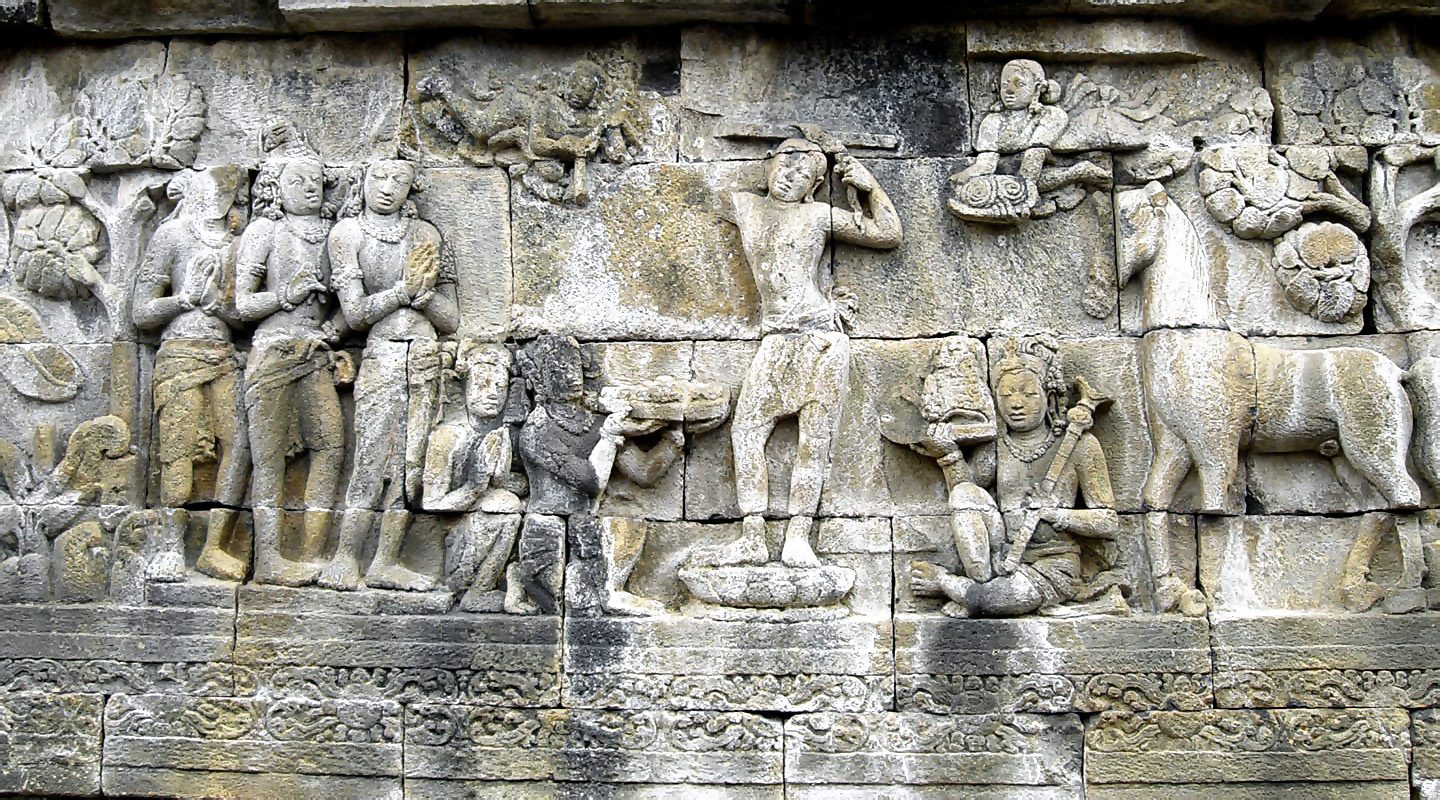
Base-relief panel showing prince Siddhartha Gautama shaving the hair off his head as the sign to decline his status as ksatriya (warrior class) and becomes an ascetic hermit, his servants hold his sword, crown, and princely jewelry while his horse Kanthaka stands on right. Source: Wikimedia Commonsꜛ (license: CC BY-SA 4.0).
While there are few inscriptions on the reliefs themselves, their arrangement and subject matter suggest that they were intended for ritual contemplation and pedagogical engagement. As pilgrims circumambulated the monument, they would encounter these stories in a structured sequence, reinforcing key ethical lessons and providing a visual path mirroring the doctrinal journey toward awakening.
Stūpas and Buddha images
The upper circular terraces of Borobudur are dominated by 72 perforated stupas, each enclosing a seated Buddha statue. These stupas, formed of latticework stone, are arranged in concentric rings around the central stūpa at the summit. The progression from narrative-filled square terraces to the abstract, geometric repetition of stupas in the upper levels reflects a transition from conceptual engagement to meditative stillness.
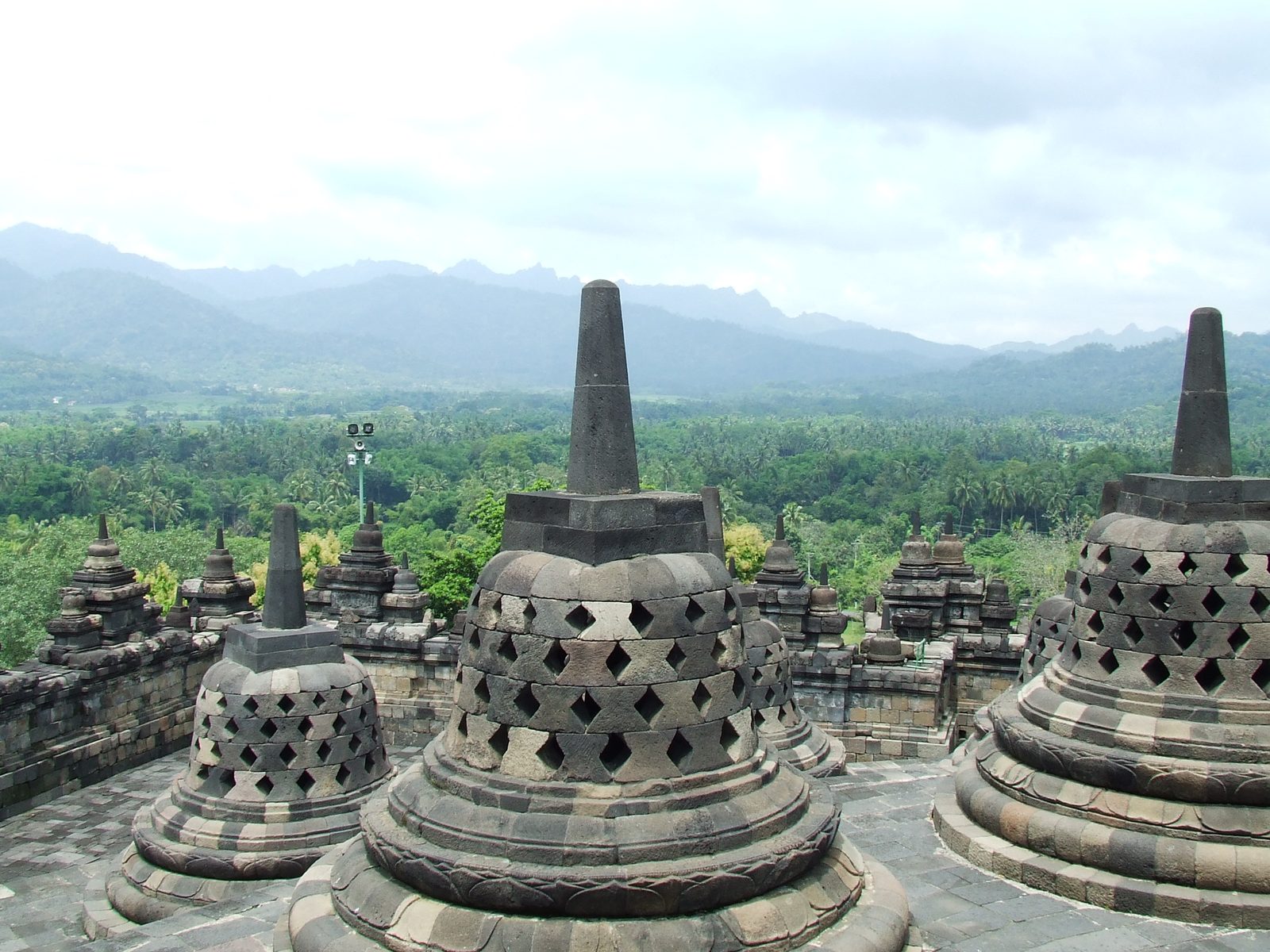
Perforated stūpas on the three upper, circular terraces of Borobudur. Inside each stūpa is a statue of the Buddha, seated in a meditative posture. Source: Wikimedia Commonsꜛ (license: CC BY-SA 3.0).
The Buddha statues within the stupas exhibit distinct hand gestures (mudrās), corresponding to different aspects of the Buddha’s qualities or actions. Among the five principal mudrās found at Borobudur are the
- bhūmisparśa (earth-touching gesture),
- dhyāna (meditation),
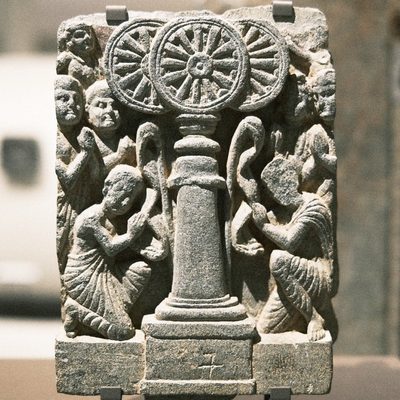
- dharmacakra (teaching),
- abhaya (protection), and
- varada (compassion/giving).
The distribution of these mudrās across levels and directions may reflect cosmological or esoteric principles, though scholarly interpretations vary.
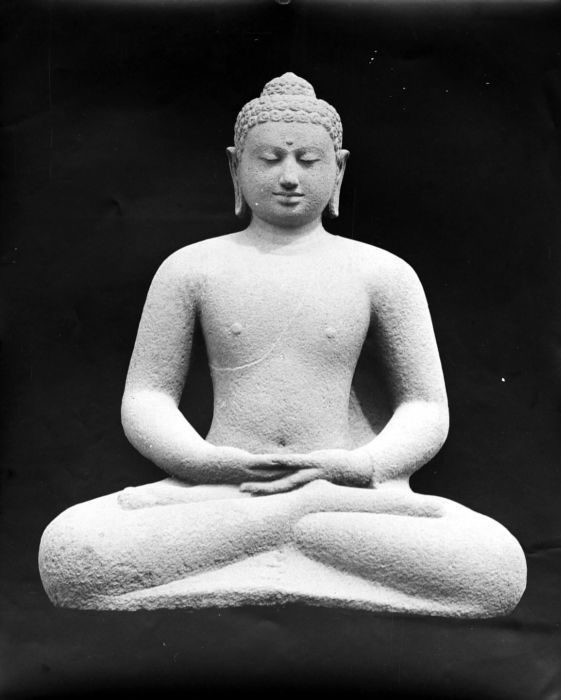
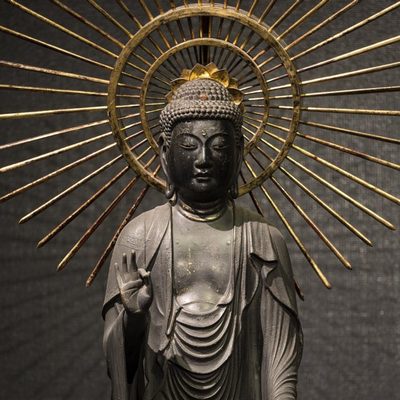
Buddha sculpture from the Borobudur, representing Dhyani Buddha Amitabha. Source: Wikimedia Commonsꜛ (license: CC BY-SA 3.0).
Together, the stūpas and Buddha images reinforce Borobudur’s function as a mandalic structure. They provide a visual and spatial framework that guides the devotee through stages of doctrinal understanding and spiritual transformation, culminating in the silent, empty central stūpa. A symbol that may represent the transcendence of form and the realization of emptiness (śūnyatā).
Ritual Use and function
Borobudur was designed not only as an architectural representation of Buddhist cosmology but also as a site to be ritually engaged with through movement, observation, and reflection. Central to its use was the practice of circumambulation, or pradakṣiṇā: ritually walking clockwise around each level of the monument. This movement mirrors the progressive structure of the monument itself, guiding the practitioner from the realm of desire (kāmadhātu), through form (rūpadhātu), and into the formless realm (arūpadhātu). As pilgrims ascended through the terraces, they encountered narrative panels and symbolic sculptures arranged to encourage ethical contemplation and gradual spiritual elevation.
The structured ritual journey likely served both lay and monastic audiences, though the degree of access and intended use remains debated. Lay practitioners may have participated in periodic pilgrimage festivals or community-sponsored merit-making rituals, while monastics would have approached the monument with more specialized doctrinal understanding. The alignment of Borobudur with other nearby temples, such as Mendut and Pawon, suggests that ritual processions may have formed part of a broader ceremonial cycle, possibly aligned with the lunar calendar or royal festivals.
Pilgrimage to Borobudur, whether historical or contemporary, entails a performative engagement with sacred space. Pilgrims experience a physical and cognitive journey: walking the galleries, viewing the reliefs, chanting, and meditating. This embodiment of the Buddhist path transforms the monument from a static structure into a dynamic ritual arena. Although the precise ritual procedures practiced during the Sailendra period remain uncertain, Borobudur’s design strongly implies that it was meant to be actively used — traversed, read, and ritually inhabited — as a microcosm of the Buddhist path to awakening.
Cultural and transregional connections
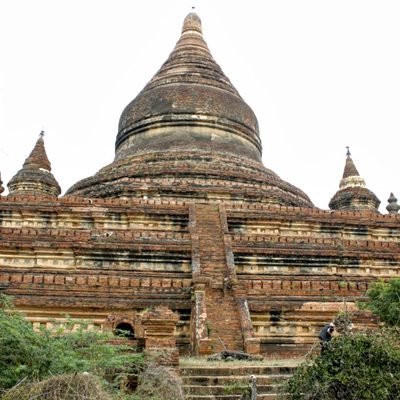
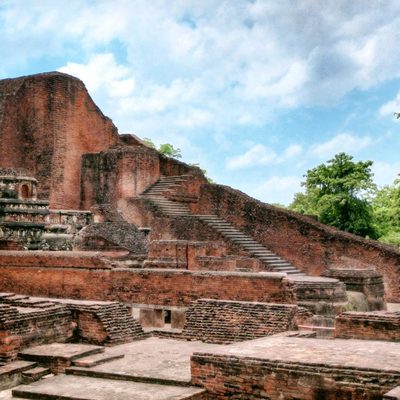
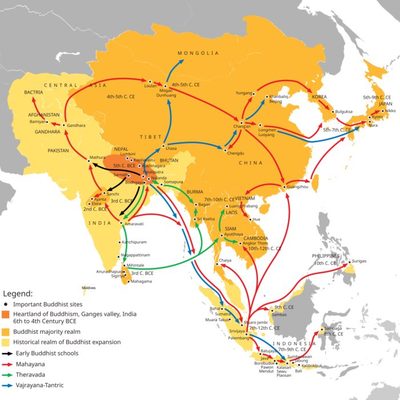
Borobudur’s iconography, cosmology, and architectural vocabulary reflect a deep engagement with Indian Mahāyāna and Vajrayāna Buddhist traditions. The monument shares notable conceptual parallels with Indian sites such as Nālandā and Vikramaśīla in terms of its use of mandalic spatial organization, doctrinal symbolism, and narrative reliefs drawn from major Mahāyāna sūtras. Textual references and stylistic comparisons suggest that Java’s monastic communities maintained intellectual links with Indian scholastic centers, possibly facilitated by itinerant monks, trade routes, and royal patronage.
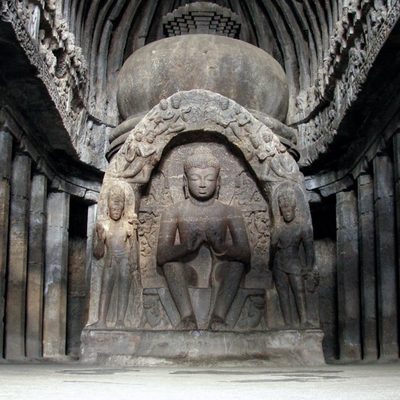
Additionally, the narrative programs at Borobudur reveal artistic affinities with Indian cave complexes such as Ajantā, where mural and relief art served both ritual and pedagogical functions. While executed in a distinct Javanese style, the sculptural grammar of Borobudur appears informed by Gupta and post-Gupta idioms transmitted through intermediaries in southern India and maritime Southeast Asia.
Borobudur’s location within a well-connected maritime world also points to its likely integration into transregional networks centered on empires like Srivijaya. Inscriptions from Nālandā mention Srivijayan monks studying in India, and Chinese Buddhist pilgrims such as I-Tsing describe scholarly stops in the region. These connections suggest that Borobudur was not an isolated monument but part of a larger Buddhist ecumene — anchored by ritual, doctrinal, and diplomatic exchanges spanning from India to China and the Indonesian archipelago.
Rediscovery, conservation, and World Heritage status
Following its peak in the 9th and 10th centuries, Borobudur gradually fell into disuse and was eventually abandoned. The decline of the Buddhist kingdom in Central Java, combined with natural overgrowth and volcanic activity in the region, led to the monument being obscured by jungle and volcanic ash for centuries. By the time of Islamic ascendancy in Java and the shift of political power to East Java in the 11th century, Borobudur had already begun to fade from collective memory.
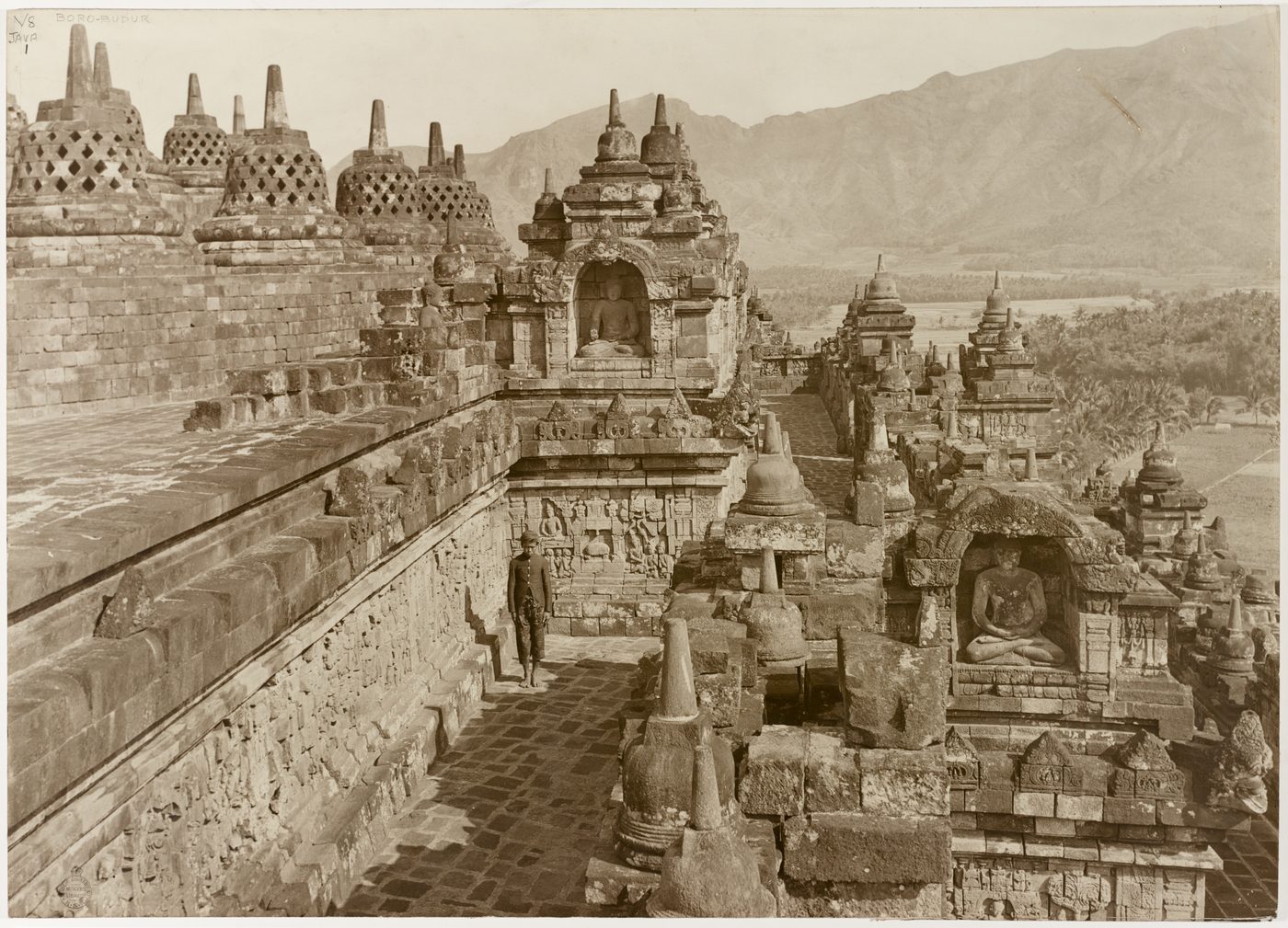
A terrace on the temple,1913, Frank Hurley. Source: Wikimedia Commonsꜛ (license: public domain).
The rediscovery of Borobudur occurred in the early 19th century under British colonial administration, when Sir Thomas Stamford Raffles, then governor of Java, received reports of a large ancient monument buried near the village of Bumisegoro. Excavation efforts soon began, bringing Borobudur back into scholarly and public view. Over the course of the 19th and early 20th centuries, Dutch colonial authorities undertook several stabilization and excavation campaigns, but it was not until the mid-20th century that large-scale, coordinated restoration efforts began.
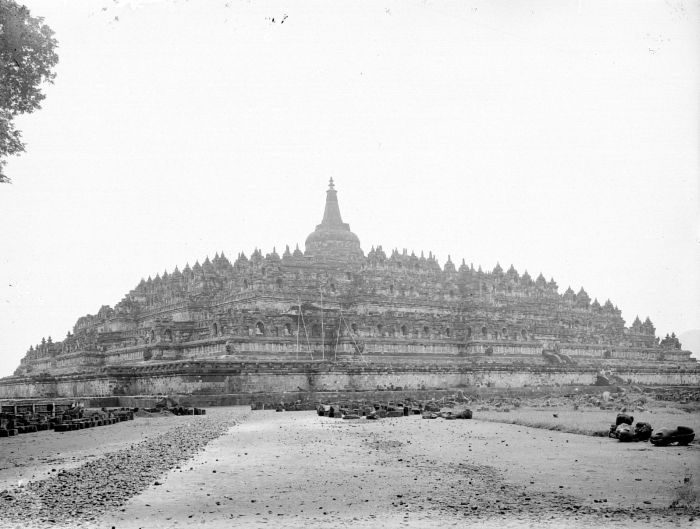
Borobudur after van Theodoor van Erp’s restoration in 1911. The chhatra pinnacle is now dismantled. In 1907, the Dutch archaeologist Theodoor van Erp began a major restoration project, which included the removal of vegetation, stabilization of the structure, and reconstruction of damaged sections. This work was controversial, as it involved significant alterations to the original design and materials. Critics argued that the restoration compromised the monument’s authenticity and integrity. Source: Wikimedia Commonsꜛ (license: CC BY-SA 3.0).
Between 1975 and 1982, a major restoration project was carried out under the auspices of UNESCO and the Indonesian government. This campaign involved disassembling and reconstructing large sections of the monument, improving drainage systems, and preserving stone reliefs and statues. The successful completion of this effort led to Borobudur’s designation as a UNESCO World Heritage Site in 1991, recognizing its global cultural and historical importance.
Today, Borobudur continues to serve both as a major heritage tourism destination and as a site of renewed Buddhist ritual activity, particularly during Vesak celebrations. Balancing preservation with access has remained a challenge, as increasing foot traffic poses a threat to the monument’s integrity. Ongoing conservation measures and visitor management strategies aim to protect the site while maintaining its role as a living symbol of Buddhist heritage in Indonesia and the wider world.
Conclusion
Borobudur stands as a unique convergence of religious doctrine, spatial symbolism, and artistic craftsmanship. Constructed during a formative period in Southeast Asian history, the monument exemplifies how Mahāyāna Buddhist thought was given material and ritual form through large-scale architecture. Its mandala-like structure, narrative reliefs, and spatial progression reflect a sophisticated cosmological vision aligned with contemporary doctrinal and meditative practices.
Beyond its role as a sacred site, Borobudur also illuminates the broader cultural and political dynamics of early medieval Java. The monument demonstrates the use of monumental religious architecture in state formation, the interplay between Buddhist and Hindu traditions, and the integration of Java into transregional Buddhist networks that stretched from India to China. Its rediscovery and conservation have likewise contributed to renewed academic and public interest in Southeast Asian Buddhism, positioning Borobudur as a critical reference point for understanding the material, ritual, and intellectual dimensions of Buddhist practice in the region.
As a preserved archaeological site and ongoing place of pilgrimage, Borobudur continues to offer insight into how religious meaning is embedded in space, narrative, and ritual movement. It remains a valuable lens for exploring the relationship between landscape, kingship, and institutional Buddhism in the wider context of Asian religious history.
References and further reading
- Gomez, Luis, Borobudur as a mandala, 1980, In: Studies in the history of Buddhism, ed. A.K. Narain, Buddhist World Press, 2010, ISBN: 978-8190638890
- Woodward, Hiram W., The art and architecture of Thailand: From prehistoric times through the thirteenth century, 2005, Leiden: Brill, ISBN: 978-9004144408
- De Casparis, J.G., Indonesian palaeography: A history of writing in Indonesia from the beginnings to c. A.D. 1500, 1975, Leiden: Brill, ISBN: 978-9004041721
- Fontein, Jan, The sculpture of Indonesia, 1990, Harry N. Abrams, Inc., ISBN: 978-0810938175
- Degroot, Véronique, Candi, space and landscape: A study on the distribution, orientation and spatial organization of Central Javanese temple remains, 2009, Leiden: Sidestone Press, ISBN: 978-9088900396




comments