The year of the horse: Exploring the cultural history of the horse in East Asia
In January, my first museum visit of the year led me once again to the Museum for East Asian Art in Cologne, where I have seen the exhibition Celebrating the lunar year of the horse. Galloping through time and spaceꜛ. The exhibition brings together works from China, Tibet, Korea, and Japan to explore the cultural history of the horse in East Asia, coinciding with the Lunar Year of the Horse. Running from December 3, 2025, until January 31, 2027, the exhibition presents a broad temporal and material spectrum, ranging from the 3rd century BCE to the modern period.
 Horse and groom, bronze, China, Eastern Han Dynasty (25-220). The elegant, long-legged form of this horse, together with its high-tied tassel, suggests a connection with the celebrated horses of the Ferghana Valley in Central Asia. In 128 BCE, Emperor Wudi of the Han sent a large military expedition to that region in pursuit of the famous “heavenly horses” (tianma). These animals were later bred for generations in imperial stables and became the subject of poetic praise. The bronze horse was cast in eleven separate sections and is a striking example of technical skill, with walls only about 4 mm thick. Traces of pigment show that it was once vividly painted. As a tomb object, it was intended to provide the deceased with the luxuries and prestige of life beyond death. The small booted groom reaching toward the reins may represent a prisoner of war, possibly from the Xiongnu.
Rather than focusing on a single tradition, the exhibition traces how the horse appears across East Asian cultures as a mythological being, military asset, social marker, and artistic motif. Paintings and woodblock prints are shown alongside ceramics, bronzes, lacquerware, and ritual objects, forming a dense visual narrative that moves between everyday life, religious belief, and imperial representation.
In this post, I’d like to summarize my impressions and insights from the exhibition.
The lunar calendar and the year of the horse
Before we begin, a brief note on the calendrical framework that gives the exhibition its title and temporal structure. The Chinese lunar calendar, introduced during the Spring and Autumn period (722–481 BCE), structures time through a cycle of twelve zodiac animals. Each year is associated with a specific animal whose perceived characteristics shape cultural expectations and symbolic meanings. The Year of the Horse begins on February 17, 2026, and ends on February 6, 2027, when it will be replaced by the Year of the Goat.
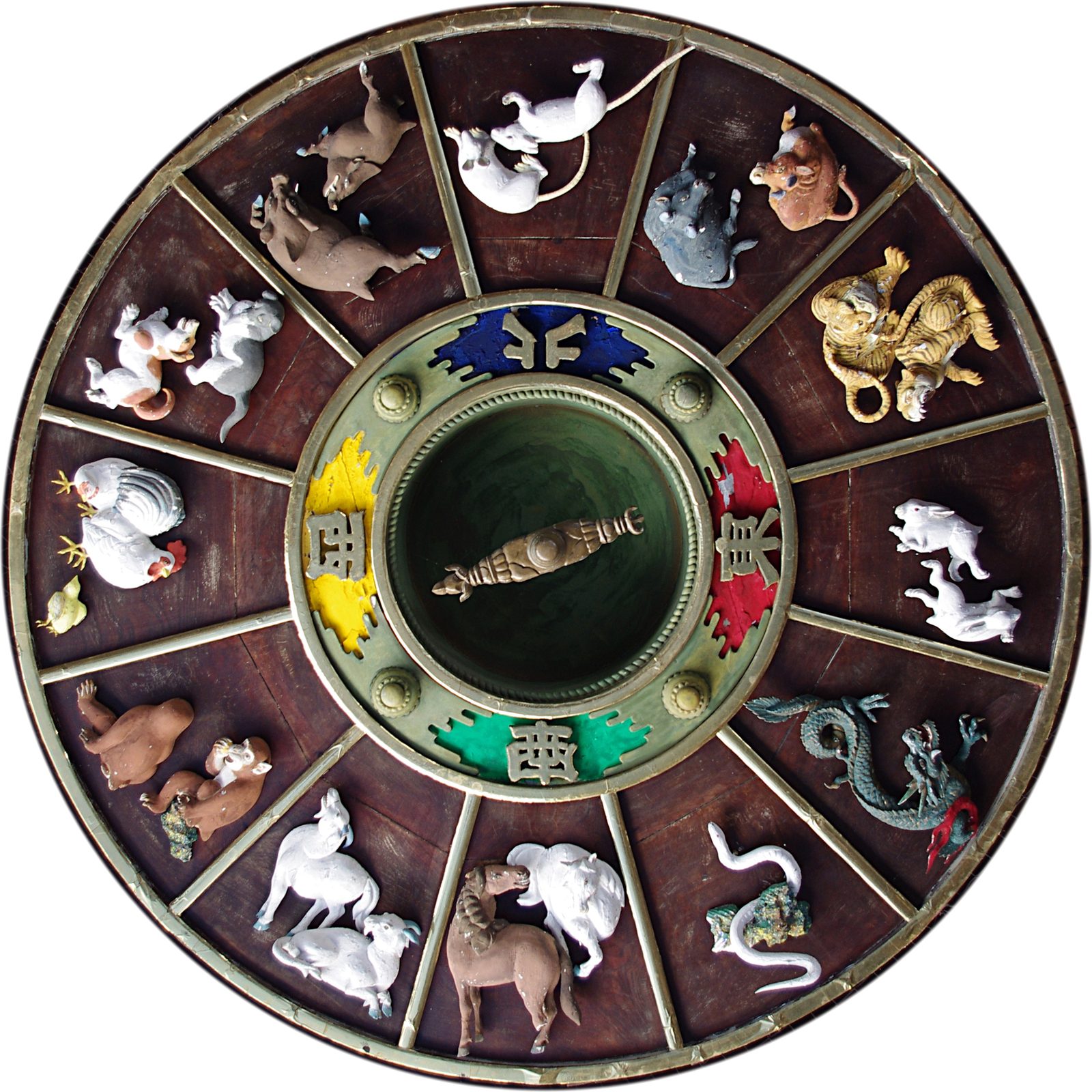
Chinese Zodiac carvings on ceiling of Kushida Shrine, Fukuoka, Japan. The twelve animals of the Chinese zodiac are depicted in a circular arrangement on the ceiling of the main hall of Kushida Shrine in Fukuoka. Each animal is intricately carved and painted, showcasing traditional Japanese craftsmanship influenced by Chinese culture. The shrine, dedicated to the deity Amaterasu, is a significant cultural site in Fukuoka, and the zodiac carvings add to its rich artistic heritage. Note: The image is mirrored. Source: Wikimedia Commons (license: CC BY-SA 4.0).
Here is a table listing the twelve zodiac animals and their corresponding years in the 21st century:
| Animal | Hanzi trad. (/simp.) | Years |
|---|---|---|
| Rat | 鼠 (shǔ) | 2008, 2020, 2032 |
| Ox | 牛 (niú) | 2009, 2021, 2033 |
| Tiger | 虎 (hǔ) | 2010, 2022, 2034 |
| Rabbit | 兔 (tù) | 2011, 2023, 2035 |
| Dragon | 龍 / 龙 (lóng) | 2012, 2024, 2036 |
| Snake | 蛇 (shé) | 2013, 2025, 2037 |
| Horse | 馬 / 马 (mǎ) | 2014, 2026, 2038 |
| Goat | 羊 (yáng) | 2015, 2027, 2039 |
| Monkey | 猴 (hóu) | 2016, 2028, 2040 |
| Rooster | 雞 / 鸡 (jī) | 2017, 2029, 2041 |
| Dog | 狗 (gǒu) | 2018, 2030, 2042 |
| Pig | 豬 / 猪 (zhū) | 2019, 2031, 2043 |
Within this calendrical system, the horse is traditionally associated with strength, mobility, endurance, and independence. These qualities are not abstract attributes but are grounded in the animal’s historical role in warfare, transport, hunting, and long-distance exchange. The exhibition uses the zodiacal framework as an entry point rather than as an explanatory endpoint, allowing the broader cultural history of the horse in East Asia to unfold across regions and centuries.
The horse in East Asia
Across East Asia, the horse occupies a central position at the intersection of myth, state power, and daily life. As a means of transport, it enabled territorial expansion, military defense, and communication over vast distances. As a living being, it became a companion to rulers, warriors, scholars, and travelers. As an artistic motif, it carried layered meanings that differed according to cultural context, religious tradition, and historical moment.
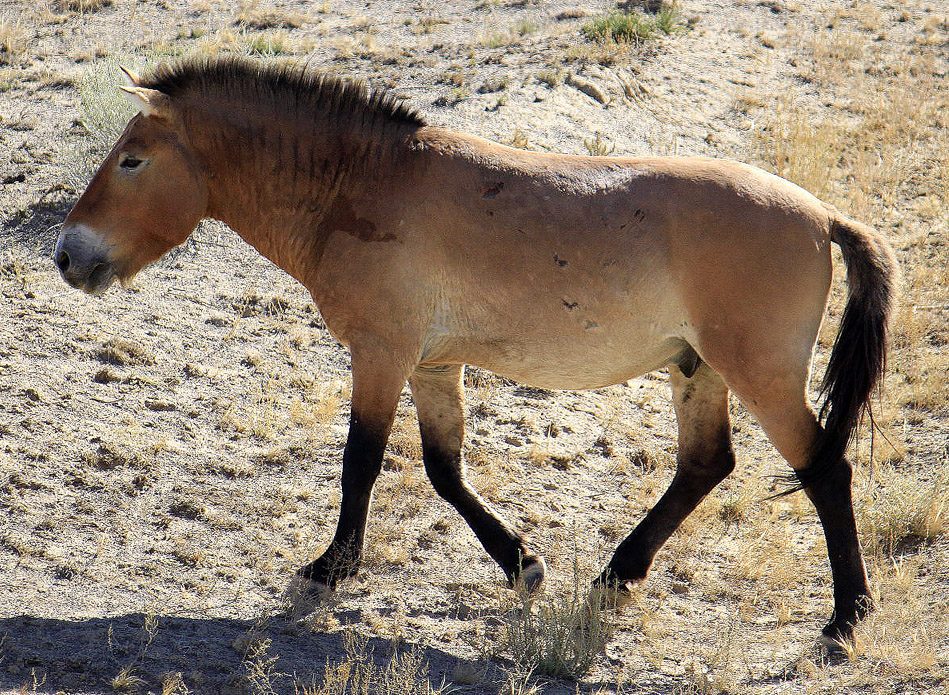 Photo of reintroduced Przewalski’s horse taken at the “Seer” release site, managed by the Association pour le cheval de Przewalski: TAKH, in the Khar Us Nuur National Park Buffer Zone. The Przewalski horse (equus ferus przewalskii), also known as the Mongolian wild horse or Takhi, is a rare and endangered wild horse native to the steppes of Central Asia. It represents the only extant horse population that did not arise from domesticated ancestors and is therefore often described as the last truly wild horse. Genetically, it forms a distinct lineage within the horse complex, separate from the ancestors of modern domestic horses (equus ferus caballus). Source: Wikimedia Commons (license: CC BY-SA 3.0).
The exhibition makes clear that while China, Korea, and Japan share certain symbolic frameworks, each culture developed its own visual language for representing the horse. These differences are not merely stylistic, but reflect distinct political systems, religious beliefs, and social structures.
China: Heavenly horses, empire, and exchange
In Chinese art, the horse is among the most long-lasting and symbolically charged motifs. Archaeological and zoological evidence suggests that horses were first domesticated in China during the Neolithic Longshan culture (ca. 4800–4000 BCE), with genetic links to the so-called Przewalski horse (a wild subspecies native to Central Asia). Artistic representations can be traced back to the Shang dynasty (ca. 1600–1046 BCE), where bronze sculptures, chariots, and ritual sacrifices attest to the horse’s importance in elite and funerary contexts.
From the Han dynasty onward (206 BCE–220 CE), horses appeared widely in tomb art, wall paintings, and sculpture. Contact with Central and West Asia introduced new, highly valued breeds from regions such as Ferghana, whose physical characteristics shaped the idealized image of the horse in Chinese art. These animals gave rise to the myth of the “Heavenly Horse” (tianma), sometimes depicted as a winged being capable of transporting the deceased or even the emperor to the heavens.
The Tang dynasty (618–907) marked a high point in the visual culture of the horse. Economic prosperity and vibrant exchange along the Silk Road fostered an unprecedented diversity of depictions, from monumental tomb figures glazed in sancai colors (“three colors”) to court paintings portraying individual horses, hunts, polo games, and foreign grooms. Horses functioned simultaneously as military assets, trade commodities, and diplomatic gifts.
Later periods expanded the symbolic register. Song dynasty scholar-painters explored new genres, while under Mongol rule during the Yuan dynasty (1271–1368), horses became vehicles for veiled political commentary. In the Ming and Qing dynasties, Western painting techniques introduced by Jesuit missionaries, most notably Giuseppe Castiglione, reshaped courtly horse portraits. In the 20th century, artists such as Xu Beihong reinterpreted the horse as an expression of modern dynamism and national strength.
 Fragment of a tomb slab, terracotta, pigment paints, China, Eastern Han Dynasty, 1st c. This tomb brick comes from Luoyang in Henan province and shows a winged tianma, or “heavenly horse”. Such horses were associated with immortality and with the journey of the deceased to heaven. The animal’s form reflects Central Asian breeds from the Ferghana Valley, indicating how far-reaching the contacts and trade routes of the period already were.
 Saddled Horse, Earthenware, three-colour glaze (sancai), China, Tang dynasty (618-907). In Tang-period China, richly glazed horse figures served as prestigious tomb furnishings for the imperial family and senior officials. Their lifelike appearance, elaborate tack, and scale expressed the social rank of the person buried with them.
 Figure of Palden Lhamo, Gilt copper, pigment colours Tibet, late 18th c. Palden Lhamo is shown here in her fierce protective form. She belongs to the eight Dharmapalas, once-dangerous beings who, according to Buddhist tradition, were subdued and made guardians of the sacred teachings. Her mount, a Himalayan mule, is decorated with the same terrifying imagery: snakes form the bridle, human skin serves as the saddlecloth, and skulls hang as a necklace.
 Figure of Palden Lhamo, Gilt metal alloy, pigment colours Tibet, 19th c. Palden Lhamo appears here as a wrathful guardian figure. She is counted among the eight Dharmapalas, fearsome beings who were brought under Buddhist discipline and became protectors of the sacred texts. The Himalayan mule beneath her is fitted with equally macabre ornaments: A bridle of snakes, a saddlecloth of human skin, and a necklace made from human skulls.

 Altar ewer, Porcelain, enamels sur biscuit, China, Kangxi Period (1662-1722). This porcelain ewer was made in China for export to Tibet. Its shape recalls the cap of a Tibetan monk. The “flying wind horse” (rlung rta) is known in Tibetan tradition as an older shamanic symbol that was later incorporated into Buddhism. As a sign of good fortune, it appears on prayer flags, textiles, and paper talismans.
 Tributary Horse and Groom, Hanging scroll, ink and colours on paper, China, probably late Ming or Qing dynasty, 17th/18th c. This hanging scroll belongs to a later tradition of Chinese horse painting inspired by Li Gonglin’s Five Horses from the Northern Song period. That earlier horizontal scroll showed five prized horses with their grooms, offered to the emperor as tribute by vassals from the western regions. Works such as this one continued to draw on that influential model.
 Horse under a Willow Tree, Hanging scroll, ink and colours on paper, China, Qing dynasty, mid-19th c. The poem on this hanging scroll celebrates Fang Bingcao’s strong and courageous “Hu horse” from the northern border regions. Its quality lies not in physical bulk, but in its inner spirit and alert temperament, described through images such as sharp bamboo-like ears and star-like eyes. Portraits of this kind could also reflect the virtues their owners wished to associate with themselves.
 Saddled Horse with Groom, Earthenware, traces of pigment colours, China, Tang dynasty (618-907). In Tang funerary art, horse grooms are often shown as foreigners, identifiable through details such as their headgear, clothing, boots, facial features, or heavy beards. Central Asian horses were highly valued as markers of status, and a foreign groom helped underline their distant origin.
 Ridge Tile in shape of an Immortal, Stoneware, coloured glazes, China, Qing dynasty, late 19th c. Figures like this once decorated the rooflines of rural temples and shrines. In a Daoist setting, the immortal’s flying horse marks the passage between the human world and the celestial sphere.
 Saddled Mongolian Horse, Bronze, China, late Ming/early Qing dynasty, 17th c. The compact body, long mane, and short, powerful legs identify this as a Mongolian horse. This hardy breed influenced many later horse types in China and Japan. Beyond riding, it was also valued for milk, meat, and its robust coat.
 Fitting, Bronze, China, Xiongnu Culture, c. 100 BCE. This bronze fitting comes from the Xiongnu cultural sphere around 100 BCE. Following their submission to the Han emperor, some Xiongnu groups were settled on the Ordos Plateau in Inner Mongolia, a region that served China both as pastureland and as a frontier defence zone. The scene shows a sleeping horse beside a saddled mule.
 Pair of Plates, Porcelain, famille rose enamels, China, Yongzheng period (1723-1735). These plates show scenes from the story of Wang Zhaojun, a famed court lady of the Han dynasty. Sent by imperial order to marry the Xiongnu leader Huhanye, she is shown leaving for the north while playing the zither. The companion plate depicts Huhanye and his brother Zhaki waiting for her arrival.
 Grazing Mongolion Horse, Bronze, China, early Qing dynasty, 17th c. The Mongolian horse is a small but exceptionally hardy breed, usually standing around 129 to 135 cm at the shoulder. Domesticated about 5,000 years ago, it later became central to the military expansion of Genghis Khan. Today, Mongolian nomads still keep around three millions of these horses.
 Consecrating Stallon, Earthenware, traces of cold paint, China, Tang dynasty (618-907). Among Tang tomb figures, horses shown in such a tense and animated pose are unusual. The raised head, neighing expression, and bent hind legs may refer to one of the prized horses kept in the stables of Emperor Xuanzong (reigned 712-756), said to have been trained to dance to drum rhythms.


 Imperial Autumn Hunt, Anonymous court painter in the style of Qiu Ying (1494-1552), two Scrolls, ink and colours on silk, China, Qing dynasty, 18th c. These two scrolls depict the Qing imperial autumn hunt at Mulan in Inner Mongolia. Held in peacetime, the hunt combined court ceremony with military practice in riding and archery. It also affirmed the Manchu identity of the ruling house before Mongol, Manchu, and Turkic groups, for whom collective hunting carried political and cultural significance. The scene presents the different military banners as part of an ordered imperial world, while Han Chinese participants were excluded. The hunted game included wild animals, big cats, wolves, foxes and bears, with the emperor or crown prince usually killing a tiger personally. The number of horses taken was always much greater than the number of hunters, and those who accidentally injured a horse or hunting dog with an arrow or spear were severely punished.

 Saddled Horse, Earthenware, three-colour glaze (sancai), China, Tang dynasty (618-907). In Tang society, large horses brought from Central Asia were valued above all for display and as signs of status. Their build made them less suited to warfare or long, demanding journeys. To make the figure appear more lifelike, real horsehair was inserted into the top of the sculpture’s trimmed mane.
 Figure of a Falconer on Horseback, Earthenware, partial green glaze, China, Ming Dynasty (1368-1644). Falconry reached China from Central Asia through the Silk Road and is attested there from the Han dynasty onward. For common people it was a way of hunting for food, while at the imperial court it became both a sport and a form of military exercise. Hunting with falcons on horseback was especially suited to open landscapes such as deserts and plains, including areas of northern Shaanxi and Shanxi, where hunters needed to travel over considerable distances.
Korea: Mediator between worlds
In Korean culture, the horse carries strong mythological and military connotations. Myths, folk tales, poetry, and songs attest to its role as a mediator between heaven and earth. The founding legend of the Silla kingdom (57 BCE–935 CE), in which the first king Park Hyeokgeose descends from heaven on a white horse, established the animal as a sacred intermediary.
This belief shaped funerary practices. Horses appear in tomb murals, terracotta rider figures, and ritual vessels, guiding the souls of the deceased to the afterlife. As mounts of protective deities, horses were also venerated in local shrines, where sculptures and paintings were believed to ward off disasters and wild animals such as tigers.
In Joseon dynasty painting (1392–1897), horses acquire a more explicitly social meaning. In official portraits, they symbolize loyalty to the state; in landscape scenes, they evoke the fluctuating fortunes and burdens of human life. Beyond imagery, the horse permeated Korean material culture. Horsehair was woven into hats and headbands, leather was used for drums, bones served medicinal purposes, and meat and milk formed part of everyday sustenance. Artistic representations can thus also be read as gestures of respect and gratitude toward an animal that supported human life in multiple ways.
 Vessel in Form of a Rider, Earthenware, Korea, possibly Three Kingdoms period, 5th c. In elite burials, vessels shaped as riders often appeared in pairs. One showed the nobleman himself, identified by his tall hat, jewellery, and robe; the other represented a smaller servant carrying a bell. The horse was understood as a guide, helping the deceased reach the afterlife safely.
Japan: Sacred mounts and secular companions
In Japanese culture, the horse is deeply embedded in religious practice, particularly in Shinto, where it serves as the sacred mount (shinme) of the gods (kami). From the Nara period onward (710–794), shrines accepted live horses as offerings tied to specific prayers, such as rain or good weather. Where live animals were impractical, substitutes such as clay figures (haniwa) or painted votive plaques (ema) were donated.
Buddhist and Daoist traditions further expanded the horse’s symbolic range. In esoteric Buddhism, the fearsome deity Bato Kannon protects horses and humans in the animal realm, while Daoist figures such as Chokaro Sennin are associated with conjured horses. The veneration of white horses may also connect to Buddhist legends surrounding Siddhartha Gautama’s horse Kanthaka.
The samurai class cultivated a particularly close relationship with horses. This is reflected in sword fittings, riding equipment, and military imagery that emphasizes courage and loyalty. From the late Edo period onward, horses entered more secular visual contexts, appearing in ukiyo-e prints as racing animals, packhorses, or companions to historical and literary figures. Through the shin-hanga movement of the early 20th century, these motifs continue to inform modern visual culture, including manga and anime.

 Groom with Bridled Horse, Hanging scroll (kakemono), ink and colours on paper Japan, Edo period, 18th c. This expressive kakemono shows a stable boy leading a black horse offered to a Shinto shrine. In Shinto practice, horses were held in special esteem from early times and could be donated by nobles when making requests to the gods. A black horse was associated with prayers for rain, while a chestnut horse was offered in hopes of fine weather.


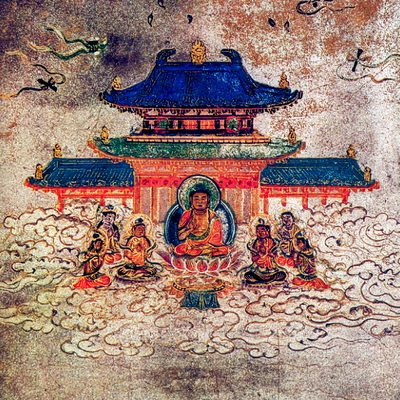
 Protective mandala against fire, Hanging scroll (kakemono), ink, colours and gold on silk, Japan, late Muromachi period, 16th c. This protective mandala centres on Atago Gongen, shown seated on a white horse. In Shinto belief, this figure combines Izanami-no-Mikoto with the bodhisattva Jizō and is associated with protection against fire, especially for the city of Kyoto. Samurai also revered Atago Gongen as a deity of war and victory. The composition surrounds him with further protective figures: Jizō and a tengu above, Bishamon and Fudō Myōō in the middle, and an unidentified deity between two komainu dogs below.

 Horse and Rider, Hanging scroll (kakemono), ink and colours on paper, Japan, Muromachi period, 16th c. From the Muromachi period onward, images of horses in training, dressage, or stable settings became popular among samurai and other members of the warrior class. Their often humorous character follows an older pictorial tradition, going back to a 13th-century scroll in which imperial bodyguards (zuishin) are shown playing with horses.


 Sliding Door with Kyoto Horse Race, Ink, pigments, calcite and gold leaf on cedar wood, Japan, Edo period, 18th/19th c. This sliding door depicts the Kamo Kurabeuma, a ritual horse race held at Kyoto’s Kamigamo Shrine every year on 5 May since 1093. In the race, the shrine’s riders compete against a team from Iwashimizu Hachimangū Shrine in nearby Yawata. Each duel begins with one horse given a one-length lead; after six laps, victory is judged by whether that distance has grown or been reduced. The event also includes mounted archery.


 Landscape with Men on Mules (‘Thousand Miles Journey’), Hanging scroll (kakemono), ink and light colours on paper, Japan, Edo period, 2nd half 18th c. In this kakemono, riders on mules leave a valley and cross a bridge toward the mountains and wilderness beyond. The inscription draws on a poem by the 8th-century Chinese poet Wang Changling, describing a lord whose generous hospitality placed his guests under an obligation to accompany him.

 The Eremite Pan Lang, Hanging scroll (kakemono), ink on paper, Japan, Muromachi period, mid-16th c. Pan Lang served King Mu in the 10th century BCE. The king possessed nine extraordinary horses, believed to embody a constellation, but Pan Lang’s praise of them broke a royal taboo. As punishment, he was exiled to Mount Huashan, where he lived as a hermit. When he was later pardoned, a horse was sent together with the order recalling him to court. Unwilling to leave his place of exile, Pan Lang is said to have ridden back facing the wrong way.

 Su Shi Riding a Horse , Hanging scroll (kakemono), ink on paper, Japan, Edo period, 17th c. Scenes from the life of the Chinese poet Su Shi were a frequent subject in Japanese painting. This kakemono probably refers to an episode from his time in southern China, when he was caught in the rain and borrowed a farmer’s straw hat and coat.
 No mask, Cypress wood, horsehair, gilt brass, Japan, Edo period (1603-1868). The Hanakobu akujo mask, whose name means “grim old man with a humpy nose”, belongs to the classical Nōgaku theatre tradition. Its facial features and light-brown horsehair beard gave it an appearance perceived as foreign in Japan. For this reason, it was used for foreign characters as well as for the dancing Dragon God.
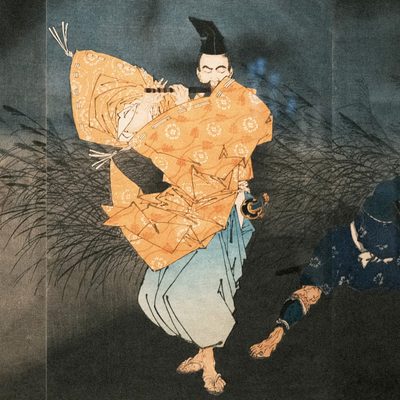
 Fukai Shidoken on a White Horse, Woodblock print, multi-colour print, Japan, Edo period, late 1760s. Fukai Shidoken, a former Shingon priest, became known as an itinerant professional storyteller. His reputation rested on humorous and ironic tales, which is reflected in the deliberately caricatured treatment of both rider and horse in this woodblock print.
 A Japanese general overlooking Julien Chang by Kobayashi Kiyochika (1847 – 1915), Woodblock print triptych, multi-colour print, Japan, Meiji period, dated November 1894. This woodblock print triptych shows an episode from the Sino-Japanese War of 1894–1895, with Japanese field artillery firing on the enemy camp at Julian Cheng. Amid rain, cannon smoke, and the flashes of enemy guns, the horse is presented as the general’s steadfast and brave companion.
 Temple Servant who was thrown from his horse, From the series ‘A Broadcast of the Miracles of Kotohira’ By Tsukioka Yoshitoshi (1839 – 1892), Woodblock print, multi-colour print, Japan, Meiji period, dated 20.12.1884. This dramatic woodblock print by Tsukioka Yoshitoshi shows a riding accident at the Shinto Kotohira Shrine on Shikoku in 1774. Black horses were offered there in prayers for rain. After being thrown from his horse, the temple servant tries to avoid being trampled, while another attendant hurries toward him to help.
 Hodogaya at the East Sea Road, From the series ‘36 Views of Mount Fuji’ by Katsushika Hokusai (1760 – 1849), Woodblock print, multi-colour print, Japan, Edo period, 1830s. Hokusai’s view of Hodogaya shows several forms of movement along the East Sea Road. Porters rest beside their sedan chair while the passenger inside sleeps. Nearby, a mounted traveller’s horse is guided by an attendant; its saddlecloths bear a lucky symbol, giving such animals the name “lucky horses”. A travelling monk moves in the opposite direction.
The exhibition
Celebrating the lunar year of the horse succeeds through its careful balance of breadth and focus. By juxtaposing funerary objects, religious images, courtly paintings, and everyday artifacts, the exhibition demonstrates how the horse moved between symbolic registers without losing its central role. The inclusion of sculptural grave goods, dynamic hunting scenes, ritual mandalas, and humorous Woodblock prints underscores the animal’s versatility as both subject and symbol.
A contemporary dimension is added through a video installation by filmmaker Jie Lu, who animates a section of the 18th-century scroll Autumn Hunt. This intervention bridges historical material and present-day visual language, reinforcing the exhibition’s theme of movement through time and space.
Conclusion
In my view, the exhibition presents the horse not as a decorative motif, but as a cultural constant that shaped artistic expression across East Asia for more than two millennia. By placing Chinese, Korean, and Japanese works in dialogue, it highlights both shared foundations and regional distinctions. As a Lunar New Year exhibition, Celebrating the lunar year of the horse situates the horse within a long continuum of East Asian cultural history rather than treating it as a seasonal symbol.
The exhibition runs until January 31, 2027, at the Museum for East Asian Art in Cologne. If you have the chance to visit, I highly recommend it.
comments