The role of the student-teacher relationship in Bankei’s Zen
Do we need a teacher to practice Zen? This is a question that is in particular relevant for those of us who approach Buddhism outside a traditional monastic setting, perhaps through books, personal reflection, or practice on our own. Bankei Yōtaku offers an interesting perspective on this question. If everyone already has the unborn Buddha-mind, what exactly is it that a teacher can give us? Bankei himself went through years of unnecessarily painful practice before realizing what he later taught others in rather simple words. He knew from his own experience how valuable good guidance could be, but also that no teacher could do the actual work of recognition for someone else. At the same time, practicing on our own comes with its own difficulties, not least because we are often quite good at convincing ourselves that we have understood something when we have not. In this post, we take a closer look at the role of the teacher in Bankei’s Zen, what we can learn from others, what we have to see for ourselves, and to what extent ordinary life can become a place of guidance and practice.
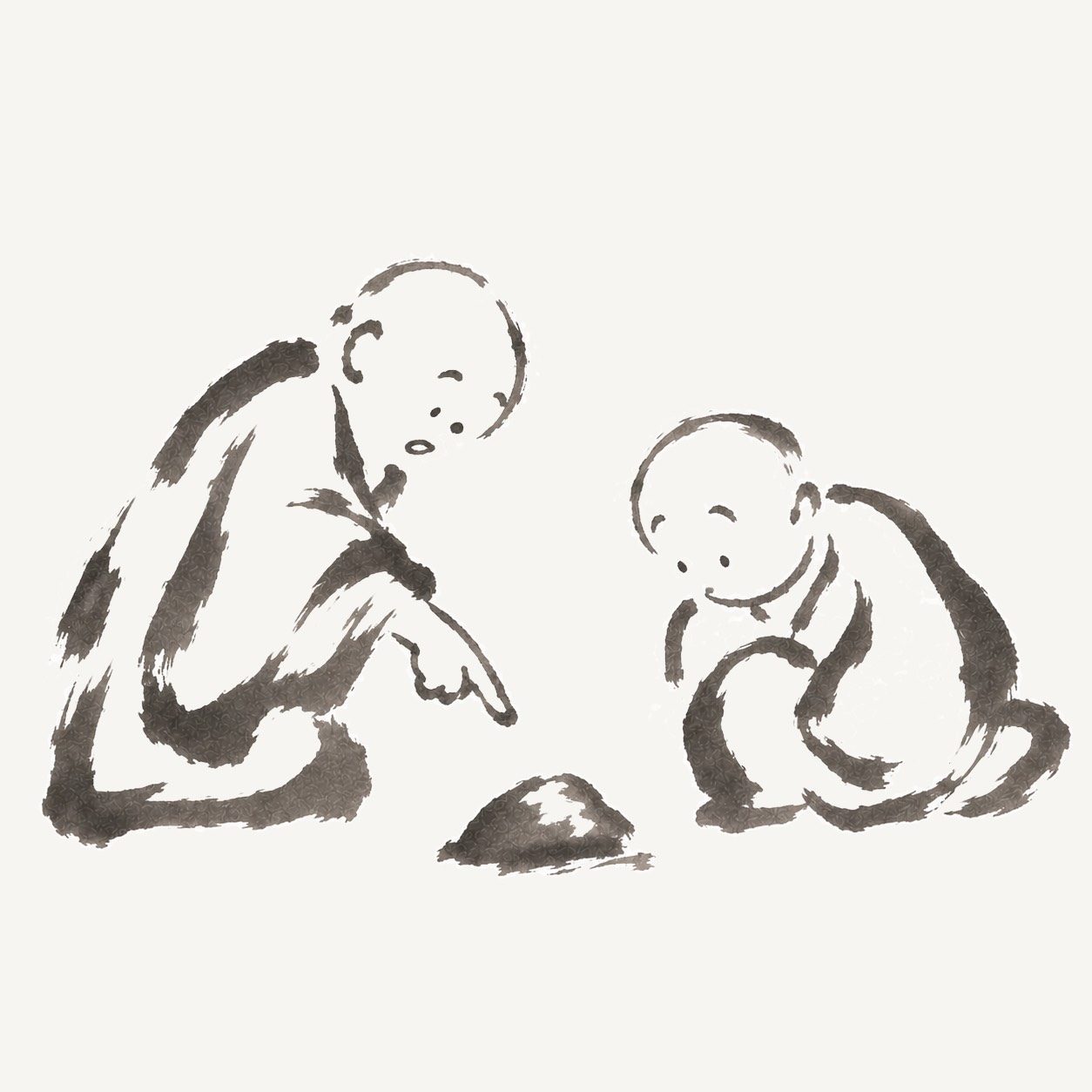
Two monks, one pointing toward a stone and the other looking at it. The motif illustrated role of the teacher in Bankei’s Zen: A teacher can direct attention to what is already present, but recognition remains the task of the student. AI-generated illustration with DALL•E 2, rendered in the style of Japanese Zenga ink painting.
Introduction
Bankei Yōtaku’s teaching of the Unborn raises an important question for the interpretation of Zen practice: What role does a teacher play if the unborn Buddha-mind is already present in every person? Zen traditions have often emphasized direct transmission, personal instruction, lineage, and the importance of a teacher who can test, guide, and correct the student. Bankei does not simply reject this framework. He was himself a teacher, instructed monks and laypeople, answered questions, corrected misunderstandings, and spoke within the broader context of Japanese Zen. Yet his teaching also limits the role of any external mediator.
For Bankei, the unborn Buddha-mind is not produced by a teacher. It is not created through ordination, transmitted as an object through institutional authority, or generated by formal training. It is already present. Bankei’s repeated claim that every person receives at birth only the unborn Buddha-mind, “nothing else”, is central here. A teacher can point out a misunderstanding, expose self-deception, clarify practice, and help the student recognize where delusion is being produced, but he does not give the Buddha-mind to the student.
Bankei’s own explanation of his biography supports this interpretation. When asked why he himself had to undergo such severe struggles before awakening, while he now taught others a more direct way, he replied that his own struggles had been fought mistakenly because he had not met a clear-sighted teacher. He had eventually discovered the Buddha-mind for himself, but he now told others about theirs so that they would not have to undergo the same ordeal. This is important because it actually gives a balanced view. A teacher can spare unnecessary suffering by pointing clearly, but he does not ‘create’ the Buddha-mind. He only helps the listener recognize what is already present.
Bankei’s view of the teacher and student relationship is therefore neither anti-teacher nor teacher-dependent. It preserves the practical value of guidance while denying that guidance is an ontological bridge between the practitioner and awakening. The teacher is useful because delusion is subtle. The teacher is not ultimate because the Buddha-mind is not located outside the practitioner.
The teacher does not give the Buddha-mind
Bankei’s teaching rests on the claim that every person already has the unborn Buddha-mind. This is not a latent substance that must first be activated by a master, nor a hidden object that requires ritual transmission. It is the original condition of the person before the mind is transformed into anger, fear, craving, self-defense, pride, or attachment to thought.
This claim appears most clearly when Bankei states that if someone confirms that the unborn, illuminating wisdom is truly the Buddha-mind and lives in it just as they are, then this person is, in that very moment, a living Tathāgata. The teacher does not insert something into the student. The decisive act is the student’s confirmation and life from the Buddha-mind.
If this premise is accepted within Bankei’s framework, then the teacher cannot be the source of awakening. The teacher can only direct attention back to what is already present. The teacher and student relationship is therefore not a relation between one who possesses the Dharma and another who lacks it. It is a relation between one who can point clearly and one who has not yet recognized the functioning of the Buddha-mind.
This is a significant shift from models of religious authority in which the teacher, priest, institution, or lineage becomes a necessary mediator between the individual and truth. Bankei’s Zen weakens this mediating structure. The Buddha-mind does not belong to the teacher. It is not stored in the lineage. It is not transmitted through rank. The decisive condition is already present in the person listening.
Bankei’s task as a teacher is therefore not to add something to the student, but to remove a misunderstanding. The student does not need a new essence, the student needs to stop mistaking conditioned reactions, thoughts, and self-centered habits for original nature.
Bankei as teacher
Bankei’s critique of dependency on external mediation should not be confused with a rejection of teachers. His own activity shows the opposite. He gave public sermons, responded to questions, corrected misunderstandings, and addressed the concrete problems of ordinary practitioners. His audiences included monks, nuns, laymen, laywomen, the fearful, the angry, the sick, the confused, and those attached to formal practice. This matters because Bankei’s teaching can easily be misunderstood as a purely individualistic path. In fact, it is not. Bankei clearly regarded instruction as useful. He also assumed that human beings are prone to self-deception. People mistake anger for temperament, fear for reality, thoughts for truth, pain for self, and religious concepts for realization. A competent teacher can interrupt these errors.
Bankei’s own pedagogical style is diagnostic rather than sacramental. When a monk claims that he was born with a hot temper, Bankei does not give him a ritual, a kōan, or an abstract theory. He asks him to show the anger. Since the monk is not angry at that moment, Bankei concludes that the anger cannot be inborn. It is produced when the monk takes sides for himself. The teacher’s role here is to expose the mechanism of delusion. The same pattern appears in Bankei’s response to the woman afraid of thunder. He does not offer a protective rite. He tells her that when she was born, she possessed only the unborn Buddha-mind, and that fear was not part of it. Her fear is an invention of thought. Again, the teacher does not create awakening. He redirects attention to the production of delusion.
The teacher’s role in Bankei’s teaching is therefore functional. He does not act as a gatekeeper of awakening, does not claim that the student must pass through him in order to access the Buddha-mind. He teaches by directing attention to the concrete production of delusion. The teacher’s function is thus diagnostic. He identifies where the student transforms Buddha-mind into delusion.
Awakening without a formal teacher
Bankei’s teaching implies that awakening without a formal teacher is possible. This does not mean that it is always easy, reliable, or free from danger. It means that the decisive condition for awakening is not external. The unborn Buddha-mind is already present. Therefore, no external authority is required to make it real.
Bankei’s own autobiographical remark is again the perfect example here. He says that his severe struggles were mistaken because he lacked a clear-sighted teacher. This does not mean that without a teacher awakening is impossible. He himself did awaken after those struggles. But it does mean that the absence of clear guidance can make the path unnecessarily painful, confused, or indirect. A teacher may shorten the path by pointing clearly, but the awakening itself still concerns the recognition of the Buddha-mind already present.
A person without a teacher can begin where Bankei’s own examples begin: By observing the mind directly. Thoughts arise and pass away, they are not permanent. They are not self. Anger appears only under certain conditions. Fear appears when thought constructs and believes a threat. Craving appears when perception is appropriated by desire. Self-defense appears when the mind takes sides for itself. Bankei’s teaching on thoughts offers a concrete practice here. He says that thoughts arise when past experiences are reflected in the Buddha-mind. Originally, however, they have no real substance. Therefore, one should let them arise when they arise and cease when they cease. One should not try to cut them off. If one does not attach to them, no delusion is formed. This is a form of practice that can be examined directly, even without a teacher.
This observation is in fact not theoretical. It takes place in ordinary experience. One can watch anger begin. One can see how a word becomes an insult. One can see how pain becomes “my suffering”. One can see how a thought becomes “my truth”. One can see how the mind shifts from simple perception into self-defense, anxiety, resentment, or grasping. This is the point at which Bankei’s Zen becomes practice. The practitioner does not need to manufacture a special state. The practitioner needs to see how delusion is produced and stop feeding that production. A teacher can help in this process, but the seeing itself must occur in one’s own experience.
The danger of self-deception
Bankei’s teaching should not be turned into the simplistic claim that everyone can safely guide themselves without correction. Human beings are capable of mistaking self-deception for insight. A person may believe that they are living in the Unborn while actually defending pride, avoiding discipline, suppressing conflict, justifying passivity, or refusing criticism. This danger is one reason why Zen traditions have often valued teachers. A teacher can sometimes see what the student cannot see. A teacher can expose premature certainty, spiritual pride, hidden attachment, or confusion between non-attachment and indifference. Without such correction, the language of Buddha-mind can itself become another ego structure.
Bankei’s own teaching contains a practical safeguard against this. The test of the Unborn is not whether one holds an attractive idea about Buddha-mind, but whether one’s conduct changes. Bankei’s instruction to remain in the Unborn for thirty days, for instance, shows this practical dimension. He asks listeners not merely to accept a doctrine, but to test it in life. If living in the Unborn becomes habitual, he says, it becomes natural. The relevant question is therefore concrete. Does anger lose some of its authority? Does fear become more transparent? Does one take sides for oneself less automatically? Does one cling less strongly to thoughts? Does one respond with greater clarity and less defensiveness? If none of this happens, then the Unborn has remained a concept. Bankei’s teaching does not support the view that merely claiming to possess Buddha-mind is equivalent to realization.
Recognition is personal, but not private possession
Bankei’s teaching distinguishes between personal recognition and private ownership. No one can recognize the Unborn on behalf of another person. In this practical sense, awakening is personal. It must be confirmed in one’s own seeing, hearing, thinking, speaking, and acting. A teacher can point toward the Buddha-mind, but the student must recognize it.
Bankei’s own formulation that one must confirm the Unborn as the Buddha-mind is propably important here. The teacher may speak, but the listener must confirm. The teacher may indicate the error, but the listener must see how anger, fear, thought, or self-partiality is being produced. The confirmation cannot be outsourced. At the same time, this recognition is not the discovery of a private spiritual possession. Buddha-mind is not “mine” in the way a soul, essence, or inner treasure might be imagined as mine. It is better understood as the suchness of experience when the mind does not fabricate selfhood around it. Seeing occurs without turning seeing into self. Pain occurs without turning pain into identity. Thought occurs without turning thought into possession. This is why the teacher cannot own the truth on behalf of the student. The teacher may see more clearly, but Buddha-mind is not an object that can be handed over. It is recognized when the self no longer appropriates experience as “I” and “mine”.
Bankei therefore avoids both dependency and isolation. The practitioner does not need an external mediator to receive Buddha-mind. But the practitioner also should not convert this into egoic self-certainty. Guidance can be useful because delusion is subtle. It is not absolutely necessary because, within Bankei’s framework, the Unborn is already present.
Ordinary life as a field of instruction
Bankei’s examples are mostly ordinary. They concern anger, fear, illness, sleep, work, speech, thought, family conflict, and daily irritation. He does not place awakening in a distant spiritual theater, but in the common situations where self-deception actually arises. For a person without a formal teacher, this is especially important. Ordinary situations can reveal the same mechanisms a teacher might point out. Irritation shows where the self defends itself. Fear shows where thought fabricates threat. Craving shows where perception becomes grasping. Pain shows where sensation becomes identity. Conflict shows where one takes sides for oneself. Bankei explicitly uses such situations in his teaching. He warns listeners that after leaving the hall someone may be pushed or insulted, or that someone at home may say something unpleasant. If one then becomes agitated and takes sides for oneself, the Buddha-mind is transformed into a fighting spirit. This is not an abstract philosophical claim, but a practical instruction for daily life.
This does not mean that ordinary life automatically teaches. The same event can deepen delusion or expose it. A harsh word can produce resentment, or it can reveal the mechanism of self-defense. Illness can produce despair, or it can reveal the difference between pain and self-identification. A thought can become obsession, or it can be seen as an empty appearance. Ordinary life functions as instruction only when it is observed without immediate self-justification. In this sense, the world can become a field of practice, but not because every reaction is already clear. It becomes practice when the practitioner uses ordinary experience to examine the arising of delusion.
Teacher, method, and immediacy
Bankei’s critique of formal methods also shapes his view of teaching. A teacher is useful insofar as the teacher points directly to the Unborn. If the teacher merely multiplies methods, strengthens dependency, or turns practice into imitation, then the teacher can become an obstacle. Bankei does not reject methods because he rejects practice. He rejects dependence on methods because they can obscure the immediacy of the Buddha-mind.
His criticism of so-called “method-Zen” is also relevant here. Bankei criticizes teachers who rely on old tools because they cannot teach directly. He complains that some teachers burden students with artificially produced great doubt instead of teaching them to live in the unborn Buddha-mind. This is not simply a rejection of all historical Zen devices. He acknowledges that past masters used different means in response to particular circumstances. His objection is to mechanical imitation. The same applies to teachers. A teacher can help or obstruct. A teacher helps when he or she enables the student to see directly. A teacher obstructs when the student becomes dependent on authority instead of recognizing the Buddha-mind in immediate experience.
This is a delicate point. Bankei’s Zen does not support anti-teacher arrogance. It also does not support teacher worship. The teacher is not irrelevant, but the teacher is not ultimate. The Dharma is not the teacher’s property. Buddha-mind is not located outside the practitioner. The best teacher, in Bankei’s sense, is one who points the student back to what has always been present rather than creating permanent dependence on the teacher’s role.
Awakening as responsibility
Bankei’s view has a strong practical consequence. If Buddha-mind is already present, then one cannot blame the absence of awakening entirely on external conditions. One cannot say that the Buddha-mind is unavailable because one lacks the right teacher. One cannot say that one cannot begin because one lacks the right method. One cannot say that one is excluded because one is a layperson. This is not meant as crude moral blame, it is a shift away from dependency. The decisive condition is already present. The work begins wherever one stands. If anger arises, one can observe it. If fear arises, one can observe it. If thoughts appear, one can let them appear without grasping them. If the self takes sides for itself, one can recognize that movement.
Bankei’s own examples make this responsibility concrete. The angry monk cannot finally explain his anger by claiming that it is inborn. The woman afraid of thunder cannot finally explain her fear as part of her original nature. The practitioner disturbed by thoughts does not need to blame the thoughts themselves. In each case, Bankei redirects attention to the activity through which delusion is produced.
Bankei’s teaching is therefore empowering, but not permissive. It gives the practitioner direct access, but also direct responsibility. The practitioner cannot hide behind the absence of a teacher. At the same time, the practitioner cannot claim realization merely because the doctrine says that everyone already has Buddha-mind. Recognition must be reflected in conduct.
Laypeople, monks, and access to awakening
Bankei’s teaching weakens a strict hierarchy between monks and laypeople. Monastic life may offer discipline, structure, reduced distraction, and access to teachers and community, which are real advantages. But monastic life does not create the Buddha-mind. A layperson does not lack the Unborn by living outside a monastery. A monk does not possess the Unborn more fully by wearing robes. This conclusion follows directly from Bankei’s statement that every person receives the unborn Buddha-mind at birth. It is also reflected in the wide range of people he addresses. His sermons are not limited to monks engaged in advanced training. He speaks to women, laypeople, sick people, fearful people, angry people, and those confused by ordinary thought and reaction. This does not make monastic practice meaningless. It means that its value is practical rather than ontological. A monastery may help one live more consistently in the Unborn. A teacher may help one recognize delusion. A practice form may support attention. But none of these produces Buddhahood from nothing.
Bankei’s openness to laypeople follows from this premise. Buddha-mind is not reserved for specialists. Anyone can recognize it because, according to Bankei, everyone already has it. The decisive difference is not social or institutional status, but recognition and conduct.
This is one of the more socially significant aspects of Bankei’s Zen. It gives full seriousness to ordinary people without romanticizing ordinary delusion.
What a teacher can still provide
A balanced interpretation should preserve the real value of teachers. A good teacher can provide forms of correction and clarification that are difficult to generate alone. Bankei himself provides examples of this. He names delusion when the student rationalizes it. He shows the angry monk that anger is not inborn. He shows the woman afraid of thunder that fear is a fabrication of thought. He shows practitioners attached to inherited methods that they may be imitating forms instead of living in the Unborn. He shows those attached to thoughts that thoughts need not be cut off, only not grasped.
A teacher can also distinguish non-attachment from indifference. A teacher can distinguish living in the Unborn from passivity. A teacher can prevent the student from turning Buddha-mind into a metaphysical soul, a universal One Mind, or a spiritual identity. A teacher can offer examples of embodied practice. A teacher can challenge the student when insight remains merely conceptual. These functions are valuable. Bankei himself performed them throughout his teaching activity. His sermons are full of concrete corrections. He does not leave people alone with abstractions. He addresses confusion directly. But these functions remain secondary to the Unborn itself. The teacher is a condition that may help recognition, but he is not the source of what is recognized. Guidance can be skillful, but it is not the foundation. The foundation, in Bankei’s teaching, is the unborn Buddha-mind.
Conclusion
Bankei’s Zen does not abolish the teacher and student relationship, but it redefines it. The teacher is not a mediator who grants access to awakening. The teacher is not the owner of the Dharma and he does not produce Buddha-mind in the student. The teacher points to what is already present and helps clarify where it is being obscured. This means that awakening without a formal teacher is possible in Bankei’s framework. The unborn Buddha-mind is already present, and the practitioner can recognize it in the arising and passing of thoughts, emotions, reactions, pain, fear, and self-defense. Ordinary life itself becomes the place where the transformation of Buddha-mind into delusion can be observed.
At the same time, Bankei’s teaching does not justify careless self-certainty. Without guidance, self-deception remains a serious danger. Bankei’s own teaching activity demonstrates why instruction can be valuable. He does not give the Buddha-mind to others, but he repeatedly exposes the places where they mistake anger, fear, thought, method, or habit for their original nature. The claim “I already have Buddha-mind” is meaningful only if it changes conduct. The Unborn must be reflected in less anger, less self-partiality, less clinging, clearer speech, and greater freedom from the drama of “I” and “mine”.
Bankei’s position is therefore neither institutional dependency nor individualistic arrogance. It is direct responsibility supported, where possible, by clear guidance. A teacher can help, but no teacher can replace the recognition of the Unborn. A teacher can point, but Buddha-mind is already where the student stands.
References and further reading
- Norman Waddell (Herausgeber), Bankei Eitaku, Die Zen-Lehre vom Ungeborenen. Leben und Lehre des großen japanischen Zen-Meisters Bankei Eitaku (1622 - 1693), 1988, ISBN-10: 3502640505
- Peter Haskel (Übersetzer), Yoshito Hakeda (Herausgeber), Mary Farkas (Vorwort), Bankei Zen - Translations From The Record Of Bankei, 1994, Grove Press, ISBN: 9780802131843
- Oliver Bottini, Das große O.-W.-Barth-Buch des Zen, 2002, Barth im Scherz-Verl, ISBN: 9783502611042
- Heinrich Dumoulin, Geschichte des Zen-Buddhismus, Band 1+2, 2019, 2., durchgesehene und erweiterte Auflage, Francke A. Verlag, ISBN: 9783772085161
- Hans-Günter Wagner, Buddhismus in China: Von den Anfängen bis in die Gegenwart, 2020, Matthes & Seitz Berlin, ISBN: 978-3957578440
- Jr. Buswell, Robert E., Jr. Lopez, Donald S., Juhn Ahn, J. Wayne Bass, William Chu, The Princeton dictionary of Buddhism, 2014, Princeton University Press, ISBN: 978-0-691-15786-3











comments