Jishō zanmai: Dōgen and the samadhi of self-experience
The idea of experiencing or knowing oneself appears straightforward, but within Dōgen’s Buddhist framework it becomes a fundamental challenge to ordinary assumptions about the self. The self cannot simply turn inward and discover an independent essence waiting to be recognized. What is called the true self emerges only through relations that exceed private consciousness: Teacher and student, hearing and teaching, body and world, scripture and practice, reception and transmission. Self-experience therefore does not confirm the individual as an autonomous authority. It exposes the individual as inseparable from the wider activity of the Buddha-Dharma.
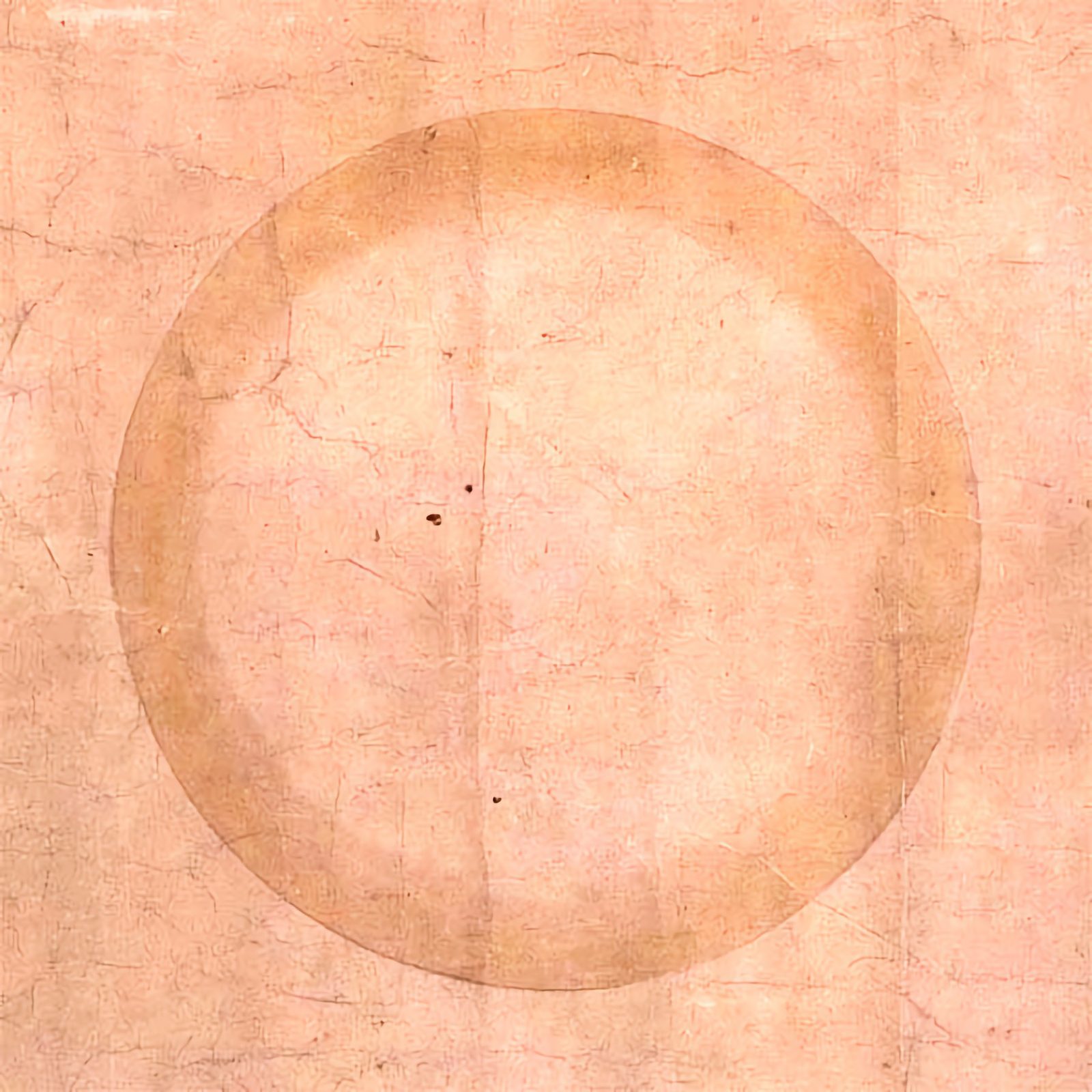
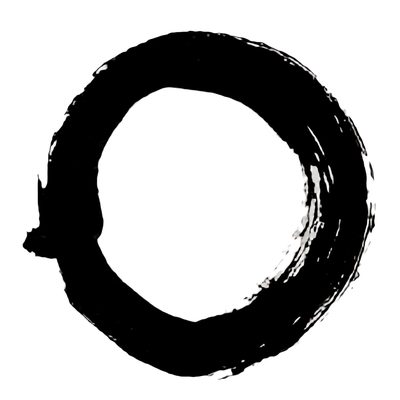
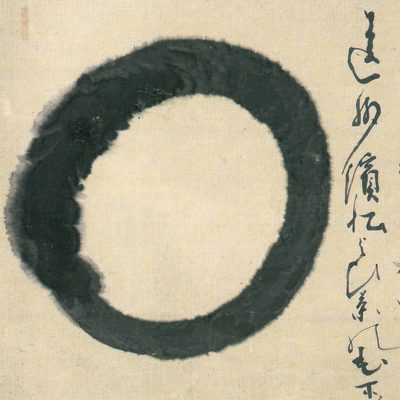
Picture No. 8 of the so-called Oxherding Pictures (十牛図, jūgyūzu), a series of ten images that depict stages of spiritual cultivation in Zen Buddhism. Painted by the Japanese Rinzai Zen monk Shubun in the 15th century after lost 12th-century originals, it is conventionally titled “Both Bull and Self Transcended” and shows an empty circle. The image is a later Zen parallel, rather than a direct illustration, to Jishō zanmai: both unsettle the opposition of subject and object, although Dōgen’s fascicle develops this problem through teachers, sutras, embodiment, and transmission. Source: Wikimedia Commonsꜛ (license: public domain)
In this post, we examine how Dōgen’s Shōbōgenzō fascicle Jishō zanmai redefines self-experience as an embodied, relational, and transmitted form of practice. We follow Dōgen’s identification of the “true self” with following teachers, following the sutras, teaching others, and encountering the universe as scripture. We also consider his criticism of self-certifying enlightenment, intellectual mastery, and experience detached from practice. The fascicle asks how self-verification can avoid becoming another possession of the ego.
Introduction
Jishō zanmai (自証三昧), often translated as the samadhi of self-experience, the samadhi of self-verification, or the samadhi of experiencing the true self, is one of the later fascicles of Eihei Dōgen’s Shōbōgenzō. It was presented in 1244 at Kippō-ji in Echizen. The title combines ji, “self”, shō, “verification”, “realization”, or “experiential confirmation”, and zanmai, derived from Sanskrit samādhi. The title therefore concerns a form of collected practice in which the self is verified or realized.
The translation “self-experience” can easily create a misleading first impression. In modern usage, it may suggest introspection, self-awareness, authenticity, or a private spiritual state. Dōgen uses the term within a very different context. He does not describe an ego observing its own inner contents, nor does he present enlightenment as an experience whose authenticity can be established by the person who has it. Instead, he connects self-verification with the inherited Buddha-Dharma, with teachers, sutras, bodily conduct, teaching, hearing, and recognized lines of transmission.
The expression “true self” therefore requires careful interpretation. It does not necessarily indicate a permanent essence concealed beneath the ordinary personality. Such a reading would conflict with non-self and would reproduce the very model of private self-certification that Dōgen criticizes. In this fascicle, the “true self” is better understood as the self examined within Buddhist practice once claims of independent ownership and authority are questioned. Dōgen describes this self through relations and activities rather than through an account of an inner substance.
The fascicle combines constructive argument with aggressive sectarian polemic. Dōgen first defines jishō zanmai through “following a good teacher” and “following the sutras”. He then extends both expressions beyond their ordinary meanings. A teacher is not merely a person who transmits information, and a sutra is not limited to a written document. Teaching, hearing, bodily gestures, robes, meals, staffs, encounters, mountains, rivers, and daily conduct all enter his account. The second half of the fascicle uses Dai-e Sōkō as a negative example. Dōgen portrays him as learned, rhetorically capable, institutionally successful, and yet unable to distinguish personal conviction from verified realization.
This makes Jishō zanmai an important companion to several of Dōgen’s other practice-centered texts. Bendōwa presents zazen as the enactment of practice-realization. Fukan zazengi gives instructions for seated practice. Shinjin gakudō examines the study of the Way through body and mind. Jishō zanmai approaches a related problem from the perspective of authorization: What counts as verified self-experience, and why can the individual practitioner not simply declare their own understanding authentic?
The structure of the text
Jishō zanmai develops through two unequal but connected parts. The first establishes Dōgen’s own account of self-verification through teachers, sutras, embodied practice, and teaching. The second uses the career of Dai-e Sōkō to show what Dōgen believes goes wrong when a practitioner claims the authority to verify themselves independently.
Dōgen begins by placing the samādhi of self-experience within the transmission of the seven Buddhas. Six Buddhas are believed to have preceded Sakyamuni Buddha in earlier ages, and together with Sakyamuni they symbolize the continuity of awakening across time. Dōgen then connects them with later Buddhas and ancestors. He immediately equates this samādhi with “following a good teacher” and “following the sutras”. This opening establishes the basic position of the fascicle: Self-verification does not mean that the practitioner becomes independent of religious teaching, communal practice, or recognized transmission.
He then describes the teacher-student relationship through inherited Chan stories involving gestures, bows, bodily sacrifice, signs, and the transmission of “marrow”. These images place self-experience within a ritualized and bodily relationship rather than within solitary reflection. Dōgen uses them to present the student not as a passive recipient of information, but as someone whose understanding is tested and formed through encounter.
The discussion of sutras begins with written Buddhist texts but expands to include the whole universe, ordinary actions, monastic objects, and ritual forms. Dōgen does not abolish the distinction between a written sutra and a walking staff. Instead, he broadens the category of scripture so that textual study, material practice, ritual conduct, and perception of the world can all function as occasions for Buddhist instruction.
Dōgen then identifies following teachers and sutras with following oneself. This does not mean that teachers and texts are projections of a private mind. It means that the self is investigated through its relations with them. His “true self” is therefore not defined by autonomy from external influence, but by participation in practices that unsettle the boundary between internal understanding and external instruction.
The fascicle next turns from receiving the Dharma to teaching it. Dōgen presents teaching and hearing as mutually implicated activities and argues that teaching others can deepen the teacher’s own understanding. He also rejects the demand that a practitioner achieve complete clarity before speaking. Since practice is inexhaustible, waiting for final certainty would become a justification for permanent silence.
These constructive sections establish the criteria by which Dōgen later judges Dai-e Sōkō. Sōkō’s biography occupies a large portion of the fascicle because Dōgen uses it to dramatize several failures: Premature demand for succession, confidence in one’s own insight, dependence on intellectual understanding, pursuit of institutional recognition, and trust in experiences described as awakening. Whether this account is historically fair is a separate question. Within the composition of the fascicle, Sōkō functions as the counterexample against which Dōgen defines authentic self-verification.
Dōgen concludes by identifying the words of Buddhas and ancestors with their body, mind, eye, bones, and marrow. This is not a neutral statement about language. It completes his argument that verified Buddhist speech cannot be separated from the embodied practice and recognized [transmission] of those who speak it. The fascicle thus moves from a potentially private concept, “self-experience”, toward an account in which the self is verified through practices, relationships, texts, objects, speech, and institutions that the individual does not control alone.
Jishō zanmai
The full text follows:
Jishō zanmai
The samadhi of experiencing the true self is what has been authentically transmitted since the seven Buddhas from one Buddha to another and from one ancestor to another. We sometimes call it “following a good teacher” and sometimes “following the sutras”. It is the eye of the Buddhas and ancestors. Therefore Sōkei, the eternal Buddha, asked a monk whether he relied on practice and experience or not. The monk answered that there is undoubtedly practice and experience, but that it is impossible to defile them. Remember, therefore, that the Buddhas and ancestors are this undefiled practice and experience. This very practice and experience is the samadhi of rolling thunder, lightning, and storm.
In the very moment when you “follow a good teacher”, you meet one another; that is, sometimes you meet half of his face and sometimes half of his body. Sometimes you meet his whole face and his whole body, and sometimes you meet half of yourself and sometimes half of the other. Sometimes it is the shared experience that the head of a god is covered with hair or that horns appear on the face of a demon. Sometimes you adapt to circumstances while living among strangers, and sometimes you change circumstances while dwelling among people of your own kind.
In all these situations in life, you cannot know how many thousands or tens of thousands of times you have given your body for the sake of the Dharma, and you cannot know how many hundreds of millions of times you have sought the Dharma for the sake of your body. Such is the powerful action when you follow a good teacher, and it is the actual situation when you investigate yourself and follow yourself. When teacher and student meet one another through a sign with the eyes, a smile appears; and when the student who has received the marrow bows down before the teacher, he cuts off his arm. Fundamentally, before and after the seven Buddhas and down beyond the sixth ancestor, there have been not just one or two good teachers who encountered their true self. And good teachers who have met others belong neither to the past nor to the present.
When you sometimes follow the sutras, you investigate and explore your own skin, flesh, bones, and marrow. And when your own skin, flesh, bones, and marrow fall away from you, you see the peach blossoms directly emerging from your eyes, and you hear the thunderous sound of bamboo directly coming out of your ears.
Fundamentally, the sutras become living reality when you follow and practice them. What I here call “the sutras” is the whole universe in the ten directions. They are the mountains, the rivers, and the earth; they are the grass and the trees, yourselves and the world. The sutras are putting on the robe and eating meals, and they are your doing and acting in every moment. When you investigate the truth by following these texts, each of which is a volume of sutras, then thousands and tens of thousands of unprecedented sutras become reality before you.
In these sutras there are statements of affirmation that describe real situations just as they are, and there are verses of negation that are clear and accord with reality. If you gain the ability to meet these sutras directly by bringing forth the full power of body and mind in order to experience and investigate them, you will undoubtedly penetrate the highest and understand them, even if long ages pass and you use long ages for this. If you give up body and mind in order to experience and investigate the sutras directly, you will undoubtedly realize the merit of having received and preserved them, even if you must carve out eternity for this and rise up from eternity.
The number of Indian Sanskrit texts that have been translated into Chinese and have become Dharma scriptures today is less than five thousand. Among these writings there are the sutras of the three and five vehicles and those of the nine and twelve teachings. You should investigate all of them and follow them. Even if you wanted not to follow them and to flee from them, this would be impossible. Therefore these sutras sometimes become a Buddha-eye and sometimes the marrow of truth. Although you receive them from others and transmit them again to others, this is only the powerful leaping forth of the Buddha-eye itself, which has freed itself from self and others, and it is only the transmission of the marrow, which is free from self and others. Because the Buddha-eye and the marrow are neither yourselves nor others, the Buddhas and ancestors have transmitted them from the past to the past, and the Buddhas and ancestors transmit them from the present to the present.
There are walking staffs that are sutras, teaching the length and breadth of the whole universe and naturally bursting apart all theories of emptiness and existence. There are fly-whisks that are sutras and that cleanse snow and frost. There are one or two encounters that are sutras of zazen, and there is a volume containing ten fascicles that is the sutra of the kesa. All these sutras are guarded and preserved by the Buddhas and ancestors. Following the sutras in the above way means that you practice and experience them and arrive at the truth. Your efforts to follow the sutras are sometimes realized with the face of a god or a human being and sometimes with the face of the sun or the moon.
Following a good teacher and the sutras therefore means following yourself. The sutras are naturally the sutras of the true self, and a good teacher is naturally a good teacher of the true self. When you seek out a teacher and investigate the teaching comprehensively, you seek out yourself and investigate yourself. To use the hundred grasses means that you use yourself, and to use the ten thousand trees means that you use yourself. In the Buddha-Dharma, we experience and investigate that you yourselves are nothing other than this effort. In this investigation and experience, you free yourselves from yourselves as persons and experience yourselves in accord with your true self.
Therefore, in the great truth of the Buddhas and ancestors, there are concrete tools, upāya, for experiencing and recognizing your true self, but without the legitimate successors of the Buddhas and ancestors they cannot be authentically transmitted. Thus there are methods received and transmitted from one legitimate successor to the next, but without the bones and marrow of the Buddhas and ancestors they cannot be authentically transmitted.
Because you experience and investigate yourselves in this way, phrases such as “you have attained my marrow” and “I have the treasury of the true Dharma-eye and transmit it to Mahākāśyapa” were spoken when they were received by one person and transmitted to another. Teaching others does not necessarily have to do with yourselves and others. Teaching others is ultimately nothing other than teaching your true self. It is a teaching and a hearing in which the true self that teaches and the true self that hears experience themselves at the same time. One ear hears and one ear teaches; one tongue teaches and one tongue hears; and the same applies to the eyes, ears, nose, body, and mind, to the sense faculties and their objects, to consciousness, and so on.
In other words, there is the practice and experience of the unity of body and mind. Then the ears themselves hear and teach, and the tongue itself hears and teaches. Yesterday you taught others the exception to the rule, and today you teach the fixed rule for yourselves. In this way, the faces of the sun and the faces of the moon line up one after another. To practice the Dharma and present it to others means that in every moment of your life you hear the Dharma, gain clarity about it, and experience it yourself.
Even in this life it will become easier for you to attain the Dharma if you teach it to others with a sincere mind. Or if you help and encourage others to hear the Dharma, it will be easier for you yourselves to investigate the Dharma. Teaching the Dharma supports and strengthens your body and mind. If you prevent others from hearing the Dharma, you prevent yourselves from hearing the Dharma.
To hear the Dharma with the whole body and throughout your whole life moment by moment, and to teach it to others moment by moment, means that in your present lifetime you hear the Dharma that was authentically transmitted to you in the past. Since you were born in the Dharma and will die in the Dharma, and since the Dharma is authentically transmitted to you throughout the whole universe in the ten directions, you hear the Dharma in every moment of your life and you practice the Dharma in every moment with your body.
Because it is possible to realize the Dharma in every moment of your life and to make your body into the Dharma in every moment, you connect the world of one dust particle with the whole universe and let it experience the Dharma. Therefore you should teach a word that you have heard in the east to a person when you come to the west. This means that you use yourself for the effort of making hearing and teaching into one single action, and it means that you practice and experience the eastern and western true self as one.
In any case, you should consider yourselves fortunate, wish for, and long for the Dharma of the Buddhas and the Way of our ancestors to come as near as possible to your body and mind, so that you may practice them. Your practice should extend from one hour to one day and from one year to an entire life. Rejoice in the Buddha-Dharma and let it play with your soul. To do this means that you have not wasted even one life.
On the other hand, you should not think that you are unable to teach other people if you yourselves have not yet attained clarity. If you wanted to wait for final clarity, this would not happen in countless ages. For even if you have gained clarity about human Buddhas, you must still gain clarity about heavenly Buddhas. Even if you have clarified the mind of mountains, you must also clarify the mind of waters. Even if you clarify the dharmas that arise from causes and conditions, you must still clarify the dharmas that do not arise from causes and conditions. And even if you have gained clarity about the sphere of the Buddhas and ancestors, you must still gain clarity about what lies beyond the Buddhas and ancestors. If you intend to gain clarity about all these things in a single life and only then teach others, then you are not making effort, you are not strong, and you do not experience and investigate the Dharma.
In general, students who investigate the Way of the Buddhas and ancestors let their will to teach others pierce the heavens, even from the time when they have experienced and investigated one method or one principle of the teaching. In this way they free themselves from themselves and from the world. In other words: when you have truly experienced yourselves to the ground, you have already experienced the world to the ground. And when you have experienced the world to the ground, you have experienced yourselves to the ground.
You cannot realize this Buddhist fundamental truth with the body if you have not received it from a teacher. This is true even if you are knowing by nature. If those who are knowing by nature have never met a teacher, they do not know what is beyond their knowledge, and they do not understand either their nature or their knowledge. Even if a person is knowing by nature, they cannot understand the great Way of the Buddhas and ancestors through this. Only after they have investigated and studied it will they understand it. The great Way of the Buddhas and ancestors is the realization of your true self in bodily experience, and it is the realization of the true self of the world in bodily experience. Simply use your beginner’s mind, which learns and investigates, and experience unity with the beginner’s mind of the world. To begin from this beginner’s mind and continue to experience yourselves and the world as one means to come into contact with the highest state of unity of self and world. And just as you work on yourselves, so should you advance the work of the world.
Nevertheless, when immature people hear words such as “experiencing oneself” or “knowing oneself”, they think that they do not need to receive the Dharma from a master, but can study it on their own. This is a great error. Those who mistakenly take discriminating thought to be knowing themselves and have not received the Dharma from a master are like the naturalists in India who are outside the Buddha Way. How could people who do not know this difference be people of the Buddha Way?
Others, when they hear the expression “experiencing oneself”, think that it refers to the five skandhas and identify this experience with the self-discipline of the small vehicle. People who cannot distinguish between Hīnayāna and Mahāyāna may experience themselves as descendants of the Buddhas and ancestors, but what clear-sighted person would be deceived by them?
In the Shōkō era of the great kingdom of Song lived Sōkō, who was also called “Zen Master Dai-e of Mount Kinzan”. Originally he studied the sutras and commentaries. During his travels through the various districts of China, he followed Zen Master Ri of Senshū and studied Unmon’s Records of the Words and Actions of the Ancient Masters as well as Master Setchō’s Praises of the Ancient Masters. This was the beginning of his study.
After he could not grasp Unmon’s Way, he eventually practiced in the order of Master Tōzan Dōbi, but Dōbi ultimately did not allow him to enter his innermost sanctuary. Master Dōbi was the Dharma-son of Master Fuyō Dōkai, and you should never regard him as equal to people who sit in the back rows. Although Zen Master Sōkō studied and practiced with Dōbi for quite a long time, he could not grasp Dōbi’s skin, flesh, bones, and marrow, and how much less could he know that the Buddha-eye exists in a single dust particle?
One day, after he had heard that on the Way of the Buddhas and ancestors there is the Dharma of the document of succession, in which incense is burned on the arm, he immediately set out to request the document from Master Dōbi. But Master Dōbi refused him and finally said: “If you want to be a Dharma successor, you should not proceed hastily. You should simply make your effort here and now. The document of the Buddhas and ancestors is not transmitted lightly. I am not withholding it from you; it is only that you do not yet have the eye.”
Sōkō then said: “I have possessed the right eye from the beginning. I experience myself and know myself. How could you withhold Dharma-transmission from me?” Master Dōbi smiled and let the matter rest.
Some time later, Sōkō went to study in the order of Master Tandō Bunjun. One day Tandō asked him: “Why is half of your nose missing today?” Sōkō answered: “I am a student in Tandō’s order.” Tandō said: “You unreliable Zen priest!”
While Sōkō was reading a sutra, Tandō asked him: “What sutra are you reading?” Sōkō answered: “The Diamond Sutra.” Tandō said: “This Dharma is balanced and level, neither high nor low. Why is Mount Ungo high and Mount Hōbō low?” Sōkō said: “This Dharma is balanced and level, neither high nor low.” Tandō said: “You have become a truly learned fellow.”
On another day, while Tandō was watching the monks clean the ten temple guardians, he asked the elder monk Sōkō: “What is this eunuch’s name?” Sōkō said: “Ryō, just like you.” Tandō rubbed his head with his hand and said: “Why do I not wear the same cap on my head, although my name is also Ryō?” Sōkō said: “Although you do not wear a cap, his nostrils are very similar to yours.” Tandō said: “You unreliable Zen priest!”
One day Tandō asked Sōkō: “You experienced monk Sōkō, you can immediately understand the theory of my here-and-now Zen. You can teach it when I allow you to teach it. You can experience it when I allow you to experience it. When I allow it, you can give praises of the ancient masters and lead discussions about them, you can give spontaneous teachings and Dharma lectures and respond to a request for instruction. There is only one thing that you still do not have. Do you know what this one thing is?” Sōkō said: “What is it that I still do not have?” Tandō said: “You lack only that one understanding when someone exclaims, ‘Ah, so that is it!’ As long as you do not have this one understanding, you have my Zen when I teach you in my room, but as soon as you leave it, you immediately lose it again. When you think about it, you have my Zen, but as soon as you fall asleep, you immediately lose it again. How could you face life and death if you are like this?” Sōkō said: “That is exactly Sōkō’s doubt!”
Several years later, Tandō became gravely ill. Sōkō asked him: “When the master dies, on whom should I rely in order to complete the great matter?” Tandō confided the following to him: “There is a man called Gon from Ha. I myself do not know him. Nevertheless, I am certain that you will clarify the great matter if you meet him. Once you have met him, you should not seek another master. Practice Zen in a later life!”
If you examine this story carefully, you will know that Tandō never confirmed Sōkō. Although Sōkō repeatedly tried to arrive at enlightenment, in the end he lacked this one thing. He could neither attain it nor free himself from it. Before this, Master Dōbi had already refused him the document of succession and shown him that there was something he still did not have. You should grant Master Dōbi that he could fully see through the capacities of a person. Sōkō did say to Tandō, “That is precisely Sōkō’s doubt”, but he could not get to the bottom of his doubt, he could not free himself from it, and he could not break through it. His doubt was not “the great doubt”, and his state did not change through the doubt.
To request the document of succession prematurely is reckless for a person who wants to experience and investigate the truth. It became clear that Sōkō did not have the will to truth and did not want to imitate the ancient masters. We can say that Sōkō lacked deep insight and had no capacity for the truth. He was an extreme example of negligence in practice. Because he was greedy for fame and loved his own advantage, he wanted to break into the innermost place of the Buddhas and ancestors.
His ignorance of the words of the Buddhas and ancestors is regrettable. He did not understand that “experiencing his true self” is nothing other than venerating the old masters, and he had neither heard nor learned that “knowing oneself” is precisely the transmitted legacy of ten thousand generations. Therefore he made such an error and fell into such self-deception. And therefore in the lineage of Zen Master Sōkō there was not one, not even half of one, genuine nose ring, but many superficial people. Such people are not capable of understanding the Buddha-Dharma because they are unable to go beyond their intellectual understanding of the Buddha-Dharma. You monks of the present day must investigate and experience this in every detail. Never be negligent or proud.
As Tandō had recommended, after his master’s passing Sōkō became the student of Master Engo Kokugon at Tennei monastery in the capital. One day Master Engo ascended the teacher’s seat in the Dharma hall. Sōkō experienced a mystical awakening and spoke with Master Engo about it. Engo said: “Not yet. Although you are in this state, you have not yet clarified the great Dharma.” On another day in the Dharma hall, Engo quoted Master Goso Hōen’s phrases about existence and non-existence. When Sōkō heard these words, he experienced great peace and joy in the Dharma. Once more he presented his understanding to Engo. Engo laughed and said: “Did I deceive you?”
This is the story of the meeting between Zen Master Sōkō and Engo. In Engo’s order, Sōkō did hold the position of a high-ranking administrative monk, but again one cannot recognize that he realized anything, neither before nor after. In his own formal or spontaneous teachings, he did not mention any such realization. You should know that he never experienced the truth. Even if the chroniclers report that he experienced a mystical awakening and attained great peace and joy in the Dharma, you should not think that he attained anything of that kind. Do not believe that his experience was significant. He was only a student who studied and investigated. Nothing more.
Zen Master Engo, by contrast, was an eternal Buddha and highly venerable in the world of the ten directions. Since Ōbaku there has not been such a venerable ancestor as Engo. He was an eternal Buddha such as one rarely finds even in other worlds, but there are few human beings and gods who know this. This human world is a regrettable place.
I have now quoted the Dharma teachings of the eternal Buddha Engo and examined the experience of the old monk Sōkō. It is obvious that Sōkō never reached the wisdom of his master and that he was not on the same level as his master. How much less could he ever have surpassed his master’s wisdom, not even in a dream? Therefore you should know that Sōkō did not even reach half of his master’s merits. He could quote to others only a few words from the Flower Garland Sutra, the Śūraṅgama Sutra, or other sutras; he never had the bones and marrow of the Buddhas and ancestors.
Sōkō thought that the Buddha-Dharma was to be equated with the view and understanding of the small and great hermits who were drawn by the spirit of grasses and trees and guided by them. If Sōkō thought that this view was the Buddha-Dharma, then it is as clear as daylight that he never mastered and experienced the great truth of the Buddhas and ancestors.
After the years with Engo, Sōkō no longer traveled through the country. He did not seek out any other teachers either, but pointlessly became the master of a great monastery, where he instructed monks. The words he left us never even approach the outer regions of the great Dharma. Nevertheless, those who do not know this think that Zen Master Sōkō need not be ashamed in comparison with the ancients. But people who see and know are undoubtedly clear that he was not enlightened. Since Sōkō ultimately did not clarify the great Dharma, his teachings are only useless chatter.
Therefore you should know that Master Dōbi of Mount Tōzan, who could see into the future, was not mistaken. Zen Master Sōkō’s students resented him for this throughout their lives, even those of later times. But it was not only Master Dōbi who refused to confirm Sōkō. Master Bunjun opposed him even more than Dōbi did, because at every meeting he had something to criticize in Sōkō. Yet Sōkō’s students do not resent him for this. How foolish must we consider the people of past and present who have attacked Master Dōbi?
In general, many in the great kingdom of Song consider themselves descendants of the Buddhas and ancestors, but few have truly reached the ground of truth, and therefore few can teach the truth. This becomes very clear from the story above. Even in the Shōkō era it was already so, but today it is much worse than at that time. Today people have become teachers and leaders of monks who do not even know what the Buddha-Dharma could be.
Remember that the document of Dharma succession was authentically transmitted in the lineage of Mount Seigen. In this lineage, the document of Dharma succession was transmitted from India to China, from one Buddha to the next and from one ancestor to another, without distortion. From the lineage of Mount Seigen the document was naturally passed on to Mount Tōzan. No one else in the ten directions knew of it. The only ones who knew of it were the descendants of Tōzan, and they teach the monks through voice and word.
In his entire life, Zen Master Sōkō did not understand the words “experience one’s true self” and “know oneself”. How much less could he have experienced other dharmas in their depth? And how much less could even one of old Sōkō’s later students have understood what the expression “self-experience” means? Therefore the words of the Buddhas and ancestors that express their true self and the world are without doubt their body, their mind, and their Buddha-eye. Because the words of the Buddhas and ancestors are nothing other than their bones and marrow, their words are not those of ordinary people who attain only the skin.
Shōbōgenzō Jishō zanmai
Presented before an assembly at Kippō-ji in Etsu-u on the twenty-ninth day of the second lunar month in the second year of Kangen, 1244.
In-depth analysis of the text
Jishō zanmai is difficult because its central term can be read in two opposite ways. “Self-verification” may mean that the self confirms its own understanding, but Dōgen uses the fascicle to deny that such confirmation is sufficient. At the same time, he does not remove the practitioner from the process. Practice is personally enacted, embodied, taught, heard, and examined. The tension between personal realization and external verification structures the entire text.
The samādhi of self-experience is transmitted practice
Dōgen opens with the statement:
The samadhi of experiencing the true self is what has been authentically transmitted since the seven Buddhas from one Buddha to another and from one ancestor to another.
The formula “from Buddha to Buddha and from ancestor to ancestor” places jishō zanmai within the lineage through which Dōgen believed authentic Buddhist practice had been preserved. It does not mean that an identical object called ‘enlightenment’ was physically or metaphorically passed from one person to another. It asserts continuity between the practice recognized in the present and the practice attributed to earlier Buddhas and teachers.
This lineage claim has both doctrinal and institutional intentions. Doctrinally, it denies that self-verification is invented by the individual practitioner. Institutionally, it gives recognized teachers and lines of succession a role in determining what counts as legitimate realization. Dōgen’s argument therefore protects practice from arbitrary personal claims, but it also places considerable authority in inherited structures of recognition.
He then gives two alternative names for jishō zanmai:
We sometimes call it “following a good teacher” and sometimes “following the sutras”.
These expressions specify how self-verification occurs. It is not achieved by looking inward until certainty arises. It develops through engagement with teachers and Buddhist teachings. The self is not removed from this process, but neither does it control the criteria by which its experience is evaluated.
Dōgen’s formulation also resists a simple opposition between dependence and autonomy. Following a teacher is not presented as surrendering the self to an external authority, while following oneself is not presented as independence from teachers. His argument is that the self becomes available for examination precisely through practices and relationships that interrupt its tendency to confirm its own assumptions.
Undefiled practice and experience
Dōgen recalls the statement:
There is undoubtedly practice and experience, but it is impossible to defile them.
The term translated as “defile” here concerns appropriation. Practice and realization become distorted when they are treated as achievements belonging to an individual. Dōgen does not deny that practice occurs or that practitioners change through it. He rejects the conversion of practice into evidence for an enhanced spiritual identity.
He continues:
The Buddhas and ancestors are this undefiled practice and experience.
The sentence does not posit a literal identity between historical people and an abstract activity. Dōgen uses it to redefine what qualifies someone as a Buddha or ancestor. Their significance does not lie merely in possessing an experience or holding a title. They represent, within his account, the continuation of practice that has not been appropriated as private accomplishment.
Dōgen then calls this “the samadhi of rolling thunder, lightning, and storm”. The phrase disrupts the expectation that samādhi means quiet inward absorption. Rather than defining samādhi as a particular psychological state, he uses violent natural imagery to emphasize that collected practice can include intensity, movement, and disruption. The comparison is rhetorical rather than a technical description of a meditative state.
Following a good teacher means investigating oneself through encounter
Dōgen describes teacher and student meeting through faces, bodies, gestures, smiles, bows, signs, and stories of bodily sacrifice:
When teacher and student meet one another through a sign with the eyes, a smile appears; and when the student who has received the marrow bows down before the teacher, he cuts off his arm.
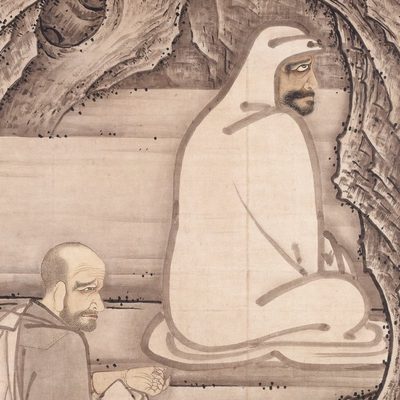
The passage compresses several inherited transmission narratives. The smile recalls the story of Mahākāśyapa, while the severed arm evokes the account of Huike approaching Bodhidharma. Dōgen treats these stories as models of commitment and recognition. They do not provide a historical description of ordinary teacher-student relations, and bodily mutilation does not constitute a general requirement of practice. Their function in the fascicle is to oppose a purely intellectual model of instruction. The relationship includes bodily presence, ritual behavior, discipline, imitation, testing, and recognition. Understanding is formed through participation rather than through the transfer of propositions alone. Dōgen writes:
Such is the powerful action when you follow a good teacher, and it is the actual situation when you investigate yourself and follow yourself.
This sentence joins what modern readers may treat as opposites. Following a teacher is not presented as abandoning self-examination, and self-examination is not presented as independence from teachers. The teacher provides situations in which the student’s claims, habits, and interpretations can be tested.
A critical reading also acknowledges the institutional implication. Dōgen grants the qualified teacher considerable authority to recognize or reject a student’s understanding. His later treatment of Sōkō shows that he considers self-assessment unreliable when it conflicts with the judgment of an authentic teacher. The argument protects against self-deception, but it also depends on the difficult question of who counts as an authentic teacher.
Following the sutras extends beyond reading written texts
Dōgen writes:
What I here call “the sutras” is the whole universe in the ten directions. They are the mountains, the rivers, and the earth; they are the grass and the trees, yourselves and the world. The sutras are putting on the robe and eating meals, and they are your doing and acting in every moment.
Dōgen expands the category of sutra beyond translated Buddhist texts. This does not make written scripture irrelevant. Immediately afterward, he explicitly recommends studying the translated canon. His expansion instead places textual learning within a broader range of practices through which Buddhist meaning is encountered and enacted. Mountains, rivers, robes, meals, and daily actions do not become written documents. Dōgen calls them sutras because he wants to challenge the assumption that teaching occurs only through verbal propositions. Monastic conduct, material objects, bodily movements, and environmental encounters can shape understanding in ways comparable to reading or hearing scripture.
This connects Jishō zanmai with Keisei sanshiki and Sansuikyō. In those fascicles, Dōgen attributes instructional significance to valleys, mountains, and waters. Here he integrates that broader view into an argument about self-verification. The self is examined not only through internal reflection or written doctrine, but through its conduct within a material and social environment.
This extension does not romanticize every experience as an unambiguous spiritual message. Dōgen still emphasizes training, teachers, textual study, and disciplined practice. Calling the universe a sutra does not eliminate interpretation. It enlarges the range of material interpreted within practice.
Written sutras retain their importance
Dōgen states that fewer than five thousand Indian texts had been translated into Chinese and instructs practitioners to investigate them. This qualification prevents his broad language about the universe as scripture from being read as a rejection of textual learning. Written sutras provide inherited concepts, narratives, ethical frameworks, and practices. Mountains and meals do not independently supply these in a fully articulated form. Dōgen’s position is therefore not that texts can be replaced by spontaneous experience of nature or daily life. Rather, textual study and lived practice interpret one another. He describes the sutras as becoming the Buddha-eye and the marrow of truth. These are inherited Chán metaphors for authoritative understanding and transmission. Dōgen uses them to deny that scripture is merely external information. Through study and practice, texts participate in the formation of perception, judgment, and conduct.
His claim that the Buddha-eye and marrow are “neither yourselves nor others” challenges ownership. A teachers does not possess the Dharma as private property, and a student does not receive it as an object that becomes exclusively theirs. Transmission here describes continuity through use, interpretation, practice, and teaching rather than a transfer between two isolated owners.
Walking staffs and fly-whisks as sutras
Dōgen writes:
There are walking staffs that are sutras, teaching the length and breadth of the whole universe and naturally bursting apart all theories of emptiness and existence. There are fly-whisks that are sutras and that cleanse snow and frost. There are one or two encounters that are sutras of zazen, and there is a volume containing ten fascicles that is the sutra of the kesa.
Walking staffs, fly-whisks, the kesa (the Buddhist robe), and monastic encounters belong to the ritual and material culture of Chán practice. Dōgen calls them sutras because they organize behavior and communicate religious roles and meanings. A kesa is not simply an illustration of doctrine. Wearing, receiving, sewing, and preserving it are practices through which monastic identity and commitment are enacted. Likewise, a walking staff can participate in teaching because it is used within encounters, journeys, gestures, and recorded dialogues. Dōgen’s statement that it “bursts apart” theories of emptiness and existence does not imply that an object refutes philosophical positions without human practice. The point is that concrete use can expose the limitations of abstract alternatives when they are detached from bodily and practical contexts.
Dōgen’s rhetoric elevates material objects, but it does not erase their conventional functions. A staff remains a staff and a robe remains a robe. Their designation as sutras concerns what they do within practice, not the discovery of a hidden scriptural essence inside them.
Following teacher and sutra means following oneself
Dōgen writes:
Following a good teacher and the sutras therefore means following yourself.
The sentence does not reduce teacher and scripture to aspects of an individual consciousness. Dōgen is not claiming that the external world is produced by the ego. He is redefining self-investigation as something that occurs through relations with what the practitioner initially experiences as external. He continues:
The sutras are naturally the sutras of the true self, and a good teacher is naturally a good teacher of the true self.
The “true self” here is not a concealed essence revealed by teacher and scripture. The phrase identifies the self that takes shape through practice once private self-certification is suspended. Teachers and sutras provide standards, resistance, inherited language, and forms of conduct against which the practitioner’s assumptions are tested.
Dōgen then writes:
In the Buddha-Dharma, we experience and investigate that you yourselves are nothing other than this effort.
This is among the clearest indications that his “true self” is defined through activity rather than substance. The self is not first established and then engaged in practice. Dōgen identifies it with the effort of investigation itself. This formulation is compatible with a process-oriented reading: What is called the self is continually enacted through bodily, cognitive, social, and religious activity.
His claim that practitioners are “freed from themselves as persons” does not describe literal self-annihilation. It concerns release from the demand that one’s existing identity, opinions, and experiences remain the final authority. Practice makes the self available for revision rather than confirming it as fixed.
Teaching others is also a form of self-investigation
Dōgen writes:
Teaching others is ultimately nothing other than teaching your true self.
Taken literally, this could sound as though other people are merely extensions of the teacher. The surrounding argument points elsewhere. Teaching requires the speaker to formulate what they have understood, respond to another person, and confront the limits of their own clarity. The act therefore changes both teacher and listener. Dōgen expresses this reciprocity through deliberately unusual formulations:
One ear hears and one ear teaches; one tongue teaches and one tongue hears.
The reversal undermines a rigid assignment of active and passive roles. Teaching is not produced by an isolated speaker and deposited into an isolated listener. The speaker also hears what they say, while the listener’s questions and responses shape what can be taught.
The passage remains grounded in bodily activity. Ears, tongue, eyes, body, mind, sensory objects, and consciousness all participate. Dōgen thereby resists the reduction of teaching to abstract information exchanged between disembodied intellects. His language does not claim that anatomical organs literally teach independently. It is a rhetorical way of describing teaching and hearing as distributed across the whole embodied encounter.
Teaching supports one’s own practice
Dōgen writes:
Even in this life it will become easier for you to attain the Dharma if you teach it to others with a sincere mind.
Teaching is presented here as part of learning rather than as an activity reserved for someone whose education is complete. Explaining a teaching requires selection, interpretation, and response. These processes can reveal uncertainty and deepen understanding. Dōgen adds:
If you prevent others from hearing the Dharma, you prevent yourselves from hearing the Dharma.
The statement gives teaching an ethical and communal dimension. Restricting access to instruction also restricts the community in which one’s own practice develops. Dōgen therefore treats circulation of the Dharma as mutually beneficial rather than as a one-directional gift from the enlightened to the ignorant.
His argument does not authorize anyone to claim unrestricted teaching authority. The qualification “with a sincere mind” and the wider emphasis on teacher and transmission remain important. Dōgen encourages practitioners to share what they have genuinely studied, not to present partial knowledge as final realization.
Teaching before final clarity
Dōgen rejects the idea that practitioners need fully understand everything before teaching:
If you wanted to wait for final clarity, this would not happen in countless ages.
He supports the claim through a sequence of examples. Clarifying one type of Buddha leaves another to be clarified. Understanding mountains does not complete the understanding of waters. Understanding conditioned phenomena does not complete the understanding of unconditioned phenomena. The list does not present a literal curriculum with a terminus. Its rhetorical function is to make completeness recede each time it appears attainable. Buddhist understanding remains open because new situations, texts, relationships, and questions continue to arise. Dōgen’s argument therefore rejects perfectionism without replacing it with indifference to accuracy. He presents teaching based on genuinely studied material, combined with awareness of incomplete understanding, as a stage of continuing practice rather than proof that practice has ended.
Self and world are examined together
Dōgen writes:
When you have truly experienced yourselves to the ground, you have already experienced the world to the ground. And when you have experienced the world to the ground, you have experienced yourselves to the ground.
The phrase “to the ground” expresses thoroughness. Dōgen’s claim is not that the personal ego becomes identical with the cosmos. It is that self-knowledge cannot be separated from knowledge of the bodily, social, and material relations through which the self exists. A person cannot examine perception without examining what is perceived, action without the environment in which action occurs, or identity without the practices and relationships that sustain it. Conversely, the world is never encountered from a neutral position outside all perspective. It is encountered through a body, history, language, and set of practices.
Dōgen continues:
The great Way of the Buddhas and ancestors is the realization of your true self in bodily experience, and it is the realization of the true self of the world in bodily experience.
The expression “true self of the world” does not denote a world-soul or universal consciousness. Dōgen extends the language of verification beyond an isolated subject. The same bodily practice through which the practitioner is examined also reveals how the practitioner is situated within the world. This is why bodily experience is central. Dōgen does not offer a purely conceptual account of relationality. Posture, eating, clothing, speech, hearing, ritual, work, and interaction provide the conditions through which the relation between self and world becomes observable and modifiable.
The necessity and danger of teachers
Dōgen warns:
When immature people hear words such as “experiencing oneself” or “knowing oneself”, they think that they do not need to receive the Dharma from a master, but can study it on their own. This is a great error.
His concern is that private thought can mistake its own coherence for truth. A teacher introduces an external standard capable of challenging what the practitioner cannot recognize alone. In this sense, transmission protects against circular self-confirmation. Dōgen’s argument differs from the claim that teachers are automatically correct. The fascicle assumes a category of “good teacher” and “legitimate successor”, but the problem of recognizing such a person remains. Dōgen answers it largely through lineage, conduct, teaching, and conformity with the inherited Buddha-Dharma.
The section is therefore both philosophically valuable and institutionally partial. Its critique of self-certification remains persuasive: Individuals can misinterpret intense conviction as insight. Yet the alternative, confirmation by a lineage, also depends on human judgment, power, and historical claims that require examination.
<–Dōgen’s polemic here against “naturalists” and practitioners associated with Hīnayāna teachings reflects medieval Buddhist classifications rather than neutral descriptions. These labels serve to mark positions he rejects and do not provide objective evaluations of other traditions.–>
Dai-e Sōkō as a constructed counterexample
The long account of Dai-e Sōkō occupies much of the fascicle. Dōgen presents Sōkō as widely read, intellectually capable, institutionally prominent, and yet fundamentally unverified. The central exchange concerns Sōkō’s request for a document of succession. Dōbi refuses, explaining that Sōkō does not yet “have the eye”. Sōkō answers:
I have possessed the right eye from the beginning. I experience myself and know myself.
Dōgen treats this sentence as the clearest example of false jishō. Sōkō makes his own conviction the evidence for his own realization. The structure is circular: He claims to possess the correct understanding because he recognizes it in himself, while the correctness of that self-recognition is precisely what is disputed. Dōgen’s criticism is not directed at introspection alone. It concerns the refusal to let one’s understanding be tested by another person or by inherited practice. In the narrative, Sōkō asks for institutional recognition while rejecting the teacher’s judgment when it is withheld.
But caution: The story also serves Dōgen’s sectarian interests. Dai-e Sōkō was an influential Chán figure associated with a different approach to practice. Dōgen’s account is openly hostile, and its historical fairness cannot be assumed merely because it appears in the Shōbōgenzō. The polemic makes clear how Dōgen wanted Sōkō to be understood, it does not by itself establish an impartial biography.
The missing recognition
Tandō tells Sōkō:
You lack only that one understanding when someone exclaims, “Ah, so that is it!”
The phrase refers to a form of recognition that is stable enough to continue beyond the immediate presence of the teacher. According to Tandō’s criticism, Sōkō can understand and perform Zen discourse while supported by the teacher’s instruction, but loses it outside that setting or during sleep. Dōgen interprets this as evidence that Sōkō’s understanding remains dependent on conceptual and situational support. It has not been integrated into how he confronts uncertainty, bodily life, and death.
Sōkō responds:
That is exactly Sōkō’s doubt!
Dōgen denies that this is the so-called “great doubt”. The distinction is polemical but important. Awareness that something is missing does not necessarily transform how the person thinks or acts. Sōkō can name his doubt without allowing it to overturn his confidence in his own understanding. The passage therefore differentiates between discussing doubt and undergoing a sustained process in which inherited assumptions lose their authority. Dōgen’s criticism is not simply that Sōkō lacks an extraordinary experience. It is that his doubt remains contained within the self-assurance it would otherwise challenge.
Reports of awakening are not self-validating
Dōgen discusses reports that Sōkō experienced awakening and later peace and joy under Engo. He rejects these reports:
You should know that he never experienced the truth.
The statement is severe and cannot be independently established from the fascicle itself. Dōgen gives his interpretation of Sōkō’s experiences and asks his audience to accept the judgment of teachers whom he regards as authoritative. The passage nevertheless clarifies an important principle in Dōgen’s argument. An intense experience, emotional relief, or sudden change of consciousness does not authenticate its own interpretation. A practitioner may experience peace, unity, certainty, or insight and still misunderstand what occurred. Dōgen therefore resists a model of enlightenment based solely on phenomenology. The felt quality of an experience is insufficient. What matters to him is how the experience relates to continued practice, conduct, teaching, and recognized transmission.
<–Calling Sōkō’s experiences “mystical” may be convenient in modern discussion, but the term should be used cautiously. Dōgen’s objection is not to every unusual or sudden experience. It is to the claim that such an experience can serve as independent proof of complete realization.–>
Dōgen’s polemic and the politics of transmission
Dōgen repeatedly contrasts Sōkō with teachers whom he praises, especially Dōbi, Tandō, and Engo. He portrays their criticism as evidence of superior discernment and Sōkō’s failure to accept it as evidence of pride. This narrative supports Dōgen’s broader defense of succession documents and legitimate lineage. The authority to verify realization belongs neither to the solitary practitioner nor to public reputation, but to qualified teachers within a recognized transmission.
Such a model can restrain arbitrary claims to enlightenment, but it can also reinforce institutional authority. A teacher can deny recognition, determine access to succession, and shape how a student’s experience is interpreted. Dōgen’s text emphasizes the protection this provides against self-deception. It says much less about the possibility of mistaken or abusive authority.
Words as body, mind, Buddha-eye, bones, and marrow
The fascicle concludes:
The words of the Buddhas and ancestors that express their true self and the world are without doubt their body, their mind, and their Buddha-eye.
Dōgen does not treat language as a neutral representation of an experience that exists independently behind it. The words of Buddhas and ancestors are inseparable, in his account, from the bodies, practices, and situations through which they were spoken and transmitted. The metaphors of “bones”, “marrow”, and “Buddha-eye” emphasize depth and legitimacy. They distinguish speech that participates in verified practice from speech that merely reproduces its vocabulary. The difference does not lie in a special linguistic form. The same words can function differently depending on their speaker, use, context, and relation to practice.
This connects Jishō zanmai with Inmo, where ordinary expressions can be used to investigate suchness. Dōgen does not reject language in favor of silence or ineffable experience. He distinguishes language that continues practice from language used to display knowledge or secure authority.
The final contrast between the words of ancestors and the words of “ordinary people” is part of Dōgen’s hierarchical rhetoric. Its analytical value lies in the claim that words cannot be evaluated by semantic content alone. Its institutional danger lies in the possibility that authorized speakers are treated as correct because of their status. The fascicle itself does not fully resolve this tension.
Jishō zanmai in a nutshell
The central arguments of Jishō zanmai can be summarized as follows:
- Self-verification is not private introspection.
Dōgen rejects the idea that an individual can establish the authenticity of enlightenment solely by examining their own mind. - Self-verification occurs within inherited practice.
Teachers, sutras, bodily conduct, teaching, and transmission provide the contexts in which understanding is tested. - The “true self” is not a hidden personal essence.
Dōgen describes it through relations and activities rather than as an inner substance waiting to be discovered. - Following a teacher can function as self-examination.
A teacher challenges interpretations that the practitioner might otherwise confirm for themselves. - The category of sutra extends beyond written texts.
Dōgen includes ritual objects, monastic conduct, bodily actions, encounters, and the natural world among the forms through which the Dharma is studied. - Written sutras remain important.
Dōgen’s expanded use of “sutra” does not replace textual study with spontaneous experience. - Teaching and learning are reciprocal.
Teaching requires practitioners to test and reformulate their own understanding in response to others. - Complete clarity is not a prerequisite for teaching.
Practitioners may responsibly share what they have genuinely studied while acknowledging that their understanding remains incomplete. - Self and world cannot be examined independently.
Self-knowledge includes the bodily, social, and material conditions through which the self exists. - Self-certification is vulnerable to circular reasoning.
Sōkō’s statement that he knows himself becomes Dōgen’s example of a claim that supplies its own evidence. - Intellectual ability and institutional status do not prove realization.
Dōgen portrays Sōkō as learned and successful but still unable to verify his understanding. - Intense experiences do not authenticate their own interpretation.
Peace, joy, certainty, or sudden insight require further examination within continued practice. - Dōgen locates authority in teacher transmission.
This protects against arbitrary personal claims but also gives recognized lineages substantial institutional power. - Words are evaluated through their use and relation to practice.
Repeating Buddhist language is not equivalent to embodying the practice in which that language functions.
Jishō zanmai and core Buddhist concepts
Jishō zanmai does not present a systematic survey of Buddhist doctrine, but its argument can be connected with several central concepts as for the other fascicles of Shōbōgenzō discussed so far:
- Non-self (anattā)
The self is not treated as an independent owner of experience or as the final judge of its own realization. Dōgen describes self-verification through relations with teachers, texts, bodies, practices, and the world. - Suchness (tathatā)
By calling mountains, rivers, meals, robes, and daily actions sutras, Dōgen treats concrete phenomena as contexts of instruction rather than as appearances concealing a more authentic reality. The connection is interpretative, since the fascicle does not organize its argument explicitly around tathatā. - Emptiness (śūnyatā)
Teacher, student, self, other, scripture, and world are not presented as entirely self-contained entities. Their roles arise through relations and practices. The fascicle does not provide a formal Madhyamaka analysis, but its account is incompatible with fixed ownership of the Dharma. - Practice-realization
Dōgen refuses to separate verification from the activities through which it occurs. Realization is not added to practice as a later possession. - Embodied practice
Hearing, speaking, bowing, eating, dressing, sitting, and using ritual objects all participate in the examination and formation of the practitioner. - Dependent arising (paṭicca-samuppāda)
Self-experience depends on teachers, language, texts, bodies, communities, and environments. The fascicle does not use the classical formula of dependent origination, so this remains a systematic comparison rather than an explicit doctrinal argument. - Bodhi-mind
The wish to help others hear the Dharma becomes part of one’s own continuing practice rather than a task postponed until complete enlightenment. - Upāya
Teachers, texts, ritual objects, gestures, and forms of instruction function as practical means through which understanding is challenged and developed. - Sangha and transmission
Dōgen locates verification within a historical and communal continuity. Realization is not treated as an event whose meaning is determined by the individual alone. - Middle Way
The fascicle rejects both isolated self-reliance and passive dependence. Practice requires personal enactment, but personal conviction alone does not establish its correctness.
Philosophical implications
Jishō zanmai addresses a problem that extends beyond its medieval Zen context: How can a person evaluate an experience when the person interpreting it may also be deceived by it? Private certainty cannot serve as infallible evidence because conviction, coherence, and emotional intensity can accompany mistaken beliefs. Dōgen responds by locating verification within continued practice, external challenge, inherited teaching, and communal recognition. His response has clear strengths. It recognizes that self-knowledge is not transparent. People interpret themselves through concepts, expectations, status, and desire. A teacher or community can expose assumptions that remain invisible from the first-person perspective. Written traditions also preserve arguments and practices that prevent each practitioner from inventing Buddhism according to personal preference.
At the same time, Dōgen’s alternative creates another problem. Teacher and lineages are not free from error, ambition, institutional interests, or self-deception. The fascicle strongly criticizes the individual who verifies themselves, but it largely assumes that authentic teachers can recognize realization correctly. Its polemic against Sōkō demonstrates how claims about lineage and spiritual authority can also serve sectarian competition.
A critical reading retains Dōgen’s rejection of self-certification without treating institutional recognition as automatically reliable. Verification may involve several interacting standards: Consistency with Buddhist teachings, sustained practice, ethical conduct, openness to criticism, the judgment of experienced practitioners, and observable consequences in how a person relates to others. No single private experience or institutional title is sufficient by itself.
The fascicle’s account of the self is equally significant. Dōgen does not solve the problem of non-self by introducing a deeper metaphysical self. His “true self” is enacted through effort, teaching, hearing, bodily conduct, and relation to the world. It is better understood as a transformed mode of selfhood than as an eternal substance.
The extension of scripture into robes, meals, staffs, and landscapes also has philosophical consequences. It refuses to divide meaning from material practice. Religious understanding is produced not only by propositions, but by habits, objects, institutions, bodily disciplines, and environments. This does not imply that every object teaches an identical doctrine. It means that thought is shaped by the material and social practices in which it occurs.
Dōgen’s treatment of teaching presents understanding as dialogical. Explaining something to another person can expose gaps in one’s own knowledge, while the listener’s response changes what can be said. Teaching and hearing therefore form a feedback process rather than a simple transfer from someone who knows to someone who does not.
The long polemic against Sōkō gives these philosophical arguments a concrete but biased form. Dōgen directs readers to distrust brilliance, reputation, emotional experience, and confident self-description. Yet his presentation is not impartial history. Sōkō is arranged rhetorically as the negative counterexample to jishō zanmai.
Conclusion
In Jishō zanmai, Dōgen takes a term that could support radical individualism and redirects it toward practice, relationship, and transmission. “Self-experience” does not mean that an autonomous self discovers and certifies its own enlightenment. It refers to a process in which the practitioner’s understanding is examined through teachers, sutras, bodily conduct, teaching, hearing, and continued participation in the Buddha-Dharma. Dōgen’s “true self” is therefore not a permanent essence hidden behind the ordinary person. He describes it through what the practitioner does and through the relations in which practice occurs. Seeking a teacher, studying scripture, wearing the robe, eating, speaking, listening, and helping others all contribute to the formation and examination of this self.
His expansion of the category of sutra reinforces this account. Written texts remain important, but they are joined by monastic objects, ritual practices, bodily actions, encounters, and the wider environment. Dōgen thereby treats understanding as inseparable from the material and social conditions of practice.
The polemic against Dai-e Sōkō supplies the negative half of the argument. Sōkō represents, in Dōgen’s presentation, the practitioner who mistakes learning, confidence, institutional success, and intense experience for verified realization. The historical fairness of this portrayal remains uncertain, but its function in the fascicle is clear: No experience can establish its own interpretation merely by being vivid or convincing to the person who undergoes it.
Dōgen’s alternative is not free from difficulty. By locating verification in recognized teachers and lineages, he limits private self-deception but strengthens institutional authority. The fascicle therefore raises a question it does not fully answer: How can the authority that verifies realization itself be evaluated?
Its most durable insight lies in the rejection of both a hidden essential self and an entirely self-authorizing individual. The self is examined through embodied activity, inherited language, relationships, and correction. In this sense, Jishō zanmai presents self-verification not as the discovery of something privately possessed, but as an open process in which the practitioner remains accountable to practice, teaching, others, and the world.
References and further reading
- Dogen Zenji, Shobogenzo – Die Schatzkammer des wahren Dharma-Auges, 4 Bände, 2013, Verlage: Kristkeitz Werner, Übersetzung: Ritsunen Gabriele Linnebach, Gudo Wafu Nishijima, ISBN: 9783921508909

comments