The immediacy in Bankei’s Zen
After a first general discussion of Bankei’s teaching of the Unborn, some aspects of his Zen seem worth examining more closely in my view. His thought may be easy to summarize at first glance, but definitely not easy to exhaust. The more we follow his language of the unborn Buddha-mind, the more questions arise about practice, self-deception, religious mediation, ethics, and the accessibility of awakening. In this post, we therefore begin with one of the central issues in his work: The immediacy with which Bankei speaks about awakening.

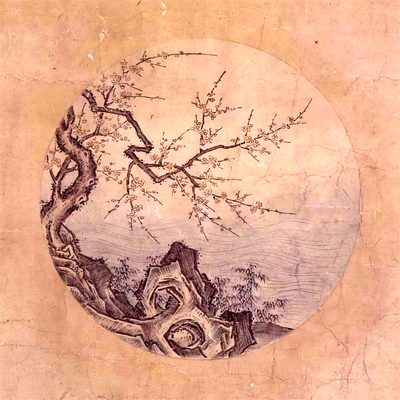
A blossoming plum tree. Awakening is not the acquisition of something absent, but the recognition of what is already present. AI-generated illustration with DALL•E 2, rendered in the style of Japanese Zenga ink painting.
Introduction
Bankei Yōtaku’s teaching of the Unborn occupies a distinctive place within the history of Japanese Zen. It is not distinctive because it introduces an entirely new doctrine, but because it formulates the familiar and central Mahāyāna and Zen theme with unusual directness. Bankei’s central claim is that every person already possesses the unborn Buddha-mind. Awakening is therefore not described as the acquisition of something absent, but as the recognition and practical confirmation of what, according to Bankei, is already present.
This claim is not merely an interpretive summary imposed from outside. Bankei states it repeatedly. For instance, he says that every person receives at birth only the unborn Buddha-mind, “nothing else”. He also says that if someone confirms that this unborn, illuminating wisdom is truly the Buddha-mind and lives in it just as they are, then this person is, from that moment, a living Tathāgata. What a releasing message for the people at that time! And also for us today. Such passages show the unusual directness of his teaching. Awakening is not postponed into a distant future as thought or may be even tought by other teachers back than or commonly misspercieved in today’s perception of what “becoming” a Buddha may be or not. Bankei frames it as the recognition and living confirmation of the Buddha-mind already present.
This emphasis gives his teaching thus a striking immediacy. Bankei reduces the (missperceived) distance between ordinary life and awakening. He does not present Buddhahood as a distant state reached only through a long institutional path, nor as a secret insight or enigma reserved for monks, specialists, or advanced practitioners. He addresses laypeople and monastics alike and repeatedly insists that the decisive condition for awakening is already given. What obstructs awakening is not an ontological lack, but the habitual transformation of Buddha-mind into delusion, anger, fear, craving, pride, self-defense, and attachment to thoughts.
Bankei’s view of human beings
One of the most characteristic features of Bankei’s teaching is his view of the people to whom he speaks. He does not primarily address them as beings who must first acquire a new spiritual essence. He addresses them as beings who already possess the unborn Buddha-mind, but fail to recognize it. This changes the structure of the path. The starting point is not deficiency, but misrecognition.
Bankei’s own language is unusually strong. He can say that everyone is a “living, breathing, firmly established Buddha”. He also says that since one is always Buddha, there is no other Buddha one could become. In another formulation, he remarks that a much shorter and easier way than trying to become Buddha is simply to be Buddha. These statements are not casual encouragements. They express the central logic of his teaching: What is sought is not absent.
At the same time, Bankei does of course not deny ignorance, suffering, or moral failure. People are plainly caught in anger, fear, craving, and self-centered habits. But he does not treat these as original nature. They are secondary formations. They arise when the Buddha-mind is transformed through deluded activity. His encounter with the monk who claims to have an inborn hot temper is the expression of this. Bankei asks him to show his anger. Since the monk is not angry at that moment, Bankei concludes that the anger cannot be inborn. It appears only under conditions, especially when the monk takes sides for himself.
This is why Bankei can describe ordinary people as living Buddhas without claiming that ordinary conduct is already enlightened in every respect. The statement should not be read as sentimental affirmation. It is a doctrinal claim about Buddha-nature and a practical claim about immediate recognition. For Bankei, the Buddha-mind does not have to be produced. It has to be recognized and no longer obscured.
His role as a teacher is therefore not to turn people into Buddhas from the outside. It is to point out the Buddha-mind they already have and to show how they obscure it through self-centered construction and manifestation.
The Unborn as immediate access
Bankei’s key term, the Unborn, refers to what is not produced in the way thoughts, emotions, bodily states, social identities, and memories are produced. Thoughts arise and pass away. Emotions arise and pass away. Bodies are born and die. Habits form and change. The Buddha-mind, by contrast, is described by Bankei as unborn. It is not an object among other objects and should not be understood as a hidden soul inside the body. It is better interpreted as the non-constructed clarity of experience before it is appropriated by self-attachment.
Bankei’s contrast between what is born and what is unborn appears in remarkably simple formulations. He says that what is born perishes, whereas what is unborn does not perish. In the opening of his Song of Original Mind (Honshin no uta, 本心の歌), which he is said to have composed in 1653 during a retreat in the mountains of Yoshino, he expresses this distinction as follows:
Unborn and imperishable
Is the original mind
Earth, water, fire and wind
A temporary lodging for the night
— Bankei Yōtaku, Song of Original Mind, translated by Peter Haskel (1984).
The four elements refer to the traditional Buddhist understanding of the material composition of the body. The image of a temporary lodging emphasizes its conditioned and impermanent nature, in contrast to what Bankei calls the Unborn. Although this language may suggest a metaphysical distinction between body and mind, Bankei’s practical teaching does not require us to interpret the unborn Buddha-mind as an immortal soul. Rather, the distinction can be understood in terms of the difference between the Unborn and the transient bodily and mental formations that people habitually mistake for a permanent self.
This point explains the immediacy of his teaching. If the Buddha-mind had to be manufactured, then a method would be needed to manufacture it. If it had to be transmitted, then an authorized transmitter would be necessary. If it had to be purified, then a ritual or disciplinary system would become central. Bankei rejects this structure. The Buddha-mind is not elsewhere, not later, and not the product of achievement.
The practical consequence is that awakening is framed as recognition rather than acquisition. Bankei does not primarily ask how one may become Buddha in the future. He asks how one obscures the Buddha-mind in the present. This shifts attention away from a distant goal and toward the immediate mechanisms of delusion: Taking sides for oneself, grasping thoughts, identifying with anger, manifesting fear, or turning pain into self-concern.
Bankei’s directness therefore rests on a specific analysis of mind. The problem is not that awakening is hidden in complexity. The problem is that ordinary experience is repeatedly transformed by unnecessary self-centered constructions.
A traditional teaching in unusually direct language
Bankei’s teaching can appear radical because of its tone, but its doctrinal background is not marginal. It belongs to the Mahāyāna tradition of Buddha-nature. In that tradition, awakening is not fundamentally external to sentient beings. The possibility of Buddhahood is grounded in their own nature, even if this nature is obscured by ignorance and attachment. Bankei’s distinctive contribution is to press this idea into direct practical speech. He does not present Buddha-nature as an abstract doctrine to be believed. He presents it as something to be confirmed in ordinary life. This is visible in his explanation of why his teaching can be called the “Buddha-mind school”. If someone confirms that the Unborn is truly the Buddha-mind and lives in it, then that person lives in the mind of all Buddhas. The point is not doctrinal classification, but direct practical confirmation.
This makes his Zen in fact traditional and unconventional at the same time. It is traditional because it develops a central Mahāyāna idea. It is unconventional because it minimizes the apparatus through which that idea is often mediated: Formal training, ritual hierarchy, doctrinal study, kōan systems, or elaborate symbolic indirection. Bankei does not deny that such forms can be useful. But he refuses to treat them as necessary sources of awakening.
His radicalism lies in the removal of postponement. He does not say that Buddhahood becomes possible only after years of special training. He says that if one recognizes and lives from the unborn Buddha-mind, one is a living Buddha now. This does of course not eliminate practice, but redefines it as the (daily) task of no longer obscuring what is already present.
Bankei’s difference from much of Zen rhetoric
Zen often speaks indirectly about awakening. It uses silence, paradox, gesture, kōan, ritual encounter, poetic expression, and symbolic transmission. This indirection has an internal logic. Direct language can turn into conceptual possession. Once awakening is described too neatly, it may become an object of thought rather than a transformation of experience. Zen’s reluctance to define awakening is therefore not accidental. It is a strategy against reification. Bankei is aware of this problem, but he chooses a different strategy. Rather than avoid direct speech, he uses direct speech to cut through unnecessary complexity. His sermons are not speculative treatises, but interventions into concrete human confusion. When he speaks about the Buddha-mind, he immediately applies it to ordinary problems such as anger, fear, illness, sleep, thoughts, work, and attachment to methods.
His criticism of inherited methods illustrates this difference. Bankei does not deny that earlier masters used particular devices. He mentions, for example, Tokusan’s staff, Rinzai’s shout, Gutei’s raised finger, and Bodhidharma’s wall-gazing. But he treats these as responses to concrete circumstances, not as universally binding techniques. His conclusion is that there is no fixed Dharma. If one tries to give the Dharma a final, fixed interpretation, one blinds oneself.
This makes Bankei a distinctive voice within Zen in my opinion. He is not anti-Zen, and he does not reject direct realization. Rather, he expresses direct realization in a less cryptic, mystical way than many traditional Zen texts. His plainness is part of the teaching, as it reflects his conviction that ordinary people can recognize the Buddha-mind without first mastering a specialized religious language or gaining any specific achievements. This also explains why his teaching could appeal to lay audiences. Bankei does not require the listener to understand complex doctrine before beginning. He begins with ordinary experience: Thoughts arise, anger is produced, fear is manifested, and self-defense turns the Buddha-mind into delusion.
Awakening beyond monastic exclusivity
I believe that Bankei’s teaching also has an important social implication. Awakening is not limited to ordained monks. It is not the possession of a monastic or any spiritual elite. Bankei addresses monks, nuns, laymen, laywomen, educated people, uneducated people, fearful people, angry people, and morally compromised people. And the reason is doctrinally simple: All possess the unborn Buddha-mind.
This point is supported by the breadth of the examples preserved in his sermons. He answers monks attached to discipline, a woman afraid of thunder, laypeople struggling with ordinary reactions, people suffering from illness, and practitioners confused about zazen or kōan. His teaching is not adjusted to a narrow monastic elite. It is framed as universally accessible because the Buddha-mind is not produced by monastic status.
This does not imply that all ways of life are equally conducive to practice. Bankei does not romanticize ordinary life. People are shaped by anger, fear, pride, craving, imitation, and habit. They mistake learned reactions for their own nature. They defend themselves, cling to opinions, fear events, and identify with thoughts. His teaching does not deny this. It says that none of these formations destroys the Buddha-mind. Bankei makes this especially clear when he says that even a serious wrongdoer, if he recognizes his error and begins to live in the Buddha-mind, is from that moment a living Buddha. This is not a denial of responsibility for wrongdoing. It is the claim that no person is permanently excluded from recognition of the Unborn.
The social significance lies in the equal accessibility of the starting point. A monk may have discipline, structure, and training. A layperson may lack those supports. But neither monk nor layperson has more or less Buddha-mind in an ontological sense. The difference lies in recognition and conduct, not in religious status.
This makes Bankei’s Zen anti-elitist without being lax. It removes spiritual exclusivity, but it also increases responsibility. If one already has the Buddha-mind, one cannot simply claim that awakening is inaccessible because one lacks ordination, institutional rank, or specialized training. It puts responsibility for awakening into the very hand of each practitioner.
The conditions for awakening
Bankei’s teaching is also reassuring because it says that the decisive condition for awakening is already present. One need not wait for a perfect teacher, monastery, method, psychological state, or life situation. The Buddha-mind is not absent from ordinary activities such as seeing, hearing, walking, speaking, working, resting, or suffering. It is obscured when these activities are appropriated through self-centered delusion.
Bankei’s remarks on zazen make this point especially clear. He says that zazen is nothing other than being at home in the Buddha-mind, without becoming caught in self-deception and without seeking enlightenment elsewhere. He also says that one should sit in the Buddha-mind, stand in the Buddha-mind, sleep in the Buddha-mind, wake in the Buddha-mind, and do everything in the Buddha-mind. This is an important passage because it shows that he does not locate awakening in one privileged religious posture.
This claim should also be handled with some care. I think, it should not be read as saying that all ordinary experience is automatically awakened. Bankei’s point is more specific here. Ordinary experience provides the field in which the Buddha-mind is either recognized or transformed into delusion. Anger, fear, pride, craving, and self-defense arise in ordinary situations. Therefore, ordinary situations are also where practice must occur. The condition for awakening is already present because the Buddha-mind is already present. But the manifestation of this recognition depends on how one relates to experience. A thought can be allowed to arise and pass, or it can be turned into identity. Pain can be felt as pain, or it can become the center of self-concern. A disagreement can be addressed as a practical matter, or it can become a defense of ego. The difference is not the presence or absence of ordinary experience, but whether experience is transformed into self-centered manifestations.
Bankei’s teaching therefore shifts the practical question. Instead of asking how one may reach awakening elsewhere, it asks how one is obscuring the Buddha-mind here.
Recognition and conduct
It is important to note that Bankei’s immediacy should not be confused with mere belief. To hear that one is already Buddha is not the same as realizing the Unborn. The statement can remain a concept, and as a concept it can even become dangerous. It can be used to justify passivity, arrogance, indifference, or refusal of practice. This is the point at which later criticism of Bankei-like teachings as “do-nothing Zen” becomes understandable (compare with Hakuin’s criticism of Bankei’s teachings). Bankei’s own teaching does not support such passivity. Recognition of the Unborn has consequences in conduct. This is clear in his instruction to remain in the Unborn for thirty days. He does not present the teaching as something to be admired intellectually. He asks listeners to test it in life. If living in the Unborn becomes habitual, he says, it becomes natural, and one will no longer be able to live outside it.
His examples show what this means. If anger is not our original nature, then anger should not be treated as unavoidable identity. If fear is constructed by thought, then fear should be examined rather than obeyed. If thoughts lack substance, then one need not chase or suppress them. If self-defense produces delusion, then one must learn not to take sides for oneself.
The simplicity of the teaching is therefore paired with practical difficulty. Nothing needs to be added, but deeply ingrained habits of addition must be recognized. The mind constantly adds ownership to experience. My thought, my pain, my insult, my fear, my anger, my view, my status. Bankei’s practice consists in not continuing this movement.
Awakening, in this framework, is not only insight. It is a way of living in which thoughts, emotions, and events are no longer automatically converted into possessions of the self.
The decisive first step
The first decisive step in Bankei’s teaching is the recognition that the Buddha-mind is already present. This recognition changes the structure of practice and perception. Before, practice may appear as a movement from lack toward completion. After the recognition, practice becomes the stabilization and embodiment of what has been recognized. Bankei’s own language supports this shift. He says that a person who confirms the Unborn and lives in it is a living Buddha from that moment. He also says that one should first try to remain in the Unborn for thirty days. These two claims belong together. Recognition is immediate, but it must be lived and familiarized in ordinary conduct.
This is indeed a major shift. One no longer asks primarily “How do I become Buddha?” One asks “How am I actually transforming the Buddha-mind into delusion, right now? Where am I taking sides for myself? Where am I turning thought into identity? Where am I turning pain into selfhood? Where am I adding fear, pride, resentment, or craving to what appears?” The answers are not found in abstraction. They are found in ordinary situations. Bankei’s examples often concern everyday disturbances such as being angered by another person, fearing thunder, suffering illness, clinging to thoughts, falling asleep, sewing while speaking, or mistaking a learned habit for nature. This concreteness is part of his method. The Unborn is not treated as an esoteric object but as the practical ground of ordinary life when it is not distorted by self-attachment. Bankei’s immediacy is therefore not a rejection of practice. It is a rejection of postponement. Practice begins exactly where delusion is produced.
Conclusion
Bankei’s teaching of the Unborn presents awakening with unusual directness. It does not deny practice, discipline, or guidance, but it refuses to make them the source of the Buddha-mind. The unborn Buddha-mind is already present. It is not created by institutions, not reserved for monks, and not withheld from laypeople. Every person already has the decisive condition for awakening. This is exactly why he can speak of people as living Buddhas. The statement should not be read as mystical inflation or as a denial of ordinary delusion. It means that Buddhahood is not an external essence to be acquired. It is the original nature that must be recognized and no longer obscured. Bankei’s own examples of anger, fear, illness, thoughts, zazen, and ordinary work show that this recognition must become conduct. And Bankei’s contribution lies in formulating this point with unusual clarity. He takes the Mahāyāna doctrine of Buddha-nature and removes much of the distance created by institutional, ritual, and methodological framing. He takes Zen’s emphasis on direct realization and expresses it in plain speech. He places practice in ordinary life, precisely where anger, fear, craving, and self-defense arise.
The result is both accessible and demanding. It is accessible because nothing essential is missing. It is demanding because the practitioner can no longer postpone the matter. If the Buddha-mind is already present, then every moment becomes a test of whether one lives from it or transforms it into delusion. Bankei’s Zen begins with the claim that one is already Buddha. Its practical force lies in the demand to recognize this, stop producing self-deception, and live accordingly.
References and further reading
- Norman Waddell (Herausgeber), Bankei Eitaku, Die Zen-Lehre vom Ungeborenen. Leben und Lehre des großen japanischen Zen-Meisters Bankei Eitaku (1622 - 1693), 1988, ISBN-10: 3502640505
- Peter Haskel (Übersetzer), Yoshito Hakeda (Herausgeber), Mary Farkas (Vorwort), Bankei Zen - Translations From The Record Of Bankei, 1994, Grove Press, ISBN: 9780802131843
- Oliver Bottini, Das große O.-W.-Barth-Buch des Zen, 2002, Barth im Scherz-Verl, ISBN: 9783502611042
- Heinrich Dumoulin, Geschichte des Zen-Buddhismus, Band 1+2, 2019, 2., durchgesehene und erweiterte Auflage, Francke A. Verlag, ISBN: 9783772085161
- Hans-Günter Wagner, Buddhismus in China: Von den Anfängen bis in die Gegenwart, 2020, Matthes & Seitz Berlin, ISBN: 978-3957578440
- Jr. Buswell, Robert E., Jr. Lopez, Donald S., Juhn Ahn, J. Wayne Bass, William Chu, The Princeton dictionary of Buddhism, 2014, Princeton University Press, ISBN: 978-0-691-15786-3








comments