How to read Dōgen
Dōgen’s fascicles often appear dense, poetic, paradoxical, and deliberately difficult. They move from doctrinal statements to old Chinese narratives, from monastic instructions to images of walking mountains, self-seeing water, and a universe that is one bright pearl. Read alongside Genjō Kōan, Bendōwa, and Uji, this textual variety nonetheless reveals recurring motifs and underlying structures. In fact, Dōgen takes a familiar Buddhist concept, unsettles its ordinary conceptual stability through images, stories, and paradoxes, and reconnects it with practice. His writing is therefore neither obscure mystical prose nor intellectual commentary on inherited Zen sayings alone. It constructs reading as a transformation of inherited forms of understanding.
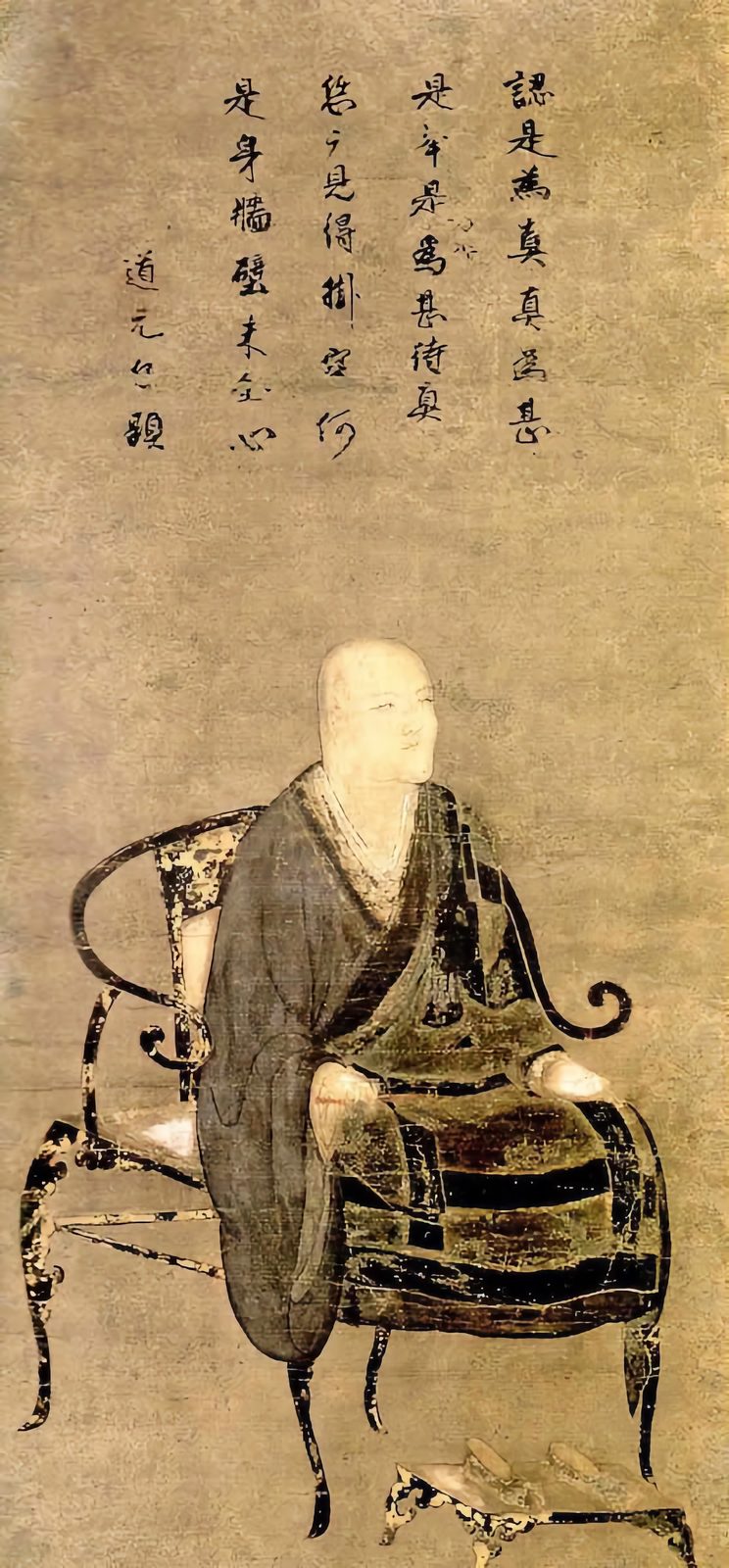
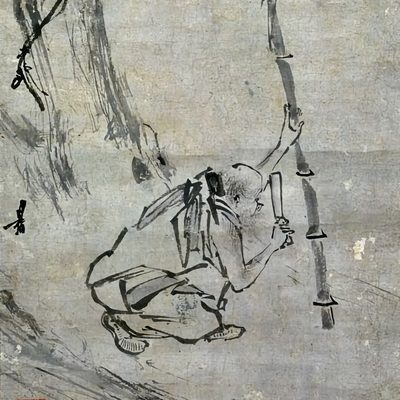
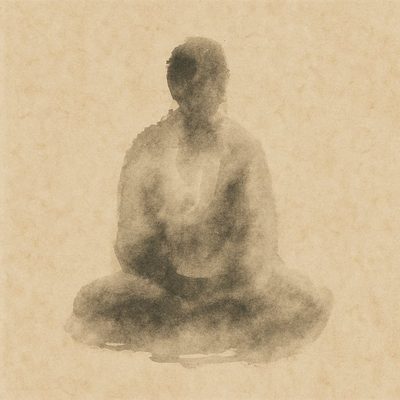
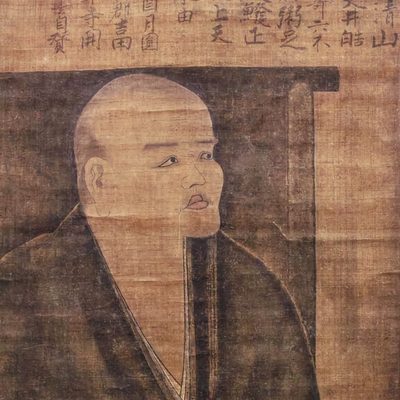
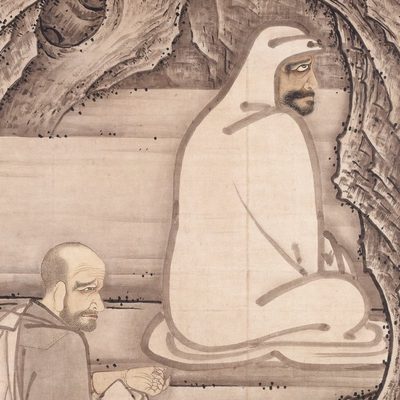
Painting showing Dōgen seated, most likely giving a Dharma talk. Artist and year unknown. Dōgen’s texts use language, narratives, and images to connect interpretation with practice. While often at first glance opaque, they invite readers to engage actively with the text and its underlying practice. In this post, we try to identify measures and concepts, that enable an easier reading and more accessible understanding of his work. Source: Store Norske Leksikonꜛ (license: Public Domain-Merket 1.0 Universal)
In this post, we examine recurrent structures in Dōgen’s writing. Of course , we will not offer a comprehensive guide to the Shōbōgenzō and Dōgen’s full work set, but we identify common textual strategies that clarify how Dōgen combines inherited sources, paradox, and monastic practice. Together, these insights hopefully help make his texts easier to read.
Dōgen does not explain Buddhism from the outside
Dōgen rarely explains Buddhism from the position of a neutral observer. His writing proceeds from within the Buddhist path and treats doctrine as inseparable from its enactment in body, speech, and mind.
This is visible in Bendōwa, which links the presence of the Dharma with the necessity of practice. Dōgen does not resolve this relation as a theoretical compromise: What is already present is nevertheless enacted. Practice does not create the Dharma, but it is the mode in which the Dharma becomes manifest in a life.
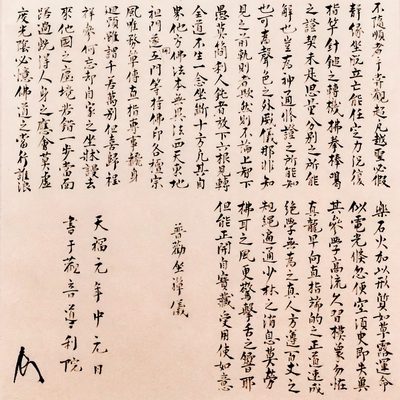
The same method appears in Fukan zazengi. Although Dōgen begins from truth’s fundamental presence, he argues that even the smallest distinction separates heaven and earth. Since practice and realization are not two, sitting becomes the text’s answer to the paradox rather than abstract argument.
This is one of Dōgen’s recurring structures. He begins with a doctrinal tension, intensifies it, and then refuses to solve it merely conceptually. The resolution is practice.
A recurring structure in Dōgen’s fascicles
Many of Dōgen’s texts follow a loose but recognizable structure.
First, he introduces a key phrase, often from a sutra, a Zen master, or a traditional saying. Examples include “practice and realization are one”, “all being is time”, “all beings have Buddha-nature”, “the whole universe is one bright pearl”, “mountains and waters”, “the valley stream and the mountain form”, “the whole universe is radiant clarity”, or “if you want to attain it, you must be a person of it”.
Second, he destabilizes the obvious reading. He presents the phrase as irreducible to ordinary understanding: Buddha-nature is not an inner essence, time is not a container, zazen is not meditation training, mountains do not merely stand still, water is not simply what humans call water, the body is not merely biological flesh, the self is not a private psychological center, and suchness is not a mystical substance.
Third, he introduces stories, images, or cases, often drawn from Chinese Chan: Bodhidharma, Huike, Huineng, Mazu, Nansen, Jōshū, Gensa, Ungo, Kyōgen, Reiun, Chōsa, Nāgārjuna, and others. These accounts are not illustrations in a modern explanatory sense but form part of his argument. Dōgen enters, reverses, questions, and extends them in order to reshape inherited understanding.
Fourth, he turns the phrase back toward concrete practice. Its significance lies not in the cleverness of the saying but in sitting, hearing, seeing, bowing, teaching, receiving, working, letting go, leaving home, preserving the Dharma, and using body and mind in the Way.
Fifth, he often ends by addressing his audience directly. These admonitions oppose wasted time, fame and gain, the confusion of intellectual understanding with realization, empty phrases, and the loss of human life as an occasion for practice.
This structure is not mechanical, but it appears often enough to be useful. In summary, Dōgen’s texts are not random collections of paradoxes. They are practice-oriented transformations of inherited phrases.
Dōgen reads old sayings as living events
Dōgen does not treat old Zen sayings as historical quotations or formulas, but as living events. When a master says “The whole universe in the ten directions is one bright pearl”, Dōgen extends the statement beyond the original intention to ask how the universe appears when it is enacted. Likewise, “The blue mountains are constantly walking” is not reduced to metaphor but placed within a mode of seeing in which mountain movement becomes intelligible.
This explains Dōgen’s resistance to the interpretive shortcut “It is just metaphor”. He does not deny metaphor, but resists its reduction to ordinary conceptual terms. Interpreting “mountains walk” as slow geological change, “water sees itself” as subjective perception, or “one bright pearl” as a slogan of interconnection diminishes the phrases’ disruptive force.
Dōgen instead treats such phrases as operations that transform perception. For instance, in Sansuikyō, mountains and waters are not scenery but the present expression of ancient Buddhas. Mountains walk, waters practice themselves, and water is the virtue of water itself rather than an object that merely flows. This language displaces the human view as the exclusive measure of reality.
In Keisei sanshiki, the valley stream and the mountain form are not aesthetic triggers for poetic religious feeling. They are the voice and body of the Dharma. Nature is not used as decoration. It is a Dharma discourse.
Dōgen’s old cases function in the same way. A story is not a riddle with a hidden answer but an event construed through body and mind.
Dōgen integrates core Buddhism through Zen language
Dōgen is often read as a Zen author whose language is difficult, strange, and very far from early Buddhist formulations. Yet the deeper structure of his thought is strongly continuous with core Buddhist teaching.
He does not always name the three marks, dependent origination, non-self, or emptiness in a textbook manner. Instead, he integrates them through his own Zen vocabulary.
Impermanence appears in his constant emphasis on the irrecoverability of time, the passing of body and mind, the disappearance of childhood, the falling of leaves, the urgency of practice, and the impossibility of holding any moment still. In Uji, time is not an abstract flow but the very being of each thing. In Gyōji, the present is not something that exists before practice. The concrete realization of pure practice is what is called “now”.
Non-self appears whenever Dōgen denies that body, mind, understanding, practice, or realization belong to a private self. In Inmo, body and mind manifest throughout the whole world without belonging to an individual. In Shinjin gakudō, the Way is studied with body and mind, while that study also involves dropping body and mind. In Jishō zanmai, self-experience is not private introspection: following a teacher or the sutras, teaching, hearing the Dharma, and using grasses and trees all displace the self as a separate psychological entity.
Dependent origination appears in Dōgen’s insistence that each phenomenon is its own complete Dharma-position while also being inseparable from the whole network of conditions. In Uji, one moment is not isolated from all time. In Sansuikyō, water is seen differently by humans, dragons, demons, fish, and gods, but these views are not simply subjective errors. They show that reality appears according to the condition of beings, without being reducible to one fixed human perspective.
Emptiness appears in Dōgen’s rejection of fixed essence. In Busshō, Buddha-nature is not an inner substance but the whole of existence without becoming a material or spiritual thing. It is neither having nor not having, neither presence nor absence, neither self nor thing. The paired statements that all beings have and are without Buddha-nature are held together rather than reconciled by ordinary logic.
Dukkha and the problem of attachment appear in Dōgen’s relentless critique of fame, gain, self-concern, comfort, and intellectual pride. In Gyōji, the addiction to fame and honor is worse than breaking the precepts because it corrupts the entire orientation of practice. In Keisei sanshiki, Dōgen attacks practitioners who use the Dharma for status, wealth, and recognition. In Jishō zanmai, he criticizes those who mistake intellectual understanding for self-realization.
Dōgen therefore does not abandon core Buddhism but radicalizes it through Zen language. Rather than identifying a passage as anattā, dependent origination, or emptiness in textbook terms, his writing demonstrates the effects of these teachings on language, self, time, body, and world.
Dōgen’s paradoxes are not ornamental
Dōgen uses paradox constantly, but not as a decorative style. His paradoxes are usually directed against dualistic thinking.
In Busshō, all beings have Buddha-nature, and all beings are without Buddha-nature. In Inmo, if one falls to the ground, one rises from the ground, but one also rises through emptiness. In Sansuikyō, mountains are still and moving, waters flow and do not flow. In Kōmyō, radiant clarity is neither merely physical nor merely spiritual, but the whole universe as it appears. In Ikka myōju, the whole universe is one bright pearl, but trying to understand this as an object of thought means entering the devil’s cave of conceptual fixation.
These paradoxes do not merely say “logic fails”. They have a more precise function. They prevent the reader from settling into a one-sided position. If Buddha-nature exists as a possession, it becomes a hidden self. If Buddha-nature does not exist, the path collapses into nihilism. If practice produces awakening, realization becomes a future product. If awakening is already present without practice, practice becomes unnecessary. If mountains are only still, the world becomes dead matter. If mountains only move like humans move, the phrase becomes trivial. If water is only what humans see, reality becomes anthropocentric. If water is only beyond human seeing, concrete water disappears.
Dōgen’s paradoxes prevent either side from becoming fixed. Their function is not ornamental admiration but the loosening of false alternatives through practice.
Dōgen is direct and encrypted at the same time
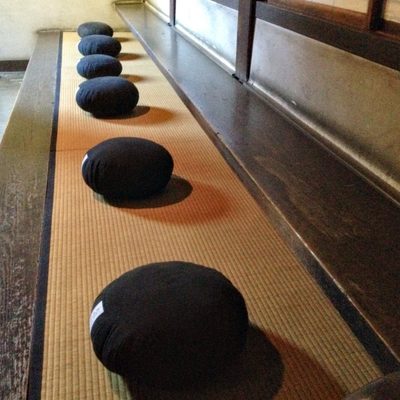
Dōgen can sound extremely cryptic, but many texts state practical demands directly. They call for zazen, immediate practice, the rejection of fame and gain (or wanting in general), non-attachment to understanding, and attention to embodiment rather than a deferred awakening. At the same time, he encrypts this directness inside dense language. The encryption is not merely literary difficulty. It is part of the teaching method. Dōgen often prevents the reader from extracting a clean doctrine too quickly. He does this because a clean doctrine can become another object of attachment. In Fukan zazengi, the instruction for instance is direct: Arrange the cushion, sit upright, regulate the posture, keep the eyes slightly open, breathe through the nose, think from the ground of non-thinking. Yet even here Dōgen adds that zazen is not meditation training but the Dharma-gate of peace and joy. The physical instruction and the philosophical claim cannot be separated.
In Gyōji, the demand to preserve pure practice every day is embedded in dozens of ancestral stories, warnings, images, and criticisms. The accumulated examples determine what “practice” means within the fascicle. In Uji, the claim “being is time” is conceptually difficult, yet its practical implication is direct: Each moment is complete, and practice is realized as this body, this action, and this situation.
Dōgen’s writing is therefore both open and guarded. It opens the Dharma directly, but it guards it against shallow possession.
Dōgen’s audience
Dōgen’s audience is not a single group. He addresses several audiences at once.
He addresses monks in training. Many passages speak directly to those who sit zazen, live in monasteries, receive robes, follow teachers, serve the community, and preserve monastic discipline. Fukan zazengi, Zazengi, and Gyōji clearly belong to this context.
He addresses serious practitioners more broadly. Bendōwa responds to questions concerning zazen. Genjō Kōan concerns practice, self, world, delusion, and awakening. And Keisei sanshiki and Sansuikyō extend the Dharma to encounters with nature beyond formal practice.
He also addresses critics and rival interpretations. Dōgen repeatedly criticizes false Zen teachers, empty rhetoricians, those attached to kōan theatricality, those who mistake intellectual insight for realization, those who reduce Buddha-nature to an inner essence, and those who chase fame, wealth, or imperial recognition.
He addresses future readers. Many passages are written as admonitions to “students of later ages”. Dōgen knows that the Dharma is always at risk of degeneration into formality, reputation, institution, or misunderstanding. His texts are therefore not merely explanations. They are attempts to transmit a way of reading, practicing, and seeing.
He also addresses himself and his lineage. In several texts, especially Gyōji, Dōgen writes with intense gratitude toward Bodhidharma, Huike, Huineng, Rujing, and the ancestors. He presents his own teaching as the continuation of their preserved practice. His audience is therefore also the lineage itself.
Dōgen’s tone
Dōgen’s tone is not always gentle. He can be poetic, subtle, and beautiful, but he can also be severe, polemical, and uncompromising. He calls false teachers animals, demons, skin bags, and people outside the Way. He criticizes entire tendencies in Song China and laments the poverty of true practice in Japan. He repeatedly attacks fame, profit, laziness, superficiality, and intellectual arrogance.
This severity is neither reducible to sectarian aggression nor appropriately romanticized. It belongs to the rhetoric of a teacher who presents the Dharma as fragile. For Dōgen, the danger is not doctrinal error alone but the conversion of the Dharma into social identity, institutional habit, aesthetic style, or intellectual performance.
His harshness often appears when practice is replaced by something else: Explanation without practice, prestige without realization, buildings without Dharma, titles without transmission, meditation as technique without dropping off body and mind, Zen gestures without bones and marrow, or Buddha-nature as metaphysical possession.
Dōgen’s severity is therefore diagnostic. He attacks what blocks practice.
Reading Dōgen’s fascicles
Dōgen’s fascicles resist rapid conceptual extraction. A single paragraph may combine doctrinal reference, an inherited Zen phrase, poetic inversion, polemical target, practical instruction, and philosophical argument. Neither a modern systematic treatise nor irrational mysticism provides an adequate model for their reading.
With the following observations we try to identify recurrent interpretive demands in his texts in order to facilitate an easier access to language and concepts.
Doctrinal tensions
Dōgen often refuses one-sided conclusions. A passage that appears to say “everything is Buddha-nature” may be followed by one asserting that all beings are without Buddha-nature. Or: Necessity of practice coexists with realization’s presence, and mountains that are mountains also walk. Such pairings do not invite selection of one statement at the expense of the other. They sustain a tension through which Dōgen discloses the limitations of the initial framework.
The practical turn
Even abstract Dōgen passages usually return to practice: sitting, letting go, non-attachment to understanding, embodiment, hearing the Dharma, teaching, preserving practice, and rejecting fame and gain. His metaphysics therefore has a practical edge.
Images before abstraction
When Dōgen writes that mountains walk, water sees itself, the universe is a bright pearl, or radiant clarity is the monk’s whole body, immediate translation into abstract meaning simply weakens the text. The image first establishes a mode of seeing that unsettles assumptions about self, time, body, and world. Figurative interpretation remains secondary here.
Kōan stories as events
Dōgen’s kōan stories are not riddles resolved by hidden answers, nor are they merely historical accounts of earlier Zen masters. They are living expressions of the Dharma, whose meaning is not exhausted by their original context. Dōgen frequently quotes an exchange between a master and a student, examines individual words, questions conventional interpretations, and then offers a reading that shifts the entire meaning of the encounter. Sometimes he even reverses the roles of question and answer or suggests that an apparently incomplete response expresses the Dharma more fully than an intellectually convincing explanation. This approach is particularly important because Dōgen does not treat the ancient masters as authorities whose words must simply be accepted. He respects their transmission of the Dharma, but he also engages with their statements critically and creatively. A master’s answer is not necessarily the final word on a question. Dōgen may extend it, challenge its traditional interpretation, or demonstrate that the question itself rests on a mistaken distinction. In doing so, he treats the inherited kōan tradition as something that remains open to interpretation rather than a fixed collection of authoritative sayings.
This is important to keep in mind. When Dōgen introduces a seemingly absurd exchange, the question is not simply what the master secretly meant or what philosophical proposition the story illustrates. More revealing is how Dōgen works with its language: Which assumptions does he challenge? Why does he emphasize one particular word? Why does he refuse an apparently straightforward interpretation? And how does his reading reconnect the encounter with practice and realization? The story is therefore not the evidence supporting an argument, but ts interpretation is part of the argument itself.
This also explains why familiarity with Chinese Chán history can substantially improve the reading of Dōgen. His texts presuppose knowledge of earlier masters, their characteristic expressions, and established interpretations of their encounters. Without that background, a passage may appear arbitrary or unnecessarily obscure. Once the original story and its conventional meaning are understood, Dōgen’s reinterpretation often becomes more intelligible. His apparent paradoxes then reveal themselves as deliberate interventions in an ongoing Buddhist conversation about the nature of understanding, practice, and awakening.
Recurrent themes
Across the fascicles, we can now identify certain recurring themes:
- Practice and realization are inseparable.
- Body and mind are not private possessions.
- Time is concrete being.
- The ordinary world is not outside the Dharma.
- Words can liberate, but words can also trap.
- Nature teaches the Dharma, but not as romantic scenery.
- Buddha-nature is not an inner essence.
- Enlightenment is not a future object.
- True practice is bodily, daily, and continuous.
- Fame and gain corrupt the Way.
- The Dharma is received, preserved, and enacted.
Their recurrence situates individual passages within Dōgen’s wider corpus.
Anti-essentialism
Dōgen constantly resists essence-thinking, that is, the assumption that things possess a fixed, independent nature underlying their changing appearances. Buddha-nature is not a substance. Mind is not a hidden self. Time is not a container. Nature is not a fixed object. Practice is not a means toward a separate goal. Self-experience is not introspection of a private self. This anti-essentialism connects him deeply to Nāgārjuna and śūnyatā, but Dōgen expresses it through Zen practice, linguistic reinterpretation, and concrete images. However, Dōgen does not simply replace a substantialist understanding of reality with the abstract proposition that everything is empty. Such a proposition could itself become another fixed conceptual position. This is precisely the problem already addressed by Nāgārjuna’s understanding of the emptiness of emptiness: Emptiness is not an ultimate substance or a metaphysical foundation underlying phenomena. It describes their lack of independent existence. Dōgen’s writing frequently performs a comparable operation. Whenever a Buddhist concept appears to have acquired a stable meaning, he unsettles that meaning and redirects attention toward the concrete existence and practice of things themselves.
This is particularly evident in Busshō, where Buddha-nature cannot simply be understood as something possessed by sentient beings. Dōgen challenges the distinction between a being that possesses Buddha-nature and a Buddha-nature that exists as its underlying essence. Similarly, in Uji, being and time are not two independently existing categories subsequently brought into relation. And in Sansuikyō, mountains and waters are not passive objects whose true nature must be discovered behind their appearances. Their concrete existence is already the expression of the Dharma.
The same reasoning applies to the practitioner. If the self is not a fixed entity, awakening cannot be the permanent achievement of such an entity either. Even the distinction between an unenlightened individual who practices and an enlightened individual who has completed practice becomes problematic. Dōgen’s unity of practice and realization challenges precisely this separation. Likewise, shinjin datsuraku, the dropping off of body and mind, does not reveal a more authentic self hidden beneath ordinary experience. It describes the relinquishment of the very identification that demands such a self.
This has an important consequence for interpreting Dōgen’s language. His paradoxes should not automatically be translated into a single positive doctrine such as “everything is one”, “everything is interconnected”, or “everything is Buddha-nature”. Although such statements may capture aspects of his thought, they can also reintroduce the essentialism he is challenging. Unity can become another substance, interdependence another universal principle treated as an independent reality, and Buddha-nature another metaphysical possession. Dōgen repeatedly resists precisely these conceptual closures.
His anti-essentialism is therefore not just a philosophical position expressed through difficult language. It also helps explain why he writes as he does. By continually reopening apparently established meanings, Dōgen prevents his own concepts from becoming fixed objects of understanding. The difficulty of his texts is partly a consequence of this refusal to allow even Buddhist doctrine to settle into unquestioned conceptual certainty.
Bodily language
Dōgen’s texts are full of term related to the human/living body: Skin, flesh, bones, marrow, eyes, ears, tongue, nose, hands, feet, skull, robe, bowl, posture, sitting cushion, rice pestle, work tools, stones, water, wind, walls, halls, and kitchens. This bodily language is not decorative. Dōgen presents the Dharma as enacted through the body and prevents Buddhism from becoming a merely mental worldview. Wisdom, self, Buddha-nature, and suchness are correspondingly bodily and situational.
The critique of possession
Dōgen attacks not only material possession but conceptual possession as well. Wealth, robes, buildings, titles, and reputation are joined by “understanding”, “awakening”, “Buddha-nature”, “emptiness”, “Zen”, and “non-attachment” as possible objects of appropriation. Many paradoxes prevent the Dharma from becoming an object of possession.
Do not confuse difficulty with irrationality
Dōgen is difficult because he often works at the limits of language. But his writing is not simply irrational. It often has a precise structure: He exposes a dualism, reverses it, dissolves it, and returns the reader to practice. The difficulty is part of the method. The text makes ordinary conceptual habits visible by frustrating them.
Repetition and intertextuality
Dōgen often becomes clearer through repetition: A sentence opaque in one fascicle may become intelligible through another. Uji illuminates Gyōji, Busshō Inmo, Sansuikyō Keisei sanshiki, Bendōwa Fukan zazengi, and Shinjin gakudō Jishō zanmai. Dōgen’s fascicles form a network that illuminates itself without requiring a single correct reading order.
Dōgen’s basic movement
Across these fascicles, Dōgen’s basic movement can be described as follows. He begins with a phrase that appears familiar, refuses its ordinary reading, and opens it through paradox, image, story, and quotation. The phrase becomes a living Dharma-event rather than a concept, and the argument returns it to practice enacted through body, mind, speech, time, and daily life. The pattern could be summarized like this:
- A concept is introduced.
- The concept is destabilized.
- The destabilization reveals attachment to ordinary thinking.
- A story or image opens another way of seeing.
- The new seeing cannot remain theoretical.
- It returns as practice.
This pattern explains why Dōgen can be both philosophical and practical, both poetic and severe, both abstract and bodily, both traditional and radical.
Dōgen and the ordinary
Dōgen does not lead the reader away from ordinary life into a separate spiritual state. He repeatedly returns to sitting, eating, drinking tea, wearing robes, working, sweeping, hearing water, seeing mountains, watching flowers, serving food, teaching, refusing gifts, preserving time, and using the body. The ordinary is not rejected, but it is also not left unchanged. Dōgen does not say that ordinary life is automatically the Dharma as long as one says the right phrase. Ordinary life becomes Dharma when it is practiced, seen, and enacted without clinging to self, possession, fame, conceptual fixation, or future attainment. This is why “great awakening is nothing other than your daily tea and rice” is not a banal statement. Tea and rice become awakening only when lived as practice. Otherwise they remain ordinary consumption.
The reader position constructed by Dōgen
Dōgen’s texts construct a reader position opposed to the aesthetic admiration of Zen language, the collection of paradoxes, and the use of original enlightenment to authorize inaction. They also reject emptiness as a concept, Buddha-nature as a possession, and Zen as an identity. The implied reader is situated in practice: Sitting, embodied action, attention to mountains and waters, renunciation of fame and gain, preservation of practice, and the reception of inherited sayings as living words. The fascicles thus train perception rather than merely communicating information about the Dharma.
This creates a particular difficulty for us readers today, especially when approaching Dōgen primarily from a philosophical or literary perspective. His writings invite intellectual analysis, but they also repeatedly question the assumption that understanding a doctrine is equivalent to realizing it. We may correctly identify the Buddhist concepts behind a passage, reconstruct its argument, and explain its historical references, yet still miss the practical significance that Dōgen assigns to it. Conversely, interpreting his texts exclusively as expressions of ineffable mystical experience risks overlooking their philosophical precision, historical context, and often deliberate linguistic construction. Reading Dōgen therefore requires holding both dimensions together: His arguments deserve careful conceptual analysis, while their significance cannot be reduced to conceptual analysis alone.
This does not mean that reading necessarily requires becoming a Zen practitioner in order to understand Dōgen. Historical, philological, and philosophical readings remain valuable in their own right. Rather, it means recognizing that Dōgen writes from within a tradition in which knowing and practicing are not entirely separate activities. His texts challenge the reader to examine not only what a statement means, but also the assumptions through which that meaning is constructed. In this sense, reading Dōgen becomes an encounter with the limitations of one’s own interpretive habits, even when approached from a scholarly rather than a religious perspective.
Conclusion
Reading Dōgen requires patience because he does not write for rapid conceptual extraction. His texts are not simply doctrinal summaries, mystical poems, kōan puzzles, or monastic instructions. They are practice-texts. They use inherited Buddhist language, Zen stories, paradox, image, and direct admonition to reconfigure understandings of self, body, time, nature, practice, and realization.
The pattern that emerges across Genjō Kōan, Bendōwa, Uji, Fukan zazengi, Busshō, Sansuikyō, Keisei sanshiki, Inmo, Ikka myōju, Kōmyō, Jishō zanmai, and Gyōji is remarkably consistent. Dōgen begins with a phrase, breaks its ordinary meaning, opens it through the Dharma, and returns it to embodied practice. And core Buddhist concepts are everywhere in these texts, but often translated into Zen and Dōgen’s typical language and expression. Impermanence appears as the irrecoverability of each moment. Non-self appears as the non-possession of body and mind. Dependent origination appears as the interpenetration of each Dharma-position with the whole world. Emptiness appears as the impossibility of fixed essence. Dukkha appears in the repeated critique of fame, gain, self-concern, and conceptual attachment. The path appears as continuous practice.
Dōgen can be cryptic, but his demand is direct. He rejects a merely intellectual relation to the Dharma, deferred awakening, possession of Buddha-nature, and the treatment of mountains, waters, body, mind, words, halls, kitchens, tea, and rice as external to the Dharma. Within this account, the present becomes real as practice.
Dōgen’s difficulty therefore has in my view a purpose. It prevents the Dharma from becoming another object of thought. And it brings reading, seeing, sitting, hearing, and acting into relation. The resulting text is not merely an object of interpretation but a medium through which practice is articulated.
From my own reading experience, I would therefore recommend not approaching Dōgen’s fascicles as texts to be read quickly, understood once, and then put aside. They often become considerably clearer when revisited, particularly after reading other fascicles or reflecting on their arguments for some time. A passage that initially seems incomprehensible may take on a different meaning once its underlying Buddhist concepts, historical references, or connections to Dōgen’s other writings become apparent. Reading a fascicle a second or third time is therefore rarely redundant. Nor is it necessary to resolve every paradox or difficult passage immediately. Sometimes it is more useful to leave a question open, continue reading, and return to it later. Dōgen’s writings reward this kind of slow, repeated engagement far more than a quick, consumptive reading aimed at extracting a final interpretation.
And now, I’m curious about your own experience with reading Dōgen. What did you find particularly difficult, surprising, or insightful? What are your approaches to read and understand his texts? Feel free to share your thoughts and experiences in the comments below.
References and further reading
- Oliver Bottini, Das große O.-W.-Barth-Buch des Zen, 2002, Barth im Scherz-Verl, ISBN: 9783502611042
- Heinrich Dumoulin, Geschichte des Zen-Buddhismus, Band 1+2, 2019, 2., durchgesehene und erweiterte Auflage, Francke A. Verlag, ISBN: 9783772085161
- Hans-Günter Wagner, Buddhismus in China: Von den Anfängen bis in die Gegenwart, 2020, Matthes & Seitz Berlin, ISBN: 978-3957578440
- Jr. Buswell, Robert E., Jr. Lopez, Donald S., Juhn Ahn, J. Wayne Bass, William Chu, The Princeton dictionary of Buddhism, 2014, Princeton University Press, ISBN: 978-0-691-15786-3
- Oliver Freiberger, Christoph Kleine, Buddhismus - Handbuch und kritische Einführung, 2011, Vandenhoeck & Ruprecht, ISBN: 9783525500040
- Dogen Zenji, Shobogenzo – Die Schatzkammer des wahren Dharma-Auges, 4 Bände, 2013, Verlage: Kristkeitz Werner, Übersetzung: Ritsunen Gabriele Linnebach, Gudo Wafu Nishijima, ISBN: 9783921508909
- Dogen Zenji, Unterweisungen zum wahren Buddha-Weg. Shobogenzo Zuimonki (2011), Verlage: Kristkeitz Werner, ISBN: 9783932337680
- Dogen Zenji, Hōkyōki, 2020, Angkor Verlag, Übersetzung: Guido Keller, Taro Yamada, Hidesama Iwamoto, ISBN: 9783943839821
- Dogen Zenji (Autor), Guido Keller (Übersetzer), Taro Yamada (Übersetzer), Eihei Shingi - Regeln für die Zen-Gemeinschaft, 2022, BoD – Books on Demand, ISBN: 9783988040008
- Dogen Zenji (Autor), Guido Keller (Übersetzer), Eihei Kôroku, 2017, Angkor Verlag, ISBN: 9783936018936
- Shohaku Okumura, Die Verwirklichung der Wirklichkeit - «Genjokoan» - der Schlüssel zu Dogen-Zenjis Shobogenzo, 2014, Kristkeitz, ISBN: 9783932337604










comments