Practicing the Unborn: Bankei’s Zen in everyday life
It is one thing to understand Bankei Yōtaku’s teaching of the Unborn intellectually, and quite another to put it into practice. What does it actually mean to live in the unborn Buddha-mind while sitting at our desks, having a difficult conversation, dealing with an unpleasant colleague, or simply going about our daily routines? How do we recognize when we are turning ordinary experience into delusion, and how do we stop doing so without constantly monitoring or trying to control ourselves? Bankei’s sermons are in particular helpful here because many of his explanations deal with surprisingly ordinary situations. His examples are just as relatable today as they were in 17th-century Japan. In this post, I therefore want to move away from the more philosophical questions surrounding the Unborn and focus on its practical side: How is Bankei’s Zen includable into our everyday lives, how we can practice it even without a formal teacher, and how we might recognize whether this practice is actually making a difference in the way we live.
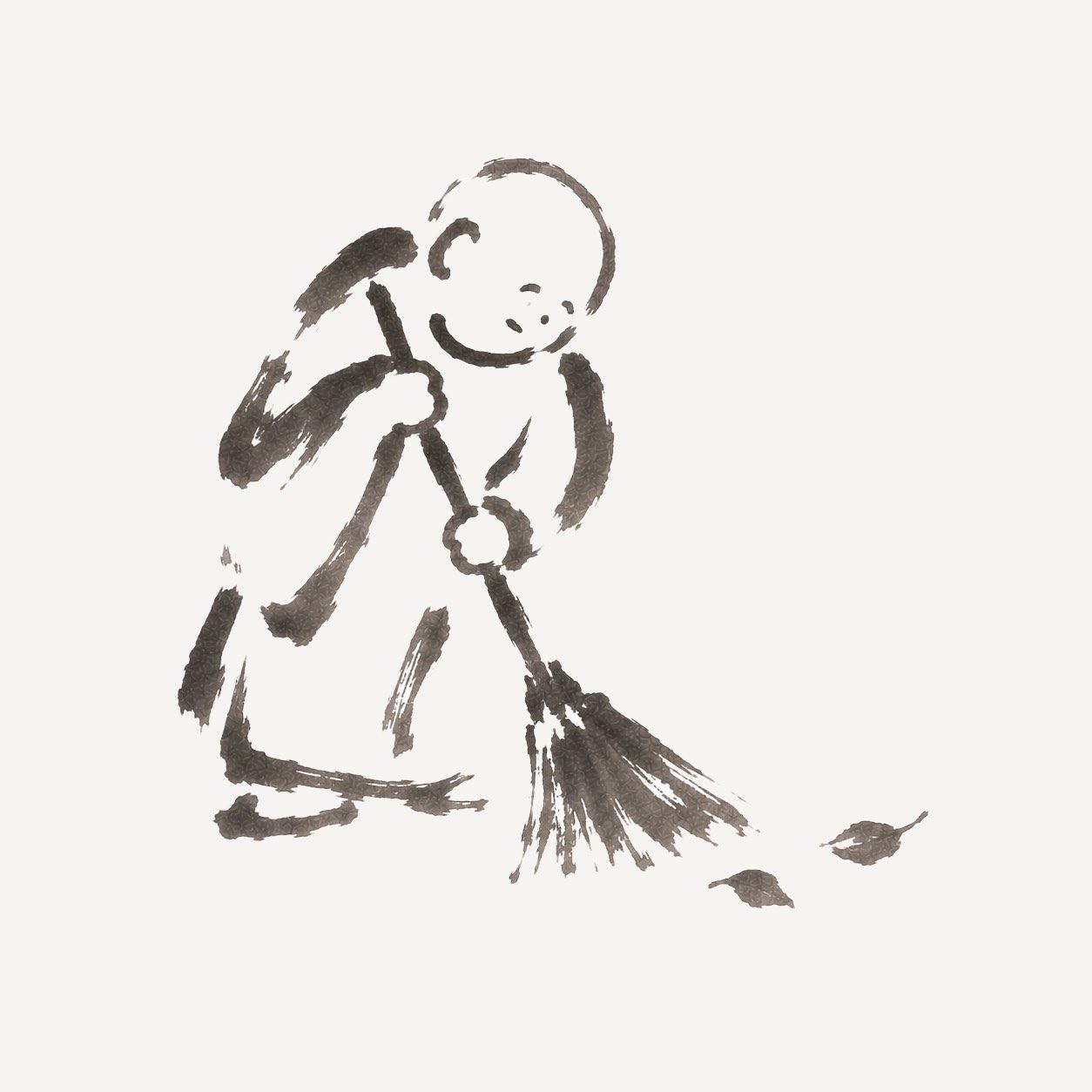
A person sweeping the ground with a simple twig broom, reflecting Bankei’s understanding of Zen practice as inseparable from everyday life. Living in the Unborn does not require a special activity or state of mind, but manifests in the natural functioning of ordinary actions. AI-generated illustration with DALL•E 2, rendered in the style of Japanese Zenga ink painting.
Introduction
Bankei’s teaching of the Unborn is often described as radically simple. Every person already has the unborn Buddha-mind. Awakening is not the creation of a new state, but the recognition of what has always been present. Yet this simplicity raises an obvious practical question: If the Unborn is already present, what does practice actually mean?
Bankei’s answer is not that one should do nothing. It is also not that one must follow a complex method. His practice is direct: Live in the Unborn. In one of the clearest formulations, Bankei says that one should sit in the Buddha-mind, stand in the Buddha-mind, sleep in the Buddha-mind, wake in the Buddha-mind, and do everything in the Buddha-mind. Beyond this, he says, there is nothing. This means that practice is not the ‘production’ of awakening. Practice is the attempt to stop the movements by which the mind turns ordinary experience into anger, fear, craving, pride, self-defense, or attachment to thoughts.
This makes Bankei’s Zen especially relevant for ordinary life. One does not need to wait for a monastery, a teacher, a retreat, a ritual context, or a special meditative state. These may be helpful, but they are not the source of the Buddha-mind. Bankei repeatedly places practice where delusion usually arises, i.e., in thoughts, irritation, fear, pain, conflict, work, speech, illness, and daily reactions.
What practice means in Bankei’s Zen
Bankei’s practice begins from a reversal. In many forms of religious training, the practitioner starts from lack: I am not awakened, therefore I must become awakened. Bankei starts from presence. The Buddha-mind is already here, therefore I must stop transforming it into delusion. This reversal is visible in his statement that every person receives only the unborn Buddha-mind at birth, and nothing else. Anger, fear, craving, and self-deception are not described as original nature. They are later productions. This is why Bankei can say that one does not need to become Buddha in the future. One should rather live as the Buddha one already is. This distinction changes the meaning of practice. Practice is no longer the effort to manufacture a purified mind. It is not the attempt to suppress thoughts, destroy emotions, or escape ordinary experience. It is the recognition that thoughts, emotions, fears, and reactions are conditioned appearances. They arise, pass, and become delusive only when grasped.
To practice the Unborn is therefore to observe where the mind adds something extra to what appears. A sound appears, then the mind adds irritation. A word is heard, then the mind adds insult. A sensation appears, then the mind adds fear. A thought arises, then the mind adds identity. A memory appears, then the mind adds resentment. In each case, the bare appearance is not the problem. The problem is the added self-centered fabrication. Bankei’s practice consists in not continuing this addition.
Recognizing the Unborn without a teacher
A teacher can help reveal self-deception, but Bankei’s teaching does not make awakening dependent on a teacher. The unborn Buddha-mind is not created by the teacher. It is not transmitted as an object. It is already present in the practitioner. Therefore, a person practicing alone can begin by observing the ordinary functioning of their own mind. Bankei himself gives this kind of observation as practical instruction. He repeatedly asks listeners to look directly at what is happening in their own experience. When a visiting monk suggests that deluded thoughts should not arise if everyone already possesses the Buddha-mind, Bankei asks him what delusion is present at the very moment he is speaking. Rather than offering a theoretical explanation, Bankei directs the monk’s attention back to his immediate experience. The teacher provides the question, but the recognition itself is something the monk must arrive at for himself. This kind of inquiry is also available to someone practicing without a teacher.
The first point of observation is therefore simple: Thoughts arise and pass away. They do not need to be chased, suppressed, purified, or believed. Bankei says that thoughts arise because previous experiences are reflected in the Buddha-mind. Yet he also insists that thoughts originally have no real substance. His instruction is not to cut them off, but to let them arise when they arise and cease when they cease. If they are not grasped, they do not become delusion.
The second point is emotional reaction. Anger, fear, and craving do not exist continuously. They arise under conditions. This means they are not original nature. A person without a teacher can directly examine this in daily life. Where was the anger before it arose? What condition triggered it? What self-image did it defend? What story did the mind add? What would remain if that story were not continued?
The third point is self-partiality. Bankei repeatedly warns against taking sides for oneself. This is the moment in which the Buddha-mind is transformed into a fighting spirit. Practicing alone means learning to notice this movement as it begins. The task is not to condemn oneself after becoming angry, but to see how anger is produced before it takes full form.
This kind of practice requires honesty. Without a teacher, the danger of self-deception remains. One can easily mistake passivity for the Unborn, indifference for non-attachment, or intellectual understanding for realization. The practical test is conduct. If the practice is real, it should gradually reduce reactivity, self-defense, pride, fear, and attachment to thoughts.
Example: When anger begins
Bankei’s most concrete teaching concerns anger. Someone says something unpleasant. The body tightens. Heat rises. The mind begins to form a response. At this point, ordinary habit says “I have been insulted. I must defend myself. I must answer. I must prove my position.” Bankei’s conversation with the monk who claims to have a hot temper gives the basic model for practice here. The monk says that he has always been hot-tempered. Bankei asks him to show this temper. The monk answers that he is not angry at that moment. The anger arises only when something provokes him. Bankei then points out that if the anger is not present now, it cannot be something he was born with. It is produced. Bankei explains the mechanism: The monk takes sides for himself, resists others, and tries to impose his own ideas. In doing so, he transforms the Buddha-mind into a fighting spirit. The monk’s error is not simply that he becomes angry. It is that he mistakes a repeated, conditioned reaction for his nature.
Practicing the Unborn in this moment means observing the transformation before it becomes complete. The pause need not be dramatic, it may be nothing more than seeing the movement. This is self-partiality beginning, this is the mind taking sides for itself, this is not original nature, this is being produced.
One does not need to suppress the anger as if it were a forbidden object. Suppression may only create another conflict. The point is to stop feeding the process that turns irritation into identity. The insult can remain a sound. The disagreement can remain a disagreement. A response may still be necessary. But it need not come from wounded selfhood. This is Bankei’s practice in its most ordinary form.
Example: When fear appears
Fear often feels more involuntary than anger. It seems to seize the body and mind before reflection can intervene. Bankei’s response to the woman who feared thunder is therefore important. He tells her that when she was born, she possessed only the unborn Buddha-mind. Fear was not part of it. Her fear, he says, is an invention of thought.
This example should not be misunderstood as a denial of bodily fear. The body can react. The nervous system can startle, but Bankei’s point concerns the mental elaboration that turns sensation into belief, and belief into self. Thunder becomes danger, a bodily reaction becomes panic. A thought becomes certainty, and the mind begins to live inside its own projection.
Bankei even reframes thunder itself. Thunder, he says, announces rain, and rain is useful. The fear therefore does not simply come from thunder as such. It comes from the mind’s construction of thunder as threat. His practical advice is to trust the Buddha-mind when thunder occurs, rather than follow the fear produced by thought.
Practicing the Unborn in fear means seeing this construction. A sound appears. A sensation appears. A thought appears. But none of these has to become “my terror”. The practitioner can observe: Fear is being generated, and the mind is adding a story. The body is reacting, but the Buddha-mind does not need to become that reaction.
This does not make fear vanish by force. Bankei’s practice is not coercive. It loosens identification. Fear may still pass through the body, but it does not need to become the owner of the mind.
Example: When thoughts proliferate
Many practitioners assume that practice means stopping thoughts. Bankei rejects this. Thoughts arise because past experiences are reflected in the Buddha-mind. If one tries to cut them off, one creates another form of attachment. The effort to suppress thought becomes another thought. Bankei’s instruction is unusually clear here: Thoughts should be allowed to arise when they arise and cease when they cease. One should not try to stop them. He says that if one pays no special attention to them, then even a thousand thoughts may arise and it will be as though nothing had happened. Not a single thought needs to be cut off.
One can test this directly. Sit quietly. Walk. Drink tea. Work. Thoughts will arise. Some are neutral, some are emotional, and some are repetitive. The usual mistake is to treat them as commands, revelations, threats, or possessions. But a thought is only a thought.
Practicing the Unborn means allowing thoughts to appear without making them into self. A memory appears, but it does not need to become regret. A plan appears, but it does not need to become anxiety. A judgment appears, but it does not need to become truth. A fantasy appears, but it does not need to become craving. The point is not blankness, but non-appropriation. Bankei’s mirror metaphor is useful here. A mirror reflects what appears before it, but it does not grasp, retain, or identify with the reflection. Likewise, the Buddha-mind allows thoughts to appear, but it does not need to become them.
Example: When pain or illness occurs
Pain and illness are difficult tests of practice because they are not merely conceptual. They involve the body. Bankei does not deny this. He does not say that pain is unreal or that illness can be dismissed. His teaching concerns the additional suffering produced when the mind identifies with the condition.
Bankei says that the unborn Buddha-mind is originally free from thought. It is when thoughts arise from the ground of the Unborn and one begins to worry about illness that suffering is produced. In other words, illness is one thing, the mind’s appropriation of illness is another.
Pain appears, and then the mind adds “This is my fate, my decline, my suffering, my fear, my injustice”. The body is already hurting, but now the mind constructs an entire self around the pain. This is where the Buddha-mind is transformed into suffering. Practicing the Unborn does not mean refusing medical care or pretending that the body is unaffected. It means seeing the difference between pain and the self-story built around pain. Pain may require action, rest, treatment, or help. But the mind does not need to turn pain into identity. A simple practice is to observe the layers. First, there is sensation. Then there is resistance. Then there is fear. Then there is self-description. The Unborn is not a hidden state behind these layers. It is the clear seeing of these layers without becoming them.
Example: In ordinary work
Bankei’s teaching is not confined to emotionally intense situations. It also applies to ordinary work. A person writes, cooks, cleans, answers emails, analyzes data, teaches, cares for others, or performs repetitive tasks. The mind often adds commentary like “I like this”, “I hate this”, “I am good at this”, “I am failing”, “I want to be elsewhere”, “This is beneath me”, “This will make me important”.
Bankei gives a practical example with a woman who is sewing while a friend speaks to her. As long as she remains in the Unborn, she can sew and listen at the same time. If she turns her attention into deliberate thought about answering, the sewing stops. If she clings to the sewing, she no longer hears properly. The example is simple, but the point is precise: When the mind clings to one thing, it loses its free responsiveness to the whole situation.
In ordinary work, practice means returning to the activity as it is. Typing is typing. Washing is washing. Listening is listening. Walking is walking. The activity does not need to be wrapped in self-commentary. The Buddha-mind functions naturally when the mind does not turn every act into identity, resistance, or performance. This does not mean becoming dull or mechanical. On the contrary, action becomes clearer when it is not divided by excessive self-reference. Practice in work therefore means letting the task be fully itself without adding unnecessary egoic drama.
Example: In conversation
Speech is one of the clearest fields of practice. In conversation, the self constantly tries to appear, defend, impress, correct, dominate, withdraw, or protect itself. Bankei’s instruction not to take sides for oneself applies directly here.
Someone disagrees. The mind prepares a counterattack. Someone praises us. The mind becomes inflated. Someone ignores us. The mind feels diminished. Someone corrects us. The mind begins to defend. In each case, speech becomes a vehicle of self-attachment. Bankei’s sermons often proceed from such ordinary social moments. He warns that after leaving the hall, someone might be pushed or insulted, or that a family member at home may say something unpleasant. If one then becomes agitated and takes sides for oneself, the Buddha-mind is transformed into a fighting spirit. This is not a secondary issue for Bankei. It is exactly where practice is tested.
Practicing the Unborn in conversation means hearing before defending. It means allowing words to appear as words before turning them into threat or confirmation. It means responding from clarity rather than from the need to protect an image. This does not require silence. One may still disagree. One may correct errors. One may state a position clearly. But the speech need not come from self-defense. It can arise from the situation itself. This is a practical form of right speech grounded in the Unborn.
Example: In conflict
Conflict reveals whether practice is real. It is easy to speak about Buddha-mind when nothing is at stake, but it is harder when one feels misunderstood, accused, or treated unfairly. And Bankei’s practice does not require becoming passive in conflict. Non-attachment is not submission. The key question is not whether one acts, but from where the action arises. Does it arise from clarity, or from the need to defend the self? Does it respond to the actual situation, or to the ego’s injury? Does it reduce delusion, or intensify it? A useful way to practice is to distinguish the practical issue from the egoic addition. The practical issue may be real: A boundary was crossed, an error was made, a responsibility was neglected. The egoic addition is the story: I have been humiliated, I must win, I must punish, I must prove my worth. Bankei’s Unborn does not erase the practical issue. It removes the unnecessary egoic addition. Then action can be firmer, not weaker, because it is less confused.
Example: With desire and craving
Desire appears in ordinary life constantly. Food, recognition, comfort, distraction, possession, status, pleasure, and certainty become objects of grasping. Bankei does not need to treat each desire as a separate metaphysical problem. The practical question is whether the Buddha-mind is being transformed into craving.
The moment of craving has a recognizable structure. Something appears as desirable, and the mind moves toward it. Then the object becomes necessary, and the self forms around lack: I need this, I must have this, I cannot be satisfied without this. The object may be small, but the structure is the same. Practicing the Unborn means seeing this movement. Desire appears, it can be known, but it does not need to become identity. The object can remain an object, the sensation can remain sensation, the thought can remain thought.
This does not mean rejecting all enjoyment. Bankei’s Zen is not self-mortification. His own criticism of his early severe practice makes this clear. The issue is not whether pleasant things appear, but whether they are turned into grasping and selfhood.
The thirty-day instruction
Bankei’s instruction to remain in the Unborn for thirty days shows that his Zen is not a mere idea. He asks people to test it in life. The instruction is simple: Try living in the Unborn. Do not transform the Buddha-mind into delusion. Observe what happens. Bankei tells his listeners to try remaining in the Unborn for thirty days. Once this becomes habitual, he says, it will become impossible to live outside it. The claim should not be read as a mechanical promise, but as a practical experiment, where repeated familiarization changes how one relates to thoughts, emotions, and reactions. For thirty days, one can repeatedly ask: “Am I producing anger? Am I taking sides for myself? Am I grasping this thought? Am I turning pain into identity? Am I creating fear? Am I clinging to a self-image? Am I acting from the Unborn or from self-defense?””
The point is not perfection. The point is familiarization. Bankei suggests that once living in the Unborn becomes natural, it becomes difficult to depart from it. The practitioner discovers that the Unborn was never far away. What seemed difficult was the habit of not trusting it.
This instruction is especially useful for someone without a teacher because it provides a concrete frame without becoming a rigid method. It does not require special equipment, ritual, or doctrine, but honest observation and repeated return.
Practicing alone without becoming isolated
Bankei’s teaching makes practice possible without a formal teacher, but practicing alone should not become spiritual isolation. Texts, teachers, communities, and conversations can still help. They can expose blind spots, and they can prevent the practitioner from turning the Unborn into a concept or self-image.
Bankei himself is evidence for this balance. He criticizes dependence on methods and inherited forms, but he also teaches people directly. He does not leave them alone with abstractions, he responds to their concrete confusions, i.e., anger, fear, illness, thoughts, attachment to methods, pride in precepts, or misunderstanding of zazen. The important point is that such supports are not the source of awakening, but conditions that may assist recognition. A person practicing alone can still read, reflect, sit, walk, write, speak with others, and examine conduct. What matters is whether these activities point back to the Unborn or become substitutes for it.
A person without a teacher should be especially careful with three errors. The first is passivity, i.e., mistaking the Unborn for doing nothing. The second is inflation, i.e., mistaking the idea “I am already Buddha” for actual realization. The third is hidden selfhood, i.e., turning Buddha-mind into a subtle soul, inner treasure, or spiritual identity. The antidote is concrete testing in life. If the practice does not reduce self-centered reactivity, it remains incomplete.
Manifesting the Unborn in daily life
To manifest the Unborn in daily life means that recognition becomes visible in conduct. It is not enough to have an idea about Buddha-mind. Bankei’s teaching must appear in how one responds.
In anger, it appears as not taking sides for oneself.
In fear, it appears as seeing the generation and manifestation of threat.
In thought, it appears as not grasping what arises.
In pain, it appears as not turning sensation into identity.
In speech, it appears as clarity without self-defense.
In work, it appears as undivided action.
In conflict, it appears as firm response without egoic aggression.
In pleasure, it appears as enjoyment without grasping.
In practice, it appears as trust in what is already present.
The Unborn is therefore not hidden in a special meditative interior. It is lived through the ordinary gestures of life. One manifests it not by performing spirituality, but by no longer producing unnecessary delusion.
The role of zazen
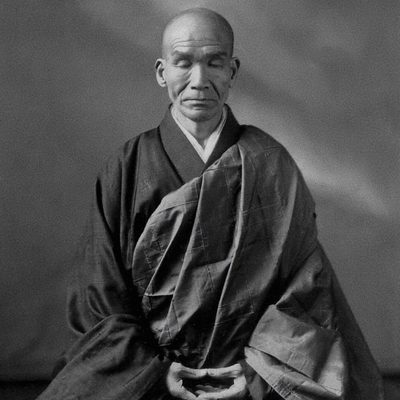
Bankei does not reject zazen, but he refuses to confine practice to sitting. He says that zazen is nothing other than being at home in the Buddha-mind, without becoming caught in self-deception and without seeking enlightenment beyond it. He also says that zazen is the sitting of the Buddha-mind in stillness. This formulation slightly changes the meaning of zazen. Zazen is not a technique that manufactures the Buddha-mind. It is one expression of it. One can sit in the Buddha-mind, but one can also stand in the Buddha-mind, walk in the Buddha-mind, sleep in the Buddha-mind, and work in the Buddha-mind.
For someone practicing alone, zazen may be the most central practice, apart from living the Unborn in daily life itself. It provides the most suitable situation in which thoughts, sensations, and reactions can be observed clearly, while this is not the main ‘goal’ of zazen. Zazen has no goal, it is just sitting. Thus, it should not be confused with any modern esotheric well-being and self-reflection practice. Zazen is sitting for the sake of sitting, in this sitting, one already sits in and expresses Buddhahood in its purest form.
No special state
A common mistake is to imagine that the Unborn must feel special. One expects peace, luminosity, silence, bliss, or a heightened meditative condition. Bankei’s teaching cuts against this expectation. The Unborn is not a state produced by practice. It is the non-generated functioning of the Buddha-mind.
This point is supported by Bankei’s example of the sleeping monk. When another monk struck him for falling asleep, Bankei objected. Did the sleeping monk leave the Buddha-mind while sleeping? Bankei’s answer is no. One sleeps in the Buddha-mind just as one wakes in the Buddha-mind. This does not mean that sleep is equivalent to realization in every sense. It means that the Buddha-mind is not a special state produced only under ideal meditative conditions. Sometimes practice may feel calm, sometimes it may not. Sometimes thoughts may be few, sometimes thoughts may be many. Sometimes the body may be relaxed, sometimes the body may be in pain. The criterion is not the presence of a special feeling, but whether the mind is producing delusion from what appears. This is important for solitary practice. Without a teacher, one may chase experiences and mistake them for realization. A peaceful state may become an object of attachment. A moment of clarity may become a self-image. A lack of thought may be mistaken for wisdom. Bankei’s teaching redirects attention away from special states and toward non-fabrication in ordinary experience. The Unborn is not proven by how extraordinary one feels. It is shown by whether one stops turning experience into self.
A practical daily frame
A person practicing Bankei’s Zen can use a simple daily frame without turning it into a rigid method. In the morning, for instance, one can recollect that the Buddha-mind is already present and that the task is not to produce it, but not to transform it into delusion. During the day, one can observe the moments where self-partiality begins. In the evening, one can review where anger, fear, craving, pride, or clinging were produced. This review should not become self-blame. Its purpose is clarity. Where did I turn a thought into identity? Where did I take sides for myself? Where did I add fear to a situation? Where did I allow speech to arise from self-defense? Where did I act naturally without fabrication?
Such reflection can gradually make the patterns of delusion more visible. Once visible, they lose some of their authority. The practitioner begins to see that what seemed like “my nature” was often a repeated construction. This is how the Unborn becomes manifest in everyday life, not through grand spiritual events, but through repeated recognition at the points where delusion is usually produced.
Conclusion
Practicing the Unborn does not mean doing nothing. It means not producing delusion. Bankei’s Zen is simple because it does not require the manufacture of awakening. The unborn Buddha-mind is already present. But it is demanding because every ordinary moment reveals whether one lives from that Buddha-mind or transforms it into anger, fear, craving, pride, self-defense, and suffering.
One can approach the Unborn by observing thoughts, emotions, pain, speech, work, desire, and conflict directly. Bankei’s own examples support this practical orientation. He does not speak only about abstract enlightenment. He speaks about anger, thunder, illness, thoughts, sewing, sleep, zazen, and daily encounters with other people. The question is always practical: What is being added? Where is the self being fabricated? Where is the mind taking sides for itself? Where is a thought becoming identity? Where is pain becoming self? Where is fear being constructed? The Unborn is recognized when these movements are seen and no longer continued. It is manifested when recognition becomes conduct, i.e., less reactivity, less self-defense, less clinging, clearer speech, more natural action, and a more direct relation to things as they are.
Bankei’s practice is therefore neither passive nor esoteric. It is ordinary, precise, and uncompromising. One does not need to become Buddha. One needs to stop obscuring the Buddha-mind that, in Bankei’s teaching, is already functioning in seeing, hearing, thinking, speaking, acting, and living.
References and further reading
- Norman Waddell (Herausgeber), Bankei Eitaku, Die Zen-Lehre vom Ungeborenen. Leben und Lehre des großen japanischen Zen-Meisters Bankei Eitaku (1622 - 1693), 1988, ISBN-10: 3502640505
- Peter Haskel (Übersetzer), Yoshito Hakeda (Herausgeber), Mary Farkas (Vorwort), Bankei Zen - Translations From The Record Of Bankei, 1994, Grove Press, ISBN: 9780802131843
- Oliver Bottini, Das große O.-W.-Barth-Buch des Zen, 2002, Barth im Scherz-Verl, ISBN: 9783502611042
- Heinrich Dumoulin, Geschichte des Zen-Buddhismus, Band 1+2, 2019, 2., durchgesehene und erweiterte Auflage, Francke A. Verlag, ISBN: 9783772085161
- Hans-Günter Wagner, Buddhismus in China: Von den Anfängen bis in die Gegenwart, 2020, Matthes & Seitz Berlin, ISBN: 978-3957578440
- Jr. Buswell, Robert E., Jr. Lopez, Donald S., Juhn Ahn, J. Wayne Bass, William Chu, The Princeton dictionary of Buddhism, 2014, Princeton University Press, ISBN: 978-0-691-15786-3






comments