Shinjin gakudō: Studying the Way with body and mind
Shinjin gakudō examines how the Buddhist Way is studied with body and mind. Eihei Dōgen begins from their familiar distinction but does not leave either term unchanged. Mind is not merely private thought or inward consciousness, and body is not merely the biological organism. Both open onto the wider field of practice, world, action, time, and relation. The fascicle consequently develops an account of body and mind that cannot be treated as fixed possessions of an isolated self.
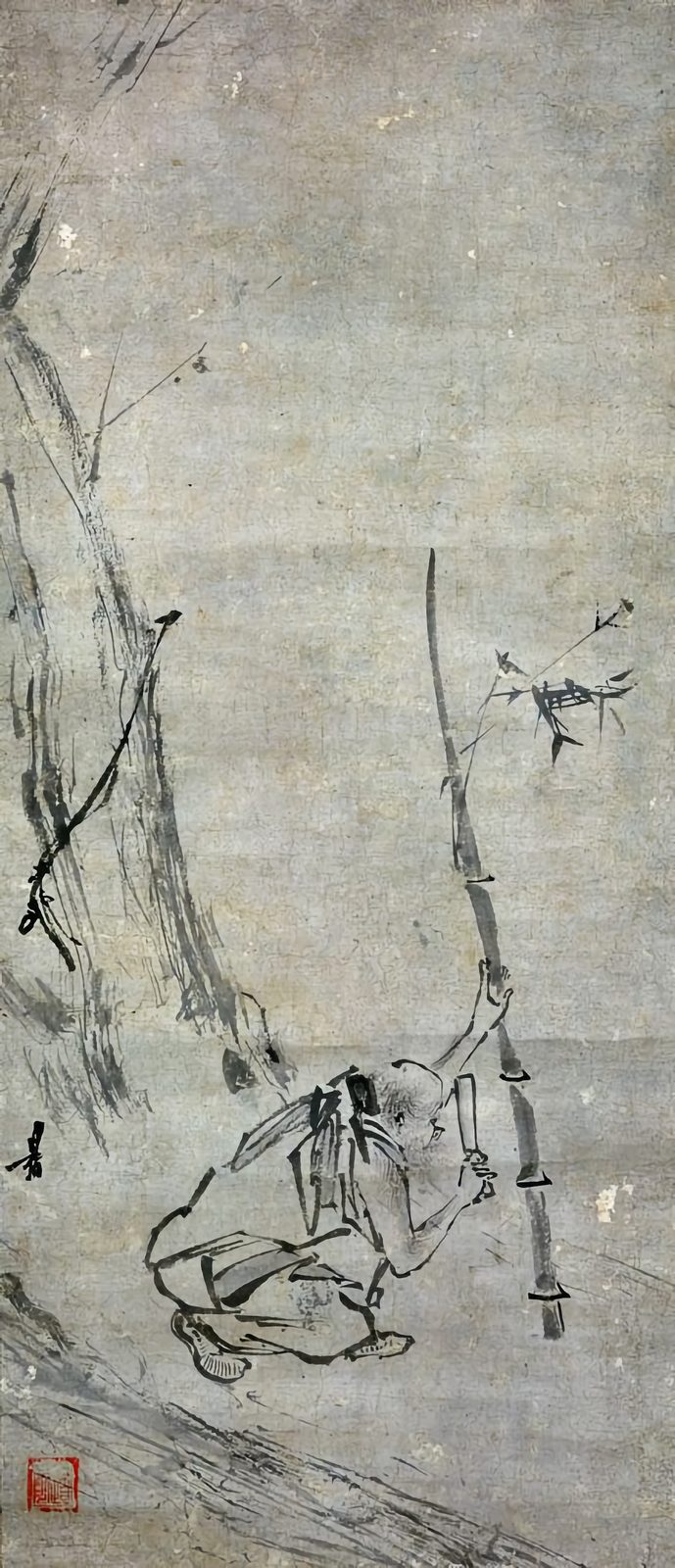
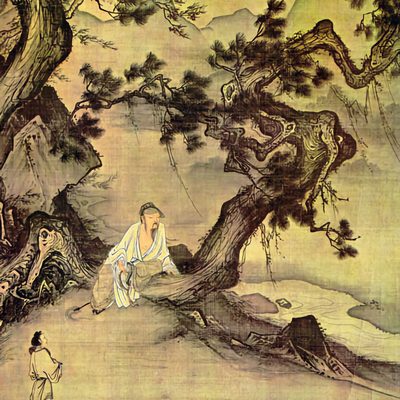
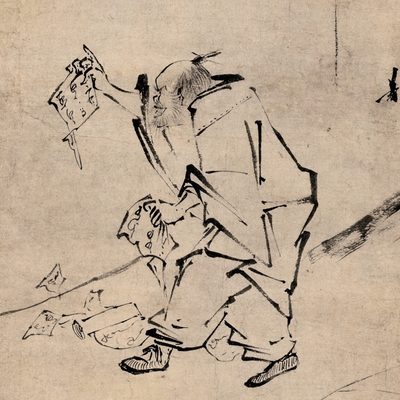
The sixth patriarch cutting the bamboo. Huineng is said to have attained sudden enlightenment upon hearing a verse about the nature of mind. He then cut a piece of bamboo in two to demonstrate his understanding. The image represents the Chan claim that the Way is not learned through thought alone but through concrete action and embodiment. Source: Wikimedia Commonsꜛ (license: public domain)
In this post, we reconstruct how Dōgen understands the study of the Way, that is, the Buddhist path in its doctrinal, practical, and soteriological dimensions, with body and mind. We examine how he expands both terms beyond their usual meanings: Mind is not limited to private thought or inner consciousness, while body is not reduced to the biological organism. Shinjin gakudō thereby presents Buddhist practice as involving the whole person and the surrounding world.
Introduction
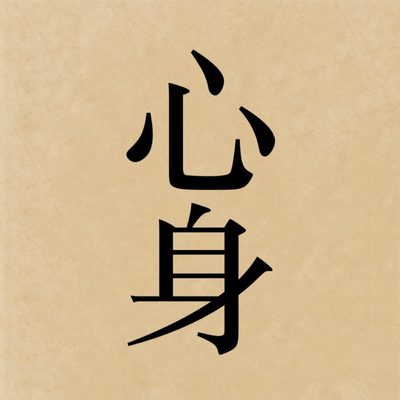
Shinjin gakudō (身心學道), usually translated as Studying the Way with body and mind, is one of Eihei Dōgen’s most sustained reflections on how the Buddha-Dharma is studied. The title announces the fascicle’s central concern: Shinjin means body and mind, while gakudō denotes studying, learning, or practicing the Way. The text treats the Buddhist path as an activity of the whole person rather than as thought, belief, doctrine, or formal identity alone. It is consequently a close companion to Dōgen’s other texts on practice: Bendōwa argues that practice and realization are not two; Fukan zazengi gives the concrete form of zazen as the direct gate of the Dharma; Uji develops the temporal structure of being and practice. Shinjin gakudō adds an account in which body and mind are not fixed possessions of an isolated self.
The Way (道)
The English expression the Way translates the Japanese dō (道), the Japanese pronunciation of the Chinese term dào. The character originally refers to a road, path, direction, method, or way of living. It was used throughout classical Chinese philosophy and was not exclusive to Daoism. In Daoist texts, however, the Dào acquired its best-known philosophical meaning as the ultimately indescribable course, order, and generative process of reality, with which human action should remain in accord.
When Buddhism entered China, its Indian concepts had to be translated into a language shaped by existing Chinese philosophical traditions. Rather than introducing an entirely new vocabulary, early translators often used familiar Chinese terms whose meanings partly overlapped with Buddhist ideas. Dào was especially suitable because Chinese readers already understood it as a path, method, normative orientation, and way of life. Applying this term to Buddhism made the new teaching more intelligible by expressing it through an established conceptual language. At the same time, the meaning of dào changed within this new context. It no longer referred primarily to the Daoist course of nature, but could designate the Buddhist path, corresponding broadly to the Sanskrit mārga, as well as the teaching, practice, and realization associated with that path. In Japanese Buddhism, dō appears in terms such as Butsudō, the Buddha Way, and gakudō, studying or learning the Way.
In Dōgen’s writings, the Way does not primarily denote the Daoist cosmic principle, even though the shared East Asian vocabulary remains visible. It refers to the Buddha Way: The whole path of Buddhist teaching, ethical orientation, practice, realization, and transmission. The Way is therefore not only a doctrine to be understood or a route leading toward a distant goal. It is learned and enacted through concrete practice, including sitting, bowing, working, speaking, receiving instruction, and living with others. In Shinjin gakudō, “studying the Way” consequently means learning and practicing the Buddha-Dharma with the whole of body and mind. Dōgen then complicates this formulation by showing that body and mind are not private possessions of an isolated self. To study the Way is to enter a form of practice in which body, mind, action, world, and realization can no longer be treated as separate domains.
Historical background
Dōgen delivered Shinjin gakudō in 1242 at Hōrin monastery. The text belongs to the early period of the Shōbōgenzō, but it already contains several themes that run through Dōgen’s mature thought: The relation between mind and world, the concrete role of the body, the danger of naturalistic or essentialist misunderstandings of Buddha-nature, the temporal structure of practice, and the nonduality of life and death. It is also, however, a difficult text because Dōgen does not simply give a clean doctrinal distinction between mind and body. He first speaks of studying the Way with mind, then of studying the Way with body, but both sections undo simplistic assumptions about what “mind” and “body” mean.
The text is therefore not a dualistic account in which the mind learns one part of the Way and the body learns another. Dōgen instead destabilizes both terms. Mind is not a private inner substance. It includes mountains, rivers, earth, sun, moon, stars, walls, tiles, and stones. Body is not merely a biological organism. It includes the whole universe of the ten directions, life and death, coming and going, action and stillness. In this sense, Shinjin gakudō expands the meaning of body and mind until they are no longer owned by an isolated self. For Dōgen, to study the Way with body and mind means to study the Way through the full field of embodied, conditioned, relational existence.
Context and central problem
Shinjin gakudō opens with a strong claim:
The Buddha-truth is such that you cannot attain it without the firm resolve to learn it. If you cannot resolve to learn the truth, it moves farther and farther away from you.
The opening rejects passivity. Although the Dharma may already be present, Dōgen presents it as unrealized without the resolve to learn and practice. This is consistent with his broader position. In Bendōwa, the Dharma is abundant but does not reveal itself without practice. In Fukan zazengi, truth is everywhere, but the slightest dualistic distinction sends it far away. Shinjin gakudō articulates the same structure through learning: Without the decision to study the Way, truth recedes. The cited saying of Zen Master Nangaku gives this opening its further structure:
It is not that practice and experience do not exist, but they must not be defiled.
The statement avoids two extremes: It does not deny practice and realization, but it warns against their defilement. Here defilement does not mean ordinary dirt. It names the self-centered appropriation of practice, realization, or the Way as a possession or identity. The passage establishes a tension that governs the fascicle: Truth is studied, but study cannot be reduced to acquisitive grasping.
Dōgen then states that there are two initial ways to study the Buddha-truth:
First, there are two ways to study the Buddha-truth: with the mind or with the body.
Dōgen develops the rest of the text around these two forms of study. But he does not present them as a simple opposition between inner thought and outer embodiment. His analysis of mind already includes the world, while his analysis of body includes the whole universe. By examining both separately, Dōgen gradually shows that neither mind nor body can be understood in the narrow sense of a private possession belonging to an isolated self.
Shinjin gakudō
The following translation provides the full text attributed to Dōgen:
Shinjin gakudō
The Buddha-truth is such that you cannot attain it without the firm resolve to learn it. If you cannot resolve to learn the truth, it moves farther and farther away from you. Zen Master Nangaku said: “It is not that practice and experience do not exist, but they must not be defiled”. If you do not learn the Buddha-truth, you fall into the domain of people outside the Buddha Way, superficial people, and so forth. Therefore, all Buddhas before and after us have, without exception, learned the truth and acted in accordance with it. To begin with, there are two ways to learn the Buddha-truth: with the mind or with the body.
“The mind learns the truth” means that you learn it with the various kinds of mind. These kinds of mind include the thinking mind, the non-thinking mind, and the balanced mind. Furthermore, when you have established an intimate connection with the truth and arrived at the bodhi-mind, you take refuge in the great truth of the Buddhas and ancestors. You then learn and investigate it through active conduct, which is itself the awakening of the bodhi-mind. Even if you have not yet arrived at the bodhi-mind, you should study the methods of the Buddhas and ancestors who awakened before you. This is the awakening of the bodhi-mind. It is the pure mind from moment to moment, the mind of the eternal Buddhas, the ordinary mind, and the one mind of the three worlds. You learn the truth by using these various kinds of mind, and you learn the truth by letting them fall away. At this time, you learn the truth both through thinking and through non-thinking.
When Gautama Buddha transmitted the Dharma to Master Mahākāśyapa, he handed him a brocade robe, and Mahākāśyapa received it. On another occasion, Master Bodhidharma said, “You have attained my marrow,” and Master Taiso Eka bowed three times and remained standing in his place. On yet another occasion, Master Daikan Enō pounded rice and Master Daiman Kōnin transmitted the robe to him. This was the study of mind by mind. Shaving the head and dyeing the robe black means changing the mind and clarifying the mind. When Gautama Buddha climbed over the city wall and went into the mountains, he gave up one mind and entered another mind. Going into the mountains means thinking from the ground of non-thinking. Leaving the world means being beyond thinking.
When you make this mind into your own eyeballs, it is as concrete as two or three barrels of water. To play with it in the midst of your karmic consciousness means encountering thousands and tens of thousands of different facts. When you learn the truth in this way, you secretly borrow the breath of the Buddhas and ancestors and let it flow out. Then you use the hooves of horses and donkeys to stamp the seal of living experience onto all things. This applies both when the effect has already appeared and recognition follows by itself, and when recognition is already present but the effect has not yet appeared. Learning the truth in this way is the standard for tens of thousands of ages.
In short, mountains, rivers, and the great earth, the sun, the moon, and the stars are mind. But what is realized before us at this very moment? Mountains, rivers, and the great earth mean that mountains are real mountains and rivers are real water.
The great earth is not only this place here. There may be many different mountains: the great Mount Sumeru and smaller Sumerus; mountains lying horizontally and mountains rising vertically; mountains of the three thousand worlds and mountains of countless spheres; mountains based on matter and mountains suspended in empty space.
There may also be many kinds of rivers: the rivers of heaven, the rivers of earth, the four great rivers, the lake without heat, the four lakes on the northern continent surrounding Mount Sumeru, as well as oceans and ponds. Earth is not always the ground on which we stand, and the ground is not always earth. There may be earth in a piece of land, earth in consciousness, and earth in the Three Treasures. Even if there are countless kinds of earth, it is impossible for earth not to exist. There may be worlds that make heaven into earth.
The views of living beings differ greatly, and humans and gods may have a completely different view of the sun, moon, and stars from other beings. In contrast, what we see with the one mind is unified, because the mountains, rivers, earth, and other things described above are already this mind.
Should we regard them as something inside or outside, or as something that comes or goes? Is something added when they arise, or is something taken away when they perish? Where should we place life and death, and the perception of life and death?
The past was only one moment of mind followed by the next moment of mind. A moment of mind followed by the next moment of mind is therefore a moment of mountains, rivers, and the great earth followed by the next moment of mountains, rivers, and the great earth.
Because mountains, rivers, and the great earth are beyond being and non-being, they are neither large nor small. They can neither be grasped nor not grasped, neither known nor not known, neither penetrated nor not penetrated. They change neither in awakening nor in non-awakening.
You should therefore firmly trust that the mind described here naturally develops the habit of learning the truth. This is what we call learning the truth with the mind. This trust itself is beyond large and small, being and non-being.
To recognize that a home is not your home and to leave your family in order to become a monk means that you are learning the truth. This lies beyond all considerations of large and small, near and far. You have your daily life, the things that develop, which are as concrete as seven or eight feet, and you cast yourselves, for your own sake and for the sake of others, into the moment. This surpasses all ancestors, from the first to the last, and lies beyond every idea of the real or unreal, because all these ordinary things are nothing other than learning the truth.
Because learning the truth is like this, hedges, walls, tiles, and pebbles are mind. This mind does not mean that the threefold world or the Dharma-world is merely “mind”. Rather, the hedges, walls, tiles, and pebbles are themselves this mind.
Before the Kantsū era, this was realized, and after the Kantsū era, it was further developed. Learning the truth means wading through the swamp of everyday life and standing in the water of difficulty. It means binding yourselves without a chain.
You gain the power to draw a precious jewel toward yourselves and the ability to dive into the water. On some days you let the process of learning go. On some days it falls into pieces, and there are days when it disappears completely. This is something different from outdoor temple pillars and stone lanterns.
Learning the truth is therefore like walking barefoot, and who could recognize that you are learning the truth when you turn a somersault? Each of you simply acts in accordance with the given circumstances. At that time, you learn that there are no collapsing walls in the ten directions and not a single gate in the four quarters.
“To awaken and attain the bodhi-mind” means that you sometimes attain it in life and death, sometimes in nirvana, and sometimes in conditions other than life and death or nirvana. You should not expect it to exist somewhere. Rather, the place where you awaken is unobstructed by anything.
It arises neither through circumstances nor through wisdom. The bodhi-mind awakens from itself, and this is the awakening of the bodhi-mind. The awakening of the bodhi-mind is beyond being and non-being. It is neither good nor bad nor neutral. Awakening is not the good effect of a cause, and gods and sentient beings can undoubtedly attain it.
The bodhi-mind is such that it awakens precisely in the moment of its time. In this very moment, the whole Dharma-world awakens and attains the bodhi-mind, because awakening does not depend on circumstances.
Even when it appears that the awakening of the bodhi-mind changes circumstances, the circumstances know nothing of it, because you and the circumstances join hands and form a unity. Nevertheless, each of you also extends your own hand, which differs from the hands of others. Even in the states of hell, hungry ghosts, animals, and asuras, the bodhi-mind awakens.
“Pure mind from moment to moment” means that the mind, moment by moment, is nothing but pure mind. These words do not describe the idea of one or two moments, but the reality of moment after moment.
Lotus leaves are completely round, and their roundness is like a mirror. The shells of water chestnuts are very sharp, and their sharpness is like needles. Although we say that lotus leaves are like mirrors, they are in reality “from moment to moment”. Although we say that the shells of water chestnuts are like needles, they are in reality “from moment to moment”.
A monk once asked National Teacher Daishō, “What is the mind of the eternal Buddhas?”
The National Teacher answered, “Fences, walls, tiles, and pebbles”.
You should therefore know that the mind of the eternal Buddhas is not the ordinary idea of fences, walls, tiles, and pebbles, and fences, walls, tiles, and pebbles are also not what is conventionally called the “mind of the eternal Buddhas”. In this way, you should learn the mind of the eternal Buddhas.
“The balanced ordinary mind” is the natural condition of mind in this world or in other worlds.
Yesterday departs from here, and today comes from here. When yesterday departs, the whole sky departs, and when today comes, the whole earth arrives here. This is the balanced ordinary mind.
It opens and closes within these limits. Because a thousand gates and ten thousand doors open and close again within a fraction of a moment, the world is balanced and stable.
“The whole sky” and “the whole earth” are like a language unfamiliar to you, and sometimes they seem like a voice arising from the earth. But words are balanced, mind is balanced, and the world is balanced. Life and action arise and perish in the moment. You can understand this only with the final body.
Even if you do not understand it, you still advance on the Way of truth when you awaken and realize the bodhi-mind. This place already exists, and no one can doubt it. Doubt is already there, and this is normal.
“The body learns the truth” means that one must learn the truth with the body, that is, with this collection of red flesh. The body is based on learning the truth, and learning the truth is based on the body.
In both cases, the body is at issue. Two ancient masters said:
The whole universe is the true body of the human being.
Life and death, coming and going, are the true body of the human being.
You bring this physical body into practice, abandon the ten evils, observe the eight precepts, take refuge in the Three Treasures, and leave your families to become monks or nuns. This is the real learning of the truth. On this basis, we speak of the true body of the human being.
Students of later ages should not hold a naturalistic view of the body like people outside the Buddha Way.
Zen Master Hyakujō Daichi said:
Whoever clings to the idea that they are originally already pure and free, by nature Buddha and one with the Way of Zen, belongs to people outside the Buddha Way who hold a naturalistic view.
These words are not the useless instruments of an idle theorist. They express Hyakujō’s long-accumulated merit and virtue in learning the truth.
Because he freed himself from materialistic and idealistic views, the merit and virtue of his body became fully manifest. Because he overcame all obstacles, they were as natural as wisteria growing around a tree.
Sometimes such practitioners reveal this body in order to liberate others and teach them reality, the Dharma. Sometimes they reveal another body in order to liberate and teach others. Sometimes they liberate others and teach reality without revealing this body. Sometimes they liberate others and teach reality without revealing another body.
Sometimes they may go beyond all verbal explanations of reality in order to teach others. When Hyakujō raises his voice and forgets his physical body, every sound ceases. When he attains the marrow of the truth through painful effort, he gives up his life. Like his own children and grandchildren, he allows even those who began learning the truth in an inconceivably distant past to mature.
“The whole universe of the ten directions” means that each of the ten directions is the whole universe. We call the ten directions east, west, south, north, the intermediate directions, nadir, and zenith.
You should experience the moment when the front and back, length and breadth of all ten directions are the complete whole. The word “experience” means here that you can feel and confirm with your own body that the human body is the whole universe of the ten directions, even though it is limited by self and world.
Here you hear words you have never heard before, because all ten directions are balanced and the whole world is balanced.
The human body consists of the four elements and the five aggregates. Ordinary people cannot fully investigate either the large or the small, while the sages experience and investigate both.
You should also experience the ten directions in a single speck of dust, but you should not think that the ten directions consist only of individual specks of dust.
Sometimes the zazen hall and the Buddha hall are built in a single speck of dust, and sometimes the whole world is built in the zazen hall and the Buddha hall. On this basis, the whole universe is formed, and form is realized on this basis.
This is the truth that the true body of the human being is the whole universe of the ten directions. You should not hold the false view of the naturalists. What lies beyond the spatially measurable world is also beyond wide and narrow.
The whole universe in the ten directions consists of the eighty-four thousand elements of Dharma-discourse, the eighty-four thousand samādhis, and the eighty-four thousand dhāraṇīs.
Because the eighty-four thousand elements of Dharma-discourse turn the Dharma-wheel, the place where the Dharma-wheel turns is the whole of the world and the whole of time.
Directions and boundaries exist in this world, and they are the true body of the human being. Now you are human beings, and I am a human being, whose true body is the whole universe of the ten directions. Learning the truth means not blindly passing by this fact.
Even if you continue for three, thirteen, or countless world ages to receive this body and then give it up again, every moment in which you learn the truth is undoubtedly a moment of learning it through action and allowing.
You prostrate yourselves and bow with joined hands, and these are certainly the active and resting forms of dignified conduct. The efforts to paint a withered tree and polish dead ashes never cease.
Even though the passing days are short and urgent, learning the Way is deep and eternal. Although your life is solitary and you have left your families to become monks, you should not compare yourselves with woodcutters. Although you must struggle for survival, you are not like farmers.
You should not compare your truth with arguments about delusion, right, and wrong. Do not remain within the domains of correct and incorrect, genuine and false.
We say that life and death, coming and going, are the true body of the human being. This life and death is the endless wandering of ordinary people, but also the liberation of the great sages.
What we call the true body of the human being does not merely mean going beyond the ordinary and the sacred. Even if there are the two and seven kinds of life and death, each is the whole of life and the whole of death when fully realized.
Therefore, you need not fear life and death. Why is this so? Because you have already encountered death before life has ended, and you have already encountered life before you have died.
Life does not obstruct death, and death does not obstruct life. Ordinary people understand neither life nor death.
Life is like a cedar tree, and death resembles an ancient practitioner. The cedar tree is limited by the cedar tree, but life is never obstructed by death.
Therefore, life is nothing other than learning the truth. Life does not come first and death afterward. Death is already part of life. Death does not stand in opposition to life, and life does not depend on death.
Zen Master Engo said:
Life is the dynamic activity of the whole universe.
Death is the dynamic activity of the whole universe.
They fill the whole of space.
The pure mind is always moment by moment.
You should quietly reflect on these words and examine them carefully. Although Zen Master Engo said this, he may not have known that life and death go even beyond the dynamic activity of the whole universe.
You experience and investigate coming and going. Life and death exist in coming, and they exist in going. There is coming and going in life, and there is coming and going in death.
Coming and going give the whole universe two or three wings, with which it flies in coming and going. Coming and going give the whole universe three or five feet, with which it advances and withdraws.
Life and death, head and tail, the true body of the human being, and the whole universe turn somersaults and move their brain cells. Turning somersaults and moving the brain cells are as concrete as a large coin and as tiny as the core of a speck of dust.
On the flat and level earth, walls a thousand feet high rise. Where the thousand-foot walls rise, the earth is flat and level. Therefore, the characteristics of human beings and heavenly beings exist.
To investigate all this thoroughly means to learn the truth. Non-thinking and the rejection of non-thinking are as real as bones and marrow. You learn the truth only when you do not allow yourselves to be caught by theories about it.
Shōbōgenzō Shinjin gakudō
Presented to the assembly at Hōrin monastery on an auspicious day in the third year of the Ninji era, 1242.
Studying the Way with mind
The main text can be divided into two parts: The first concerns studying the Way with mind, the second studying it with body. The first part shows that Dōgen does not reduce the Way to a purely physical practice. Mind is not rejected as an obstacle to awakening. It is presented as a field of study and practice in its own right.
Mind is not merely thinking
Dōgen first defines studying the truth with mind:
“The mind studies the truth” means that you study it with the various kinds of mind. These kinds of mind include the thinking mind, the non-thinking mind, and the balanced mind.
The first point is that “mind” is plural and dynamic. Dōgen does not reduce mind to ordinary thought. He includes thinking mind, non-thinking mind, and balanced or ordinary mind. Zen is often misunderstood either as anti-intellectualism or as a technique for emptying the mind. Dōgen does neither. Thought is part of the field, but so is non-thinking, and so is the ordinary balanced mind.
The phrase “non-thinking” recalls the instruction in Fukan zazengi:
Think from the ground of non-thinking.
In both texts, non-thinking does not mean unconsciousness or mental blankness. It denotes a mode of awareness not governed by grasping, discursive elaboration, or self-centered conceptualization. Dōgen thereby presents the study of the Way as involving not only the production of thought but also the release of fixation on thought.
Dōgen then connects mind with the awakening of the bodhi-mind:
When you have established an intimate connection with the truth and arrived at the bodhi-mind, you take refuge in the great truth of the buddhas and ancestors.
The mind that studies the Way is therefore not detached cognition. It is the mind that turns toward awakening, takes refuge, and enters the practice of the Buddhas and ancestors. Even before the bodhi-mind is fully awakened, one studies the methods of those who have awakened before. Learning the Way means entering a transmitted field of practice.
Learning by using mind and by letting mind fall away
Dōgen writes:
You study the truth by using these various kinds of mind, and you study the truth by letting them fall away. At this time you study the truth both through thinking and through non-thinking.
Mind is neither rejected nor treated as an object of attachment. Dōgen’s paired formulation, studying with mind and letting mind fall away, avoids both affirmation and negation as fixed positions. Mind is necessary, but not a possession. This has a direct connection to non-self. If mind were treated as an inner essence, study with mind would become a subtle form of self-grasping. By holding together the use and release of mind, Dōgen presents it as an instrument, field, process, and Dharma-position rather than a permanent self.
This also explains why Dōgen can speak of studying through thinking and non-thinking. Thought is not excluded from the Way, but Dōgen refuses to make it the sovereign center. Non-thinking is not the opposite of thought in a dualistic sense. It is the release of thought from self-centered possession.
Transmission as the study of mind by mind
Dōgen then gives examples from the Zen lineage: Siddhartha Gautama transmitting the robe (Japanese: kesa) to Mahākāśyapa, Bodhidharma saying to Huike, “You have attained my marrow”, and Huineng pounding rice before receiving the robe from Hongren. Dōgen comments:
This was the study of mind by mind.
These examples show that mind is learned through concrete acts of transmission, not through abstract doctrine alone. A robe is handed on. A disciple bows. Rice is pounded. A teacher recognizes a student. Mind is studied through embodied situations. This is important because it prevents “mind” from becoming an inward psychological category. Mind is not merely what happens inside the head. Mind appears in bowing, receiving, working, shaving the head, and practicing. Dōgen writes:
Shaving the head and dyeing the clothing means changing the mind and clarifying the mind.
External acts are not merely external. They are transformations of mind. Leaving home is not only a change of location. It is a change in the structure of attachment, identity, and orientation. Dōgen even says Siddhartha Gautama :
When he climbed over the city wall and went into the mountains, he gave up one mind and entered another mind.
This sentence shows how broad Dōgen’s notion of mind is. Mind is not a hidden inner object. It is a way of being situated and acting. To leave the palace and enter the mountains is to enter another mind. To go into the mountains is “to think from the ground of non-thinking”. To leave the world is “to be beyond thinking”. These are not merely mental states. They are whole forms of life.
Mountains, rivers, and earth are mind
Dōgen then gives one of the most striking statements in the text:
In short: mountains, rivers, and the great earth, the sun, the moon, and the stars are mind.
This sentence can easily be misunderstood if read through idealism. Dōgen is not simply saying that the external world is a projection of the mind. He immediately qualifies the point:
The mountains, rivers, and the great earth mean that mountains are real mountains and rivers are real water.
The qualification establishes that Dōgen does not dissolve the world into a private mental substance. Mountains are mountains, rivers are water. The claim is not that mind imagines the world, but that mind and world cannot be separated in an ordinary dualistic way. The mind that studies the Way is not confined to an individual person but includes the whole field of manifestation. Dōgen develops this claim by multiplying the forms of mountains, rivers, earth, sun, moon, and stars. There are cosmic mountains, horizontal and vertical mountains, rivers of heaven and earth, oceans and ponds, earth in land, earth in consciousness, earth in the Three Treasures, and worlds where heaven functions as earth. This proliferation prevents any simple definition: “Earth,” “mountain,” and “mind” are not fixed objects. The relevant philosophical claim is that the world encountered by beings differs according to their conditions:
The views of living beings are very different, and it may be that humans and gods have a completely different view of the sun, moon, and stars.
This is close to the Buddhist analysis of conditioned perception. Things are not simply encountered from nowhere. They appear according to body, sense organs, karma, form of life, and conditions. Yet this does not make the world arbitrary. The mountains are real mountains, and rivers are real water. The point is relational, not subjective in a trivial sense.
Mind beyond inside and outside
Dōgen asks:
Should we regard them as something inside or outside, or as something that comes or goes? Is something added when they arise, or is something taken away when they perish?
These questions undo ordinary spatial and temporal assumptions. If mountains, rivers, earth, sun, moon, and stars are mind, then mind cannot be simply inside. But if they are real mountains and real rivers, mind cannot be simply outside either. Likewise, arising and perishing cannot be understood as the addition or subtraction of fixed substances.
This connects Shinjin gakudō with Uji. Dōgen writes:
The past was only a moment of mind followed by the next moment of mind. A moment of mind followed by the next moment of mind is therefore a moment of mountains, rivers, and the great earth followed by the next moment of mountains, rivers, and the great earth.
Here mind and world are temporalized together. The sequence of mind-moments is not separate from the sequence of world-moments. Mind is not a stable observer of changing phenomena. Mind itself changes as mountains, rivers, and earth change. This is a direct challenge to any view of consciousness as a permanent witness.
Dōgen continues:
Because mountains, rivers, and the great earth are beyond being and non-being, they are neither large nor small, cannot be grasped nor not grasped, known nor not known, penetrated nor not penetrated. They change neither in awakening nor in non-awakening.
This passage follows a structure closely related to Madhyamaka. Nāgārjuna repeatedly shows that phenomena cannot ultimately be fixed within opposing conceptual categories such as being and non-being, arising and non-arising, permanence and annihilation, identity and difference, or coming and going. Any phenomenon that existed through an independent essence would have to remain what it is by its own power. It could neither arise through conditions nor change into something else. Conversely, saying that phenomena simply do not exist would deny their concrete appearance and causal functioning. Madhyamaka therefore rejects both substantial existence and nihilistic non-existence. Dōgen applies a similar logic to mountains, rivers, earth, and mind. To say that they are “beyond being and non-being” does not mean that they disappear into an ineffable realm outside reality. Mountains remain real mountains, and rivers remain real water. What is rejected is the assumption that they possess a fixed nature that can be captured once and for all by categories such as large or small, internal or external, graspable or ungraspable, known or unknown. These distinctions function conventionally, but none of them defines what a mountain, river, world, or mind is in itself.
The same applies to arising and perishing. If something with a fixed essence arose, its existence would have to be added to a previously non-existent entity. If it perished, an independently existing substance would have to be removed from reality. For Madhyamaka, both models are incoherent because phenomena arise only through conditions and therefore never possess an independent essence that could be added or taken away. Dōgen’s questions about whether anything is gained at arising or lost at perishing point in the same direction. Mountains, rivers, mind, life, and death occur as conditioned processes rather than as substances entering and leaving existence. Dōgen nevertheless does not merely repeat Madhyamaka philosophy in Zen terminology. His emphasis is practical and experiential. Nāgārjuna exposes the contradictions produced when conceptual thought attributes fixed essence to phenomena. Dōgen asks what it means to study the Way once mind and world are no longer separated into an inner observer and external objects. The emptiness of mountains and rivers does not make them abstract or unreal. It allows them to appear fully as mountains and rivers, free from the demand that they fit a permanent conceptual identity.
This also clarifies Dōgen’s statement that mountains and rivers “change neither in awakening nor in non-awakening”. Awakening does not create a new reality, while delusion does not destroy the reality already present. What changes is the way phenomena are encountered. In delusion, they are grasped as self-existing objects standing opposite a self-existing subject. In awakening, they are experienced as empty, conditioned, and relational, without ceasing to be concrete. Mountains do not become more real when awakening occurs, and they do not become less real when awakening is absent. Their suchness does not depend on whether a person conceptually understands it. The Madhyamaka-like structure of the passage therefore does not lead away from the world into a position beyond all statements. It removes the claim that any statement can capture phenomena through a fixed essence. Mountains and rivers remain available for walking, seeing, drinking, crossing, and practicing. Their emptiness is precisely what allows them to arise, change, function, and enter into relations. They are not metaphysical objects waiting to be classified, but the conditioned and concrete field in which mind studies the Way.
Walls, tiles, and stones are mind
Dōgen later states:
Because studying the truth is like this, hedges, walls, tiles, and pebbles are mind. This mind is not that the triple world or the Dharma-world is only “mind”; rather, hedges, walls, tiles, and pebbles are themselves this mind.
This passage is crucial because it explicitly rejects a simplistic “everything is mind” doctrine. Dōgen does not say that the world is merely mental. He says that concrete things themselves are mind. Hedges, walls, tiles, and pebbles are not symbols of mind. They are not objects inside mind. They are mind in their concrete thusness. This again fits Dōgen’s broader anti-essentialism. If one says “everything is mind” and imagines a universal mental substance behind things, one has created another metaphysical object. Dōgen’s point is more concrete: This wall, this tile, this stone, this hedge is the mind of the Way, not because it is absorbed into subjectivity, but because the distinction between inner mind and outer object does not hold at the level of realized practice.
He then adds images of practice:
To study the truth means to wade through the swamp of everyday life and stand in the water of difficulty, and it means to bind yourselves without a chain.
Studying the Way is not clean abstraction. It takes place in mud, water, difficulty, and self-discipline. The phrase “bind yourselves without a chain” suggests a voluntary discipline that is not imposed externally as mere constraint. Practice binds the practitioner to the Way, but not through coercion. It is the self-binding of commitment.
Bodhi-mind awakens in its own time
Dōgen turns to the awakening of the bodhi-mind:
Bodhi-mind is such that it awakens precisely in the moment of its time. In this very moment, the whole Dharma-world awakens and attains bodhi-mind, because awakening does not depend on circumstances.
This is one of the most important temporal statements in the text. The bodhi-mind here is more than the conscious intention to seek awakening. It is the awakening orientation in which Buddha-nature becomes active as resolve, practice, and realization throughout the whole Dharma-world, without constituting a hidden or permanent inner essence. It does not appear as a simple effect mechanically produced by external conditions. It awakens “in the moment of its time”. This does not mean that conditions are irrelevant. Dōgen repeatedly emphasizes conditions, practice, body, lineage, and effort. But he refuses to reduce awakening to a linear causal mechanism.
The phrase also connects Shinjin gakudō to Uji. Awakening is not merely an event in time. It is a temporal position. When bodhi-mind awakens, the whole Dharma-world awakens in that moment. This is also close to the structure found in Bendōwa, where the act of sitting is not private but involves the whole Dharma-world.
Dōgen adds:
Even in the states of hell, hungry ghosts, animals, and asuras, the bodhi-mind awakens.
This statement is striking because it universalizes the possibility of awakening. Bodhi-mind is not restricted to favorable human or monastic conditions. It can awaken even in painful and confused states of existence. This does not romanticize suffering. It means that no state is metaphysically excluded from the possibility of the Way. The bodhi-mind is not owned by a privileged class of beings.
Pure mind from moment to moment
Dōgen then explains “pure mind from moment to moment”:
“Pure mind from moment to moment” means that the mind, moment by moment, is nothing but pure mind. These words do not describe one or two moments, but the reality of moment after moment.
This passage does not support the claim that a pure permanent mind exists beneath change. The purity here is temporal. Mind is pure “from moment to moment” because each moment is itself, not because an eternal substance persists through all moments. Dōgen gives two images:
The leaves of the lotus are completely round, and this roundness is like a mirror. The shells of water chestnuts are very sharp, and this sharpness is like needles.
The lotus leaf and the water chestnut shell each have their own concrete characteristics. Dōgen nevertheless says that conventional comparisons to mirrors or needles remain, in reality, “from moment to moment”. Their shape is real in the present, but not a permanent essence. The lotus leaf is round now. The water chestnut is sharp now. Their properties function concretely without becoming fixed substances. This is a precise expression of impermanence and suchness together. Things appear with concrete qualities that are momentary, conditioned, and without fixed essence. Dōgen thus presents the study of the Way with mind without turning either permanence or emptiness into abstraction.
The ordinary balanced mind
Dōgen then discusses the “balanced normal mind”:
Yesterday goes away from here and today comes from here. When yesterday goes away, the whole sky goes away, and when today comes, the whole earth comes here. This is the balanced normal mind.
The ordinary mind is not trivial. It is the mind in which yesterday goes and today comes, the sky departs and the earth arrives. This is not ordinary mind as mere habit or dullness. It is the balanced functioning of reality in each moment. The “normal” is not opposed to the Dharma. It is the field in which the Dharma is encountered. Dōgen writes:
Words are balanced, mind is balanced, and the world is balanced. Life and action arise and perish in the moment.
This formulation shows again that mind, language, world, life, and action are not separate domains. They arise and perish together in the moment. The balanced mind is not psychological calm alone. It is the dynamic equilibrium of reality as experienced and practiced. The sentence that then follows is especially important:
Even if you do not understand it, you still advance on the Way of truth when you awaken and realize the bodhi-mind. This place already exists, no one can doubt it. Doubt is already there, and this is normal.
Doubt is not excluded. Even doubt is part of the normal functioning of the Way. This recalls Uji, where Dōgen says that doubt itself is time. The practitioner need not eliminate all uncertainty before practicing. Doubt itself can be part of the path when it is not turned into identity or avoidance.
Studying the Way with body
The second part of the text concerns studying the Way with body. It is central to Dōgen’s account of embodied practice. The body is not a mere vehicle for mind or a container for a spiritual subject. Dōgen presents the body itself as studying truth. This directly challenges dualistic separations of mind and body, spirit and matter, or practice and realization.
The body studies the truth
“The body studies the truth” means that one must study the truth with the body, that is, with this collection of red flesh. The body is based on studying the truth, and studying the truth is based on the body.
This is among Dōgen’s clearest formulations of embodied practice. The body is not merely a vehicle for mind or a container for a spiritual subject. It studies truth itself. The reference to “this collection of red flesh” makes the claim deliberately concrete. Practice is not attributed to a disembodied consciousness but to blood, flesh, posture, gesture, bowing, walking, eating, sitting, and acting.
At the same time, Dōgen does not reduce the body to biological material. He immediately cites two sayings:
The whole universe is the true body of the human being.
Life and death, coming and going, are the true body of the human being.
This expands the body beyond anatomy. The true body is not merely the physical organism bounded by skin. The whole universe is the true body. Life and death are the true body. Coming and going are the true body. The body is local and cosmic, concrete and relational, flesh and universe. This is why Dōgen warns:
Students of later ages should not hold a naturalistic view of the body like people outside the Buddha Way.
A naturalistic view here does not simply mean modern scientific naturalism. It means a reductive view that treats the body as a self-existing natural entity, originally pure, already Buddha, and therefore in no need of practice. Dōgen is not rejecting the body. He is rejecting a false view of the body as an already sufficient essence.
Against naturalistic Buddha-nature
Dōgen quotes Zen Master Hyakujō:
Whoever clings to the idea that they are originally already pure and free, by nature Buddha and one with the Way of Zen, belongs to people outside the Buddha Way who hold a naturalistic view.
This passage is extremely important for interpreting Dōgen’s approach to Buddha-nature. Dōgen strongly affirms that the Dharma is present and that beings can awaken. But he rejects the idea that “I am already Buddha by nature” can be used as a reason to abandon practice. This is the same issue that appears in Bendōwa through the story of Hōgen and Soku. The formula “mind here and now is Buddha” becomes false when it is grasped intellectually as self-assurance. Here, the idea of original purity becomes false when it produces passivity. The problem is not original purity as a doctrinal expression. The problem is clinging to it as identity. Dōgen’s critique is therefore directed against spiritual essentialism. If one believes that one is originally pure and therefore does not need practice, one has turned Buddha-nature into a subtle ātman. Dōgen rejects this. The body studies the Way not by assuming its purity, but by practicing.
The whole universe of the ten directions as the true body
Dōgen develops the body section through the phrase:
The whole universe of the ten directions means that each of the ten directions is the whole universe.
The ten directions include east, west, south, north, the intermediate directions, nadir, and zenith: All directions in the entire universe. Dōgen defines experience as the moment in which front and back, length and breadth of all ten directions are the complete whole. He adds:
The word “experience” means here that you can feel and confirm with your own body that the human body is the whole universe of the ten directions, even though it is limited by self and world.
This passage distinguishes Dōgen’s claim from a merely speculative identification of body and universe. The body is not only thought about as the universe. It is confirmed with the body. The true body is therefore presented not as doctrine alone but as felt, verified, and enacted.
This does not erase ordinary bodily limitation. Dōgen acknowledges that the body is limited by self and world. But within that limitation, the body is the whole universe. This is not a contradiction if understood through interpenetration. Each concrete body is not separate from the total field of conditions. The whole universe is not elsewhere. It is present as this body, this breath, this action, this moment. Dōgen then gives a characteristic image:
Sometimes the zazen hall and Buddha hall are built in a single speck of dust, and sometimes the whole world is built in the zazen hall and Buddha hall.
This recalls Huayan imagery, but Dōgen gives it practical force. The meditation hall is not merely a physical room. It is a field in which the whole world can be enacted. Conversely, even a speck of dust can contain the zazen hall. The point is not fantasy, but nonseparation: part and whole interpenetrate.
Bowing, acting, and resting
Dōgen writes:
Every moment in which you study the truth is undoubtedly studying it in acting and in allowing. You prostrate, bow with joined hands, and these are certainly the active and resting forms of dignified conduct.
In this passage, studying the Way with the body includes acting and allowing, movement and stillness, bowing and resting. The body studies not only in dramatic acts but in ordinary forms of conduct. Bowing is not treated as ritual alone but as bodily learning. Prostration becomes an enactment of humility, relation, and non-self.
This connects Shinjin gakudō to Dōgen’s wider emphasis on practice as enacted form. The Way is not learned only by holding correct views. It is learned through conduct: shaving the head, leaving home, bowing, practicing precepts, taking refuge, sitting, and moving. The body learns by doing.
“Acting and allowing” is especially interesting here. Practice is not only active effort. It is also allowing things to be, releasing grasping, letting body and mind drop, and allowing the Dharma to manifest. Body practice includes both exertion and receptivity.
Life and death as the true body
Dōgen then turns to life and death:
Life and death, coming and going, are the true body of the human being.
This connects the body to the deepest Buddhist problem of samsara. The true body is not a static organism that temporarily experiences life and later experiences death. Life and death themselves are the true body. Coming and going are the true body. Dōgen writes:
Life and death are the never-ending wandering of ordinary people, but also the liberation of the great sages.
This sentence shows the nondual structure of the text. Life and death are bondage when lived through ignorance and clinging. But they are also the field of liberation when realized as the Dharma. Liberation is not escape into a separate realm outside life and death. This is consistent with Dōgen’s critique in Bendōwa of the view that nirvana exists outside life and death.
Dōgen then makes the relation more precise:
Life does not obstruct death, and death does not obstruct life. Ordinary people understand neither life nor death.
This resembles the firewood and ash logic of Genjō Kōan. Life is fully life. Death is fully death. Life is not merely a step toward death, and death is not merely the negation of life. Each has its own Dharma position. Dōgen adds:
Life does not come first and death after. Death is already part of life. Death does not stand in opposition to life, and life does not depend on death.
This is not nihilism, because the passage does not make life and death meaningless. Dōgen refuses to force them into a simplistic temporal opposition. Death is not merely an external event at the end of life. It is already present as the impermanent structure of life. Life is not merely the absence of death but its own complete manifestation.
Engo on life, death, and the whole universe
Life is the dynamic activity of the whole universe.
Death is the dynamic activity of the whole universe.
They fill the whole space.
The pure mind is always moment by moment.
This poem condenses several themes of the text. Life is not private. Death is not private. Both are the dynamic activity of the whole universe. The pure mind is not a fixed entity, but moment-by-moment. Again, Dōgen’s account joins body, mind, world, and time.
Dōgen then adds that Engo may not have known that life and death go even beyond the dynamic activity of the whole universe. This is characteristic of Dōgen’s method: He cites an authoritative saying, affirms it, and then pushes it further. Life and death are the dynamic activity of the universe, but they are not captured even by that statement. The Way cannot be enclosed by formulas, even good formulas.
The closing section returns to the demand of practice:
All this to investigate thoroughly means to study the truth. Non-thinking and the rejection of non-thinking are as real as bones and marrow. You study the truth only when you do not let yourselves be caught by theories about it.
The conclusion does not reject theory by producing no theory. Dōgen constructs a difficult philosophical text while warning against being caught by theories. Truth is studied but not possessed. It is learned with mind and body, neither of which can become fixed doctrine.
Shinjin gakudō in a nutshell
The central claims of Shinjin gakudō can be summarized as follows:
- The Way is learned.
Dōgen presents the Buddha-truth as unrealized through passive possession; without the resolve to study and practice, it recedes. - Practice and experience are not to be defiled.
Practice and realization are defiled when they are turned into self-possession, pride, or fixed identity. - The Way is studied with mind.
Dōgen’s account of mind includes thinking, non-thinking, balanced mind, bodhi-mind, moment-by-moment pure mind, and the mind of the ancient Buddhas. - Mind is not merely internal.
Mountains, rivers, the great earth, sun, moon, stars, walls, tiles, and stones are mind. This does not make the world merely subjective; it dislodges the ordinary dualistic separation of mind and world. - The Way is studied by using mind and by letting mind fall away.
Dōgen neither rejects mind nor permits it to become a permanent essence. - The Way is studied with body.
The body is not a secondary vehicle for mental insight; this “collection of red flesh” studies truth. - The true body is the whole universe.
The body is local and concrete, yet also the whole universe of the ten directions. In the fascicle, practice is verified with the body. - Dōgen rejects naturalistic passivity.
The claim that one is already pure, already Buddha, and therefore need not practice is rejected as an outside view. - Life and death are the true body.
Life does not obstruct death, and death does not obstruct life. Liberation is presented not as escape from life and death but as their realization. - Theory does not replace practice.
The philosophically dense text concludes by warning against being caught by theories about truth.
Shinjin gakudō and core Buddhist concepts
Shinjin gakudō is deeply rooted in core Buddhist ideas:
- Non-self (anattā)
The fascicle undermines the idea of a fixed inner mind or isolated bodily self. Its claims that mind includes mountains and rivers and body includes the whole universe deny that either is a separate essence belonging to a permanent self. - Impermanence (anicca)
Mind is described as moment-by-moment. Life and death are not opposites but temporal forms of the true body. Nothing remains as an unchanging essence. - Dependent arising (paṭicca-samuppāda)
Mind, body, world, practice, perception, conditions, and awakening arise relationally. Dōgen’s account of mountains, rivers, earth, and the ten directions constructs existence as thoroughly conditioned. - Emptiness (śūnyatā)
Dōgen refuses fixed categories such as inside and outside, being and non-being, large and small, grasped and ungrasped. Mind and body are empty of fixed essence. - Bodhi-mind
The awakening of the bodhi-mind is central. It does not depend mechanically on circumstances; rather, it awakens in the moment of its own time and involves the whole Dharma-world. - Suchness (tathatā)
Mountains are real mountains, rivers are real water, lotus leaves are round, and water chestnut shells are sharp. Things appear in their concrete suchness, without becoming permanent substances. - Practice-realization
Studying the Way is not separate from realizing it. Dōgen presents bowing, leaving home, sitting, acting, allowing, and living through life and death as forms of embodied practice-realization. - Middle Way
Dōgen avoids both materialism and idealism, eternalism and nihilism, body-reduction and mind-reduction. The Way is studied through body and mind without clinging to either as essence.
Philosophical implications
Shinjin gakudō offers one of Dōgen’s most radical critiques of the ordinary separation between inner mind and outer world, and between spiritual mind and physical body. The fascicle begins with a seemingly simple distinction, study with mind and study with body, before transforming both terms. Mind is not merely thought, consciousness, or inward awareness. It includes mountains, rivers, earth, sun, moon, stars, walls, tiles, and stones. Body is not merely biological flesh: It is this red flesh, but also the whole universe of the ten directions, life and death, coming and going. Dōgen is therefore not advancing a dualistic anthropology in which human beings have separate mental and physical parts that each contribute to practice. Both “mind” and “body” exceed their conventional boundaries. Mind is worldly, body is cosmic, and both are relational, temporal, and empty of fixed essence.
The text also criticizes two opposing positions. Intellectualism assumes that the Way can be learned through ideas, explanations, or theories alone. Naturalistic passivity assumes that practice is unnecessary because one is already originally pure or Buddha by nature. Dōgen rejects both. The fascicle presents the Way as learned through concrete embodied practice, while refusing to turn that practice into self-possession.
The body section is especially important for understanding Dōgen’s Zen as embodied rather than purely contemplative. The body studies the Way not only in zazen but through bowing, taking refuge, observing precepts, leaving home, acting, resting, living, dying, coming, and going. This does not reduce the Way to ritual behavior. Rather, the fascicle treats the Dharma as inseparable from the forms through which it is enacted.
The life-and-death passages also clarify Dōgen’s account of liberation. If life and death are the true body, liberation cannot be escape from embodied temporality into a separate eternal realm. Life and death are the field of practice: Bondage when grasped through ignorance, but the dynamic activity of the whole universe when realized through the Way. This connects Shinjin gakudō with Dōgen’s broader critique of a permanent soul or immortal mind.
Conclusion
Shinjin gakudō is a key text for understanding Dōgen’s embodied account of the Buddha Way. It begins from the claim that truth cannot be attained without the resolve to study it. Such study is not merely intellectual but takes place with mind and body. Dōgen’s treatment of both therefore refuses ordinary dualism: Mind is not a private inner substance, body is not merely biological matter, and both open onto the whole field of the Dharma.
The analysis of mind includes thinking, non-thinking, balanced mind, bodhi-mind, moment-by-moment purity, and the mind of the ancient Buddhas. It also denies that mind is separate from mountains, rivers, earth, sun, moon, stars, walls, tiles, and stones. The body section adds that truth is studied with this red flesh, while the true body is also the whole universe of the ten directions, life and death, and coming and going.
Dōgen therefore rejects both intellectualism and spiritual essentialism. The Way cannot be reduced to theories about mind, nor replaced by the assertion of an original purity that eliminates the need for practice. Body and mind are released from fixed identity through practice rather than treated as its prior foundation. This links the fascicle closely with Bendōwa, Fukan zazengi, Genjō Kōan, and Uji. Each presents the Dharma not as an object of possession but as enacted reality.
The force of Shinjin gakudō lies in this embodied radicalism. The study of the Way neither withdraws into mind nor reduces practice to body. Dōgen instead makes body and mind, world and action, life and death, thought and non-thinking the field of practice. The fascicle situates the Way in the concrete activity of body, mind, world, and moment.
References and further reading
- Dogen Zenji, Shobogenzo – Die Schatzkammer des wahren Dharma-Auges, 4 Bände, 2013, Verlage: Kristkeitz Werner, Übersetzung: Ritsunen Gabriele Linnebach, Gudo Wafu Nishijima, ISBN: 9783921508909





comments