Busshō: Dōgen and the problem of Buddha-nature
How can Buddha-nature be universal without becoming a hidden soul, permanent essence, or spiritual substance inside living beings? This tension lies at the center of Busshō. The Mahāyāna teaching that all beings have Buddha-nature can express the universal possibility of awakening, but it can also appear to contradict the core Buddhist principles of non-self, impermanence, and emptiness. Eihei Dōgen addresses this problem by questioning the very idea that Buddha-nature is something beings possess.
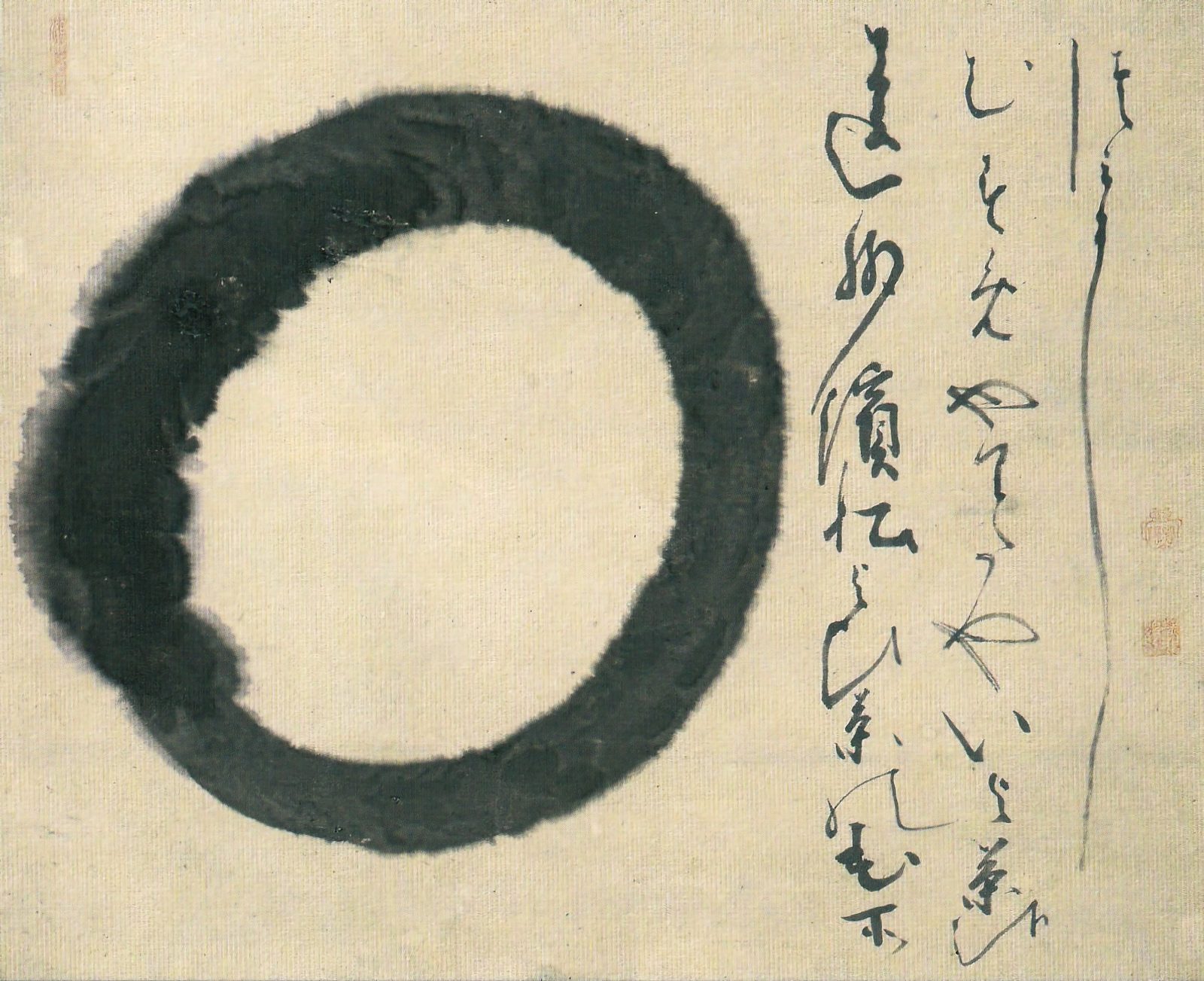
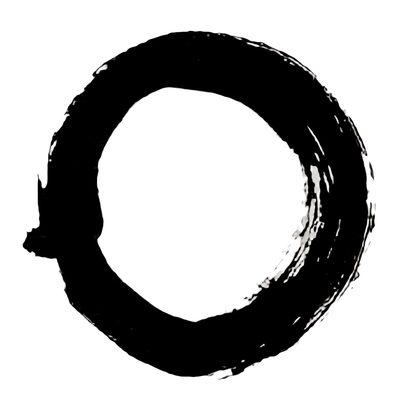
“Circle” by Hakuin Ekaku (1686-1769), before 1770. The circle is a common motif in Zen art, often symbolizing the whole of existence, the present moment, or the nature of mind. However, as Dōgen argues in Busshō, such symbols can be misleading if they are taken as representations of a hidden essence. The circle is not Buddha-nature itself. It is a form that can point to the whole of existence, but it must not be mistaken for an object of worship or a metaphysical guarantee. Source: Wikimedia Commonsꜛ (license: CC BY-SA 4.0)
In this post, we examine how Dōgen reinterprets Buddha-nature as the whole of existence rather than an inner property, why he treats the statements that beings “have” and are “without” Buddha-nature as complementary rather than simply contradictory, and how Busshō connects Buddha-nature with time, body, practice, non-abiding, and the concrete activity of the world.
Introduction
Busshō (佛性), usually translated as Buddha-nature, is one of the most important and difficult fascicles of Eihei Dōgen’s Shōbōgenzō. It was presented in 1241 at Kannondōri-kōshō-hōrin-ji in Kyoto, only a few years after Dōgen’s return from China and shortly before several other central fascicles such as Uji and Shinjin gakudō. The topic is one of the most sensitive in Buddhist thought: the meaning of Buddha-nature.
Buddha-nature has a productive but unstable place in Buddhist thought. It can express the universal possibility of awakening, the inclusion of all beings within the path, and a basis for compassion and confidence in practice. It can also be interpreted as a hidden essence, pure inner self, eternal spiritual substance, or metaphysical guarantee that makes practice unnecessary. Such an interpretation creates a serious problem for a Buddhist tradition structured by non-self, impermanence, dependent arising, and emptiness. If Buddha-nature is treated as an immortal essence within beings, it risks functioning as a Buddhist version of ātman, precisely what Buddhism rejects.
Dōgen’s Busshō is one of the most radical attempts to prevent this misunderstanding. He does not reject Buddha-nature. He does not say that the teaching is false or merely symbolic. But he refuses to allow Buddha-nature to become a substance, property, possession, potential seed, psychological awareness, or metaphysical self. Instead, he interprets Buddha-nature as the whole of existence, as concrete activity, as emptiness, as the present moment, as mountains and rivers, as body, as form, as non-abiding, and even as the statement that beings are “without Buddha-nature”.
This makes Busshō a key text for understanding Dōgen’s Zen. In Bendōwa, Dōgen argues that the Dharma is already present but must still be practiced. In Fukan zazengi, he warns against trying to become Buddha as a future object of attainment. In Busshō, he applies the same logic to Buddha-nature itself. Buddha-nature is not something that beings possess before practice. It is not something that will arrive later. It is not something hidden behind phenomena. It is the whole field of existence as it is realized in practice.
The central problem of Buddha-nature
The fascicle begins with a famous saying attributed to Sakyamuni Buddha:
All living beings fully have Buddha-nature.
The Tathāgata is always present, without any change.
This formulation is both revealing and potentially misleading. It can express the universal possibility of awakening, but it can also appear to affirm a universal and permanent Buddha-nature. The phrase “The Tathāgata is always present. There is no change” may, when read superficially, support precisely the essentialist view that Dōgen seeks to dislodge: An unchanging Buddha essence hidden within all beings.
Dōgen’s strategy is not to reject the statement. Instead, he re-reads it. He shifts the meaning of “have”, “being”, “living beings”, “Buddha-nature”, and “unchanging”. He does not allow any of these terms to remain stable in an ordinary metaphysical sense. He writes:
Fully being is Buddha-nature, and the all-inclusive whole of all existence is called “living beings”. Now, in this moment, the inside and outside of all living beings is the whole existence of Buddha-nature.
This is a decisive move. Buddha-nature is not a hidden possession inside living beings. Rather, the whole of existence itself is Buddha-nature. Living beings are not containers that contain Buddha-nature. They are the whole field in which Buddha-nature is expressed. Dōgen also writes:
You must know that Buddha-nature is now the whole of existence and is therefore beyond being and non-being.
This sentence sets the direction for the entire fascicle. Buddha-nature is neither an entity that exists nor a nothing. It is beyond the duality of being and non-being because it is not a thing to be counted, possessed, or denied. It is presented as the whole of existence, here and now.
The problem, then, is not whether Buddha-nature exists or does not exist. That question is already too crude. The deeper question is how Buddha-nature is realized without being turned into an essence. Dōgen’s answer is that Buddha-nature is not possessed. It is enacted, expressed, seen, forgotten, misunderstood, practiced, and realized in the concrete field of life.
The structure of Busshō
Busshō is a long and layered fascicle. It does not unfold as a linear philosophical treatise. Instead, Dōgen moves through scriptural quotations, lineage stories, paradoxical statements, critical corrections, and close readings of Zen dialogues. The text can be roughly divided into several major movements.
First, Dōgen interprets Sakyamuni’s statement that all living beings fully have Buddha-nature. He immediately reframes it as a statement about the whole of existence rather than a property possessed by beings, and rejects its identification with a permanent self, mental awareness, or pure inner substance.
Second, Dōgen criticizes interpretations of Buddha-nature as a seed. The image of a plant seed nourished by Dharma-rain is rejected as ordinary emotional thinking. In Dōgen’s reading, the metaphors of seeds, flowers, and fruits name momentary formations of mind and time rather than a hidden essence maturing into awakening.
Third, Dōgen reinterprets the saying, “When the time has come, Buddha-nature appears”. He rejects a future-oriented reading in which Buddha-nature is expected to reveal itself later. For Dōgen, the phrase means that the time has already come: The present moment is Buddha-nature appearing.
Fourth, Dōgen discusses the ocean of Buddha-nature through the saying of Aśvaghoṣa: Mountains, rivers, the great earth, samādhi, and the six powers (six supernormal powers; usually: miraculous abilities, divine hearing, knowledge of others’ minds, recollection of past lives, divine vision, and the extinction of mental defilements) all arise from Buddha-nature. Dōgen interprets this not as a doctrine of origin, but as the concrete identity of Buddha-nature with mountains, rivers, earth, and the functioning of practice.
Fifth, Dōgen examines stories about the fourth, fifth, and sixth ancestors, especially the statements “You are without Buddha-nature” and “a person from south of the mountains is without Buddha-nature”. These passages are central because Dōgen treats “without Buddha-nature” not as a denial, but as a more radical expression of Buddha-nature itself.
Sixth, Dōgen turns to the non-abiding or non-enduring character of Buddha-nature. The sixth ancestor says that Buddha-nature does not abide, while the discriminating mind that divides all things into good and bad does abide. Dōgen interprets non-abiding as a key feature of Buddha-nature: Grasses, trees, lands, body, mind, awakening, and nirvana are Buddha-nature because they do not abide.
Seventh, Dōgen discusses Nāgārjuna’s teaching that the relinquishment of self-attachment is required to see Buddha-nature. He analyzes the story in which Nāgārjuna reveals his body as the roundness of the full moon and uses it to argue that Buddha-nature is not an invisible essence but the manifesting body itself.
Eighth, Dōgen criticizes visual representations of Nāgārjuna’s moon-body, especially circular images that reduce the manifesting body to an abstract circle. The section is a critique of symbolic abstraction: Buddha-nature cannot be reduced to a diagram, icon, or empty visual sign.
Ninth, Dōgen examines statements from Chinese masters such as Enkan Saian, Isan Reiyū, Hyakujō, Nansen, Ōbaku, and Jōshū. These dialogues revolve around whether all beings have Buddha-nature, are without Buddha-nature, or whether even a dog has Buddha-nature. Dōgen refuses simplistic answers. “Has”, “has not”, “exists”, “does not exist”, and “no” all become ways of expressing and unsettling Buddha-nature.
Finally, Dōgen analyzes the story of the cut worm and the question of where Buddha-nature is located when the worm is divided into two moving parts. The answer, “Do not be deluded” and “wind and fire have not yet dispersed”, prevents any attempt to locate Buddha-nature in one part, both parts, movement, life, or consciousness. The fascicle ends by rejecting materialist, spiritualist, and originalist misunderstandings of Buddha-nature.
The overall structure is therefore not a simple explanation of what Buddha-nature is. It is a systematic dismantling of wrong ways of asking the question. Buddha-nature is not an object. It is not a property. It is not a hidden self. It is not psychological awareness. It is not waiting in the future. It is not merely “inside” living beings. It is not excluded from stones, walls, rivers, mountains, dogs, worms, birth, death, form, sound, practice, error, and the present moment.
Busshō
Because of its length, the full text of the fascicle is available on this separate page.
In-depth analysis of the text
The following sections reconstruct Dōgen’s argument through selected passages. They do not cover every section of the fascicle, but focus on its central conceptual movements.
Buddha-nature as the whole of existence
Dōgen begins by redefining the Mahāyāna statement that all living beings have Buddha-nature:
Fully being is Buddha-nature, and the all-inclusive whole of all existence is called “living beings”.
This sentence is the foundation of the fascicle. Dōgen does not read Buddha-nature as something added to beings. Nor does he read living beings as individual containers. Instead, “fully being” itself is Buddha-nature. The all-inclusive whole of existence is called living beings. There is no separation between beings and Buddha-nature. Beings are not something that have Buddha-nature as a property. They are the whole field of existence in which Buddha-nature is expressed. This indeed shifts the issue from possession to totality. The next sentence makes the point more concrete:
Now, in this moment, the inside and outside of all living beings is the whole existence of Buddha-nature.
Buddha-nature is not an interior essence. It includes inside and outside. For Dōgen, it includes the living being as a total field. The phrase “now, in this moment” is also essential. Buddha-nature is not a timeless metaphysical object. It is present as the whole existence of this moment. This interpretation prevents a common misunderstanding. When people hear that beings “have” Buddha-nature, they may imagine that each being contains a pure Buddha-substance hidden inside. Dōgen rejects this. The “having” of Buddha-nature is not possession. It is not a relationship between a subject and an object or between a container and its contents. It is the totality of existence itself. To say that beings have Buddha-nature is not like saying that a person has an organ, a mind, a soul, or a capacity. It is to say that beings are nothing outside the whole field of Buddha-nature. Dōgen’s next sentence intensifies this:
You must know that Buddha-nature is now the whole of existence and is therefore beyond being and non-being.
The phrase “beyond being and non-being” does not mean vague mysticism. It means that Buddha-nature cannot be grasped as an existing thing and cannot be dismissed as non-existence. It does not fit the binary question “Does it exist or not?”, “Do I have it or not?”. This already anticipates Dōgen’s later analysis of “having Buddha-nature” and “being without Buddha-nature”. Both statements can express the truth, and both can distort it if understood dualistically.
Dōgen’s reinterpretation of Buddha-nature as the whole of existence dislodges its treatment as a hidden essence or pure inner self. Buddha-nature cannot be reached by looking inward, nor is it a potential seed that grows into awakening. It is neither something beings possess before practice nor something that arrives after practice. Rather, it is the whole of existence here and now, with nothing outside or separate from it. This initial move establishes the non-essentialist, non-dualistic, and practice-oriented interpretation developed in the following passages.
Against Buddha-nature as a hidden self
Dōgen sharply criticizes a common error:
Many students, when they hear the term “Buddha-nature”, misunderstand it as a permanent self, as Senika described, who was not a Buddhist.
This warning is central. Dōgen knows that Buddha-nature can easily become a disguised ātman. The error is to imagine Buddha-nature as a permanent, pure, knowing essence hidden within the body and mind. Such a view directly contradicts non-self. Dōgen explains the cause of this misunderstanding:
They believe that mind, will, and consciousness, which are only the movement of brain cells, are enlightened knowledge and understanding of Buddha-nature.
This is an unusually blunt passage. Dōgen rejects the identification of Buddha-nature with ordinary mental activity. Mind, will, and consciousness are not Buddha-nature as inner essence. They are conditioned movements. The problem is not that mental activity is unreal. The problem is that people mistake it for enlightened knowledge. Dōgen adds:
Those who awaken and understand are Buddhas, but Buddha-nature is beyond enlightened knowledge and understanding.
This sentence is subtle. Buddhas awaken and understand, but Buddha-nature itself is not reducible to awakened knowledge. Buddha-nature is not a cognitive possession. It is not a purified consciousness. It is not an inner light that the mind owns. The awakened one does not possess Buddha-nature as an object of knowledge. Rather, awakening is one concrete expression of Buddha-nature.
This passage is especially important for the non-essentialist interpretation of Buddha-nature. Dōgen is not denying awakening. He is denying that awakening can be understood as the mind discovering a permanent essence within itself. Buddha-nature is beyond enlightened knowledge and understanding because it is not a mental object.
Dōgen touches the mental and cognitive aspects of Buddha-nature in these passages. And he does this in a very direct and rational way. He does not simply say that Buddha-nature is not a hidden self. He explains why it is not a hidden self. He identifies the specific error of mistaking ordinary mental activity for enlightened knowledge. This is a crucial point because it shows that Dōgen is not rejecting the idea of awakening or enlightenment. He is rejecting the idea that awakening is the mind discovering a permanent essence within itself. Instead, awakening is one concrete expression of the whole field of existence that is Buddha-nature.
Buddha-nature is neither material nor spiritual
Dōgen writes:
Buddha and nature are concrete; they realize this or that. Buddha-nature is always the whole of existence, precisely because the whole of existence is Buddha-nature. The whole of existence is neither material nor spiritual. Because the whole of existence is nothing other than doing and action, it is neither large nor small.
This passage condenses much of Dōgen’s argument. Buddha-nature is concrete. It realizes “this or that”. It is not a general metaphysical principle floating behind phenomena. It is not a purely spiritual essence. It is not a material substance. It is doing and action. Buddha-nature is dynamic. It is not an inert essence that beings possess. It manifests as activity, practice, form, body, speech, perception, error, liberation, and the present moment.
This connects Busshō with Dōgen’s broader teaching of practice-realization. Buddha-nature is not fulfilled by being believed in. It is realized in action. I.e., it is enacted in the very moment of practice and beyond: In every action, in every moment of life, in every form of existence. This also explains why Buddha-nature is neither large nor small. Size belongs to objects. Buddha-nature is not an object. It is the total activity of existence. To call it large would be to imagine it as a cosmic substance. To call it small would be to imagine it as an inner seed. Both miss the point according to Dōgen.
Against the seed metaphor
Dōgen criticizes another common view:
Other people think that Buddha-nature is like the seed of a plant or tree: while the Dharma-rain falls upon it, the seeds germinate and the plant or tree can grow.
This metaphor seems harmless at first. It presents Buddha-nature as latent potential. Practice, teaching, or merit allow it to grow. But Dōgen rejects this view as ordinary emotional thinking:
This understanding corresponds to the emotional thinking of ordinary people.
Why is this a problem? Because the seed metaphor can turn Buddha-nature into a hidden inner capacity that “matures” over time. It suggests that Buddha-nature exists inside the being before practice, waiting to unfold. This risks turning Buddha-nature into a potential essence. Dōgen does not simply discard the imagery of seeds, flowers, and fruits. Instead, he rereads it:
The roots, stalks, branches, and leaves are all Buddha-nature, arising and passing away with them moment by moment and making up the whole of their existence.
The key is “moment by moment”. Seeds, roots, branches, flowers, and fruits are not stages in the development of a hidden essence. They are each Buddha-nature as temporal manifestation. The seed is Buddha-nature as seed. The flower is Buddha-nature as flower. None is merely a deficient stage on the way to the real thing.
This transforms the metaphor in a distinctively Dōgenian way. Dōgen does not deny development, but he refuses to reduce any moment to preparation for another. Each moment is complete as its own Dharma-position. This connects Busshō directly to Uji: Buddha-nature is not a seed moving through time toward future completion, but each moment of seed, root, branch, flower, and fruit as being-time. There is no hidden essence that grows; there is the whole of existence in each moment of temporal unfolding.
“When the time has come” means the time is already here
Dōgen quotes another saying:
If you want to understand the meaning of Buddha-nature, you should here and now grasp the causes and conditions of real time. When the time has come, Buddha-nature directly appears before you.
This statement could easily be read as future-oriented. Many people understand it to mean that Buddha-nature will reveal itself later, when the proper time arrives. Dōgen explicitly rejects this:
For a long time, from past to present, many people have believed that the words “when the time has come” refer to a future time for which they wait until Buddha-nature reveals itself before them.
This is the same structure Dōgen criticizes in spiritual striving more generally. If Buddha-nature is imagined as something that will appear later, practice becomes waiting. The present becomes incomplete. The practitioner looks toward a future manifestation instead of realizing the Dharma now. Dōgen’s counterinterpretation is direct:
“When the time has come” means that it is already here.
This sentence is one of the clearest expressions of Dōgen’s temporal understanding of Buddha-nature. The time of Buddha-nature is not deferred. It is not a future reward. It is now. Dōgen continues:
Because the time is already here, Buddha-nature does not come. Therefore the time that is now here is nothing other than Buddha-nature directly appearing before you.
If Buddha-nature is already the present moment, then it cannot “come” from elsewhere. It is not waiting outside the present. It does not arrive like an object. The present time itself is Buddha-nature appearing. This connects Busshō very closely to Uji. Being-time and Buddha-nature intersect: The present moment is not a container in which Buddha-nature appears, but the temporal reality of Buddha-nature itself. Dōgen even adds:
Even if there is a time of doubt, it is Buddha-nature coming to you.
Doubt is not outside Buddha-nature. Confusion, uncertainty, and questioning are not excluded from the field. This does not mean that delusion is equivalent to realization in a careless sense. It means that delusion is also not a separate metaphysical realm outside the Dharma. Doubt itself becomes part of the temporal field in which Buddha-nature is studied.
Mountains and rivers are Buddha-nature
Dōgen quotes Aśvaghoṣa, an ancient Indian Buddhist philosopher and poet:
The mountains, rivers, and the great earth
all rest on Buddha-nature and arise through it.
Samādhi and the six powers rest on it
and are revealed through it.
Dōgen interprets this concretely:
If you see mountains and rivers, you are looking at Buddha-nature itself.
This is one of the most important non-essentialist statements in the fascicle. Buddha-nature is not hidden behind mountains and rivers. It is not an invisible essence that must be inferred from visible forms. Mountains and rivers themselves are Buddha-nature. This does not mean that they contain Buddha-nature as a substance. It means that the concrete existence of mountains and rivers is the appearing of Buddha-nature. Dōgen continues in characteristic style:
And when you look at Buddha-nature itself, you see a donkey’s jaw or a horse’s mouth.
Thus, Buddha-nature is not only found in sacred images, luminous visions, or noble states. It is also donkey jaw and horse mouth, i.e., in the ordinary. Dōgen deliberately uses earthy, ordinary, even awkward images to cut through spiritual abstraction. If Buddha-nature is the whole of existence, it cannot be restricted to what appears elevated or pure. This connects Busshō directly to suchness. To see Buddha-nature is to see things as they are, not to look past them toward a hidden metaphysical core. Mountains as mountains, rivers as rivers, donkey jaw as donkey jaw: These are not obstacles to Buddha-nature. They are its concrete expression.
“Without Buddha-nature” as a deeper expression
One of the most radical parts of Busshō concerns the phrase “without Buddha-nature”. Dōgen discusses the story of the fourth and fifth ancestors. When the young future fifth ancestor says that his name is Buddha-nature, the fourth ancestor replies:
You are without Buddha-nature.
Dōgen refuses to read this as a denial. Instead, he treats “without Buddha-nature” as a powerful expression of the truth. He writes:
In what moment of now could you be without Buddha-nature? Are you without Buddha-nature when you begin as Buddhists, or when you go beyond Buddha?
“Without” does not mean that Buddha-nature is absent. It means that Buddha-nature is not an object one possesses. To be “without Buddha-nature” is to be without any thing called Buddha-nature. It is to be free from the objectification of Buddha-nature. Dōgen later clarifies:
The words “because Buddha-nature is emptiness, we say that it is without something” clearly express that emptiness is not non-existence.
Thus, “without Buddha-nature” is not nihilism. It is not the claim that Buddha-nature does not exist. It is the statement that Buddha-nature is emptiness, and therefore cannot be grasped as a thing. To be without Buddha-nature is to be without an objectified, possessable Buddha-nature. This is crucial for understanding Dōgen’s thought. He uses both “having Buddha-nature” and “being without Buddha-nature” to point to the same truth:
The two statements, “all living beings have Buddha-nature” and “all living beings are without Buddha-nature”, express exactly this fundamental truth.
This may sound contradictory at first. How can beings both have and be without Buddha-nature? The key is to understand that both statements are not describing a relationship between beings and a thing called Buddha-nature. They point beyond that way of thinking altogether. The contradiction is only a contradiction if Buddha-nature is understood as a thing. If one asks, “Do beings have it or not?”, one is already asking the wrong kind of question. Dōgen uses both statements to break the dualism of possession and absence. Buddha-nature is not something that one possesses, and being “without Buddha-nature” does not mean that it is absent. Both formulations point to the fact that Buddha-nature cannot be objectified as a thing.
This is where a connection with the Buddhist catuṣkoṭi is helpful. One can say that
- beings have Buddha-nature,
- do not have Buddha-nature,
- both have and do not have it, and
- neither have nor do not have it.
Dōgen does not present this as abstract logic, but he performs something structurally similar. He forces the reader beyond the fixed alternatives of existence and non-existence, possession and absence. The point is not to choose the correct statement, but to see why the very structure of the question is already misleading.
Buddha-nature and emptiness
The fifth ancestor’s explanation develops this issue further:
Because Buddha-nature is emptiness, we say that it is without something.
and Dōgen’s comment:
The formulation clearly expresses that emptiness is not non-existence.
as this is an important passage for understanding Dōgen’s relation to śūnyatā. Emptiness does not mean nothingness. It means that things do not exist as independent, fixed essences. To say that Buddha-nature is emptiness is not to deny Buddha-nature. It is to deny that Buddha-nature is a substance. Dōgen rejects two misunderstandings. First, emptiness is not simply a void. Second, form is not a thing that is artificially turned into emptiness. He writes:
The statement that form is nothing other than emptiness does not describe a form that one willfully turns into abstract emptiness, nor an emptiness that one cuts apart in order to artificially produce form.
This is a critique of conceptual manipulation. Emptiness is not produced by intellectual negation. Form is not dissolved by analysis into some abstract nothing. Dōgen then writes:
The statement may rather describe a situation in which emptiness is simply emptiness.
Emptiness is not a metaphysical substance behind things. It is the way things are: Without fixed essence, yet fully concrete. This is why Dōgen can say that Buddha-nature as emptiness is “without something”. It is without thingness, without possession, without fixed self.
The sixth ancestor and the absence of Buddha-nature
Dōgen also analyzes the encounter between the fifth ancestor and Huineng, the future sixth ancestor. The fifth ancestor says:
A man from south of the mountains is without Buddha-nature. How can you hope to become Buddha?
Dōgen interprets this carefully:
This statement does not mean that a man from south of the mountains has Buddha-nature or does not have it. It simply says that a man from south of the mountains, without being anything, is Buddha-nature.
Again, “without” is not absence. It is emptiness. It is being without fixed essence. A person from the south is Buddha-nature precisely as “without something”, i.e., in his true nature as he is, empty of a fixed self and yet fully concrete.
Dōgen then adds one of the most striking statements in the fascicle:
It is the direct way to realize Buddha when you speak or hear the words that you are without Buddha-nature. Therefore, you are Buddha precisely in the moment when you are without Buddha-nature.
This is not a paradox for its own sake. Dōgen continues to remove Buddha-nature from the structure of possession. The statement “I have Buddha-nature” may become clinging to Buddha-nature as identity, whereas “You are without Buddha-nature” cuts off the object of possession. In this logic, Buddha-nature is realized as non-objectifiable emptiness. Dōgen’s claim that people should rejoice in hearing that all living beings are without Buddha-nature thus names release from Buddha-nature as spiritual property and a hearing of the Dharma beyond the duality of having and not having.
Thus, “without Buddha-nature” is not a denial of Buddha-nature. It is a deeper expression of it. It is the way to realize Buddha-nature as emptiness, as non-possessable, as the whole of existence without fixed essence.
Buddha-nature does not abide
Dōgen further cites the sixth ancestor:
Buddha-nature does not abide. Only the thinking mind that divides all things and phenomena into good and bad abides.
This reverses a common assumption. Many people imagine Buddha-nature as the permanent element and ordinary discriminating mind as unstable. Dōgen’s reading is different. The discriminating mind “abides” in the sense that it clings, repeats, fixes, and divides. Buddha-nature does not abide because it is not a static essence. Dōgen writes:
The non-abiding moments of grasses, trees, and forests are nothing other than Buddha-nature. The non-abiding moments of body and mind of human beings are Buddha-nature. Since lands, mountains, and rivers do not abide, they are Buddha-nature.
This is one of the most important passages in the whole fascicle. Buddha-nature is not permanence. It is non-abiding. Grasses and trees are Buddha-nature because they do not abide. Human body and mind are Buddha-nature because they do not abide. Mountains and rivers are Buddha-nature because they do not abide. Even awakening and nirvana are Buddha-nature because they do not abide. This deepens impermanence into a positive account of Buddha-nature. Impermanence is not a defect in things that prevents them from having Buddha-nature. Impermanence is precisely their Buddha-nature. To look for Buddha-nature as something permanent behind impermanent phenomena is to miss Dōgen’s point entirely. This also rejects the idea of a fixed eternal Tathāgata hidden behind change. The phrase “always present, without any change” from the opening cannot mean permanent substance. For Dōgen, what is truly constant is not a static essence, but the non-abiding functioning of the Dharma. Buddha-nature is not destroyed by impermanence. It is impermanence realized. And in process-oriented view, impermanence is the actual reason that Buddha-nature even can be. If things were permanent, they would be fixed and unchanging, and thus could not manifest the dynamic activity of Buddha-nature. It is precisely because things do not abide that they can be Buddha-nature.
Nāgārjuna: Seeing Buddha-nature by giving up self-attachment
Dōgen tells a story about Nāgārjuna. When people ask how one can see Buddha-nature, Nāgārjuna says:
If you want to see Buddha-nature, first give up self-attachment.
This is a direct and practical statement. Buddha-nature is not seen by acquiring a doctrine. It is seen by releasing self-attachment. Dōgen comments:
It is not that this true seeing does not exist. Rather, this seeing truly exists when you give up self-attachment.
This is important because Dōgen does not deny seeing Buddha-nature. He rejects the idea that Buddha-nature is seen by a self that remains intact as possessor. The self that wants to own Buddha-nature is precisely what obstructs seeing.
Nāgārjuna is then said to manifest his body like the roundness of the full moon. Dōgen interprets this not as a supernatural spectacle, but as the manifestation of Buddha-nature through body:
This body is nothing other than the roundness of the moon manifesting itself.
He explicitly rejects the idea that Nāgārjuna displayed a magical transformed body:
Ignorant people think that what Nāgārjuna calls the roundness of the moon is the manifestation of a body that has been supernaturally transformed. But this is the false view of those who have not authentically received the Buddha-truth.
For Dōgen, the manifesting body is not an illusion, symbol, or magical projection. It is the concrete body itself. Buddha-nature appears as the body that manifests. This connects Busshō strongly with Shinjin gakudō: The body is not an obstacle to truth. The body is the field in which truth appears. Dōgen writes:
The Buddha’s body is the true body that manifests itself. Buddha-nature exists in the form of a body that manifests itself.
This is a radically embodied view of Buddha-nature. Buddha-nature is not hidden behind form. It appears as form. It is not outside the skandhas, even though it is not reducible to a fixed identity within them. The manifesting body is Buddha-nature.
Against abstract images of Buddha-nature
Dōgen criticizes later attempts to depict Nāgārjuna’s moon-body as a simple circular image:
When they tried in vain to paint it with the brush, they represented a circle like a round mirror above the Dharma seat. They regarded this as Nāgārjuna’s body revealing the roundness of the moon.
Dōgen calls this a false representation. His criticism is not merely aesthetic. It is directed against abstraction. The moon-body is not an empty symbol, not an abstract circle, not a decorative ensō. To replace the manifesting body with a circle is to miss the point. Dōgen compares this mistake to a painted rice cake, an image that cannot satisfy hunger. He writes:
Earlier and present Buddhas should truly experience the manifesting body and not delight in images of painted rice cakes.
The statement criticizes what may be called secondhand spirituality: The enjoyment of symbols of realization in place of realization, or the drawing of a circle in place of the manifesting body. The deeper point is that Buddha-nature cannot be reduced to an image, even a Zen image. When Dōgen describes the depiction of Buddha-nature, he insists on the concrete manifesting body: Eyebrows rising, one eye winking, skin, flesh, bones, marrow, the stillness of sitting, and the smile that creates Buddhas and ancestors. In this account, Buddha-nature appears concretely rather than as an abstract sign.
The limits of saying “have” and “without”
Dōgen later returns to the two statements that have already shaped the central argument of Busshō: “All living beings have Buddha-nature” and “all living beings are without Buddha-nature”. At this later point, however, the focus shifts. Dōgen is no longer merely explaining that “without Buddha-nature” is not a denial. He is now examining the danger of turning either formulation into a fixed doctrine.
He first cites Enkan Saian’s statement:
All living beings have Buddha-nature.
Dōgen interprets “all living beings” in an unusually broad way:
If we say “all living beings” in the Buddha-Dharma, this means that everything that has mind is a living being, because mind is a living being. What appears to be without mind may also be a living being, because everything that exists has mind. Therefore everything that has mind is a living being, and all living beings have Buddha-nature.
This expands Buddha-nature beyond human beings and even beyond sentient beings in the ordinary sense. Grass, trees, lands, sun, moon, and stars are not excluded from the field of Buddha-nature. Dōgen’s point is not simply that animals and humans possess Buddha-nature. It is that the whole field of existence is already involved in Buddha-nature. The distinction between beings that have Buddha-nature and things that do not is therefore already too narrow.
But Dōgen also criticizes the wording “have”:
He should let the word “have” fall away in the statement “have Buddha-nature”.
This is the decisive correction. “Have” can mislead because it suggests possession. It makes Buddha-nature sound like a property, capacity, or inner essence that belongs to a being. If Buddha-nature is possessed, then living beings and Buddha-nature become two separate things. Dōgen’s entire reading of Busshō works against this separation. The problem is therefore not only the denial of Buddha-nature. The affirmation of Buddha-nature can also become false when it is understood as possession.
Dōgen then discusses Isan’s statement:
All living beings are without Buddha-nature.
He gives this statement a strikingly high status:
The statement that all living beings are without Buddha-nature alone has the highest rank in the Buddha-Dharma.
This does not mean that Dōgen simply prefers negation over affirmation. The phrase “without Buddha-nature” has the highest rank because it cuts more sharply through the idea of possession. It prevents Buddha-nature from being turned into something one owns, contains, discovers, or secures. Yet even this formulation becomes dangerous if it is frozen into doctrine. If “without Buddha-nature” is taken as a metaphysical denial, it misses the point just as much as the possessive statement “have Buddha-nature”. This is why Dōgen cites Hyakujō:
If we teach that all living beings have Buddha-nature, we degrade Buddha, Dharma, and Sangha. If we teach that all living beings are without Buddha-nature, we also degrade Buddha, Dharma, and Sangha. Thus both become degradation, whether we say that living beings have Buddha-nature or whether we say that they are without it. But even so, one should still make such statements.
This is one of the most nuanced passages in Busshō. Both statements distort when they become fixed positions: “All beings have Buddha-nature” can become essentialism, while “all beings are without Buddha-nature” can become nihilism. Nevertheless, Dōgen treats both as necessary expressions because language cannot simply be abandoned. His point is not that one statement is true and the other false, but that both function as liberating expressions rather than doctrinal definitions.
This gives the earlier discussion of “without Buddha-nature” a broader linguistic frame. The issue is not only the meaning of “without,” but how any statement about Buddha-nature can open insight or produce attachment. “Have” and “without” are useful insofar as they release the reader from objectifying Buddha-nature, but misleading when treated as final descriptions. Dōgen therefore uses language against its own tendency to harden into concepts: He speaks of Buddha-nature in order to prevent it from becoming a thing.
Nansen, Ōbaku, and non-dependence
Dōgen discusses a dialogue between Nansen and Ōbaku. Nansen asks about the theory that when balance and wisdom are practiced together, Buddha-nature is clearly realized. Ōbaku replies:
If you are dependent on nothing for twenty-four hours, you already have Buddha-nature.
Dōgen interprets the “twenty-four hours” not merely as clock time, but as a complete temporal field:
The twenty-four hours exist moment by moment for twenty-four hours, and they depend on nothing else. The clear realization of Buddha-nature exists because these real twenty-four hours depend on nothing.
This establishes another connection between Buddha-nature and time. Buddha-nature is not a future arrival but the non-dependent reality of each moment. To depend on nothing for twenty-four hours does not mean isolation. It denotes freedom from conceptual supports, identities, possessions, or expectations.
Nansen then challenges Ōbaku by asking whether this is his own view. Ōbaku says:
I would not dare to say that.
Dōgen notes that this phrase is not simple denial. It expresses that Ōbaku truly has the capacity, while not appropriating it as personal possession. Again, Dōgen’s critique of possession appears. Buddha-nature is realized, but not owned.
The dialogue ends with Ōbaku’s silence. Dōgen comments:
Silence can be eloquent and laughter sharp as a sword. It is the clear realization of Buddha-nature when one is satisfied with rice in the morning and at noon.
Buddha-nature appears here not as a doctrine, but as everyday sufficiency. Rice in the morning, rice at noon, silence, walking, speaking, not answering: These are not outside Buddha-nature. They are its concrete forms when not grasped.
Jōshū’s dog and the word “no”
Dōgen also analyzes the famous kōan:
A monk asked Jōshū, “Does even a dog have Buddha-nature, or not?”
Jōshū answered, “No!”
This “No”, or “Mu!” in Japanese or “Wu!” in Chinese, is one of the most famous words in Zen. Dōgen refuses to reduce it to a simple denial. He writes that this “No” may describe Buddha-nature itself, the dog, or an exclamation from a third position. The point is that “No” is not merely the opposite of “Yes”. It is a Dharma-word that cuts through the question.
The monk asks why the dog exists without Buddha-nature if all living beings have it. Jōshū replies:
Because it has karmic consciousness conditioned by earlier experience.
Dōgen interprets this carefully:
The dog exists “without” the idea of Buddha-nature, and Buddha-nature exists “without” the idea of Buddha-nature. The dog’s consciousness can never grasp its nature.
This is not an animal psychology claim. It is an analysis of grasping. Consciousness cannot grasp Buddha-nature. Whether one says the dog has Buddha-nature or does not have it, one remains within conditioned consciousness if one treats Buddha-nature as an object.
Dōgen also discusses another version in which Jōshū answers, “It exists”. Dōgen writes:
Jōshū’s statement “it exists” means that the dog exists, and because the dog exists, Buddha-nature also exists.
Here “exists” is not ordinary existence. It is Buddha-existence. The dog is not a container of Buddha-nature. The dog’s existence itself is Buddha-nature. The “No” and the “It exists” are not simply contradictory answers. Both are ways of undoing the same mistaken question.
The cut worm and the impossibility of locating Buddha-nature
Near the end of the fascicle, Dōgen analyzes a dialogue about a worm cut in two:
A worm was cut into two parts, and both parts move. I wonder in which part Buddha-nature is located.
This question assumes that Buddha-nature must be located in a part. If the worm is split, where does Buddha-nature go? In one part? Both? Neither? Chōsa answers:
Do not be deluded!
The official asks how to explain the fact that both parts move. Chōsa replies:
Wind and fire have not yet dispersed.
Dōgen refuses to let the question be answered by locating Buddha-nature. He writes that Chōsa did not say that the worm has Buddha-nature, nor that it does not have Buddha-nature. He only said not to be deluded and that wind and fire have not yet dispersed. This is important because it rejects both materialist and spiritualist interpretations. Buddha-nature is not found by identifying movement, life, consciousness, or vital forces. It is not located in the moving part. It is not absent from the moving part. It is not identical with wind and fire, but also not separate from them. The question itself is wrongly formed. Buddha-nature cannot be located in a part of the worm because it is not a thing that can be located. It is not a substance that can be divided. It is not a property that can be assigned to one part or another. The question of location is a trap that assumes Buddha-nature is an object.
Dōgen then gives one of his strongest warnings:
It is very naive and superficial if you think that Buddha-nature exists only while you live and disappears when you have died.
He continues:
As long as you live, you have Buddha-nature, and at the same time you do not have it. When you have died, you have Buddha-nature, and at the same time you do not have it.
This is the catuṣkoṭi-like structure again. Living and dead, having and not having, existence and non-existence all fail to capture Buddha-nature if treated as fixed alternatives. Buddha-nature is not material life-force, not spiritual awareness, and not original essence. Dōgen writes:
Those who claim that Buddha-nature is something material whose existence or non-existence depends on whether something moves or not are not Buddhists. Those who claim that Buddha-nature is something spiritual whose holiness or non-holiness depends on whether one is aware of it or not are also not Buddhists. Ultimately, those who say that Buddha-nature is something original whose nature or non-nature depends on whether one recognizes it or not are also not Buddhists.
This passage summarizes Dōgen’s critique. Buddha-nature is neither material, spiritual, nor original essence. It cannot be tied to movement, awareness, recognition, life, or death. It is not a thing.
The final expression is concrete and deliberately startling:
If you want to describe Buddha-nature further, it is simply the fences, walls, tiles, and pebbles before you. If you want to express the situation even more truly, what is this Buddha-nature? Have you fully understood it? Three heads and eight arms!
Dōgen ends not with abstraction, but with walls, tiles, pebbles, and mythic bodies. Buddha-nature is here, concrete, strange, ordinary, and ungraspable.
Busshō in a nutshell
The central aspects of Busshō can be summarized as follows:
- Buddha-nature is not a hidden self.
Dōgen explicitly warns that many people misunderstand Buddha-nature as a permanent self. This would contradict the Buddhist teaching of non-self. - Buddha-nature is the whole of existence.
It is not a property contained inside beings. The inside and outside of all beings, here and now, is the whole existence of Buddha-nature. - Buddha-nature is beyond being and non-being.
It cannot be understood through the binary question of whether it exists or does not exist. - Buddha-nature is not mental awareness.
Dōgen rejects the view that ordinary mind, will, consciousness, or the movement of thought is Buddha-nature. - Buddha-nature is neither material nor spiritual.
It is not a physical substance, not a spiritual essence, and not an original hidden nature. - Buddha-nature is doing and action.
Dōgen describes the whole of existence as activity. Buddha-nature is enacted, not possessed. - Buddha-nature is not a seed waiting to grow.
The seed metaphor is rejected if it suggests a hidden potential essence. Seeds, roots, flowers, and fruits are each Buddha-nature moment by moment. - The time of Buddha-nature is now.
“When the time has come” does not mean a future moment. It means the time is already here. - “Without Buddha-nature” is not nihilism.
It means being without an objectified thing called Buddha-nature. It expresses Buddha-nature as emptiness. - Buddha-nature does not abide.
Grasses, trees, lands, mountains, rivers, body, mind, awakening, and nirvana are Buddha-nature because they do not abide. - Buddha-nature appears as the manifesting body.
Nāgārjuna’s moon-body is not a magical symbol, but the body manifesting Buddha-nature. - Buddha-nature includes ordinary and non-human forms.
Mountains, rivers, walls, tiles, pebbles, dogs, worms, donkey jaws, horse mouths, grasses, trees, sun, moon, and stars all belong to its field. - Language is used and released.
“Have Buddha-nature”, “without Buddha-nature”, “exists”, “no”, and “emptiness” function as Dharma-expressions insofar as they loosen fixed views.
Busshō and core Buddhist concepts
Busshō is one of Dōgen’s most important attempts to articulate Buddha-nature within core Buddhist teachings without turning it into an essence. Its principal conceptual relations include:
- Non-self (anattā)
The fascicle directly rejects the interpretation of Buddha-nature as a permanent self. Buddha-nature is not an inner owner, witness, soul, or pure consciousness. - Impermanence (anicca)
Buddha-nature does not abide. Grasses, trees, body, mind, lands, mountains, rivers, awakening, and nirvana are Buddha-nature precisely because they are non-abiding. - Dependent arising (paṭicca-samuppāda)
Buddha-nature is understood through causes and conditions of real time, but not as a mechanical product of them. It appears as the concrete field of conditions here and now. - Emptiness (śūnyatā)
The phrase “without Buddha-nature” expresses Buddha-nature as emptiness. This emptiness is not non-existence, but the absence of fixed, possessable essence. - Suchness (tathatā)
Buddha-nature is not hidden behind things. It appears as mountains, rivers, donkey jaws, horse mouths, bodies, gestures, walls, tiles, and pebbles. This is Buddha-nature as suchness. - Buddha-nature (tathāgatagarbha)
Dōgen reinterprets Buddha-nature radically. It is not potential essence, not spiritual self, not mental awareness, not future attainment. It is the whole of existence as concrete activity. - Practice-realization
Buddha-nature is not realized by belief in Buddha-nature. It is realized in action, practice, body, speech, time, and letting go of self-attachment. - Middle Way
Dōgen avoids the extremes of existence and non-existence, possession and absence, materialism and spiritualism, permanence and nihilism. - Catuṣkoṭi-like logic
Dōgen repeatedly moves beyond binary alternatives. Living beings have Buddha-nature, are without Buddha-nature, both have and do not have it, and neither possess nor lack it in any ordinary sense. This is not abstract logic, but a practice-oriented dismantling of fixed views. - Embodiment
Nāgārjuna’s manifesting body and Dōgen’s critique of abstract images show that Buddha-nature is not apart from bodily form. The body itself can manifest Buddha-nature.
Philosophical implications
Busshō systematically critiques essentialist interpretations of Buddha-nature. Dōgen recognizes that “all living beings have Buddha-nature” can generate a false ontology: Living beings appear on one side, Buddha-nature on the other, as a property they possess. The fascicle dismantles this structure. Living beings do not possess Buddha-nature as a thing. The whole of existence is Buddha-nature.
This has major implications for the relation between Buddha-nature and non-self. A permanent inner essence would contradict Buddhism’s rejection of self. Dōgen avoids this result by presenting Buddha-nature as empty, non-abiding, and active. It is not a self behind change but the concrete, changing, non-abiding activity of existence.
The fascicle also transforms the meaning of impermanence. Interpretations of Buddha-nature as real often assume that it must be permanent. Dōgen reverses this premise. Buddha-nature is Buddha-nature because it does not abide. Grasses, trees, body, mind, lands, mountains, rivers, awakening, and nirvana are Buddha-nature because they are temporal and non-fixed. Impermanence is not Buddha-nature’s opposite but its concrete mode of appearing.
Dōgen’s treatment of “without Buddha-nature” is equally significant. Negation does not mean nihilism: To be without Buddha-nature is to be without an objectified Buddha-nature. The formula removes the illusion that Buddha-nature is something owned and makes negation a linguistic form of liberation from grasping.
The fascicle also demonstrates Dōgen’s distinctive use of language. He does not seek a final doctrinal formula but uses conflicting formulations to unsettle fixed views. “All living beings have Buddha-nature” can release separation or create possession. “All living beings are without Buddha-nature” can express emptiness or become nihilism. “No” cuts through objectification, while “it exists” can identify existence itself with Buddha-nature. Language is not rejected. It functions as practice rather than metaphysical possession.
Finally, Busshō gives an embodied account of Buddha-nature. Nāgārjuna’s manifesting body, Jōshū’s dog, Chōsa’s worm, mountains, rivers, fences, walls, tiles, and pebbles all reject the treatment of Buddha-nature as a hidden spiritual essence. It appears as form, body, action, speech, silence, and ordinary things. This links Busshō to Dōgen’s broader account of the Dharma as enacted in concrete phenomena rather than located elsewhere.
Conclusion
Busshō is one of Dōgen’s most radical texts because it confronts a central tension in Mahāyāna Buddhism: The tendency to turn Buddha-nature into a metaphysical self. Dōgen does not reject the teaching that all beings have Buddha-nature. He rereads it so that “having Buddha-nature” no longer denotes possession. Buddha-nature is not an inner essence, permanent soul, pure consciousness, original substance, seed of enlightenment, or future revelation. It is the whole of existence as concrete, empty, non-abiding activity.
This interpretation locates Buddha-nature within the core Buddhist framework of non-self, impermanence, dependent arising, and emptiness. Dōgen’s Buddha-nature is not behind phenomena. It is mountains and rivers, grasses and trees, walls and tiles, body and speech, life and death, dogs and worms, doubt and practice, form and emptiness, now.
The fascicle’s most provocative formulation is Dōgen’s insistence that “without Buddha-nature” may express the truth more sharply than “having Buddha-nature”. To be without Buddha-nature does not mean that Buddha-nature is absent. It means that there is no thing called Buddha-nature to possess. The negation cuts through spiritual ownership and presents Buddha-nature as emptiness, action, and the present field of existence.
Read alongside Bendōwa, Fukan zazengi, Shinjin gakudō, and Uji, Busshō belongs to a consistent pattern in Dōgen’s thought. The Dharma is already present but not possessed, not elsewhere but not automatic, and not a self but realized as body, mind, world, and action.
Ultimately, Busshō presents Buddha-nature not as something beings have, lack, or await, but as the whole of existence here and now, beyond being and non-being and manifesting as the concrete activity of the ten thousand things.
References and further reading
- Dogen Zenji, Shobogenzo – Die Schatzkammer des wahren Dharma-Auges, 4 Bände, 2013, Verlage: Kristkeitz Werner, Übersetzung: Ritsunen Gabriele Linnebach, Gudo Wafu Nishijima, ISBN: 9783921508909





comments