Ikka myōju: One bright pearl. Dōgen’s interpretation of Gensa Shibi’s famous saying in the Shōbōgenzō.
Zen texts often use compact images to address philosophical questions that resist straightforward definition. In Dōgen’s Ikka myōju, the image of a bright pearl articulates relations between self and world, unity and multiplicity, appearance and reality, and practice and realization. The image originates in a saying attributed to the Chinese Chán master Gensa Shibi:
The entire universe in the ten directions is one bright pearl.
Dōgen develops the statement as an account of the relation between practitioner and world. Rather than treating the pearl as a hidden substance or as a symbol of underlying metaphysical unity, he uses it to challenge the assumption that self and world are independently constituted domains. “One bright pearl” thus names the totality of experience and existence in Dōgen’s account.
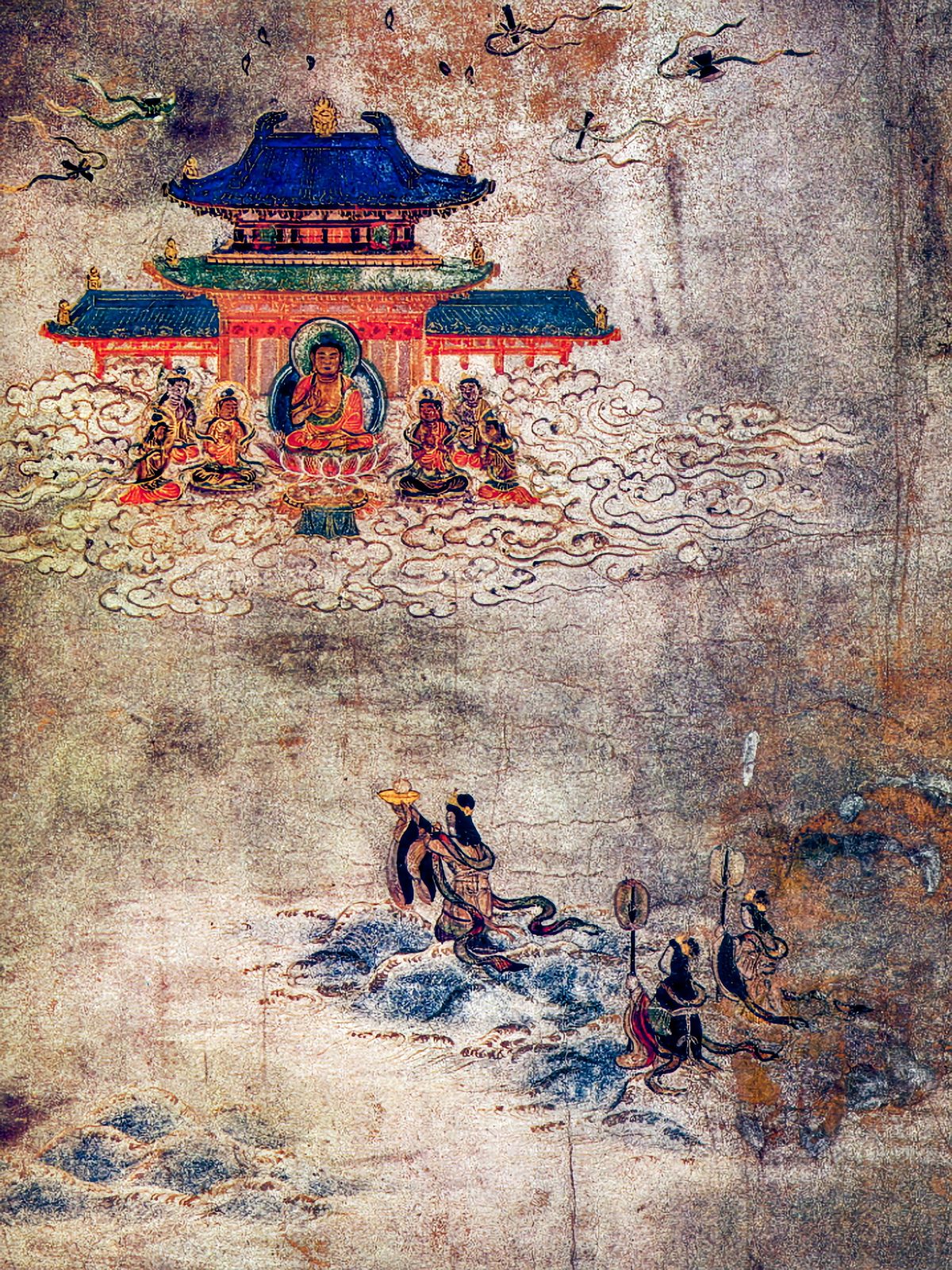
Frontispiece of the Devadatta chapter scroll (chapter 12 of the Lotus Sutra) in the Heike Nokyo, a 12th-century set of sutra scrolls. The dragon king’s daughter Longnü offers her priceless jewel to the Buddha. In Buddhist art and literature, the jewel commonly signifies the preciousness of the Dharma, enlightenment, or reality. The image provides a visual parallel to Dōgen’s Ikka myōju, where the bright pearl names the whole universe without becoming a separate luminous substance. Source: Wikimedia Commonsꜛ (license: public domain)
The fascicle develops this image through its dialogue with Gensa Shibi, its treatment of the pearl as the entire universe, and its inclusion of doubt, confusion, and ordinary experience within that scope. It also relates to suchness, emptiness, non-self, and Dōgen’s broader account of practice and realization. In this post, we take a closer look at this fascicle and the ways in which Dōgen develops the image of the bright pearl.
Introduction
Ikka myōju (一顆明珠), usually translated as One bright pearl, is one of the early fascicles of Eihei Dōgen’s Shōbōgenzō. It was presented in 1238 at Kannondōri-kōshō-hōrin-ji and later copied by Ejō in 1243. The title consists of ikka, “one”, myō, “bright” or “luminous”, and ju, “pearl”. The phrase therefore means “one bright pearl”. The fascicle centers on a saying by the Chinese Chán master Gensa Shibi:
The whole universe in the ten directions is one bright pearl.
Dōgen valued this statement so highly that he devoted an entire fascicle to it. The sentence is short, but its implications are vast. It does not merely say that the universe is beautiful, pure, or radiant. It says that the whole universe, in all ten directions, i.e., in all of its dimensions and aspects, is one bright pearl. The world is not a collection of separate things externally assembled into a whole. It is one luminous reality, one complete field of manifestation, one round and unobstructed Dharma-expression.
This makes Ikka myōju a natural companion to several of Dōgen’s other texts. Inmo uses the ordinary word “it” to point toward suchness, reality as already this. Uji says that all being is time. Busshō interprets Buddha-nature as the whole of existence rather than a hidden inner essence. Sansuikyō says that mountains and waters are themselves a sutra. Ikka myōju expresses the same world from another angle: all of it is one bright pearl.
The pearl gives this account of the world a specific visual form. Its roundness suggests completeness without an external boundary, while its luminosity and reflective surface allow multiplicity to appear without dividing the pearl into separate parts. Dōgen does not, however, use it to posit a mystical object or a hidden reality behind phenomena. The “one bright pearl” designates the universe in its concrete differentiation: Body and mind, grasses and trees, mountains and rivers, life and death, coming and going, confusion and clarity, and even the effort to understand. The universe is therefore not merely compared to a pearl. In Dōgen’s interpretation, the image serves to deny that the many phenomena of the world exist as fully independent entities or that they conceal a separate reality behind them.
The structure of the text
Like other fascicles in Dōgen’s Shōbōgenzō, Ikka myōju unfolds through linked reflections rather than a linear argument.
First, Dōgen introduces Gensa Shibi. Before becoming a monk, Gensa was a fisherman. At the age of 30, he suddenly felt the urge to leave ordinary life, entered the mountains, and became a student of Seppō. Dōgen uses these details to characterize Gensa as a practitioner defined by decisive commitment rather than as a thinker detached from religious practice.
Second, Dōgen recounts the episode in which Gensa injures his toe on a stone while preparing to leave and seek other teachers. The pain makes him reflect on the Buddhist claim that the body is not ultimately real. If the body does not truly exist, where does pain come from? He turns back and remains with Seppō. This becomes a decisive moment of realization.
Third, Dōgen presents Gensa’s famous saying (i.e., “The whole universe in the ten directions is one bright pearl.”), the central statement of the fascicle.
Fourth, Dōgen recounts an exchange between Gensa and a monk. The monk asks how to understand the saying. Gensa replies, “The whole universe is one bright pearl. What use is it to understand this?” Later, Gensa asks the monk how he understands it. The monk repeats the master’s earlier words, and Gensa criticizes him for struggling to enter the devil’s cave in a black mountain. This exchange shows that repeating the correct phrase is not the same as realizing it.
Fifth, Dōgen analyzes the meaning of “the whole universe in the ten directions”. It is not merely large or small, round or square, active or clear. Because it is beyond life and death, coming and going, it is precisely real life and death, coming and going. The universe is not a static totality but the ongoing activity of self and world.
Sixth, Dōgen interprets “one bright pearl”. The body and mind now living are the bright pearl. Grasses, trees, mountains, rivers, and all directions are the bright pearl. The pearl passes directly through ten thousand years. It includes past and present without being confined by them.
Seventh, Dōgen returns to the monk’s mistaken repetition. Yesterday Gensa expressed the general principle. Today he asks about the concrete situation. The monk repeats the phrase but does not embody it. Dōgen therefore distinguishes living realization from conceptual imitation.
Eighth, Dōgen expands the pearl image. The whole universe is the one true Dharma-eye, the true body of reality, one phrase, luminous clarity, and the whole universe itself. The pearl rolls freely and is not obstructed by itself. It may appear in empty space, under clothing, under a dragon’s chin, or braided into hair. It changes its appearance, but remains one bright pearl.
Finally, Dōgen concludes that even doubt, worry, thoughts, non-thoughts, forward steps, backward steps, and the devil’s cave in a black mountain are not separate from the bright pearl. The pearl is not only clarity. It includes the very confusion that tries to grasp or deny it.
Taken together, Dōgen constructs the fascicle by using Gensa’s biography, sayings, and encounters as successive stages of interpretation. The account of Gensa’s injured toe first connects the teaching with bodily experience and with the refusal to accept inherited formulations uncritically. The dialogue with the monk then allows Dōgen to distinguish between repeating a statement, understanding it conceptually, and responding to it within a concrete situation. He subsequently takes individual phrases from the exchange and extends their implications to body and mind, temporal change, perception, doubt, and ordinary action. In this way, the inherited stories provide the structure through which Dōgen develops his account of the Dharma: Reality cannot be divided into a self that observes and a world that is observed, nor can realization be separated from the changing conditions in which body, thought, action, error, and understanding occur. His method gradually removes increasingly subtle forms of separation, first between practitioner and world, then between conceptual understanding and practical realization, and finally between experiences regarded as obstacles to awakening and the actual circumstances in which practice takes place.
Ikka myōju
The full text follows:
Ikka myōju
In this Sahā world, in the great kingdom of Song, in the Gensha Mountain monastery in the province of Fukushū, there lived the great master Shūitsu, whose Dharma name was Shibi and whom people in the world called Sha. Before he became a monk, he loved fishing and, like the other fishermen, let himself drift down the Nantai River. Perhaps he was not even waiting for the fish with golden scales that comes to the surface by itself. At the beginning of the Kantsū era of the Tang dynasty, he suddenly felt the desire to leave the ordinary world. He left his boat behind and went into the mountains. At that time he was just thirty years old and knew the questionable nature of the impermanent world, and he recognized the greatness of the Buddha Way. Finally he climbed Mount Seppō and entered the order of the great master Shinkaku. Day and night he practiced zazen.
One day, when he was just about to leave the mountain with a bag under his arm in order to seek other masters in the wider region, he struck his toe against a stone. He was in great pain and bled heavily when suddenly this thought flashed through his mind: “It is said that this body does not truly exist. Where does the pain come from?” At once he turned around and returned to Seppō, who asked him: “What is the matter with you, Shibi the ascetic?” Gensa answered: “Ultimately, I cannot let myself be deceived by others.” Seppō was deeply impressed by these words and said: “Who is able to say this, even if he has the words within him?” And Seppō continued: “You ascetic Shibi, why do you not go away in order to deepen your experience further?” Master Gensa answered: “Bodhidharma did not come to the eastern land, and the second ancestor, Taiso Eka, did not travel to the western heaven.”
Master Seppō greatly praised this answer. In his everyday life as a fisherman, Master Gensa had not seen the sutras and writings even in a dream. Yet if the most important thing is that the will to truth be strong and not superficial, his extraordinary determination is revealed here. Seppō himself praised Gensa as the most outstanding among his students. Gensa possessed only one cotton robe, which he never replaced and repeatedly repaired. Under it, directly on his skin, he wore only clothing made of paper or moxa plants. After this event, he sought no other teachers than Seppō. And yet he undoubtedly possessed the power to succeed to his master’s Dharma. After he finally realized the truth, he instructed people with the words: “The whole universe in the ten directions is one bright pearl.”
One day a monk asked him: “I have heard the master’s words that the whole universe in the ten directions is one bright pearl. How should we students understand this?” The master answered: “The whole universe is one bright pearl. What use is it to understand this?”
On a later day, Master Gensa asked the monk: “The whole universe is one bright pearl. How do you understand this?” The monk answered: “The whole universe is one bright pearl. What use is it to understand this?” The master then said: “I see that you are struggling to enter the devil’s cave in a black mountain.”
Master Gensa was the first to use the expression “the whole universe in the ten directions is one bright pearl”. The essential point is this: the whole universe in the ten directions is neither wide nor large, neither tiny nor small, neither square nor round; it is not the middle way and not the right way, it is not powerful activity and not stainless clarity. Because it is completely beyond life and death, coming and going, it is real life and death, coming and going. And since this is so, the past went away from here and the present comes from here. Who, in investigating the highest, could see the universe as consisting only of present moments? And who could grasp it and investigate it in its stillness?
“The whole universe” describes the never-ending movement of making objects into ourselves and ourselves into an object. Rising feelings and the discriminating intellect, which we regard as separate from the whole, are as real as turning the head, changing the expression of the face, doing things, and throwing ourselves into the moment. Since we make ourselves into an object, the whole universe exists without end. And because this whole universe is a reality before the moment, we cannot control the present moment now. The “one pearl” is not yet known, but it expresses the truth. It will become famous and recognized. The “one pearl” passes directly through ten thousand years. The eternal past is not yet finished, and the eternal now has already begun. Although our body now lives and our mind now exists, they are “one bright pearl”. They are neither “this” nor “that”, like a blade of grass, a tree, or the mountains and rivers in all directions. They are simply “one bright pearl”.
“How should we students understand this?” Although it appears as if the monk is asking here with his karmic consciousness, the great working that is itself the great standard for truth nevertheless reveals itself in his words. If you go one step further, you must clearly recognize that water one foot long corresponds to a wave one foot long, and this means that a pearl ten feet long also has a brightness ten feet long. To express this truth, Gensa says: “The whole universe is one bright pearl. What use is it to understand this?” Here Gensa speaks words of truth that have been received and transmitted from Buddha to Buddha, from ancestor to ancestor, and from Gensa to Gensa. If Gensa wanted to escape this truth and if such an escape were possible, if he desperately wanted to flee this reality, then the moment in which he lives and speaks would nevertheless reveal itself as a whole.
On the following day Gensa asks the monk: “The whole universe is one bright pearl. How do you understand this?” This means that yesterday Gensa taught the general principle, but today he takes up the present concrete situation, which is not the general principle. After throwing yesterday overboard, he nods and laughs. The monk says: “The whole universe is one bright pearl. What use is it to understand this?” And we could answer him, if he simply repeats the words of his master: “You chase the thief with his own horse. When the eternal Buddha teaches you, he dwells among strangers who do not truly understand him.” You should turn your light inward and let it reflect for a while. How many examples are there of the uselessness of “understanding” reality? First we could formulate it in this way: teaching and practice are one reality, like seven milk cakes and five vegetable cakes, but they can also be seen from different perspectives, for example when one looks at the land from south of the Sho River or north of the Tan River.
Master Gensa says: “I see that you are struggling to enter the devil’s cave in a black mountain.” Remember that the face of the sun and the face of the moon have not changed since the very distant past. The face of the sun appears together with the face of the sun. The face of the moon appears together with the face of the moon. Therefore Master Yakusan Igen says: “Even if I say that the sixth lunar month is a beautiful hot time of year, I should not say as a monk that my family name is ‘Hot’.” The real being of this bright pearl is without beginning and without end, and “the whole universe in the ten directions is one bright pearl”.
Master Gensa does not speak of two or three pearls. The whole universe is the one true Dharma-eye, the whole universe is the true body of reality, the whole universe is one spoken or written phrase, the whole universe is radiant clarity, and the whole universe is the whole universe itself. And when the whole universe is the whole universe, it is not obstructed by itself, but it has the perfect roundness of a pearl that rolls and rolls. Since it is a quality of the bright pearl to realize itself in this way, there are today Avalokiteśvaras and Maitreyas who see forms and hear sounds, and there are old Buddhas and new Buddhas who reveal their bodies and teach the Dharma. Exactly in this moment, everything in the whole universe is “one bright pearl”: sometimes it likes to hang openly in empty space or to be hidden under clothing, and sometimes it likes to be hidden under the dragon’s chin or braided into the hair. Do not say that it is on the clothing when it is hanging under the clothing. Do not hope that you can play with the pearl on the hair braid or above the chin when it is braided into the hair or hidden under the chin. When you are intoxicated, there is a good friend who gives you a pearl, and you should always give a pearl to a good friend. When a pearl is hung around your neck, you are always intoxicated. What is “already so” is the “one bright pearl”, which is the whole universe. Although it apparently changes its face constantly, sometimes rolling and sometimes not rolling, it nevertheless remains the bright pearl. Even the knowledge that the pearl has been this way or that way is already the bright pearl. The bright pearl has forms and sounds that can be heard in this way. Having the pearl in your possession, you should never doubt that you yourselves are the pearl, even if you think: “I cannot be the bright pearl.”
It is only a limited view when you form opinions voluntarily or involuntarily, when you doubt, cling to things, or reject them. This is nothing other than the attempt to adjust the pearl to the narrow intellect. How could you not love the bright pearl? Its colors and its light are without end, just as they are. In every moment and in every situation, the color and brightness of the pearl have the virtue of the whole universe. Who would think of taking possession of it? No one would throw a roof tile into a busy market street. Do not worry about falling or not falling into the six worlds of cause and effect. The six worlds themselves are the original state, right from beginning to end and never unclear, and they have the bright pearl as their face and eye. And yet neither I nor you know what the bright pearl truly is and what it is not. Hundreds of thoughts and non-thoughts have merely joined together into one completely clear idea of the pearl. Thanks to Master Gensa’s Dharma words, you have heard, recognized, and clarified the real state of body and mind, that it has already become the bright pearl. After this, the mind is not something that belongs to you personally. Why, then, should you worry about whether it is or is not the bright pearl? How could you decide whether what appears and disappears here is a person? Even opinions and worries do not differ from the bright pearl. No action and no thought has ever been caused by anything other than the bright pearl. Thus even the steps forward and backward in the devil’s cave in a black mountain are the bright pearl.
Shōbōgenzō Ikka no myōju
Presented before an assembly at Kannondōri-kōshō-hōrin-ji in the district of Uji, Yoshū, on the eighteenth day of the fourth lunar month in the fourth year of Katei, 1238.
Copied in the main building of Kippō-ji in the region of Shibi, in the district of Yoshida, Esshū, on the twenty-third day of the seventh lunar month of the leap year in the first year of Kangen, 1243, by the monk Ejō.
In-depth analysis of the text
Ikka myōju is built around a single sentence, but Dōgen treats that sentence as an entire universe of practice:
The whole universe in the ten directions is one bright pearl.
The analysis below follows the main tracks of the fascicle: Gensa’s biography, the pain of the body, the meaning of the pearl, the failure of mere repetition, and the inclusion of doubt, confusion, and the six worlds within the pearl itself.
Gensa Shibi: From fisherman to Zen master
Dōgen begins with Gensa’s life before monastic practice. Gensa was not originally a learned monk. He was a fisherman who drifted on the Nantai River. Dōgen emphasizes that he had not studied sutras and scriptures in any ordinary scholastic sense. Yet he became one of Seppō’s most outstanding disciples. This biographical opening is not decorative. It makes a point about practice. Gensa’s awakening does not depend on literary learning or institutional prestige. It depends on strong resolve:
If the most important thing is that the will to truth be strong and not superficial, his extraordinary determination is revealed here.
This links Ikka myōju with several other Dōgen texts. In Keisei sanshiki, valley sounds and mountain colors become occasions of realization within an established practice. Shinjin gakudō describes the Way as studied through body and mind. In Ikka myōju, Gensa’s lack of scholastic background does not hinder him because his body and mind are directed toward the Dharma.
The pearl is therefore not a doctrine of detached contemplation. The fascicle presents it through practice, resolve, and bodily immediacy.
Pain, body, and the impossibility of being deceived
The decisive episode occurs when Gensa strikes his toe against a stone:
It is said that this body does not truly exist. Where does the pain come from?
The episode confronts a doctrinal claim about the non-substantiality of the body with the immediate fact of physical pain. If one understands emptiness only conceptually, pain appears as a problem. If the body does not truly exist, why does it hurt? Gensa does not solve this by theoretical explanation. Instead, he abandons his plan to seek other teachers and returns to Seppō. He responds to him:
Ultimately, I cannot let myself be deceived by others.
This does not mean that Gensa rejects Buddhist teaching. Rather, the account denies the adequacy of second-hand understanding: Inherited doctrine cannot be repeated without being tested against direct experience. The stone, toe, pain, body, and teaching become inseparable elements of the episode’s realization.
This passage is important for understanding Dōgen’s attitude toward emptiness. Emptiness is not a denial of concrete experience. The body may be empty of independent essence, but pain is not dismissed. Reality is neither grasped as substantial nor denied as unreal. It is encountered as the bright pearl.
Bodhidharma did not come east
When Seppō asks why Gensa does not leave to deepen his experience, Gensa answers:
Bodhidharma did not come to the eastern land, and the second ancestor did not travel to the western heaven.
What Gensa here does, is to deny that the Dharma could be reached somewhere else than where one already is. Historically, Bodhidharma did travel from India (=the West) to China (=the East). A famous kōan was developed around this story, asking:
What is the meaning of coming from the West?
A kōan destabilizes habitual assumptions and inherited interpretations by bringing them into doubt. Here, the question unsettles the certainty that Bodhidharma simply came from the West and that the journey conceals a deeper meaning. Its force lies in the possibility that no hidden meaning awaits discovery. Gensa’s statement responds directly to this challenge. He adds that the second ancestor, Taiso Eka (Chinese: Huike), did not travel to India to seek the Dharma there. The account consequently rejects the location of the Dharma elsewhere, whether in a distant land or in a teacher who possesses it. In the logic of the “one bright pearl,” the Dharma cannot be divided into here and there.
Gensa’s decision to remain with Seppō does not contradict the claim that the Dharma is not tied to a particular place. Leaving the mountain would not in itself bring him closer to realization. After the incident with the stone, Gensa no longer treats travel as a necessary step in deepening his practice. He remains with Seppō because the decisive question is not where the Dharma can be found, but how it is realized where one already is. This also resonates with Inmo, where the practitioner seeks it because they are already a person of it.
The whole universe in the ten directions
Dōgen further analyzes Gensa’s phrase:
The whole universe in the ten directions is neither wide nor large, neither tiny nor small, neither square nor round; it is not the middle way and not the right way, it is not powerful activity and not stainless clarity.
Thus, the whole universe cannot be captured by spatial or doctrinal categories. It is not simply vast, not simply small, not merely round like a pearl in a physical sense, not merely “middle way”, not merely “right way”, not merely activity, not merely clarity. Dōgen negates all these because the pearl is not a concept. He continues:
Because it is completely beyond life and death, coming and going, it is real life and death, coming and going.
Dōgen does not place the bright pearl outside life and death as a separate or higher reality. To say that it is “beyond” life and death means that it cannot be reduced to either one as an independent state. Life and death, coming and going, are not excluded from it, but are the concrete forms in which reality occurs. This reflects a broader pattern in Dōgen’s thought: Realization does not require leaving the world of change, but understanding change itself as an expression of suchness. The same logic appears in Uji, where being-time is not outside past and present, but the real temporal structure of existence. In Ikka myōju, the pearl is not outside the universe. It is the universe as one luminous reality.
Subject and object within the pearl
Dōgen writes:
“The whole universe” describes the never-ending movement of making objects into ourselves and ourselves into an object.
Dōgen uses this formulation to challenge a model in which a self first exists independently and then encounters an equally independent external object. His wording instead presents self and object as mutually constituted within perception and action. To “make objects into ourselves” can be read as the incorporation of what is encountered into experience, while making “ourselves into an object” points to the way the practitioner also becomes perceptible, situated, and involved in what occurs. The sentence therefore does not describe the universe as a container holding already completed subjects and objects. It describes their distinction as something continuously produced within concrete activity. Dōgen extends this argument to mental and bodily processes:
Rising feelings and the discriminating intellect, which we regard as separate from the whole, are as real as turning the head, changing the expression of the face, doing things, and throwing ourselves into the moment.
The qualification “regarded as separate from the whole” is central to the passage. Dōgen does not reject feeling or discriminating thought in themselves. He criticizes their interpretation as activities of an isolated inner subject standing apart from the rest of experience. By placing emotion and conceptual discrimination beside facial movement, bodily action, and practical involvement, he refuses to divide cognition from embodied activity or assign it to a separate mental domain.
Within the argument of the fascicle, the pearl therefore does not designate a purified condition from which thought, emotion, and discrimination have been removed. Dōgen includes these processes while distinguishing their occurrence from the mistaken belief that they belong to an independently existing self. His interpretation of Gensa’s saying is directed less against conceptual thought itself than against the subject-object framework through which thought is commonly understood.
The pearl passes through ten thousand years
Dōgen says:
The “one pearl” passes directly through ten thousand years. The eternal past is not yet finished, and the eternal now has already begun.
Dōgen uses the image of the pearl to reject the idea that the whole universe exists only at a single point in a linear sequence of time. The expression “ten thousand years” does not assign an immeasurably long lifespan to an object called the pearl. It extends Gensa’s saying across past and present, so that neither can be treated as a self-contained temporal unit. The past continues to participate in the present, while the present is not an isolated instant without temporal depth. This resembles Dōgen’s treatment of time in Uji, where moments are distinct but cannot be reduced to points arranged in a simple chronological line.
Dōgen then applies this temporal interpretation to body and mind:
Although our body now lives and our mind now exists, they are “one bright pearl”.
The statement does not describe body and mind as observers of a reality represented by the pearl. Nor does it present the pearl as an object possessed by them. Dōgen identifies the presently living body and the presently functioning mind with what Gensa’s phrase designates. His interpretation therefore shifts the saying away from cosmological speculation and toward the practitioner’s immediate existence.
When Dōgen adds that body and mind are neither “this” nor “that”, like grasses, trees, mountains, and rivers, he is not denying their differences. He is rejecting the attempt to determine their relation to the whole universe by assigning them fixed identities as separate entities. Within this reading, suchness does not mean that all phenomena become identical. It means that body, mind, grasses, trees, mountains, and rivers cannot be separated from the concrete conditions in which each exists.
What use is it to understand?
The monk asks:
How should we students understand this?
Gensa replies:
The whole universe is one bright pearl. What use is it to understand this?
Gensa’s reply does not amount to a general rejection of understanding. Dōgen himself subjects the phrase to extensive interpretation. The exchange instead questions a particular model of understanding in which the student stands outside the teaching and attempts to acquire its correct conceptual meaning. If the saying includes the student, the question, and the act of asking, it cannot be understood solely as an external proposition. Dōgen nevertheless refuses to dismiss the monk’s question as worthless. He writes that the question appears to arise from karmic consciousness, but that the activity of the Dharma is also expressed through it. The distinction is therefore not between a false question and a true answer. The question itself belongs to the situation through which the teaching is examined, even though the student’s initial approach still treats understanding as something to be obtained.
Dōgen also presents Gensa’s reply as part of the teaching transmitted through the Buddhist lineage, from one Buddha to another and from one ancestor to the next. He thus treats Gensa’s words as continuous with the inherited tradition of Buddhist teaching and practice. Their authority does not rest only on transmission, however: In the fascicle, they are understood and expressed anew within each concrete situation rather than repeated as fixed formulations.
The passage parallels Dōgen’s Inmo. In both fascicles, a practitioner seeks to acquire what has never been separate from them. The problem is not conceptual activity itself, but the assumption that realization can be possessed as knowledge about an external object.
Repetition is not realization
The next day, Gensa reverses the situation and asks the monk:
The whole universe is one bright pearl. How do you understand this?
The monk repeats Gensa’s earlier answer:
The whole universe is one bright pearl. What use is it to understand this?
Gensa responds:
I see that you are struggling to enter the devil’s cave in a black mountain.
The monk’s response reproduces Gensa’s wording accurately, but Gensa rejects it because the function of the words has changed. On the previous day, they answered the monk’s question. On the following day, the monk uses them as a ready-made response to Gensa’s question. The same sentence therefore does not retain the same force merely because its wording remains unchanged. Dōgen explains this shift by distinguishing between the “general principle” expressed yesterday and the “present concrete situation” addressed today:
Yesterday Gensa taught the general principle, but today he takes up the present concrete situation, which is not the general principle.
Dōgen is not opposing abstract doctrine to a supposedly wordless experience. He is showing that Buddhist language functions within particular encounters. The monk fails not because he speaks, but because he treats an earlier statement as a formula that can be detached from the circumstances in which it was first used. The exchange therefore illustrates Dōgen’s broader approach to inherited Chán language. He preserves traditional sayings while refusing to treat them as self-sufficient answers. Their meaning depends on how they are used, who speaks them, what question they address, and whether they continue the inquiry or merely reproduce its vocabulary. Repetition becomes inadequate when it replaces a response to the present situation.
The devil’s cave in a black mountain
Gensa describes the monk as “struggling to enter the devil’s cave in a black mountain.” Within the dialogue, the expression characterizes the monk’s attempt to answer by repeating a statement whose wording he has learned but whose use he has not understood. It does not name a separate metaphysical condition, but describes the confusion produced when inherited language is mistaken for an adequate response.
Dōgen adds a saying attributed to Yakusan:
Even if I say that the sixth lunar month is a beautiful hot time of year, I should not say as a monk that my family name is “Hot”.
The example distinguishes between describing something and identifying oneself with the description. Calling the sixth month hot does not make “Hot” one’s family name. In the same way, repeating the phrase “the whole universe is one bright pearl” does not establish that the speaker has understood how Gensa uses it. Dōgen is criticizing the conversion of a situational statement into a fixed identity or doctrinal possession.
Later, at the end of the fascicle, Dōgen returns to Gensa’s image:
Thus even the steps forward and backward in the devil’s cave in a black mountain are the bright pearl.
Dōgen therefore retains Gensa’s criticism of the monk while refusing to place the monk’s confusion outside the scope of Gensa’s saying. The repeated answer remains inadequate, but the doubt, conceptual struggle, and mistaken use of inherited words still occur within the reality described as the bright pearl. The monk’s answer remains mistaken. Dōgen’s point is that even this mistake, together with the doubt and confusion behind it, occurs within the same reality described by Gensa’s saying. The “devil’s cave in a black mountain” is not a separate realm of error, but one of the many forms in which the bright pearl appears.
Not two or three pearls
Dōgen writes:
Master Gensa does not speak of two or three pearls.
Dōgen emphasizes the word ikka, “one”, in order to prevent Gensa’s saying from being interpreted as a collection of separate beings that each possess their own pearl-like nature. The singular does not erase differences among phenomena, but it rejects the assumption that those differences divide the universe into independently existing units.
Dōgen then presents a series of formulations:
The whole universe is the one true Dharma-eye, the whole universe is the true body of reality, the whole universe is one spoken or written phrase, the whole universe is radiant clarity, and the whole universe is the whole universe itself.
These are not descriptions of several properties possessed by a cosmic object. Dōgen places different expressions from Buddhist teaching in parallel and applies each of them to “the whole universe”. The sequence prevents any one formulation from becoming a final definition. The universe can be described in terms of perception, embodiment, language, clarity, or simply as itself, but none of these terms establishes a separate essence behind phenomena. The final phrase, “the whole universe is the whole universe itself”, is especially important because it interrupts the accumulation of doctrinal language. After identifying the universe with the Dharma-eye, the body of reality, a phrase, and clarity, Dōgen returns to a formulation that adds no further predicate. This limits the tendency to treat the preceding expressions as explanations of what the universe ultimately is. Dōgen continues:
When the whole universe is the whole universe, it is not obstructed by itself, but it has the perfect roundness of a pearl that rolls and rolls.
The movement of the pearl allows Dōgen to describe the whole universe as undivided without presenting it as static. Its unity does not require temporal or material immobility. His interpretation therefore resists two possible readings: That unity depends on a fixed substance, or that change necessarily separates reality into unrelated parts. The rolling pearl represents a whole that remains continuous while its forms and conditions change.
The pearl appears in many places
Dōgen writes:
Exactly in this moment, everything in the whole universe is “one bright pearl”: sometimes it likes to hang openly in empty space or to be hidden under clothing, and sometimes it likes to be hidden under the dragon’s chin or braided into the hair.
Dōgen brings together several established stories and images involving precious pearls. One pearl hangs in empty space, another is concealed inside clothing, another lies beneath a dragon’s chin, and another is placed in the hair. He does not explain these images as parts of a single allegorical system. Instead, he applies Gensa’s phrase to each of them and thereby extends the “one bright pearl” across a range of inherited Buddhist and Chinese motifs.
He then warns:
Do not say that it is on the clothing when it is hanging under the clothing.
The statement continues Dōgen’s treatment of these traditional images. The pearl concealed inside clothing is not extracted and displayed elsewhere, just as the pearl beneath the dragon’s chin or in the hair remains in its setting. Dōgen does not search behind the stories for a purer pearl existing independently of them. He treats the pearl as present in each image exactly in the form that image describes. The passage thus shows how he works with inherited material: It preserves the differences among traditional pearl stories while interpreting them through Gensa’s statement. “One bright pearl” is not a separate object shared by the stories, but the term through which Dōgen brings their distinct situations into his account of the whole universe.
The pearl and the self
Dōgen writes:
Having the pearl in your possession, you should never doubt that you yourselves are the pearl, even if you think: “I cannot be the bright pearl.”
The sentence combines two apparently different relations to the pearl: Possessing it and being it. Dōgen does not resolve this tension by choosing one formulation and rejecting the other. Instead, the contradiction undermines the assumption that a stable self could possess or lack the pearl as an object. The identification of the person addressed with the pearl does not affirm ego as an absolute or inherently luminous substance. The fascicle has already identified body, mind, mountains, rivers, thoughts, and actions with what the pearl designates. The practitioner is included on the same basis rather than elevated above the universe. This is consistent with non-self: If self is not an independent essence, the relation between self and pearl cannot be modeled as ownership between two separate entities. The sentence challenges the position from which a practitioner asks whether they possess or qualify as the pearl. It also resembles Inmo, where the seeker is already described as a person of it. In both cases, Dōgen does not abolish practice or doubt, but questions the assumption that practice begins from complete separation between seeker and sought.
Doubt, opinion, and the narrow intellect
Dōgen warns:
It is only a limited view when you form opinions voluntarily or involuntarily, when you doubt, cling to things, or reject them. This is nothing other than the attempt to adjust the pearl to the narrow intellect.
Dōgen does not condemn all thought, interpretation, or doubt. Elsewhere in the fascicle he explicitly includes thoughts and non-thoughts within the scope of the pearl. His criticism concerns the attempt to make Gensa’s saying conform to categories that are treated as complete and authoritative in advance. The “narrow intellect” therefore does not simply mean rational thought. It refers more specifically to an interpretive stance that reduces the whole universe to a proposition that can be accepted, rejected, possessed, or classified. Opinions, doubt, attachment, and rejection become restrictive when they are used to force the saying into a fixed conceptual scheme. This warning also applies to philosophical interpretations of the fascicle. The phrase “one bright pearl” can easily be recast as a doctrine of cosmic unity, an assertion of universal consciousness, or a claim about an underlying luminous substance. None of these interpretations follows necessarily from Dōgen’s text. His repeated reformulations instead frustrate the attempt to stabilize the pearl as one explanatory concept.
Dōgen then asks:
How could you not love the bright pearl?
The language of love and references to limitless color and light belong to Dōgen’s affirmative rhetoric, rather than establishing a hidden metaphysics of luminosity. After criticizing conceptual restriction of the pearl, he shifts to appreciation of the inexhaustible phenomena included in Gensa’s saying.
The six worlds are the pearl
Dōgen writes:
Do not worry about falling or not falling into the six worlds of cause and effect. The six worlds themselves are the original state, right from beginning to end and never unclear, and they have the bright pearl as their face and eye.
The passage extends Gensa’s saying to the six worlds of rebirth and suffering. Dōgen thereby prevents the pearl from being restricted to purified, awakened, or pleasant forms of existence. States conventionally associated with samsaric existence belong to the same account. “Original state” need not imply an eternal substrate beneath the six worlds. In context, it indicates that they are not deviations from a separate reality represented by the pearl. Dōgen treats them as present from beginning to end within the conditions described by Gensa’s statement. This neither erases ethical distinctions nor makes suffering insignificant. His point is narrower: Samsaric existence cannot be assigned to one domain and the pearl to another. The distinction between delusion and realization remains relevant without dividing existence into independently constituted realities. This is compatible with a central Mahāyāna refusal to locate Nirvana in a separate world outside samsara.
Mind beyond personal possession
Dōgen concludes:
Thanks to Master Gensa’s Dharma words, you have heard, recognized, and clarified the real state of body and mind, that it has already become the bright pearl. After this, the mind is not something that belongs to you personally.
Dōgen uses Gensa’s saying to challenge the treatment of mind as private property located inside an independent subject. The phrase “does not belong personally” does not deny that individual mental processes occur. It rejects the assumption that thoughts, perceptions, and feelings originate within a self-contained owner standing apart from the rest of the world. This conclusion follows from the earlier discussion of making objects into ourselves and ourselves into an object. If self and object arise relationally within perception and action, mind cannot be isolated as a private interior domain. Dōgen’s argument is directed against ownership and separation, not the existence of mental activity. He then asks:
Why, then, should you worry about whether it is or is not the bright pearl?
The question resembles the reasoning of Inmo. A practitioner worries whether body and mind satisfy a condition from which they are already described as inseparable. Dōgen does not answer by proving that an individual possesses a special nature. He questions the conceptual position that divides body and mind from the whole universe before asking how they can be reunited.
Dōgen finally includes opinions, worries, actions, and thoughts within the scope of Gensa’s statement:
Even opinions and worries do not differ from the bright pearl. No action and no thought has ever been caused by anything other than the bright pearl.
The passage does not establish fatalism or a cosmic agent causing every event. Dōgen does not identify the pearl as a causal substance. He denies that thoughts and actions originate from an independent source outside the conditions described as the whole universe. Opinions and worries can remain confused or limiting, but they do not arise from a separate self-standing domain. Even the monk’s mistaken repetition and movement within the “devil’s cave” remain part of the situation Dōgen analyzes.
Ikka myōju in a nutshell
The central arguments of Ikka myōju can be summarized as follows:
- Gensa’s pearl serves as a model for the relation between the individual and the whole universe.
Dōgen interprets the phrase “one bright pearl” as a denial that the practitioner and the surrounding world exist as independently constituted domains. - The pearl does not refer to a hidden substance behind phenomena.
Dōgen applies the image to body, mind, natural objects, actions, thoughts, and temporal change. It therefore functions as a description of concrete existence rather than of a separate metaphysical reality. - The word “one” does not erase differences among phenomena.
Dōgen rejects the idea that the universe consists of isolated entities, but he does not claim that all things are identical. Particular bodies, places, events, and states remain distinguishable within the unity expressed by Gensa’s saying. - Unity is compatible with change.
The image of the rolling pearl allows Dōgen to describe the universe as undivided without making it static. Temporal and material transformation do not require reality to fragment into unrelated parts. - Body and mind are included within what the pearl designates.
They are not presented as observers standing outside the universe or as owners of a truth represented by the pearl. Dōgen uses the image to question this subject-object division. - The episode of Gensa’s injured toe tests doctrine against bodily experience.
The story challenges an interpretation of emptiness that would reduce the body and pain to mere unreality. Gensa refuses to accept inherited teaching without examining how it applies to concrete experience. - Conceptual understanding is necessary but insufficient.
Gensa’s question does not reject interpretation as such. It criticizes the assumption that the teaching can be possessed as knowledge about an object external to the practitioner. - The meaning of inherited words depends on their use in a concrete situation.
The monk repeats Gensa’s earlier response accurately, but the same words no longer answer the new question. Dōgen thereby distinguishes active engagement with inherited language from mechanical repetition. - Mistaken understanding remains part of the situation being analyzed.
Dōgen criticizes the monk’s confusion without assigning it to a separate reality outside the scope of Gensa’s saying. Error remains error, but it still occurs within the world under discussion. - Doubt does not establish separation from the Dharma.
The thought “I cannot be the bright pearl” expresses uncertainty, but it does not create an independent self outside the conditions described by the phrase. - The six worlds are not excluded from Dōgen’s account.
Cause and effect, suffering, and the six realms cannot be assigned to one reality while awakening belongs to another. This does not abolish ethical or practical distinctions between delusion and realization. - Mind is not treated as the private possession of an independent self.
Dōgen’s statement that mind does not belong personally to the practitioner challenges the model of an isolated inner subject from which thoughts and perceptions originate. - The fascicle expands Gensa’s saying until it includes its own misunderstanding.
By returning at the end to the “devil’s cave in a black mountain”, Dōgen shows that conceptual confusion and failed responses do not stand outside the reality to which the saying refers, even though they remain subject to criticism.
Ikka myōju and core Buddhist concepts
Dōgen does not organize Ikka myōju as a systematic discussion of Buddhist doctrine. Nevertheless, his interpretation of Gensa’s saying can be related to several central Buddhist concepts:
- Suchness (tathatā)
Dōgen does not present the bright pearl as a reality concealed behind appearances. He applies Gensa’s phrase directly to body, mind, mountains, rivers, actions, thoughts, and changing situations. The image can therefore be read as a way of describing phenomena without separating them from a supposedly more authentic reality behind them. - Emptiness (śūnyatā)
The pearl is not described as an independently existing cosmic substance. Dōgen repeatedly identifies it with changing bodies, thoughts, actions, temporal relations, and forms of experience. This makes an essentialist interpretation difficult, although the fascicle does not present a formal analysis of emptiness. - Non-self (anattā)
Dōgen rejects the model of an independent self that observes, possesses, or stands outside the reality designated by the pearl. His statement that mind does not belong personally to the practitioner challenges the idea of a self-contained owner of thought and experience. - Impermanence (anicca)
By connecting the pearl with past and present, life and death, and coming and going, Dōgen includes temporal change within his interpretation of Gensa’s saying. The unity expressed by the pearl is therefore not based on permanence or immobility. - Dependent arising (paṭicca-samuppāda)
Dōgen’s description of making objects into ourselves and ourselves into an object can be read in relation to dependent arising because it presents self and object as mutually constituted rather than independently given. The fascicle does not explicitly explain this process through the classical formula of dependent origination, so the connection remains interpretative. - Buddha-nature (tathāgatagarbha)
Dōgen’s interpretation resembles his argument in Busshō, where Buddha-nature is not treated as a hidden property inside beings. In both cases, he resists an essentialist distinction between an ordinary world of appearances and a concealed awakened nature behind it. - Practice-realization
The exchange between Gensa and the monk shows that preserving the correct words does not by itself constitute realization. Dōgen distinguishes between repeating an inherited statement and responding adequately within the present situation. - Dharma-position
Dōgen’s treatment of the different pearl stories preserves their specific settings rather than reducing them to interchangeable examples of one abstract object. This resembles his broader emphasis on each phenomenon occurring in its particular temporal and relational position. - Samsara and nirvana
By including the six worlds of cause and effect within the scope of Gensa’s saying, Dōgen rejects a simple division between a defiled world of suffering and a separate purified reality. This does not make samsara and awakening equivalent or eliminate the practical need for liberation. - Middle Way
Dōgen’s interpretation avoids presenting the pearl either as a material object encompassing the universe or as a spiritual essence underlying it. The image instead allows him to reject both an account based on independently existing things and one based on a hidden metaphysical unity.
Philosophical implications
Ikka myōju is philosophically interesting because it gives Dōgen’s nondual account a precise image. The whole universe is one bright pearl, but this neither reduces all things to a single substance nor presents them as separate entities externally related. The pearl includes grasses, trees, mountains, rivers, body, mind, life, death, coming, going, doubt, worry, and conceptual failure. It thus expresses non-obstruction: The universe remains whole without erasing differences, dynamic without becoming fragmented, and luminous without standing apart from confusion. Even the six worlds and the devil’s cave belong to the pearl. The fascicle consequently does not locate realization in a pure realm outside ordinary existence, but within ordinary existence without treating it as an object of possession.
The episode of Gensa’s injured toe prevents a false reading of emptiness. Although body is empty of independent essence, the fascicle does not dismiss pain as illusion. Gensa’s insight occurs when doctrinal language about non-existence meets physical pain. The body is neither fixed substance nor nothing, but the bright pearl as bleeding toe, pain, stone, and return to the teacher.
The exchange between Gensa and the monk also clarifies Dōgen’s understanding of Zen language. Correct words become inadequate when repeated without realization. Yesterday’s answer is not necessarily today’s answer. The Dharma is not transmitted as a formula, but through a phrase arising from a concrete situation. This explains Dōgen’s criticism of the monk’s repetition of Gensa’s answer: The monk has the words but not the pearl.
Finally, the fascicle deepens Dōgen’s critique of personal ownership. Mind is not private property, and body and mind have already become the bright pearl. The question of whether a self is the pearl already misconstrues the issue because the questioner is not outside the pearl. Even worry about being the pearl belongs to the pearl. This is not a doctrine of reassurance but a critique of reducing the universe to the narrow intellect.
Conclusion
In Ikka myōju, Dōgen takes Gensa’s statement,
The whole universe in the ten directions is one bright pearl
and develops it into an account of the relation between practitioner and world. The image rejects two opposing models: A universe composed of fully independent entities and a hidden unity behind observable phenomena. Dōgen instead applies Gensa’s phrase to body and mind, natural objects, temporal change, bodily pain, thought, doubt, and the six worlds. The pearl functions less as the description of a cosmic object than as an instrument for questioning the divisions through which these phenomena are usually understood.
The fascicle also clarifies how Dōgen approaches suchness. Suchness does not name a more authentic reality concealed behind appearances. It concerns the concrete occurrence of body, mind, perception, action, pain, life, death, and change without assigning them to separate ontological domains. Dōgen neither abolishes distinctions among these phenomena nor identifies confusion with realization. He rejects the assumption that their differences require an independent self on one side and an external world on the other.
Dōgen develops this argument through inherited Chán stories rather than systematic definition. Gensa’s injured toe tests doctrine against bodily experience. The dialogue with the monk distinguishes a response to the present situation from mechanical repetition. And the inclusion of doubt, opinion, and the “devil’s cave” prevents mistaken understanding from being assigned outside the reality under discussion. In each case, inherited material challenges another form of separation.
The practical implication is not that conceptual understanding is worthless, but that it cannot function as possession of the Dharma. Words remain necessary, as Dōgen’s extended analysis demonstrates, but their adequacy depends on their use within practice. Ikka myōju therefore presents realization not as access to another reality, but as a change in how the relations among self, world, thought, embodiment, and experience are understood and enacted.
References and further reading
- Dogen Zenji, Shobogenzo – Die Schatzkammer des wahren Dharma-Auges, 4 Bände, 2013, Verlage: Kristkeitz Werner, Übersetzung: Ritsunen Gabriele Linnebach, Gudo Wafu Nishijima, ISBN: 9783921508909
o



comments