Inmo: Dōgen and suchness
Sansuikyō and Keisei sanshiki examine how the phenomenal world can be understood as an expression of the Dharma. Inmo continues this line of thought from a different angle: It asks how reality can be indicated without turning it into an object, a hidden essence, or an abstract principle separate from the concrete phenomena through which it appears. The term inmo, meaning “it”, “this”, “thus”, or “such”, serves Dōgen precisely because of its ordinary and deliberately indefinite character.
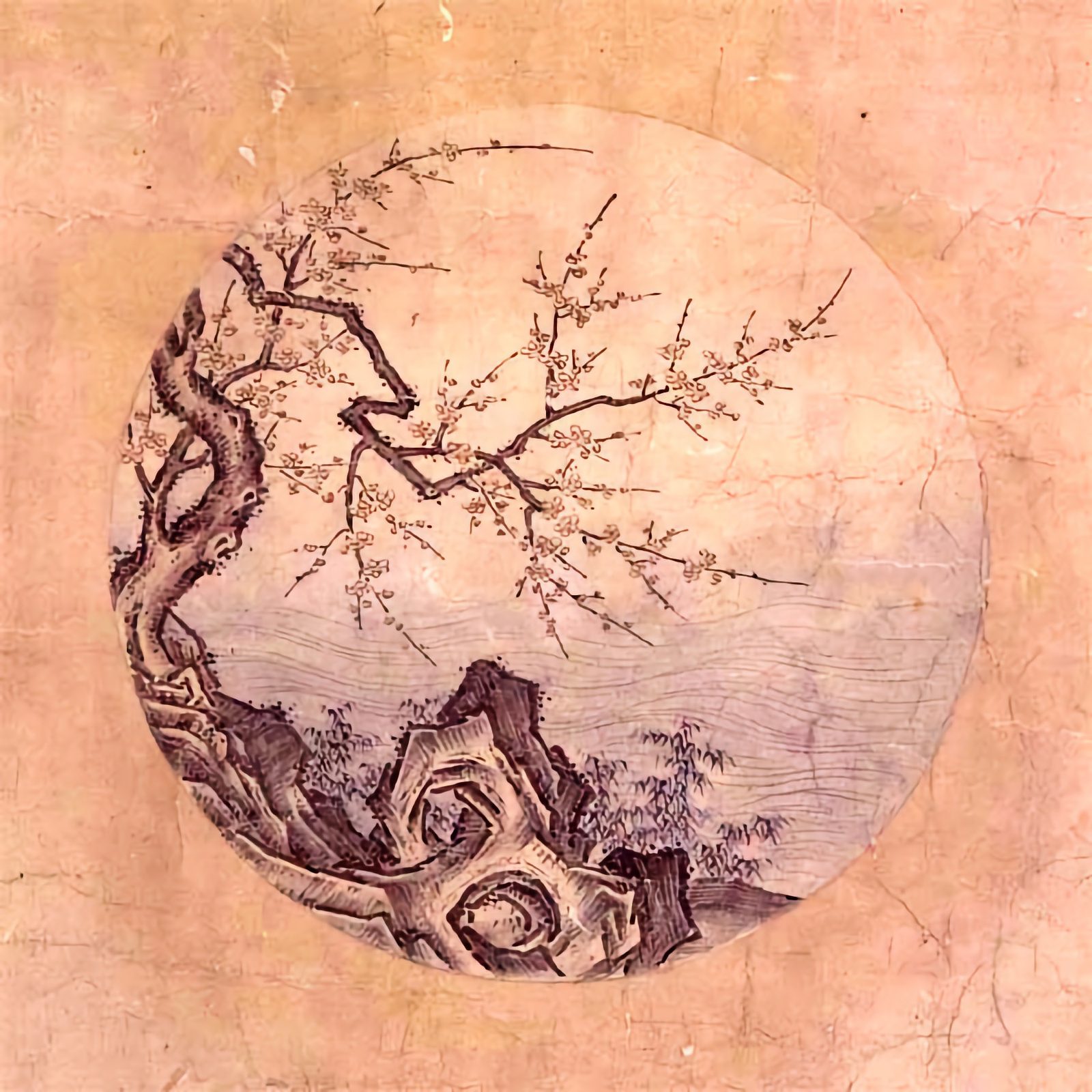
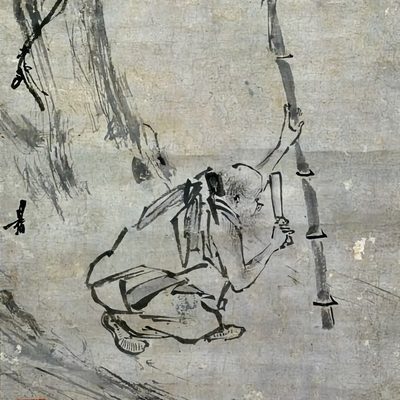
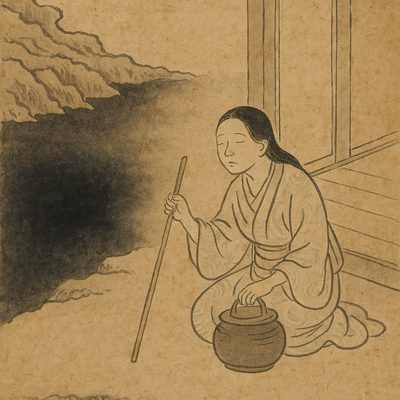
Picture No. 9 of the so-called Oxherding Pictures (十牛図, jūgyūzu), a series of ten images depicting stages of cultivation in Zen Buddhism. Painted by the Japanese Rinzai Zen monk Shubun in the 15th century after lost 12th-century originals, it is titled “Returning to the source” and shows a river running along a wooded bank. I’ve chosen the image for this post as it offers a visual parallel to Inmo in my view: Dōgen examines an ungraspable “it” that cannot be attained as an object, while the return-to-the-source motif suspends the distinction between a seeker and a reality to be recovered. What remains is not the discovery of something hidden elsewhere, but the ordinary world appearing as it already is. Source: Wikimedia Commonsꜛ (license: public domain)
The fascicle uses this ordinary expression to approach suchness without treating it as a separate metaphysical reality. It asks why we seek what we already are, how body and mind can be present without belonging to a fixed self, and how ground, emptiness, movement, perception, wisdom, and doubt can all belong to the same ungraspable field.
In this post, we therefore take a closer look at Dōgen’s Inmo and examine how the fascicle approaches suchness without turning it into a fixed concept or metaphysical principle.
Introduction
Inmo (恁麼), sometimes rendered as “it”, “this”, “thus”, “such”, “what”, or “how”, is one of the most elusive terms in Eihei Dōgen’s Shōbōgenzō. It was an everyday expression in Song-dynasty China, used to indicate something obvious, something that does not require explanation, or something referred to simply as “this” or “that”. Chinese Chán masters adopted the term to point toward the truth or reality that cannot be grasped by concepts and does not call for explanation as an object. This makes Inmo one of Dōgen’s most direct reflections on suchness, although the text does not present suchness as an abstract doctrine. Dōgen does not define inmo once and for all. He circles around it through sayings, stories, paradoxes, and concrete images: being already a person of it, falling to the ground and getting up from the ground, the bell and wind, the moving flag, the wisdom that comes to wisdom, the sixth ancestor hearing the Diamond Sutra, and the question, “What is this something that has thus come?”
The difficulty of Inmo lies in the fact that the term points to what is closest and most immediate. It does not name a remote metaphysical principle. It points to reality as it is already present, before it is turned into an object of thought. It is the “such” of suchness, the “this” of this body and mind, the “it” of what is already here, the “thus” of what has come just as it is. Yet precisely because it is so near, it cannot be grasped by ordinary conceptual thought.
Inmo therefore belongs together with several of Dōgen’s other central texts. Uji says that being is time. Busshō says that Buddha-nature is not a hidden essence but the whole of existence. Sansuikyō says that mountains and waters are a living sutra. Keisei sanshiki says that the valley’s voice and the mountains’ form disclose the Dharma. Inmo asks how all of this can be understood when reality is simply “it”, already so, already such, already beyond possession and explanation.
The structure of the text
As for the entire Shōbōgenzō, Inmo unfolds through a series of connected reflections rather than through a linear argument.
First, Dōgen introduces the saying of Master Ungo Dōyō:
If you want to attain the thing that is “it”, you must be a person who is “it”. Since you are already a person who is “it”, why should you worry about attaining the thing that is “it”?
This is the central statement of the fascicle. The practitioner seeks it, but the seeker is already a person of it. The anxiety of attainment is therefore itself misplaced, although even that anxiety is not outside it.
Second, Dōgen reflects on body, mind, impermanence, and the awakening of bodhi-mind. In his argument, body and mind are manifested throughout the world without belonging to an independent self. Life moves too quickly to be grasped, and even the pure mind does not remain still. Yet something awakens and seeks the Dharma. This seeking shows that the seeker is already a person of it.
Third, Dōgen develops the image of falling to the ground and getting up from the ground. Rising occurs where falling occurs. Dōgen then radicalizes the image: Neither ground nor emptiness alone is sufficient for rising. The image brings together materiality and emptiness, body and openness, concrete support and ungraspability.
Fourth, Dōgen discusses the story of Samghanandi and Geyata, in which the sound of a bell moved by the wind is attributed neither simply to the wind nor to the bell, but to “my mind”. Dōgen rejects the interpretation that sound is merely produced or recognized by an observing mind. Instead, the story questions the separation between perceiver, perceived object, and event: wind, bell, hearing, and ringing belong to one concrete occurrence and cannot be reduced to any single component.
Fifth, Dōgen analyzes the famous story of the sixth ancestor and the moving flag. The sixth ancestor attributes movement to mind rather than wind or flag. Dōgen refuses a psychological interpretation in which only a personal mind moves. Instead, the universal mind is wind, flag, and movement; the text accordingly identifies the person addressed with movement.
Sixth, Dōgen presents the sixth ancestor, Huineng as an example of wisdom directly meeting wisdom. Huineng hears the Diamond Sutra without prior training and awakens. This is not because wisdom comes from outside or from inside. Wisdom transmits wisdom directly. We will see what he means by this when we look at the story of transmission between the fifth and sixth ancestors.
Seventh, Dōgen reflects on wisdom, doubt, and change. Seasonal images such as spring pines and autumn chrysanthemums illustrate that suchness is not a fixed state but the concrete reality of things as they appear under changing conditions. Wisdom and non-wisdom are therefore not treated as two completely separate domains: Both arise within the same field of experience and are included in what Dōgen calls inmo.
Eighth, Dōgen recounts the transmission between the fifth and sixth ancestors. The episode takes place during Huineng’s work pounding rice and is communicated through a sequence of gestures rather than explicit doctrinal explanation. Dōgen uses the story to show that Dharma transmission cannot be reduced to the transfer of verbal knowledge: It is enacted and recognized within a concrete relationship between teacher and student, even when its meaning is not fully available to ordinary reflective awareness.
Finally, Dōgen presents two dialogues that address the limits of conceptual description. Nangaku tells Yakusan that inmo cannot be grasped either by affirming that it is “so” or by denying that it is so. Daikan’s question to Nangaku, “What is this something that has thus come?””, then shifts attention from defining reality to encountering each concrete phenomenon as it appears. Suchness is therefore not presented as an underlying substance or principle, but as the ungraspable yet concrete character of things as they are.
Inmo
Before we continue, here’s the full fascicle:
Inmo
The great master Kōkaku of Mount Ungo, Master Ungo, was the Dharma successor of Master Tōzan Ryōkai. He was the thirty-ninth successor of Sakyamuni Buddha and an authentic ancestor in Tōzan’s lineage. One day he taught before an assembly: “If you want to attain the thing that is ‘it’, you must be a person who is ‘it’. Since you are already a person who is ‘it’, why should you worry about attaining the thing that is ‘it’?”
This means that those who want to attain “it” must themselves be “it”. Since they already are “it”, the question arises why they should worry about attaining “it”. This statement has the following meaning: when you directly experience the highest awakening, the word “it” is used for this. The whole universe of the ten directions is only a small part of the domain of this highest awakening. It may also be that awakening even exceeds the whole universe. We ourselves are tools in this universe of the ten directions.
How do we know that it exists? We know it because our body and mind manifest themselves throughout the whole world, but neither body nor mind belongs to us. Not even the body is ours, because its life flies by like an arrow and we cannot stop it for even a moment. Where have the rosy faces of our childhood gone? When we look for them, we know that they have vanished without a trace. When we think thoroughly, it becomes clear that there are countless things of the past that we will never meet again. Even the pure mind never stands still; it comes and goes, moment by moment. Although this purity exists, it does not dwell in the domain of the personal self. Even though this is so, there is something that suddenly and without recognizable reason awakens and attains the bodhi-mind. Once this mind awakens, we end our “games” and want to hear what we have never heard and experience what we have never experienced. This does not rest only on our own will. You should recognize that this is so because you are already a person who is “it”.
How do you know that you already are it? You know it because you long to attain it. You already have the eyes and face of a person who is “it”. Therefore you should not worry about attaining what is already present, which is “it”. Since the worry itself is also “it”, “it” is beyond worry. Furthermore, you should not be astonished when “it” exists in this way. Even if you are astonished and doubtful about “it”, your astonishment and doubt are also “it”. There is something about which you should not be astonished. This something cannot be grasped by the thought of a Buddha, not by the thought of your mind, not by the thought of the Dharma-world, and not even by the thought of the whole universe. This “it” can only be expressed in this way: “Since you are already a person who is ‘it’, why should you worry about attaining ‘it’?” Therefore the sounds and forms of reality, the body and mind of reality, and all Buddhas of reality could be “it”.
For example, we know that “it” is the moment when we fall to the ground. “It” is also the moment when we get up again and in doing so always support ourselves on the ground, and we are not astonished that we have fallen to the ground. There are statements of this kind that were made in the past in the western heaven, India, and in our heaven, China and Japan. One such statement is: “When someone falls to the ground, they also get up again from the ground. If they wanted to get up without using the ground, this would ultimately be impossible.” This means that when someone falls to the ground, they can only get up directly from the ground. If they wanted to stand up without supporting themselves on the ground, it is impossible.
If you take up these words, you can regard them as a springboard for the great awakening and as a way to let body and mind drop away. If someone asks you what the principle is by which all Buddhas realized the truth, you can say that “it” is like someone falling to the ground and standing up again from the ground. If you experience and investigate this principle, you must penetrate the past and let it go again, you must penetrate the future and let it go again, and you must penetrate this exact present moment and let it go again. The great awakening, non-awakening, falling back into delusion, or the ceasing of delusion are nothing other than awakening just as it is and nothing other than delusion just as it is. All this rests on the truth that someone also rises again from the ground when they have fallen to the ground. This principle expresses the truth in heaven and on earth. It expresses the truth in India and in China, in the past, present, and future. And it expresses the truth of old and new Buddhas. These words are complete and without error.
But if you understand them only in the above way, without also understanding them in another way, it is exactly as if you had neither experienced nor investigated them for yourself. Although this truth of an eternal Buddha has been expressed and transmitted in the above way, you must hear it like a Buddha beyond Buddha. That is, you must hear it as an eternal Buddha hears the words of an eternal Buddha. We must also formulate the truth differently, even if the following was never spoken in the western heaven, India, or in our heaven.
If someone falls to the ground and tries to get up only by using the ground, they can never do it, even if they tried for countless ages. They can get up only through a powerful action that can be described in this way: one who has fallen and supports themselves on the ground can get up only if they also support themselves on emptiness. Conversely, one who supports themselves on emptiness after falling can get up only if they also support themselves on the ground. If it were not so, we could ultimately never get up. All Buddhas and ancestors have done this.
Let us suppose that someone asks you how far emptiness is from the ground. Then you should answer that emptiness is infinitely far from the ground. Therefore, if someone falls to the ground, they can get up only with emptiness; and if they did not want to get up with emptiness, this would ultimately be impossible. If someone falls into emptiness, they can get up only with the ground; and if they wanted to get up without using the ground, this would ultimately be impossible. Whoever never spoke such words has neither understood nor experienced in themselves the dimension of ground, the material, and emptiness, the immaterial, in the Buddha-Dharma.
The seventeenth ancestor, the venerable Samghanandi, had Geyata as Dharma successor. One day Samghanandi heard the sound of the bell in the monastery hall, which began to ring as it was moved by the wind, and he asked Geyata: “Is this the ringing of the wind or the ringing of the bell?” Geyata said: “Neither the wind nor the bell rings. It is my mind that rings.” The venerable Samghanandi asked: “What does ‘mind’ mean?” Geyata said: “It rings because everything is still.” The venerable Samghanandi said: “Excellent. Excellent. Who other than you, my student, could succeed to my Way?” Later he transmitted to Geyata the treasury of the true Dharma-eye.
At the place where there is no ringing of the wind, you can learn that “it is my mind that rings”. At the time when there is no ringing of the bell, you can learn that “it is my mind that rings”. Even if the ringing of my mind is “it”, everything is still. This story was transmitted from the western heaven, India, to the eastern land, China, and it has come down to us from ancient times until today. Although it has set the standard for studying the truth, many students have misunderstood it. In their view, Geyata’s statement, “neither the wind nor the bell rings; it is my mind that rings”, means that there is a hearer whose attention is directed to the ringing in this very moment. When this attention is present, they call it “mind”. How could the sound of ringing be recognized as ringing if this attention of mind did not exist? They say that hearing is realized through this attention and that therefore it is called the root of hearing. For this reason, they think Geyata said that it is his mind that rings.
But they have misunderstood the story because they lack the power of a true teacher. Such an understanding resembles that of teachers of commentaries who interpret the sutras on the basis of subject and object. This is not the profound understanding of the Buddha-truth. The students of the authentic successors of this truth describe the highest truth, namely the treasury of the true Dharma-eye, with the words “stillness”, “non-doing”, “samādhi”, or “dhāraṇī”.
The principle can be presented as follows: when just one dharma is still, the ten thousand dharmas are still. When the blowing of the wind is still, the ringing of the bell is also still. Therefore Geyata says that everything is still. The ringing of mind is not the ringing of wind; the ringing of mind is not the ringing of the bell, and the ringing of mind is also not the ringing of the ordinary mind. Only when this state is familiar to you, when you have directly experienced it and fully investigated it, can you go further and say: the wind rings, the bell rings, the blowing rings, and the ringing rings. “It” exists here just as it is and stands in no relation to what we call worry.
When the thirty-third ancestor, Zen Master Daikan, had not yet shaved his head, he lived at Hosshō-ji in Kōshū. There were two monks there who were having an exchange. One said that the flag moved in the wind, and the other said that the wind moved. The two discussed back and forth until the sixth ancestor said: “Neither the wind nor the flag moves. You are the mind that moves.” When the two monks heard this, they were immediately convinced.
The two monks had come from India. With this statement, the sixth ancestor means that the universal mind is both the wind and the flag and the movement. Even today, when people hear the words of the sixth ancestor, they do not understand them. How much less could they themselves express in words what the sixth ancestor expressed here? Why do I say this? Because they think that the words “you are the mind that moves” can only mean that “your” personal mind moves. But whoever says this has not seen the sixth ancestor, has not understood him, and cannot be his Dharma heir. The children and grandchildren of the sixth ancestor who now express the truth with his body, skin, and hair should express it this way: we can leave the words “you are the mind that moves” as they are, but we could just as well say: “You are the movement.” Why can it also be said in this way? Because movement is movement, and because you are you. We say this because you are already people who are “it”.
The sixth ancestor was first a woodcutter in Shinshū. He knew the mountains and rivers well. Through his efforts in the forest under the green pines, he cut through the roots of delusion. But how could he have known of the eternal teachings that make the mind glow quietly at a bright window? From whom could he have learned how to purify body and mind? One day, at the marketplace, he heard the Diamond Sutra. This happened without his having expected it himself and without anyone else having recommended it to him. He had already lost his father as a boy and had to support his mother as he grew up. He did not know that a precious pearl was hidden in the woodcutter’s cloak, one that could illuminate the whole universe. When he heard the sutra, he suddenly awakened, set out in search of a good teacher, and left his mother. Such conduct is rarely found among human beings. Who could value gratitude and love for one’s mother lightly? But because he regarded the Dharma as highest and gratitude as lesser, he was able to set gratitude aside.
There is the principle that those who are wise and hear the Dharma can immediately trust and understand it. Such wisdom is not obtained from others, and it does not come from oneself. Rather, wisdom directly transmits wisdom, and wisdom comes directly to wisdom. Wisdom consumed the bodies of the five hundred bats, for they had no body of their own and no mind of their own. When the ten thousand swimming fish heard the Dharma, they immediately understood it, not because of circumstances or causes, but because wisdom was in their bodies.
Wisdom does not come, and you do not enter into it. It is like the spirit of spring, which is a complete unity with spring. Wisdom does not depend on seeing or not seeing, and wisdom is neither conscious nor unconscious. How much less could it have anything to do with large and small? And how much less could one speak about it in terms of delusion or awakening?
The sixth ancestor did not even know what the Buddha-Dharma was. Since he had never heard of it before, he did not strive for it or long for it. Yet when he heard the Dharma, he regarded gratitude toward his mother as less important, and he forgot his own body. The body and mind of the wise no longer belong to them. Therefore we say that they can immediately trust and understand the Dharma. We do not know through how many lives and deaths a human being must wander meaninglessly in hardship and in the dust of the world, although they always possess this wisdom. It is like a jewel enclosed in a stone. The jewel does not know that it is hidden in the stone, and the stone does not know that a jewel is enclosed in it. A human being can recognize the jewel and can remove it. The jewel can never hope for this, and the stone cannot expect it. It does not arise from the knowledge of the stone or from the thought of the jewel. Even if the human being and wisdom seem to know nothing of each other, the truth is undoubtedly recognized through wisdom.
In the Lotus Sutra it is said that “those who are without wisdom doubt and lose the Dharma forever”. Wisdom does not necessarily have something to do with being wise or not being wise, and yet there is the wisdom of the being of a moment of the pine in spring, and there is the wisdom of the without-something-being of the chrysanthemum in autumn. In the moment of this wisdom, which is “without something”, even the truth of sambodhi becomes questionable, and all dharmas become doubts. In this moment, “losing forever” is nothing other than action. In action itself, words that should be heard and the Dharma that should be experienced become completely doubtful. In the whole world, which is not the self, there is nothing hidden. It is rather like one iron rail, ten thousand miles long, that belongs to no one. While the buds blossom in this way in spring, “in the Buddha-lands of the ten directions there is only the one vehicle”. And while the leaves fall in this way in autumn, “all things remain in their place in the Dharma, and the forms of this world are constant”. Since all this is already “it”, there is wisdom and non-wisdom, and there is the face of the sun and the face of the moon.
Because the sixth ancestor was already “a person who is it”, he awakened and attained clarity. Therefore he finally went to Mount Ōbai and prostrated himself before Zen Master Daiman, who had him housed in the workers’ hall. For eight months he pounded rice every night. One day, Master Daiman secretly entered the room where the sixth ancestor was pounding rice at midnight and asked him whether the rice was already white or not. The sixth ancestor answered that the rice was white, but not yet sifted. Master Daiman struck the mortar three times with the pestle. Thereupon the sixth ancestor sifted the rice three times through the swinging sieve. It is said that the truth of the master and that of the student joined in this moment. They themselves were not aware of it, and others could not understand it, and yet the Dharma and the robe were transmitted exactly in this moment.
The great master Musai of Mount Nangaku was once asked by Yakusan: “I know quite well about the three vehicles and the twelve teachings. Once I heard that in the south they point directly to the human heart so that one may see one’s nature and become Buddha. Frankly, I have not yet gained clarity about this. I ask you, Master, have compassion and teach me.”
This was Yakusan’s question. Yakusan had previously given lectures himself, and he had a clear understanding of the three vehicles and the twelve teachings. It seemed that there was nothing in the Buddha-Dharma that he did not understand. At that time, the different schools had not yet arisen, and it was customary to acquire the teaching through understanding the three vehicles and the twelve teachings. Because people today are limited, many set up their own principles and take them to be the Buddha-Dharma, but they by no means correspond to the standard of the Buddha-Dharma.
The great master answered: “That ‘it’ is so cannot be grasped, and that ‘it’ is not so also cannot be grasped. Either way, ‘it’ is completely ungraspable. What do you think of this?” This is what the great master said to Yakusan. Because “it” is truly completely ungraspable, one cannot say that it is so or not so. Suchness describes it. This is not a matter of using limited or unlimited concepts in order to explain it. Rather, you should learn “it” in the ungraspable itself, and you should investigate the ungraspable by being “it” yourselves. It is by no means the case that “it”, which is concrete and at the same time ungraspable, is relevant only to the reflections of Buddhas. Understanding itself is ungraspable, and realization itself is ungraspable.
Zen Master Daikan of Mount Sōkei once asked Zen Master Nangaku Daie: “What is this something that has thus come?” These words leave no doubt that “something” has thus come because it is beyond understanding. Because it is “something”, you should experience and investigate for yourselves that the ten thousand things are in reality always “something”. You should experience and investigate for yourselves that each individual thing is in truth “something”. This ungraspable “something” is beyond all doubt: it has thus come.
Shōbōgenzō Inmo
Presented before an assembly at Kannondōri-kōshō-hōrin-ji on the twenty-sixth day of the third lunar month in the third year of Ninji, 1242.
In-depth analysis of the text
Inmo is among Dōgen’s compact but philosophically far-reaching Shōbōgenzō fascicles. It asks how reality can be indicated when it is already present and functioning, yet cannot be grasped as an object. The ordinary word inmo becomes Dōgen’s means of speaking about what is closest, most evident, and most resistant to explanation.
The following sections trace the fascicle’s key themes and images in the order in which they develop.
Inmo as the obvious and ungraspable “it”
The term inmo comes from ordinary Chinese usage. In everyday speech, it identifies something already established by context rather than explaining it. Chán/Zen masters employ the expression for the Dharma precisely because the Dharma cannot be captured by abstract definition. In Dōgen’s use, this is not vagueness but concreteness: Body, mind, sound, movement, question, doubt, falling, and rising all belong to its range. His inmo is consequently close to suchness, without naming a metaphysical substance behind things. It indicates phenomena prior to the conceptual division of subject and object, being and non-being, attainment and lack, or worry and freedom from worry.
Inmo and attainment
The central saying of the text comes from Ungo Dōyō, the 39th ancestor in the Sōtō Zen lineage and a Dharma successor of Tōzan Ryōkai, the 13th ancestor and actual founder of the Sōtō school. He says:
If you want to attain the thing that is “it”, you must be a person who is “it”. Since you are already a person who is “it”, why should you worry about attaining the thing that is “it”?
This saying establishes the basic structure of Dōgen’s argument. The desire to attain it already arises in someone who is a person of it. The fascicle therefore does not present the Dharma as an external object of acquisition; seeking takes place within the field it seeks to attain. Dōgen writes:
You know it because you long to attain it.
The longing functions as evidence rather than as a merely private project: The fascicle treats it as it in the mode of seeking. The desire to hear or experience what is not yet known is thereby presented as a manifestation of suchness, not as proof that realization has been completed. Practice begins within reality rather than outside it. Dōgen also writes:
Since the worry itself is also “it”, “it” is beyond worry.
The formulation places worry about attainment within suchness. Anxiety, doubt, and confusion are not separate from it, but neither do they define it. This resembles Dōgen’s treatment of doubt in Uji, where doubt belongs to the temporal movement of reality. Inmo is not a state of worry or freedom from worry, but the field in which both arise.
Body and mind beyond possession
Dōgen frames the question of how it exists as follows:
We know it because our body and mind manifest themselves throughout the whole world, but neither body nor mind belongs to us.
This sentence links Inmo directly to non-self. Body and mind appear without being owned by an independent self. The body cannot be possessed because life moves too quickly for possession:
Not even the body is ours, because its life flies by like an arrow and we cannot stop it for even a moment.
Dōgen makes this claim through concrete examples: The rosy face of childhood vanishes, past moments cannot be recovered, and the pure mind comes and goes moment by moment. This is not a pessimistic claim, but a basis for suchness. Since body and mind cannot be owned, they manifest throughout the world and belong to the field of the Dharma. Inmo is thus not an object grasped by a self, but what body and mind already are when possession is relinquished.
Awakening does not rest only on personal will
Dōgen writes:
Once this mind awakens, we end our “games” and want to hear what we have never heard and experience what we have never experienced. This does not rest only on our own will.
The awakening of bodhi-mind is not merely an act of personal decision. It arises through conditions, yet cannot be reduced to calculation. The fascicle describes a practitioner as drawn toward the Dharma by a movement that is not owned by a self. Inmo thereby avoids both self-power and passivity: The wish for the Dharma is it functioning as the wish for the Dharma. In the vocabulary of dependent arising, awakening arises through causes and conditions. In Dōgen’s terms, it arises because someone is already a person of it.
Falling to the ground and getting up from the ground
Dōgen introduces a traditional saying:
When someone falls to the ground, they also get up again from the ground. If they wanted to get up without using the ground, this would ultimately be impossible.
The image is both practical and direct: Rising occurs where falling occurs. In Buddhist terms, Dōgen does not locate the resolution of delusion outside the concrete situation in which it appears. The ground of falling becomes the support for rising. He interprets the image as a principle of realization:
If someone asks you what the principle is by which all Buddhas realized the truth, you can say that “it” is like someone falling to the ground and standing up again from the ground.
This is a concrete account of practice. The Dharma is not realized by abandoning the ground of body, karma, confusion, and situation. The same ground makes rising possible. Fall and ground are therefore not outside the path or separate from awakening.
Dōgen then expands the image:
The great awakening, non-awakening, falling back into delusion, or the ceasing of delusion are nothing other than awakening just as it is and nothing other than delusion just as it is.
This is not a careless equivalence of delusion and awakening. The passage treats each in its suchness: Awakening as awakening, delusion as delusion, falling as falling, and rising as rising. Each is inmo, just so.
Ground and emptiness
Dōgen then qualifies the traditional formulation: Rising cannot rely on the ground alone.
One who has fallen and supports themselves on the ground can get up only if they also support themselves on emptiness. Conversely, one who supports themselves on emptiness after falling can get up only if they also support themselves on the ground.
This passage brings together ground and emptiness. Ground denotes concrete material support. Emptiness denotes the ungraspable openness of all dharmas. Dōgen refuses an exclusive reliance either on material ground or on emptiness, thereby rejecting the corresponding extremes of materialism and abstraction. The Buddha Way holds the concrete and the empty together without making them separate domains or possessions. His claim that emptiness is infinitely far from the ground prevents their easy identification: Ground remains ground, and emptiness remains emptiness, while rising depends on both. The passage thus provides a practical interpretation of the Middle Way.
This may find a surprising parallel in the thought of Meister Eckhart, especially in his concept of the Grund, the “ground” of the soul. At least at first glance. Meister Eckhart was a medieval Christian mystic who also used the image of ground to describe the deepest level of spiritual reality. For Eckhart, the Grund is the innermost, undifferentiated depth of the “soul”, where the distinction between the soul’s ground and God’s ground is overcome. It is not ordinary material ground, but the imageless and detached depth in which the divine birth occurs and in which the soul is united with the Godhead. Dōgen’s ground, by contrast, is not an inward metaphysical foundation of the self and does not designate a hidden spiritual depth beneath appearances. It is the concrete ground on which one falls, while emptiness refers to the absence of independent essence in all dharmas. Both thinkers use the image of ground to challenge the idea of an isolated and self-sufficient ego, but they do so within different philosophical frameworks. Eckhart leads the self beyond its created individuality into the ground shared with the divine. Dōgen shows that neither concrete existence nor emptiness can function as an independently graspable foundation. Eckhart’s Grund belongs to a Christian metaphysics of divine unity. Dōgen’s relation between ground and emptiness belongs to a Buddhist account of dependent arising and non-substantiality. The concepts are therefore comparable at the level of self-transcendence, but they are not equivalent.
The ringing of wind, bell, and mind
The story of Samghanandi and Geyata begins with a ringing bell moved by wind:
Is this the ringing of the wind or the ringing of the bell?
Geyata answers:
Neither the wind nor the bell rings. It is my mind that rings.
This answer could be read as the claim that sound exists only in the mind, but Dōgen explicitly rejects that interpretation. For him, “my mind rings” does not describe a personal consciousness attending to sound. It displaces the ordinary separation of ringing, wind, bell, mind, stillness, and all dharmas. Geyata explains:
It rings because everything is still.
The statement is paradoxical only if ringing and stillness are treated as opposites. Dōgen writes:
When just one dharma is still, the ten thousand dharmas are still. When the blowing of the wind is still, the ringing of the bell is also still.
Ringing is not opposed to stillness but constitutes its ringing. Stillness is not an absence of sound, but the settled suchness of each dharma. This recalls the logic of Sansuikyō, where mountains are still and moving at once.
Dōgen then says:
The ringing of mind is not the ringing of wind; the ringing of mind is not the ringing of the bell, and the ringing of mind is also not the ringing of the ordinary mind.
The formulation negates simple identifications before allowing a further formulation:
The wind rings, the bell rings, the blowing rings, and the ringing rings.
The point is not a reduction of everything to mind. Each dharma rings as itself: Wind as wind, bell as bell, blowing as blowing, and ringing as ringing. This is inmo: Each thing is just so.
The moving flag and the moving mind
The famous flag story is similar. Two monks argue whether the wind or the flag is moving. The sixth ancestor says:
Neither the wind nor the flag moves. You are the mind that moves.
Again, Dōgen rejects the idea that the phrase “mind moves” merely denotes a personal mind experiencing movement. He writes:
With this statement, the sixth ancestor means that the universal mind is both the wind and the flag and the movement.
Wind, flag, and movement are neither external objects observed by an inner mind nor mere projections of subjective consciousness. Mind here is not personal mind, but the field in which wind, flag, movement, and the person addressed appear.
Dōgen then radicalizes the phrase:
We can leave the words “you are the mind that moves” as they are, but we could just as well say: “You are the movement.”
This is a strong expression of non-self and process. The self is not a fixed observer to which motion is added, but movement. The person is the movement of the Dharma. Dōgen explains:
Because movement is movement, and because you are you. We say this because you are already people who are “it”.
Movement is not reduced to a person, nor is a person reduced to movement. Each remains itself, while suchness permits the identification of the person addressed with movement. This is the grammar of inmo.
Wisdom directly transmits wisdom
The section on the sixth ancestor turns to the question of immediate awakening. The sixth ancestor was an uneducated woodcutter who heard the Diamond Sutra and awakened. Dōgen uses this story to discuss wisdom:
Such wisdom is not obtained from others, and it does not come from oneself. Rather, wisdom directly transmits wisdom, and wisdom comes directly to wisdom.
This sentence rejects both externalism and internalism. Wisdom does not arrive from outside as a possession transferred to a self, nor does it arise from a self as private property. Wisdom meets wisdom. The Dharma recognizes the Dharma. Dōgen extends the claim to fish and bats who hear the Dharma and immediately understand. Wisdom is consequently not limited by ordinary assumptions about intelligence, education, or self-generated effort.
Wisdom does not come, and you do not enter into it. It is like the spirit of spring, which is a complete unity with spring.
Wisdom is not a thing moving from one place to another. It is not an object entered by a subject. It is like spring being spring. Spring does not enter spring. Spring does not receive spring from elsewhere. Spring is the suchness of spring.
This is a particularly clear connection between Inmo and suchness. Wisdom is not a possession but reality’s direct functioning as itself.
The jewel in the stone
Dōgen gives the image:
It is like a jewel enclosed in a stone. The jewel does not know that it is hidden in the stone, and the stone does not know that a jewel is enclosed in it. A human being can recognize the jewel and can remove it.
The image could suggest a doctrine of hidden essence, but Dōgen’s interpretation prevents that reading. Neither jewel nor stone knows, and recognition arises neither from the thought of the jewel nor from the stone’s knowledge. This does not imply that each person contains a fixed spiritual jewel. Dōgen has already rejected such essentialist readings in Busshō. Here, the image stages the relation of wisdom and ignorance: Wisdom may already be present without being self-owned or self-produced.
Spring pines and autumn chrysanthemums
Dōgen writes:
There is the wisdom of the being of a moment of the pine in spring, and there is the wisdom of the without-something-being of the chrysanthemum in autumn.
This sentence connects Inmo to Keisei sanshiki and Sansuikyō. Natural forms do not illustrate wisdom but express it as seasonal specificity: The spring pine has the wisdom of being, and the autumn chrysanthemum that of being without something. Dōgen does not reduce this relation to symbolic contrast. Spring pine is spring pine, autumn chrysanthemum is autumn chrysanthemum, and each is inmo.
He continues:
Since all this is already “it”, there is wisdom and non-wisdom, and there is the face of the sun and the face of the moon.
Wisdom and non-wisdom are both within it. Sun-face and moon-face, a phrase known from Zen literature, refer to a long-lived Buddha and a Buddha who lives for only one day and one night. They therefore express long and short life, health and illness, and life and death without ranking them as absolute opposites. Suchness includes both.
Transmission without ordinary awareness
Dōgen recounts the secret transmission between the fifth and sixth ancestors. The fifth ancestor strikes three times with the rice pestle. The sixth ancestor sifts rice three times. Dōgen comments:
It is said that the truth of the master and that of the student joined in this moment. They themselves were not aware of it, and others could not understand it, and yet the Dharma and the robe were transmitted exactly in this moment.
Transmission occurs, but not as an object of ordinary consciousness. The master and student do not possess it as knowledge. Others cannot recognize it. Yet it happens. This is another form of inmo: it is simply so.
The rice-pounding scene is also important because transmission occurs through bodily action. Striking, sifting, rice, night, labor, and silence become the field of Dharma-transmission. This links Inmo to Shinjin gakudō, where the Way is studied with body and mind. Suchness is not only thought. It is enacted.
“So” and “not so” are both ungraspable
Yakusan asks Nangaku about the teaching that points directly to the human heart so that one may see one’s nature and become Buddha. Nangaku replies:
That “it” is so cannot be grasped, and that “it” is not so also cannot be grasped. Either way, “it” is completely ungraspable. What do you think of this?
This is one of the fascicle’s most direct philosophical statements. It cannot be grasped either as “so” or as “not so”: Both affirmation and negation fail. Yet Dōgen does not leave the matter in abstraction. He writes:
Because “it” is truly completely ungraspable, one cannot say that it is so or not so. Suchness describes it.
This is close to Madhyamaka logic, but Dōgen makes the ungraspable a matter of practice rather than a logical formula. He writes:
You should learn “it” in the ungraspable itself, and you should investigate the ungraspable by being “it” yourselves.
This passage states the fascicle’s central logic. Suchness cannot be grasped as an object, but is enacted through being it. The study of inmo therefore does not consist in definition. It concerns the ungraspable in body, mind, action, and world.
“What is this something that has thus come?”
The final dialogue concerns Nangaku and the sixth ancestor:
What is this something that has thus come?
This question is among the most famous in Dōgen’s tradition. It asks about “this something”, but does not define it. It points to what has come thus, as it is. Dōgen comments:
Because it is “something”, you should experience and investigate for yourselves that the ten thousand things are in reality always “something”. You should experience and investigate for yourselves that each individual thing is in truth “something”. This ungraspable “something” is beyond all doubt: it has thus come.
This is Dōgen’s final formulation of inmo. The ten thousand things are each “something,” not in the sense of fixed substance but as concrete suchness. Each has thus come: It is neither nothing, mere concept, nor mere appearance, and it has no independent essence. It is this ungraspable something.
This final question also resonates with tathāgata, “thus come” or “thus gone.” The reality of each thing is its thusness: It has come as such and cannot be captured by calling it so or not so. It is simply inmo.
Inmo in a nutshell
The central aspects of Inmo can be summarized as follows:
- Inmo means “it”, “this”, “thus”, or “such”.
It is an ordinary word used by Zen masters to point to what is obvious, immediate, and ungraspable. - Seeking presupposes already being it.
The fascicle treats longing for the Dharma as evidence that the seeker is already a person of it. - Worry and doubt are also it.
Anxiety about attainment is not outside suchness, but suchness is not defined by anxiety. - Body and mind do not belong to the self.
Body and mind manifest throughout the whole world but cannot be owned by an independent self. - Rising occurs where falling occurs.
Delusion and awakening take place on the same ground. The concrete situation is not abandoned in order to awaken. - Ground and emptiness are mutually necessary.
The Buddha Way avoids both materialism and abstract emptiness. Rising depends on ground and emptiness together. - Mind is not personal subjectivity.
In the bell and flag stories, “mind” is not an inner observer. It is the field in which wind, bell, flag, movement, and self appear. - Each dharma expresses itself as itself.
Wind rings, bell rings, blowing rings, and ringing rings. In the fascicle’s idiom, movement is movement and the person addressed is movement. - Wisdom directly transmits wisdom.
Wisdom does not come from outside or from the self. It recognizes itself through the Dharma. - Nature expresses wisdom.
The pine in spring and the chrysanthemum in autumn are not symbols added to wisdom. They are wisdom as seasonal suchness. - Transmission can occur beyond ordinary awareness.
The fifth and sixth ancestors transmit the Dharma through bodily action that they do not possess as ordinary knowledge. - So and not-so are both ungraspable.
Inmo cannot be captured by affirmation or negation. - Each thing is an ungraspable something.
The ten thousand things have thus come. Each is suchness as concrete reality.
Inmo and core Buddhist concepts
Inmo gives a distinctively “Dōgenian” form to several central Buddhist ideas:
- Suchness (tathatā)
Inmo is one of Dōgen’s most direct ways of speaking about suchness. It points to reality as “this”, “thus”, or “it”, without turning it into an object. - Non-self (anattā)
Body and mind manifest throughout the world without belonging to an independent self. The personal self cannot own body, mind, wisdom, or awakening. - Impermanence (anicca)
The falling body, the ringing bell, the moving flag, and the changing seasons all express impermanence. Yet they are not reduced to impermanence. They are each “something” that has thus come. At the same time, inmo is not static essence and undergoes change. However, this is the true nature of reality: process-driven and ungraspable, yet concrete and real. - Emptiness (śūnyatā)
Rising depends on both ground and emptiness. Emptiness is not separate from concrete support, and concrete support is not sufficient without emptiness. - Dependent arising (paṭicca-samuppāda)
Awakening of bodhi-mind does not rest only on one’s own will. It arises through conditions that cannot be reduced to a self. - Practice-realization
Inmo is not a theory to possess. In Dōgen’s formulation, it is enacted as it through body, mind, action, and the ungraspable. - Wisdom (prajñā)
Wisdom comes directly to wisdom. It is neither internal nor external, neither conscious nor unconscious, neither large nor small. - Buddha-nature (tathāgatagarbha)
Inmo avoids treating Buddha-nature as a hidden essence. Suchness is not possessed. It is already expressed as the ten thousand things. - Dharma-position
Each thing is an ungraspable something that has thus come. Each occupies its own concrete position as suchness. - Middle Way
Dōgen avoids the extremes of ground-only materiality and emptiness-only abstraction, affirmation and negation, so and not-so.
Philosophical implications
Inmo is philosophically important because it shows how Dōgen speaks about reality without turning it into a concept. The word inmo does not define reality but indicates it: “this,” “it”, “thus”, or “such”. Dōgen retains ordinary language while using it against objectification.
The fascicle also clarifies Dōgen’s relation to suchness. Suchness is not a metaphysical substance behind phenomena, but the concrete thusness of each thing. Falling body, ground, emptiness, wind, bell, flag, movement, rice, pestle, spring pine, autumn chrysanthemum, sun-face, moon-face, and every individual thing are each “something” that has thus come. The treatment of ground and emptiness is especially significant: Buddhist emptiness can be misconstrued as a denial of concrete reality, while Dōgen keeps the material and empty distinct without separating them in practice. Form is form and emptiness is emptiness, but neither can be grasped independently.
The stories of the ringing bell and moving flag challenge psychological interpretations of Zen. “Mind” is neither subjective consciousness nor an inner observer producing or attending to external phenomena. In Dōgen’s reading, wind, bell, flag, movement, and self are expressions of a wider field. “Mind moves” does not deny wind and flag. It exposes the inadequacy of the division between inner subject and outer object.
Finally, Inmo addresses the problem of attainment. Seeking what one already is does not make practice unnecessary. Rather, the fascicle presents practice as the mode in which it becomes evident. Longing for the Dharma, anxiety about attainment, falling, rising, bell, flag, body beyond self-possession, and wisdom meeting wisdom all belong to the same field of suchness.
Conclusion
Inmo is one of Dōgen’s most precise texts on suchness. Its central word means “it”, “this”, “thus”, or “such”, although none of these translations fully exhausts its force. Inmo points to reality as already present and functioning, yet beyond possession. It cannot be grasped by the thought of a Buddha, mind, the Dharma-world, or the whole universe. Dōgen’s central claim is that it is not sought from outside: The wish to attain the Dharma, worry, doubt, body, mind, falling, rising, wind, bell, flag, movement, wisdom, spring pine, and autumn chrysanthemum are all already it. Practice therefore begins within suchness rather than outside it.
The fascicle’s concrete images and stories lend determinate form to an otherwise abstract discussion of suchness. Ringing bell, moving flag, falling body, rising effort, jewel in stone, spring pine, and autumn chrysanthemum are not mere metaphors, but expressions of inmo in everyday life. Dōgen uses them to articulate the inseparability of ground and emptiness, the non-duality of subject and object, and the immediacy of wisdom. Rising from ground depends equally on emptiness, and rising from emptiness on ground. Dōgen thereby refuses both materialism and abstract emptiness. The Buddha Way is neither escape from nor attachment to the concrete, but the practice of ground and emptiness together.
The final question, “What is this something that has thus come?”, gives the fascicle its most concentrated formulation. Each thing is such a “something”: not a fixed substance, empty nothing, or private mental object, but an ungraspable concrete reality that has thus come. The study of Inmo is consequently not a matter of definition, but of enacting this suchness.
References and further reading
- Dogen Zenji, Shobogenzo – Die Schatzkammer des wahren Dharma-Auges, 4 Bände, 2013, Verlage: Kristkeitz Werner, Übersetzung: Ritsunen Gabriele Linnebach, Gudo Wafu Nishijima, ISBN: 9783921508909


comments