Keisei sanshiki: Dōgen’s account of non-human Dharma-preaching, perception, and relational awakening
Keisei sanshiki presents the voice of a valley and the visible form of a mountain as expressions of the Dharma and the body of Buddha. Like Sansuikyō, it treats mountains and waters as active expressions of the Buddha Way: Mountains move and practice, waters see and express themselves, and the natural world functions as a living sutra. The fascicle shifts the emphasis toward reception and realization, asking how valley sounds and mountain forms become audible and visible as the Buddha-Dharma within a practitioner’s life. In this post, we therefore trace Dōgen’s account of non-human Dharma-preaching, perception, and relational awakening through the text’s structure and its three examples of awakening: Tōba, Kyōgen, and Reiun.

Listening Quietly to Soughing Pines (靜聽松風圖), by Ma Lin, before 1246, ink and color on silk. Nature is a central theme in Dōgen’s Keisei sanshiki, and this painting by Ma Lin (馬麟, active 1222–1280) captures the essence of the natural world with a focus on the interplay between sound and silence. The painting depicts a scholar sitting quietly under a pine tree, listening to the wind rustling through the branches. This emphasizes the harmony between the human figure and the natural environment, reflecting the themes of awakening and realization that are central to Dōgen’s text. Source: Wikimedia Commonsꜛ (license: public domain)
Introduction
Keisei sanshiki (谿声山色), usually translated as Valley sounds and mountain colors or The voice of the valley and the form of the mountains, is one of Eihei Dōgen’s most poetic and practice-oriented reflections on nature as a manifestation of the Buddha-Dharma. The title is built from four terms: kei (谿), valley or rocky gorge; sei (声), voice or sound; san (山), mountain; and shiki (色), form, color, or visible appearance. The title therefore names two dimensions of natural experience: The audible voice of the valley and the visible form of the mountains. In Buddhist language, these are not merely poetic images. It is said that the valley’s voice is the teaching of Siddhartha Gautama, and the mountains’ form is his pure body. What this means: The physical world expresses the Dharma not as a metaphor added by human interpretation, but as one side of reality itself. The sounds, colors, forms, seasons, rivers, valleys, flowers, and mountains reveal the cosmic order of the Dharma day after day.
This makes Keisei sanshiki a close companion to Sansuikyō we have discussed in the previous post. Sansuikyō presents mountains and waters as a sutra: Mountains move, waters see themselves, and different beings encounter water in different ways. Keisei sanshiki approaches the same insight from another angle, examining how natural phenomena become occasions of awakening. The sound of a valley stream, the strike of a tile against bamboo, or the sight of peach blossoms can disclose the Dharma within conditions formed by study, practice, failure, humility, and resolve.
The text does not establish a romantic celebration of nature as automatically spiritual. Dōgen presents nature as teaching, even when its voice remains unheard and its forms unseen for many years. The decisive issue is not whether the natural world expresses the Dharma, but the conditions under which a practitioner receives and enacts that expression. Body, mind, discipline, and bodhi-mind are central to those conditions.
The structure of the text
The structure of Keisei sanshiki unfolds through several closely related tracks.
First, Dōgen begins with the transmission of the Way by Buddhas and ancestors. He recalls intense examples of devotion to the Dharma, such as cutting off an arm or covering mud with one’s hair. The opening establishes that awakening does not arise through casual appreciation, but through serious practice and the shedding of fixed views.
Second, Dōgen presents the story of the layman Tōba, better known as Su Shi, who awakened upon hearing the sound of a valley stream at night. His poem identifies the valley’s voice as the Buddha’s long and broad tongue, and the mountains’ form as the Buddha’s pure body. This story gives the fascicle its title and central theme.
Third, Dōgen reflects on how Tōba’s awakening occurred. He had previously asked a Zen master how insentient beings preach the Dharma. The master’s teaching did not immediately transform him, but later the sound of the valley opened the matter. Dōgen therefore asks whether it was the valley, the teacher’s words, or both together that awakened him.
Fourth, Dōgen tells two further awakening stories: Kyōgen Chikan, who awakened when a tile struck bamboo, and Reiun Shigon, who awakened upon seeing peach blossoms after thirty years of practice. These stories show that natural or ordinary phenomena can trigger realization, but only after long preparation and the exhaustion of conceptual effort.
Fifth, Dōgen discusses several dialogues about mountains, rivers, and earth. Chōsa, a Zen master, asks how mountains and rivers can be one with oneself. The master answers that mountains and rivers are one with oneself, but the questioner does not understand. This reverses the question of how to make mountains and rivers one with oneself. Rōya Ekaku repeats a philosopher’s question about how mountains and rivers arise from original purity. These dialogues prevent the reader from turning nature into either an external object or a metaphysical problem.
Sixth, the text shifts into a strong exhortation. Dōgen criticizes those who become monks for fame and profit, who do not truly seek the Dharma, and who doubt the true dragon when it appears. This section gives the text a moral and institutional dimension.
Seventh, Dōgen formulates a vow to hear and receive the true Dharma in this and future lives. The voice of the valley and the form of the mountains become available through vow, confession, pure faith, and the dissolution of karmic obstacles.
Finally, the text ends by connecting confession, trust, body, mind, and nature. If one does not hold on to fame, profit, body, or mind, the valleys and mountains will withhold nothing. The full teaching of the valley and mountains is therefore not an aesthetic experience alone. It is inseparable from practice, humility, and the release of self-centered grasping.
Keisei sanshiki
The following translation provides the full text attributed to Dōgen:
Keisei sanshiki
In the highest truth, there were many Buddhas and ancestors who transmitted the Way and took up Buddhist action. The traces of the ancients, who were so persistent that they made their bones into dust, cannot be denied. You should learn from the ancient ancestor who cut off his arm for the Dharma, and you should not depart from that bodhisattva who covered the muddy puddle with his own hair. When each of you removes your husk, you are no longer restricted by former views and judgments, and things that have been unclear for long ages suddenly reveal themselves. In the here and now of such a moment, you do not notice it yourselves, and no one else notices it. You do not expect it, and even Buddha-eyes cannot see it. How could human thought fathom it?
In the great kingdom of Song there lived the layman Tōba, whose name was Soshoku and who also called himself Shisen. In the world of poets he seemed to be a true dragon, and he also investigated the dragons and elephants of the Buddhist world. He was so creatively gifted that he could easily swim through the deepest waters and even penetrate dense layers of cloud. One day he visited the Lushan region. It is said that in the night he heard the sound of a river in the valley and awakened to the truth. Thereupon he composed the following poem and presented it to Zen Master Jōsō:
The voice of the valley is Buddha’s broad and long tongue,
the form of the mountains nothing other than his pure body.
Eighty-four thousand verses resound in the night,
how can I tell this to people on another day?
When he presented these verses to Zen Master Jōsō, the master confirmed his experience. Jōsō was Master Shōkaku Jōsō, a Dharma successor of Master Ōryū Enan. Enan was the Dharma successor of Zen Master Jimyō Soen. One day, when the layman Tōba met Master Butsu-in Ryōgen, the master gave him the Dharma robe, the precepts, and so on, and so the layman always wore the robe and practiced the truth. Then he gave Master Ryōgen a jeweled belt of immeasurable value. His contemporaries said of him that his conduct had gone beyond that of ordinary people. Therefore the story of his awakening when he heard the voice of the valley may benefit those who later enter the stream.
It is regrettable that this form of teaching, in which the body of valleys and mountains reveals itself in order to preach the Dharma, had failed to reach him so many times before. What made the layman Tōba suddenly see the form of the mountains anew and hear the voice of the valley anew? Was it one phrase, half a phrase, or eighty-four thousand verses that he heard? How regrettable that the voice and form of the mountains and rivers had been hidden from him until then.
We can rejoice that there are moments, causes, and conditions in which mountains and rivers make themselves known. The manifesting tongue of Buddha never grows tired; how could the form of his body once exist and then disappear? Should we learn that tongue and body are near us when they appear, or when they are hidden? Should we regard them abstractly as an all-embracing whole or concretely as a half? In the spring and autumn of earlier years, Tōba had not truly seen and heard mountains and rivers, but in the moment of that night he could see and hear mountains and rivers just a little.
The bodhisattvas who today strive for the truth should likewise enter this gate of learning through nature and begin with flowing mountains and non-flowing waters. On the day before the night when Tōba awakened to the truth, he had visited Zen Master Jōsō and asked him how insentient beings preach the Dharma. While the Zen master spoke, Tōba’s body was not yet ripe for sudden transformation, but in the moment when he heard the voice of the valley, the spray of the breaking waves rose high into the sky. Therefore, if the voice of the valley suddenly surprised Tōba, one may ask whether it was the voice of the valley or the influence of Master Shōkaku. It is likely that Shōkaku’s words about the Dharma-preaching of insentient nature continued to resound in him and imperceptibly joined with the voice of the valley that night. Who could decide whether Tōba’s experience was as physical as one shō of water? And who would want to idealize it and make it the most important standard? Was it ultimately the layman Tōba who awakened to the truth, or were it the mountains and rivers that awakened to the truth? How could anyone with clear eyes not immediately perceive Buddha’s long tongue and his pure body?
In another case, Zen Master Kyōgen Chikan once studied the truth in the order of Master Dai-i Daien. One day Master Dai-i said: “You, who are sharp-minded and comprehensively learned, describe for me in a few words the state before the birth of your parents, without quoting from the scriptures and commentaries.” Master Kyōgen searched for words many times, but found none. Deeply ashamed of his body and mind, he searched the books he had kept for many years and still found no words. Finally he burned all the writings he had collected over the years and said: “A picture of a rice cake cannot satisfy hunger. I vow that in this life I will no longer try to understand the Buddha-Dharma. I only want to be a monk who serves rice in the morning and food at noon.”
After that, he spent months and years serving the meals. The monk who serves rice in the morning and food at noon is someone who serves the other monks in the morning and at noon; in our country this is roughly equivalent to an attendant. While he was doing this work, he said to Dai-i: “My body and mind are dull and cannot express the truth. Would the master have the kindness to say something to him?” Master Dai-i answered: “It is not that I do not want to say it, but later you might perhaps reproach me for it.”
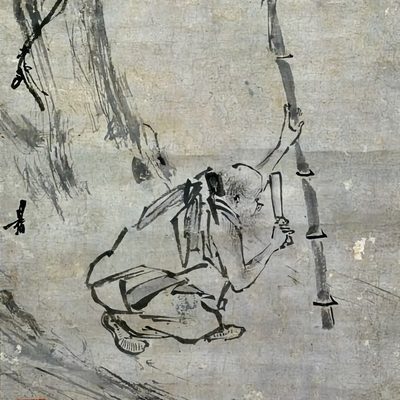
Many years and months passed in this way until Chikan followed the traces of the great master Daishō to Mount Butō and built a straw hut exactly at the site of the great master’s hut. He planted bamboo and made it his friend. One day, while he was sweeping the path, a piece of tile came loose and struck the bamboo with a blow. When he heard this sound, Chikan realized the great awakening. He bathed and purified himself, turned toward Mount Dai-i, burned incense, and prostrated himself. Then he spoke in the direction of Master Dai-i: “Great Master Dai-i! Had you told me before, how could this have happened now? Your kindness is so great that it surpasses even that of my parents.” Thereupon he composed the following poem:
Forgotten with one blow is all knowledge,
no longer must I restrain myself.
My action reveals the Way of the ancients,
never again falling into gloom.
Nowhere the slightest trace:
dignified conduct is beyond sound and form.
People everywhere who awaken to the truth
praise this complete state.
He presented these verses to Master Dai-i, who said: “This student is complete.”
In yet another case, Master Reiun Shigon investigated the truth for thirty years. Then one day, during an excursion in the mountains, he stopped at the foot of a slope; his gaze wandered to the villages in the distance. It was spring, and the peach trees were in full bloom. When he saw them, he suddenly realized the truth. He composed this poem and presented it to Master Dai-i:
For thirty years a wanderer searching for a sword.
How many times did leaves fall and buds bloom?
All at once, when I saw the peach blossoms,
I arrived directly in the now and have no more doubts.
Dai-i said: “Someone who enters through the outer world will never fall back or hesitate.” This is his confirmation. How could someone who has entered not have trust in the world that surrounds him? How could someone who has entered fall back or hesitate? Dai-i’s words do not concern only Shigon’s experience. After all, Shigon followed the Dharma of Master Dai-i. If the form of the mountains were not Buddha’s pure body, how could such a thing happen?
A monk asked Zen Master Chōsa Keishin: “How can we make the mountains, rivers, and earth one with ourselves?” Master Chōsa said: “How can we make ourselves one with the mountains, rivers, and earth?” This means that we are already naturally ourselves. Although we also are the mountains, rivers, and earth, we should not allow ourselves to be restricted by being one with them.
Master Ekaku of Rōya, who was also called the great master Kōshō, was a distant successor of Master Nangaku. Once a scholar of a philosophical school named Shisen asked Master Kōshō: “How does it happen that mountains, rivers, and earth suddenly arise from original purity?” The master replied: “How does it happen that mountains, rivers, and earth suddenly arise from original purity?” Here we are taught that we must not confuse the mountains, rivers, and earth, which are original purity, with the terms “mountains, rivers, and earth”. Since this scholar had not even heard of this in a dream, he did not know mountains, rivers, and earth as real mountains, rivers, and earth.
Remember: if there were no form of the mountains and no voice of the valley, Buddha would have taught nothing when he held up the flower, and Eka, who attained the marrow of the Dharma, would not have remained standing in his place. Precisely because the voice of the valley and the form of the mountains possess this virtue, “the earth and all living beings realize the truth together”. There are many Buddhas who awaken when they see the bright morning star. The old masters who attained the truth were human skin bags whose will to investigate the Dharma was unwavering. People today should certainly investigate the traces of those masters. Even now they must have such determination. They must truly practice and not cling to fame and profit.
In this remote country, those who sincerely seek the Buddha-Dharma are rare nowadays. They do exist, but they are rarely encountered. On the other hand, there are many people who have accidentally become monks, who appear to have turned their backs on the world, but who use the Buddha-truth only in order to become known and rich. It is truly regrettable and sad that they do not lament the impermanence of life and spend it in dark schemes. When could they ever hope for liberation and attain the truth? Even if they met a true master, they would not love the real dragon. My former master, the eternal Buddha, calls such persons “pitiful people”; because of former wrongdoing they have this character. Although they have received life, they have no desire to seek the Dharma for the sake of the Dharma. When they see the true Dharma, they will doubt the real dragon, and when they encounter the true Dharma, they will not like it. Because their body, their mind, their bones, and their flesh have never lived according to the Dharma, they do not live in accordance with the Dharma and cannot receive and use it. Many founders of schools, teachers, and students have long continued this tradition. They understand the mind of awakening, the bodhi-mind, as an old dream. How regrettable that they were born on a mountain of treasures but do not know what a treasure is and do not recognize it. How much less could they attain the treasure of the Dharma?
But once they have awakened to the bodhi-mind, the causes and conditions of their life all transform into actions and wishes that correspond to the truth, even if they must still pass through the six painful states and the four kinds of birth. Therefore they should now, still in this life, despite the former waste of their precious time, immediately make the following vow:
“I sincerely ask that I, together with all living beings, may hear the true Dharma in this and all future lives. If I may hear it, I will never doubt it or be unbelieving. If I encounter the true Dharma, I vow to renounce worldly things and receive and preserve the Buddha-Dharma, so that the earth and living beings may in the end realize the truth together.”
If you make such a vow, the causes and conditions for true awakening to the bodhi-mind will arise of themselves. Do not be negligent or lazy in this attitude.
In Japan, which lies far away beyond the sea, the minds of people are limited. Since ancient times, no people have been born here who are holy or naturally wise, and therefore it need not be emphasized that high-minded people who truly seek the truth are rare. When someone speaks of the will to truth to people who do not know the will to truth, this good advice hurts their ears, and they resent the other person because they do not know themselves. In regard to your actions and wishes that arise from the bodhi-mind, you should not think that ordinary people will recognize whether you have awakened to the bodhi-mind or not, or whether you practice the truth or not. You should try to remain unrecognized in this and not boast of it. Because people today rarely seek what is real, they want others to confirm that their practice and understanding agree, even when their body does not practice and their mind has not awakened. The expression “creating new delusions within delusion” describes precisely this condition. You must immediately abandon this false attitude.
When you study the truth, the pure attitude of mind that corresponds to the true Dharma is difficult to recognize and understand, but it is precisely this attitude that has been transmitted and received from Buddha to Buddha. This attitude has been transmitted and received as the radiant light of Buddha and as the mind of Buddha. From the time of the Tathāgata until today, many people seem to have believed that the essential point in studying the Way was to strive for reputation and wealth. Yet if such people encounter the teaching of a true master, transform themselves, and strive for the true Dharma, they will naturally realize the truth. You must know that the disease described above among those who study the truth today really exists. Among beginners and among long-standing practitioners, some have the capacity to receive the transmitted truth and to pass on Buddhist action, and some do not. There may be those who have the capacity to learn out of reverence for the ancients. And there may also be unteachable demons who will never learn. You should neither love nor hate both groups. But how could you feel no concern about this? Perhaps no one feels concern because hardly anyone recognizes the three poisons, hatred, greed, and ignorance, as such.
Furthermore, you should not forget your determination at the beginning of your joyful striving for the truth. This means that when you first awakened the will to truth, you did not seek the Dharma for the sake of others, you did not strive for fame and profit, which you had already left behind, and you wanted only to attain the truth. You did not expect reverence or gifts from kings and ministers. Nevertheless, today the causes and conditions for such greed exist. Reputation and wealth were never the original aim and never the object of our efforts. We want precisely to avoid becoming entangled in the fetters of humans and gods. But foolish people wrongly expect gifts from humans and gods and rejoice that the merit of the Buddha-Dharma has now come to them. This applies even to such people who initially had the will to truth but soon forgot it. When kings and ministers repeatedly show them reverence, limited people believe this to be the realization of their Way, but this is one of the demons in studying the truth. Although you should not forget your compassion, there is no reason to rejoice over such reverence.
Remember Buddha’s golden words: “Even during the lifetime of the Tathāgata there was much envy and jealousy.” Thus fools do not recognize who is a sage, and small animals make great saints into their enemies.
Furthermore, many of the old masters in the western heaven, India, were killed by followers of other teachings, by adherents of the first two of the four vehicles, by kings, and so on. This did not happen because of the superiority of these followers of other teachings, nor because the old masters lacked insight. When our first ancestor Bodhidharma came from the West and settled in the Song mountains, neither King Wu of the Liang dynasty nor the ruler of the Wei dynasty knew who he was. At that time there were two human dogs known as Bodhiruci Tripiṭaka and Vinaya Master Kōzu. They were afraid that their hollow reputation and greed would be endangered by a true person, and they behaved as if they could darken the sun merely by looking up at the sky. They were worse than Devadatta during the lifetime of the Buddha. How deeply they must be pitied. Reputation and wealth, which they loved above all, were more disgusting to the old master than excrement. That such things occur is not a defect of the Buddha-Dharma. You must know that there are dogs who bark at great people. Do not be afraid of barking dogs. Do not hate them. Rather, vow to guide and lead them. Explain to them: “Although you are animals, you should awaken to the bodhi-mind.” A wise master says: “They are only animals with human faces.” There may also be a kind of demon that reveres and gives gifts to them. An old Buddha said: “Do not have intimate dealings with kings, princes, ministers, rulers, Brahmins, and worldly people.” If you want to study the Buddha Way, you must not forget this kind of conduct. After bodhisattvas have begun to learn, their merits increase according to their progress.
Furthermore, there have always been god-kings who appeared in order to test the determination of practitioners, and there have been death-demons who wanted to obstruct their practice. This always happened when practitioners had not freed themselves from the desire for reputation and profit. When great compassion and great mercy are deep and your vow to free all living beings has matured, such obstacles do not arise. It happens that the power of practice naturally finds the approval of a country. And it happens that a practitioner apparently obtains worldly happiness. When this happens, examine the situation carefully. Do not sleep. Limited people enjoy worldly successes like foolish dogs licking a gnawed bone. Sages and saints reject worldly happiness as ordinary people reject dirt and excrement.
In general, the emotional thinking of a beginner cannot grasp the Buddha-truth. The beginner forms conjectures, but they miss their goal. Even if you cannot fathom the truth at the beginning, you must not deny complete awakening because of this. The inner depth of complete realization goes far beyond the superficial consciousness of the beginner. First, you should walk the Way of the old sages through practical action. At this time, when you seek teachers and investigate the truth, you must climb mountains and cross oceans. If you truly seek and long for a master and teacher, he descends from heaven or comes forth from the earth. Wherever you meet him, he lets sentient and insentient beings speak the truth. You listen to him with your body and with your mind. To hear with the ears is everyday like drinking tea and eating, but to hear a voice with the eyes is manifold and not fixed.
When you encounter Buddha, you encounter yourself and others as Buddha, and you encounter great and small Buddhas. Do not be amazed and do not fear a great Buddha. Do not doubt a small Buddha and do not worry about it. The great and the small Buddhas are what you recognize in the moment as the form of the mountains and the voice of the valley. In them are present the broad and long tongue and the eighty-four thousand verses. What they reveal exceeds everything, and this highest dimension is unique and unusual. Therefore a worldly scripture of Kongzi says: “The closer one comes to him, the higher and stronger he becomes.” A previous Buddha said: “The Buddhas penetrate heaven and earth.” The freshness of the pine in spring and the excellence of the chrysanthemum in autumn are real, and they are only here and now. When a good teacher has arrived in this concrete reality, he is without doubt a great master of humans and gods. But those who only happen to have the appearance of a teacher, yet have not reached this domain, become a nuisance to humans and gods. How could those who do not know the pine in spring and do not see the chrysanthemum in autumn be worth the price of their straw sandals? How could they cut through the roots of their ignorance?
Furthermore, when mind or flesh become sluggish and you doubt, you should sincerely confess before Buddha. If you do this, the power and virtue of confession before Buddha will free and purify you. Such virtue lets pure trust and the powers of devotion grow without limit. And once pure trust reveals itself, you yourselves and the world are equally transformed, and this merit pervades sentient and insentient beings everywhere. The meaning of such confession is as follows:
“Although I have committed many wrong actions in the past and there are causes and conditions that obstruct my Way, I ask the Buddhas and ancestors who attained the truth through the Buddha Way to take care of me, dissolve my karma, and remove the obstacles to my study of the truth. May their virtue and Dharma-gates fill and pervade the boundless Dharma-world. Let me share in their compassion. In the past, the Buddhas and ancestors were like me. May I also become Buddha and ancestor in the future.”
If you look up to the Buddhas and ancestors in this way, they and you are one Buddha-ancestor; and if you awaken to mind in this way, it is the awakening of the mind of reality. When the Buddhas and ancestors give their compassion in all directions, favorable conditions arise and good opportunities open up. Therefore Master Ryūge says: “If you were not complete in past lives, you can become complete now. In this life you can liberate the body of successive lives. Before awakening, the eternal Buddhas were like the people of today. After awakening, the people of today will be eternal Buddhas.”
You should calmly investigate and experience this thought. This means directly experiencing Buddha. If you confess in this way, the mystical support of the Buddhas and ancestors will surely become effective. Confess and reveal your thoughts and the conduct of your body before Buddha. The power of such confession causes the roots of wrongdoing to dissolve. This is the pure, undefiled, and true practice. It is true trust in mind and true trust in body. If you practice in this way, the voice and form of the valley, and the form and voice of the mountains, will withhold none of the eighty-four thousand verses from you. If you do not keep fame or wealth, body or mind, for yourselves, the valleys and mountains will also withhold nothing. But who could recognize you as the voice of the valley and the form of the mountains if you are not yet able to explain with all your strength to others that the valleys and mountains are real valleys and mountains? This applies regardless of whether the voice of the valleys and the form of the mountains realize eighty-four thousand verses in the night or do not realize them.
Shōbōgenzō Keisei sanshiki
Presented before an assembly at Kannondōri-kōshō-hōrin-ji on the fifth day after the beginning of the summer training in the second year of En’ō, 1240.
In-depth analysis of the text
Keisei sanshiki develops one of Dōgen’s central ideas: The Dharma is not restricted to scriptures, teachers, doctrines, or human speech. Valleys, mountains, tiles, bamboo, peach blossoms, rivers, and seasonal forms can preach the Dharma. Yet the text also insists that this natural preaching is not automatically received. It becomes transformative only for those whose practice has matured.
The Dharma is not gained through casual appreciation
Dōgen begins with demanding examples of earlier practitioners:
You should learn from the ancient ancestor who cut off his arm for the Dharma, and you should not depart from that bodhisattva who covered the muddy puddle with his own hair.
The first example recalls Huike, the second ancestor of Zen, who is said to have cut off his arm to demonstrate his resolve before Bodhidharma. The second recalls the bodhisattva who covered mud with his hair so that a Buddha could pass. These examples place the text within a tradition of radical dedication. They are not literal models for imitation. Their function is to establish that the Dharma is not received through half-hearted interest. This matters because the fascicle concerns awakening through natural phenomena. Without the opening, Keisei sanshiki could be misread as a poetic celebration of nature. Dōgen instead presents hearing the valley and seeing the mountains as inseparable from serious practice. The valley’s voice is not entertainment, nor are mountain forms mere scenery: Both are Dharma. He writes:
When each of you removes your husk, you are no longer restricted by former views and judgments, and things that have been unclear for long ages suddenly reveal themselves.
The “husk” is the shell of previous views, judgments, and self-protective habits. The valley and mountains may have always been speaking, but the practitioner remains unable to hear until this husk breaks open. Awakening is not produced by nature alone. It occurs when nature, teacher, practice, and the release of fixed views meet in one concrete moment.
Tōba and the voice of the valley
The first major example is the layman Tōba, the Chinese poet Su Shi. Dōgen presents him as both a literary genius and a serious Buddhist practitioner. His awakening occurs when he hears a valley stream at night:
The voice of the valley is Buddha’s broad and long tongue,
the form of the mountains nothing other than his pure body.
Eighty-four thousand verses resound in the night,
how can I tell this to people on another day?
This poem gives the fascicle its title. The valley’s sound is Buddha’s tongue. The mountains’ visible form is Buddha’s body. The night resounds with eighty-four thousand verses, a traditional number for the immeasurable teachings of the Dharma. The problem is not that there is too little teaching. The problem is how to communicate what has been heard.
Dōgen does not treat Tōba’s experience as isolated. Tōba had asked Master Jōsō about the Dharma-preaching of insentient beings the day before. The master’s words did not immediately transform him, but later the valley’s voice completed the process. Dōgen therefore asks:
Was it ultimately the layman Tōba who awakened to the truth, or were it the mountains and rivers that awakened to the truth?
This is a typical Dōgen question. It unsettles the assumption that awakening belongs only to an individual subject. Tōba awakened, but perhaps the mountains and rivers awakened as well. Or perhaps awakening is not a private event at all, but a relational event in which human practitioner, teacher’s words, valley sound, mountain form, night, and previous practice converge.
This connects Keisei sanshiki to Sansuikyō. In Sansuikyō, mountains and waters practice and investigate themselves. Here, mountains and rivers may awaken. Nature is not passive material. It participates in the event of the Dharma.
Insentient beings preach the Dharma
Tōba’s question to Jōsō concerns the Dharma-preaching of non-sentient beings. This is a major Mahāyāna and Zen theme. If only human teachers can preach, the Dharma remains restricted to language and consciousness. If valleys and mountains can preach, the whole world becomes a field of teaching. Dōgen writes:
We can rejoice that there are moments, causes, and conditions in which mountains and rivers make themselves known. The manifesting tongue of Buddha never grows tired; how could the form of his body once exist and then disappear?
The Buddha’s tongue and body are not limited to the historical body of Siddhartha Gautama. The valley’s voice and the mountains’ form are continuing manifestations of the Buddha’s preaching. The Dharma is not locked in the past. It resounds now. Yet Dōgen also insists that Tōba had failed to hear this many times before:
It is regrettable that this form of teaching, in which the body of valleys and mountains reveals itself in order to preach the Dharma, had failed to reach him so many times before.
The Dharma is constantly present, but its reception is conditioned. The valley may speak without being heard, and mountains may reveal without being seen. Practice is therefore configured as a transformation of hearing and seeing. The fascicle does not present nature as a magical source of awakening, nor does it make awakening a result of practice alone. The valley’s voice and mountain forms are not rewards for practice. They are the Dharma and belong to the process of awakening itself.
Kyōgen, the tile, and the end of conceptual dependence
The second major awakening story concerns Kyōgen Chikan. His teacher, Dai-i, asks him to describe the state before the birth of his parents without quoting scriptures. Kyōgen cannot answer. He searches his books and finds nothing. Finally he burns them and says:
A picture of a rice cake cannot satisfy hunger.
“A picture of a rice cake cannot satisfy hunger” is frequently quoted in Zen. It figures the limits of conceptual understanding: A picture can represent food but cannot feed. In the same way, scriptural knowledge can represent the Dharma without replacing realization. Kyōgen does not reject the Dharma but his reliance on borrowed words. His later awakening occurs while sweeping:
One day, while he was sweeping the path, a piece of tile came loose and struck the bamboo with a blow. When he heard this sound, Chikan realized the great awakening.
The sound of tile striking bamboo becomes the valley’s voice in another form. It is not only beautiful nature that teaches. A broken tile and bamboo can preach the Dharma. The event is ordinary, almost accidental, but it becomes transformative because Kyōgen’s previous conceptual structures have collapsed. Kyōgen then thanks his teacher for not explaining too soon:
Had you told me before, how could this have happened now?
This sentence even adds a pedagogical meaning to the story. The teacher’s silence was not neglect. It preserved the student’s possibility of direct realization. Had Dai-i given him a conceptual answer, Kyōgen might have possessed the answer without realizing the Dharma. The tile against bamboo could then not have opened the matter.
This story shows that nature’s teaching is not opposed to teacher-student transmission. The teacher’s refusal and the sound of bamboo belong together. The Dharma can be heard in bamboo because the student has been prepared by the teacher, failure, humility, and work.
Reiun and the peach blossoms
The third major example is Reiun Shigon, who awakened after thirty years of practice when he saw peach blossoms:
For thirty years a wanderer searching for a sword.
How many times did leaves fall and buds bloom?
All at once, when I saw the peach blossoms,
I arrived directly in the now and have no more doubts.
The image is simple. A practitioner sees peach blossoms in spring. Yet after thirty years of searching, this ordinary sight becomes decisive. The blossoms do not produce awakening mechanically. They appear within a life of practice. The same blossoms may have been seen many times before. Only now are they fully seen. Dai-i confirms him:
Someone who enters through the outer world will never fall back or hesitate.
“Outer world” here does not mean something inferior to inner mind. It means that awakening can occur through the world that surrounds the practitioner. The outer is not outside the Dharma. The form of the mountains, the peach blossoms, and the valley voice are the Buddha’s pure body. And Dōgen asks:
If the form of the mountains were not Buddha’s pure body, how could such a thing happen?
This is the central thesis of the text. Natural forms do not merely remind the practitioner of doctrine. They are the body of the Buddha. Awakening through peach blossoms is possible because the blossoms are not outside the Dharma. And this accounts for all dharmas.
Mountains, rivers, earth, and the question of self
Dōgen then presents a dialogue:
A monk asked Zen Master Chōsa: “How can we make the mountains, rivers, and earth one with ourselves?”
Master Chōsa said: “How can we make ourselves one with the mountains, rivers, and earth?”
The monk assumes a self positioned to unite with nature. Chōsa reverses the direction: Rather than incorporating mountains and rivers into the self, the dialogue asks how the self is already implicated in mountains, rivers, and earth. Dōgen explains:
We are already naturally ourselves. Although we also are the mountains, rivers, and earth, we should not allow ourselves to be restricted by being one with them.
This prevents two misunderstandings. First, Dōgen rejects separation: Selves are not isolated from mountains, rivers, and earth. Second, he rejects fusion: Being one with mountains and rivers cannot become a fixed identity. The point is neither separation nor mystical merger, but the dynamic suchness of self and world. A second dialogue sharpens the point. A philosopher asks:
How does it happen that mountains, rivers, and earth suddenly arise from original purity?
Master Kōshō repeats the same question back to him. Dōgen interprets this as a correction:
We must not confuse the mountains, rivers, and earth, which are original purity, with the terms “mountains, rivers, and earth”.
The philosopher assumes original purity as one thing and mountains, rivers, and earth as another that somehow arise from it. Dōgen rejects this structure. Mountains, rivers, and earth are original purity, but cannot be reduced to the names “mountains, rivers, and earth.” Again, the problem is neither nature nor purity, but conceptual separation.
The world realizes the truth together
Dōgen writes:
Precisely because the voice of the valley and the form of the mountains possess this virtue, “the earth and all living beings realize the truth together”.
This sentence is one of the most important in the fascicle. Awakening is not only an individual psychological event. The earth and all living beings realize the truth together. This does not erase the practitioner’s responsibility. It means that awakening is relational and cosmic. The practitioner awakens with the world, not apart from it. Dōgen links this to the bright morning star:
There are many Buddhas who awaken when they see the bright morning star.
This recalls the awakening of Siddhartha Gautama. Seeing the morning star is not a private visual event. It is the world disclosing itself. The star, the body, the night, the resolve, the earth, and the practitioner all participate in awakening. This is why Dōgen insists on determination:
The old masters who attained the truth were human skin bags whose will to investigate the Dharma was unwavering.
The phrase “human skin bags” is blunt, as often in Zen texts. It prevents idealization. The old masters were bodies. What distinguished them was unwavering resolve. Natural phenomena can awaken, but only a practitioner with resolve can receive their teaching.
Against fame and profit
After the poetic stories, the text becomes sharply critical. Dōgen laments that many people become monks but use the Buddha-Dharma for reputation and wealth. He writes:
Although they have received life, they have no desire to seek the Dharma for the sake of the Dharma.
This section belongs to the central argument. Dōgen presents attachment to fame and profit as incompatible with receiving valley sounds and mountain colors as Dharma. Self-interest blocks the hearing of the valley, and attachment to status prevents recognition of the true dragon. He writes:
When they see the true Dharma, they will doubt the real dragon, and when they encounter the true Dharma, they will not like it.
This recalls the story of the person who loved images of dragons but feared the real dragon. Dōgen used the same image in Fukan zazengi. Here, the real dragon is the actual Dharma. People may love the image of Zen, the poetry of mountains, the prestige of religion, or the appearance of practice. But when the real Dharma appears, they resist it. This is an important warning for any aesthetic reading of Keisei sanshiki. One can enjoy the idea that mountains and valleys preach the Dharma while still avoiding the Dharma itself. Dōgen’s critique of fame and profit prevents the text from becoming mere nature mysticism. The voice of the valley is not for spiritual entertainment. It demands transformation.
The vow to hear the true Dharma
Dōgen then gives a vow:
I sincerely ask that I, together with all living beings, may hear the true Dharma in this and all future lives. If I may hear it, I will never doubt it or be unbelieving. If I encounter the true Dharma, I vow to renounce worldly things and receive and preserve the Buddha-Dharma, so that the earth and living beings may in the end realize the truth together.
This vow is in principle the practical conclusion of the text. It is not a general statement of faith, it is a specific vow to hear the true Dharma in all facets of life, including the voice of the valley and the form of the mountains. And the vow is not a passive wish. It is an active commitment to receive the Dharma when it appears. This requires openness, trust, renunciation of worldly grasping, and willingness to receive and preserve the Dharma.
The vow also returns to the phrase “the earth and living beings realize the truth together”. The practitioner’s awakening is not private. The vow is made together with all living beings and for the realization of earth and beings together. This gives the text an actual bodhisattva orientation. Nature’s teaching is received as part of a vow to participate in the liberation of all beings. Dōgen adds:
If you make such a vow, the causes and conditions for true awakening to the bodhi-mind will arise of themselves.
This does not mean that practice becomes automatic and the vow is some kind of magic formula one just needs to speak out. It means that this (or any other Buddhist) vow reshapes conditions. The mind that vows to hear the true Dharma begins to inhabit a different causal field. The valley’s voice can then become audible.
Hearing with the body, mind, and eyes
Dōgen writes:
Wherever you meet him, he lets sentient and insentient beings speak the truth. You listen to him with your body and with your mind. To hear with the ears is everyday like drinking tea and eating, but to hear a voice with the eyes is manifold and not fixed.
A true teacher makes both sentient and insentient beings speak the truth. The teacher does not replace the valley’s voice. The teacher opens the practitioner’s ability to hear it. Listening is not merely auditory. One listens with body and mind, and even with the eyes. “To hear a voice with the eyes” means that perception is not confined to ordinary sensory categories. Mountain form can be heard. Valley sound can be seen. The Dharma is not limited to one sensory channel. This does not mean fantasy or synesthetic mysticism in a loose sense. It means that the whole body-mind becomes receptive to the Dharma.
Dōgen continues:
The great and the small Buddhas are what you recognize in the moment as the form of the mountains and the voice of the valley.
Buddhas are not only figures in scripture or images in temples. They are encountered as the mountains’ form and the valley’s voice. This is not a reduction of Buddha to nature. It is a statement that the Buddha’s body and tongue are manifest in the natural world when perceived through practice.
Confession and the purification of perception
In the later part of the fascicle, Dōgen turns to confession:
When mind or flesh become sluggish and you doubt, you should sincerely confess before Buddha. If you do this, the power and virtue of confession before Buddha will free and purify you.
At first, confession may seem unrelated to valley sounds and mountain colors. But it is deeply connected. The problem is not that the Dharma is absent. The problem is that karmic obstacles, doubt, sluggishness, pride, and self-attachment prevent one from receiving it. Confession is therefore a practice of removing the obstructions that make one deaf and blind to the Dharma. Dōgen says:
Once pure trust reveals itself, you yourselves and the world are equally transformed, and this merit pervades sentient and insentient beings everywhere.
This is another relational statement. Confession transforms not only the practitioner but the world as encountered. When trust appears, self and world change together. Sentient and insentient beings are included. The valley’s voice and the mountain’s form become available because perception, body, mind, and conditions are purified.
The confession formula asks the Buddhas and ancestors to dissolve karma and remove obstacles to studying the truth. This is not a denial of personal responsibility. It is a recognition that practice is relational. One receives support from Buddhas and ancestors, from teachers, from valleys and mountains, from body and mind, and from the whole Dharma-world.
Before awakening and after awakening
Dōgen quotes Master Ryūge:
Before awakening, the eternal Buddhas were like the people of today. After awakening, the people of today will be eternal Buddhas.
This sentence prevents both despair and arrogance. The Buddhas were once like present practitioners. Present practitioners can become Buddhas. Yet the transformation depends on practice, vow, confession, trust, and the release of worldly grasping. Dōgen interprets confession as direct experience of Buddha:
If you confess in this way, the mystical support of the Buddhas and ancestors will surely become effective.
The term “mystical support” does not denote magical intervention in a crude sense. It expresses the power of entering the transmitted field of practice. Confession, vow, and trust open the practitioner to the working of the Dharma that was previously blocked.
The valleys and mountains withhold nothing
The final lines return to the title:
If you practice in this way, the voice and form of the valley, and the form and voice of the mountains, will withhold none of the eighty-four thousand verses from you.
This is the resolution of the text. The valley and mountains have always been speaking, but they withhold nothing only when the practitioner stops holding back. Dōgen adds:
If you do not keep fame or wealth, body or mind, for yourselves, the valleys and mountains will also withhold nothing.
The condition is not intellectual brilliance. It is non-appropriation. If one does not keep fame, profit, body, or mind as self-possession, the Dharma is no longer blocked. The valley speaks. The mountains reveal. The eighty-four thousand verses are available in the night. This final statement also returns to non-self. The self that grasps fame, wealth, body, and mind cannot hear the valley. The self that releases possession can receive the Dharma of the world.
Keisei sanshiki in a nutshell
The central arguments of Keisei sanshiki can be summarized as follows:
- The natural world is included within the communicative field of the Dharma.
Dōgen interprets sounds and visible forms in nature as possible expressions of the Dharma, rather than as spiritually neutral objects onto which human beings merely project religious meaning. - Natural phenomena do not produce awakening by themselves.
The experiences of Tōba, Kyōgen, and Reiun occur within long processes of study, practice, questioning, failure, and preparation. The stream, the sound of tile striking bamboo, and the peach blossoms become decisive only within these developed conditions. - Awakening arises through interacting conditions.
Tōba’s experience cannot be attributed exclusively either to Jōsō’s teaching or to the sound of the valley. Dōgen presents realization as emerging from the interaction of teacher, practitioner, prior inquiry, environment, and a particular moment. - Direct realization cannot be replaced by conceptual knowledge.
Kyōgen’s learning and familiarity with Buddhist texts do not provide an adequate response to his teacher’s question. The text distinguishes intellectual knowledge about the Dharma from its realization in practice. - Ordinary sensory events can become conditions of realization.
Awakening does not require a supernatural vision or an extraordinary environment. Familiar sounds and forms can transform perception when the practitioner’s conditions have matured. - The world encountered through perception is not external to the Way.
Mountains, rivers, blossoms, sounds, and material objects belong to the field of Buddhist practice. Dōgen rejects a division between an inner domain of realization and an outer world lacking spiritual significance. - The relation between self and world cannot be reduced to either separation or unity.
The reversal of the question about becoming one with mountains, rivers, and earth challenges the assumption of an independent self confronting an external world. At the same time, Dōgen does not replace separation with a fixed doctrine of universal oneness. - Ethical and motivational orientation affects the potential for realization.
Attachment to fame, wealth, status, and recognition redirects practice toward self-interest. For Dōgen, this orientation prevents practitioners from receiving the Dharma even when they encounter authentic teachings. - Bodhi-mind, vow, and confession reshape the conditions of practice.
The determination to seek and preserve the true Dharma, together with confession and the acknowledgment of karmic obstacles, prepares the practitioner to receive teachings that had previously remained inaccessible. - Perception becomes part of embodied practice.
Hearing and seeing are not treated as passive reception of sensory information. The whole body-mind participates in the encounter, and ordinary distinctions between sensory channels are loosened in Dōgen’s description of hearing with the eyes and receiving visible form as teaching. - Awakening is relational rather than exclusively private.
The realization of the practitioner occurs together with teachers, environmental conditions, inherited practices, and the wider world. The statement that the earth and living beings realize the truth together presents awakening as more than an isolated psychological event. - The availability of the Dharma depends on the relinquishment of appropriation.
The valleys and mountains do not become meaningful only after the practitioner assigns them a Buddhist interpretation. Rather, Dōgen argues that their teaching becomes accessible when attachment to fame, wealth, body, mind, and personal possession no longer determines perception.
Keisei sanshiki and core Buddhist concepts
Keisei sanshiki is a Zen text about nature, but its deeper structure, like that of Dōgen’s other texts, is rooted in core Buddhist ideas:
- Suchness (tathatā)
Valleys and mountains express the Dharma by being valleys and mountains. Their voice and form reveal suchness directly, without needing to become something else. - Non-self (anattā)
The practitioner hears the Dharma when fame, wealth, body, and mind are no longer held as self-possessions. The valley’s voice becomes audible when self-clinging loosens. - Impermanence (anicca)
The sound of the stream, the strike of tile and bamboo, and peach blossoms in spring are transient events. Their very impermanence becomes the occasion of awakening. - Dependent arising (paṭicca-samuppāda)
Awakening arises through conditions: teacher, question, prior study, failure, natural sound, seasonal form, vow, confession, and practice. - Emptiness (śūnyatā)
Mountains, rivers, self, and world cannot be fixed as separate entities or collapsed into a single identity. They are empty of independent essence and function relationally. - Bodhi-mind
The will to seek the Dharma for the sake of the Dharma is central. Without bodhi-mind, nature may be admired but not received as Dharma. - Practice-realization
Awakening through valley sound or peach blossoms is not accidental inspiration. It is practice-realization becoming manifest through concrete conditions. - Buddha-nature (tathāgatagarbha)
The form of the mountains as Buddha’s pure body and the voice of the valley as Buddha’s tongue show that Buddha-nature is not hidden behind the world but disclosed as the world. - Confession and purification
Dōgen integrates natural awakening with confession. The ability to hear nature depends on the purification of karmic obstacles and the growth of pure trust. - Interpenetration
The earth and all beings realize the truth together. The valley, mountains, teacher, practitioner, and all beings participate in one Dharma-event.
Philosophical implications
Keisei sanshiki gives one of Dōgen’s clearest accounts of nature as Dharma-expression. The physical world does not merely symbolize Buddhist truth. In the fascicle it teaches. The valley’s voice is not a metaphor for scripture but Buddha’s tongue, and the form of mountains is not a metaphor for purity but Buddha’s pure body. This does not make every natural experience an automatic awakening. Rather, the text presents the world as capable of preaching the Dharma while making its reception conditional. It thereby avoids both romantic naturalism, in which nature saves by itself, and doctrinalism, in which awakening depends on concepts, scriptures, and explanations alone. Tōba, Kyōgen, and Reiun awaken through natural or ordinary phenomena only within long histories of study, questioning, failure, humility, and teacher-student relations. The Dharma appears in water, a tile hitting bamboo, and peach blossoms without being reducible to any of them.
The text also deepens Dōgen’s account of perception. Seeing and hearing are not merely sensory functions but forms of practice. His formulations of hearing with the eyes, body, and mind do not simply confuse the senses. They dislodge the habitual boundaries of perception. Mountain form can teach as voice, and valley sound can reveal as body.
The critique of fame and profit identifies what obstructs the reception of the Dharma. The obstacle is not an absence of teaching but self-centered orientation. Dōgen presents the use of the Dharma for reputation and gain, or the possession of body and mind, as conditions that block the valley’s voice and mountain forms. His account of non-human Dharma-preaching is therefore inseparable from ethics and practice.
Finally, the text presents awakening as relational. Tōba awakens through the valley and Jōsō’s prior teaching; Kyōgen through bamboo and Dai-i’s refusal to explain; Reiun through peach blossoms after thirty years of searching. The claim that earth and all beings realize truth together displaces awakening from a private mental event into a convergence of world, teacher, practitioner, vow, body, mind, and the speaking of sentient and insentient beings.
Conclusion
Keisei sanshiki is one of Dōgen’s most sustained statements on the Dharma of nature. Valleys and mountains are not mute objects: The valley’s voice is Buddha’s long and broad tongue, and the mountains’ form is Buddha’s pure body. The fascicle extends Dharma-preaching beyond scriptures, teachers, and rituals to streams, bamboo, tiles, peach blossoms, mountains, and seasonal forms. It does not, however, make nature an easy substitute for practice. Tōba’s awakening follows prior questioning and Jōsō’s instruction. Kyōgen’s follows the collapse of dependence on books and years of work. Reiun’s follows thirty years of practice. The text therefore presents natural phenomena as disclosing the Dharma within the conditions of body, mind, practice, and resolve.
This makes Keisei sanshiki a direct continuation of Sansuikyō. In Sansuikyō, mountains and waters function as a sutra. In Keisei sanshiki, that sutra is heard and seen as awakening. Together, the two texts show that Dōgen’s Zen is not confined to formal sitting or doctrinal study, though it does not abandon disciplined practice. The world itself becomes the field of practice.
Keisei sanshiki closes by reversing the question of whether valleys and mountains are willing to teach. In Dōgen’s account they already withhold nothing. The decisive issue is what a practitioner continues to withhold through attachment to fame, wealth, body, mind, recognition, and fixed understanding. When self-protective grasping loosens, the eighty-four thousand verses are not projected onto the landscape by interpretation but heard in the valley’s voice and seen in mountain forms. The fascicle thus presents the living Dharma not as an escape from ordinary reality but as its concrete expression.
References and further reading
- Dogen Zenji, Shobogenzo – Die Schatzkammer des wahren Dharma-Auges, 4 Bände, 2013, Verlage: Kristkeitz Werner, Übersetzung: Ritsunen Gabriele Linnebach, Gudo Wafu Nishijima, ISBN: 9783921508909








comments