Bankei and the critique of religious mediation
How do we preserve a religious teaching without losing what originally made it meaningful? Over time, teachings develop their own traditions, rituals, methods, and institutions. These help pass knowledge and experience from one generation to the next, but they can also become ends in themselves. Bankei Yōtaku was quite critical of this tendency within Zen. His remarks on teachers, kōan, zazen, scriptures, and precepts repeatedly return to the same basic question: If the unborn Buddha-mind is already present, why do we sometimes behave as though access to it depended on a particular method or religious authority? What I find worth exploring here is that Bankei’s criticism does not necessarily lead to a rejection of tradition. Instead, it invites us to reconsider what makes a religious practice meaningful in the first place. When does a tradition help us see more clearly, and when does it get in the way? In this post, we take a closer look at Bankei’s criticism of religious forms and institutions, a criticism that, I think, remains relevant well beyond the context of Japanese Zen.

The ruins of a Buddhist temple. The motif illustrated the impermanence of religious institutions and forms. The Dharma is not confined to buildings, rituals, or institutional structures, but remains alive through practice. When the teaching is reduced to rigid forms, it risks sharing their fate. AI-generated illustration with DALL•E 2, rendered in the style of Japanese Zenga ink painting.
Introduction
Bankei Yōtaku’s teaching of the Unborn is not only a doctrine of Buddha-mind. It also contains a sustained critique of religious mediation. However, this critique should be stated carefully. Bankei was not simply anti-institutional. He was a Zen master, taught in monastic settings, spoke to monks and laypeople, and belonged to the broader Rinzai tradition. He did not reject teachers, zazen, scriptures, precepts, temples, or inherited forms in every possible sense. But he repeatedly challenged the idea that such forms are the source of awakening.
And this is important. Bankei’s criticism is not primarily directed against religious forms as such. It is directed against the moment when forms become substitutes for direct recognition. A teacher may point to the Unborn. Zazen may support practice. A scripture may confirm realization. Precepts may guide conduct. A monastery may provide a structured environment. But none of these creates the unborn Buddha-mind. None of them owns it. None of them can replace the recognition of what Bankei calls the Unborn. Bankei’s position can therefore be described as a critique of dead mediation, not as a rejection of living form. When a form remains responsive, concrete, and directed toward recognition of the Buddha-mind, it can function as a skillful means. When it becomes mechanical, self-validating, status-bearing, or detached from direct experience, it becomes an obstruction. This is the central tension in Bankei’s view of religious tradition.
The problem of religious mediation
Religious mediation becomes problematic when it places an unnecessary distance between the practitioner and what is already present. In many religious traditions, teachers, priests, scriptures, rituals, institutions, and lineages can come to function as necessary gateways to truth. They may begin as supports, but later become claims of control. Truth is here, access is through us, legitimacy belongs to this form, liberation requires this institution. Bankei’s teaching weakens this structure because it begins from a different premise. Every person already has the unborn Buddha-mind. It is not manufactured by practice, not granted by a teacher, not transmitted as an object, and not created by institutional status. Bankei can therefore say that if someone confirms that the Unborn is truly the Buddha-mind and lives in it as they are, then that person is already a living Tathāgata. The decisive point is not external authorization, but confirmation and conduct.
This does not make mediation useless. It makes it secondary. A teacher can help, a community can support, a temple can preserve continuity, a text can transmit memory, a ritual can organize attention, a practice form can stabilize life. But all these forms remain secondary to the recognition of the Unborn. Their value depends on whether they return the practitioner to direct seeing or replace direct seeing with dependence on the form. The danger begins when the mediator becomes more important than what it mediates.
Living response and dead repetition
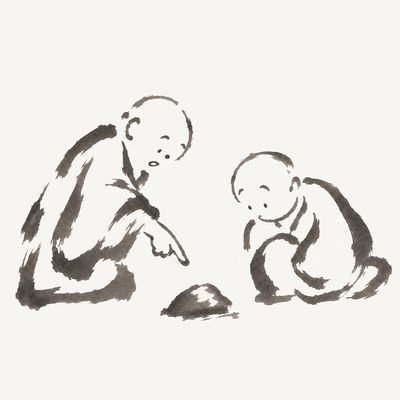
Bankei’s critique becomes clearest in his remarks on inherited Zen methods. He does not deny that past masters used striking means such as a shout, a blow, a raised finger, a kōan, or silent sitting. His point is that such acts were originally responses to concrete situations. They were not universal techniques. They worked, if they worked, because they met a specific student at a specific moment. This is why Bankei sharply criticizes what he calls “method-Zen”. He complains that later teachers rely on old devices because they cannot meet students directly. Bankei here says that such teachers are unable to teach directly, and must therefore rely on inherited tools. His criticism is not that the old tools were always wrong, but that they had become detached from the living situations that once gave them force.
This is a general problem of institutionalization. A living word becomes a formula, a specific gesture becomes a ritualized sign, a kōan that once cut through attachment becomes part of a curriculum. In all such cases, the form survives, but its living function is weakened. Bankei’s concern is therefore not preservation as such. Without preservation, teachings vanish. His concern is the confusion of preservation with realization. A preserved form must be reanimated in practice. Otherwise, it becomes an empty shell.
Bankei’s critique of method-Zen
Bankei’s criticism of fixed methods is actually very precise. He does not say that methods are always false. He says that methods become false when they are treated as inherently necessary. In one exchange, a monk asks why Bankei does not use kōan in the way earlier masters such as Engo and Daie did. Bankei responds by asking whether the Zen masters before Engo and Daie used kōan. The point is historical and doctrinal at once, as a method that arose in a certain period cannot be turned into a timeless condition of awakening.
Bankei makes the same point about “great doubt”. He acknowledges that genuine great doubt existed in earlier cases, for example in the story of Nangaku and the sixth patriarch (Huineng). But he criticizes practitioners who imitate doubt simply because they have heard that earlier masters passed through it. He compares this to pretending to have lost something one has not actually lost. Artificial doubt is not genuine doubt, it is imitation.
The same logic appears when he discusses the old gestures and techniques of past masters. Tokusan used a staff. Rinzai shouted. Gutei raised a finger. Bodhidharma sat facing a wall. Bankei does not deny these forms, he interprets them as responses to concrete circumstances. His conclusion is “There is no fixed Dharma”. To define the Dharma once and for all through a particular method is, in Bankei’s view, to blind oneself.
This is the central point. A method may be useful as upāya, skillful means, when it is alive. It becomes a problem when it is absolutized. Bankei does not reject practice. He rejects the reification of practice.
Zazen as expression, not production
Bankei’s remarks on zazen show the same pattern. He does not reject zazen, but he refuses to treat it as a special technique that ‘produces’ the Buddha-mind. For him, zazen is “nothing but being at home in the Buddha-mind”, without becoming caught in self-deception and without seeking enlightenment elsewhere. He also says that zazen is the sitting of the Buddha-mind in stillness. This formulation changes in fact the function of zazen. Zazen is not a mechanism that manufactures awakening. It is an expression of living in the Unborn. One may sit in the Buddha-mind, but one may also stand, walk, sleep, wake, and work in the Buddha-mind. Bankei explicitly refuses to confine practice to formal sitting periods.
This does not make zazen meaningless. It means that its value depends on whether it expresses and supports the recognition of the Unborn. If zazen becomes a practice through which one tries to become Buddha while overlooking the Buddha-mind already present, then it has become confused. If zazen is simply sitting in the Buddha-mind, it remains alive.
Bankei’s critique is therefore not anti-zazen. It is anti-reification. Zazen is valid when it remains transparent to the Unborn. It becomes misleading when treated as an independent source of awakening.
Scriptures as confirmation, not substitute
Bankei’s view of scriptures follows the same logic. He is often described as avoiding quotations from the Buddha or the patriarchs. In his teaching style, he preferred immediate response to concrete situations over doctrinal citation. This does not mean that he regarded scriptures as worthless in all contexts. Rather, he was concerned with how texts are used.
In one exchange, Itsuzan asks whether it is useful for students to read sutras and Zen writings. Bankei replies that reading has its time. If one reads while still searching for the meaning as something external, one only blinds oneself. If one reads after transcending the meaning, scriptures can confirm one’s realization. This distinction is important here. A text can function as confirmation, but it can also become a substitute. If the reader seeks truth as an object contained in the text, reading can deepen dependence on conceptual understanding. If the reader has already recognized the matter directly, the text may clarify, confirm, or resonate with what has been seen.
Bankei therefore does not reject textual tradition. He limits its authority. The Dharma cannot be reduced to inherited words, even when those words are revered. Texts preserve and transmit, but they do not replace realization. They are alive when they return the practitioner to direct seeing. But they become dead when they stand in place of seeing.
The teacher as pointer, not owner
Bankei’s own role as teacher shows that his critique of mediation was not a rejection of guidance. He actually taught constantly. He answered questions, corrected misunderstandings, and addressed concrete forms of suffering (anger, fear, illness, attachment to thoughts, precept-pride, and dependence on methods). His public activity was itself a form of religious mediation. But Bankei’s teacher role was functional, not possessive. He did not present himself as the owner of the Buddha-mind. He did not claim that students had to pass through him in order to receive it. His function was to point out what, according to his teaching, was already present and to show where it was being obscured.
This becomes in particular clear when Bankei draws his listeners’ attention to their own hearing. Although they are concentrating on his words, they can simultaneously recognize and distinguish the sounds of crows, sparrows, and the wind without deliberately trying to hear them. Bankei points to this ordinary experience as evidence of the natural functioning of the unborn Buddha-mind. He does not teach his listeners how to hear, nor does he give them a new capacity. He simply draws their attention to something they have been doing all their lives without recognizing its significance. The teacher’s contribution lies in making something already familiar recognizable in a different way.
The teacher’s function is, thus, diagnostic. He identifies where delusion is being produced. The teacher may be useful, even indispensable for some practitioners, but he is not ultimate. The best teacher, in Bankei’s sense, does not create dependence on the teacher, but returns the student to the Buddha-mind.
Precepts, pride, and moral identity
Bankei’s criticism of precept-pride belongs to the same broader critique of mediation. He does not reject precepts as such. In his encounter with priests of the Disciplinary School, who prided themselves on observing the 250 monastic precepts, he says that observing precepts is not wrong. It is a good thing. But it is not the best. His criticism concerns the way precepts can become a badge of superiority. He explains that precepts were originally established in response to violations of the Dharma. A person who does not steal does not need to build an identity around a rule against theft. A truthful person does not need to turn a rule against lying into a mark of spiritual rank. When one begins to boast of discipline, the rule has become part of self-making.
Here again, Bankei’s concern is not form itself, but the attachment to it. Precepts can guide conduct, they can restrain harmful behavior, they can support community. But when they become identity, merit, or status, they no longer serve the Unborn. They reinforce the self they were meant to discipline. A living precept disappears into conduct. A dead precept becomes a possession.
Ritual and institutional form
The same analysis can be applied to ritual and institutional form. Bankei does not need to be read as someone who rejects all ritual, temple structure, or communal practice. Such forms can organize attention, preserve continuity, support ethical discipline, and protect teachings from disappearing into private vagueness. The problem arises when such forms become inherently salvific or self-legitimating. A robe, a bow, a chant, a lineage ceremony, or a temple role can support practice. But it can also become a sign of identity and superiority. In that case, the form no longer points beyond itself. It becomes an object of attachment. Bankei’s own position here is best understood functionally. A form is useful if it returns the practitioner to the Unborn. It is harmful if it draws the practitioner into imitation, pride, dependence, or self-deception. This applies equally to rituals, teachings, institutions, and methods. The criterion is not whether a form is old or new, but whether it is alive.
Institutional authority and spiritual dependency
Institutional religion often creates dependency when it implies that the practitioner lacks direct access. The individual is told, explicitly or implicitly, that truth requires authorization, ritual validity, lineage status, doctrinal correctness, or institutional belonging. Such structures can preserve teachings, but they can also weaken direct responsibility. Bankei’s teaching moves in the opposite direction. If the Buddha-mind is already present, one cannot outsource awakening. One cannot say that the institution must first grant access, or that the teacher must first make one complete. One can also not say that a method must first produce the Buddha-mind. The Unborn is already where one stands.
This is liberating. But it is also demanding. Institutional mediation can be comforting because it gives the practitioner something external to rely on. Bankei removes some of that comfort. He does not replace it with individualistic arrogance, but with responsibility. The question is no longer whether one has access to the correct system, but whether one is transforming the Buddha-mind into delusion in this moment. In this sense, Bankei’s critique of mediation is also a critique of spiritual evasion. The practitioner cannot hide behind the absence of ideal conditions. According to Bankei, the decisive condition is already present.
When institutions remain alive
A fair reading must also acknowledge the positive function of institutions. Without institutions, teachings may vanish. Without teachers, many practitioners may misunderstand themselves. Without texts, later generations may lose contact with earlier insights. Without ritual and shared practice, religion can become purely private opinion. Without forms, practice can become unstable, vague, or self-indulgent. Bankei’s own teaching survived because it was recorded, edited, transmitted, translated, and studied. This is indeed institutional mediation. Without such mediation, his critique of mediation would not be available to us. Therefore, Bankei’s position cannot responsibly be used as a naive, absolute und unbalanced rejection of all institutions. The real distinction is thus not institution versus no institution, but living institution versus dead institution.
A living institution remains transparent to the Dharma. It does not claim ownership over awakening. It preserves forms while allowing them to function as supports, not idols. It teaches without replacing direct recognition. It honors lineage without imprisoning the present in the past. It uses ritual without mistaking ritual for realization. A dead institution protects itself. It repeats inherited forms because they are inherited. It confuses office with insight. It treats method as necessity. It values conformity over seeing. It makes the practitioner dependent on external validation. It preserves the language of awakening while no longer pointing effectively to awakening. Bankei’s criticism is directed at the latter, not necessarily at the former.
When methods remain alive
The same distinction applies to methods. Zazen can be alive. Kōan practice can be alive. Precepts can be alive. Chanting can be alive. Study can be alive. Bowing can be alive. Silence can be alive. Even inherited institutional forms can be alive. They are alive when they function as skillful means and support recognition of the Unborn. They are dead when they become objects of attachment, spiritual identity, mechanical imitation, or institutional control.
Bankei’s teaching does not require one to despise forms. It requires one not to be deceived by them. If zazen is sitting in the Buddha-mind, it is alive. If zazen is performed in order to become Buddha later while overlooking the Buddha-mind now, it becomes confused. If a kōan cuts through self-attachment, it is alive. If a kōan is merely repeated because it belongs to a curriculum, it risks becoming dead. If precepts express conduct from the Unborn, they are alive. If precepts become a badge of superiority, they are dead. The living Dharma cannot be identified with any single form, but it can appear through many forms.
The danger of anti-institutional arrogance
A critique of religious mediation has its own danger. One can become attached to being anti-institutional. One can say “I do not need teachers, texts, rituals, or communities because I already have the Buddha-mind””. This too can become self-deception. The ego may use Bankei’s teaching to protect itself from correction. Bankei’s position should must not be reduced to modern spiritual self-sufficiency. He teaches direct responsibility, not spiritual isolation. A practitioner without formal mediation must be especially careful, because self-deception becomes easier when no one can challenge it. The question is not whether one uses institutions or avoids them, but whether one lives from the Buddha-mind or from self-attachment. A person inside a temple can be attached to form, and a person outside a temple can be attached to independence. A monk can cling to robes, while a layperson can cling to anti-clerical pride. The same accounts to the scholar, who can cling to texts, while a meditator can cling to silence. And a critic can cling to criticism. Every position can become delusion when appropriated by the self.
Bankei and the living Dharma
Bankei’s teaching returns again and again to living immediacy. The Dharma is alive when it addresses the actual movement of delusion. It is alive when anger is seen as produced. It is alive when fear is recognized as a fabrication of thought. It is alive when pain is not turned into self. It is alive when thoughts are allowed to arise and pass without being grasped. It is alive when a teacher points directly to the Unborn. It is alive when a text confirms direct recognition. It is alive when zazen is simply sitting in the Buddha-mind. But the Dharma dies when it becomes primarily a matter of preserving form. It dies when it becomes self-display, status, institutional identity, or mechanical imitation. It dies when a method continues after its living function has disappeared. It dies when the practitioner imitates gestures of awakening instead of seeing delusion directly.
Bankei’s plain speech can be understood as an attempt to restore living function. He reduces ornament, obscurity, excessive technique, and institutional distance. He speaks directly because the problem, in his view, is direct, as people already have the Buddha-mind, but transform it into delusion. The living Dharma is therefore not located in the form alone. It is present wherever this transformation is seen and no longer continued.
A broader religious implication
Bankei’s critique has implications beyond Zen. Many religious traditions face the same danger, where a living insight becomes teaching, teaching becomes doctrine, doctrine becomes institution, institution becomes authority, authority becomes self-preservation. What began as liberation can become control. What began as a path can become a system that protects itself. This does not mean that all institutions are corrupt or that all doctrine is false. It means that religious forms are always vulnerable to inversion. The form that once served awakening may later obstruct it. The teacher who once pointed to truth may become a figure of dependency. The scripture that once preserved insight may become a substitute for direct seeing. The ritual that once embodied practice may become identity. Bankei’s Zen offers a functional criterion: Does the form return the practitioner to the Unborn? If yes, it remains alive. If no, it has become secondary at best and obstructive at worst. This criterion avoids two extremes, institutional absolutism, which treats form as inherently authoritative, and anti-institutional simplification, which treats all form as inherently false. Bankei’s standard is thus functional, not ideological.
Preservation and renewal
A living teaching must be preserved, but preservation alone is not enough. It must also be renewed in practice. This is the paradox of tradition. Without preservation, the teaching is lost. Without renewal, the preserved teaching becomes dead. Bankei himself illustrates this paradox. His words were preserved in records. Later editors, translators, scholars, and practitioners transmitted them. This preservation allows us to encounter him. But simply repeating Bankei’s words is not yet Bankei’s Zen. To repeat “the Unborn” without recognizing the Buddha-mind would be precisely the kind of dead form Bankei criticized.
Every tradition must therefore do both, preserve and reanimate. It must carry forward words, forms, and practices, but also test whether they still point to direct seeing. The task is not to abolish the past, but to prevent the past from becoming a substitute for the living present. Bankei’s own teaching is not exempt from this. “Abide in the Unborn” can also become a slogan. “Everyone is already Buddha” can become spiritual laziness. “No method is necessary” can become refusal of discipline. Even Bankei can be institutionalized into dead Bankei-ism. His critique must therefore be applied to his own reception as well. The living teaching survives only when it remains practice.
Conclusion
Bankei’s Zen contains a strong critique of religious mediation, but it is not a simple rejection of teachers, scriptures, rituals, institutions, methods, or lineages. His criticism is directed against the reification of these forms. They can support awakening, but they do not create the unborn Buddha-mind. They are secondary to direct recognition. When they remain alive, they are useful, but when they become objects of attachment, authority, imitation, pride, or dependency, they can obscure the Dharma they were meant to serve.
The death of living teaching through institutionalization occurs when form replaces function. A method once used to awaken becomes a method performed because it is traditional. A teacher once pointing to the Unborn becomes an authority who controls access. A scripture once confirming insight becomes a substitute for insight. A temple once supporting practice becomes a structure preserving itself.
Bankei’s answer is not the rejection of all form, but the return to living immediacy. If zazen is alive, sit. If kōan is alive, use kōan. If scripture confirms realization, read. If ritual supports practice, perform it. If a teacher points clearly, listen. But none of these should be mistaken for the source of awakening. The source is not elsewhere, the unborn Buddha-mind is already present.
Bankei’s critique remains valuable because it asks a difficult question of every religious form: Does it return the practitioner to the Unborn, or does it make the practitioner forget the Unborn while preserving its language? Where the answer is the first, tradition lives. Where the answer is the second, the living Dharma has become institution without awakening.
References and further reading
- Norman Waddell (Herausgeber), Bankei Eitaku, Die Zen-Lehre vom Ungeborenen. Leben und Lehre des großen japanischen Zen-Meisters Bankei Eitaku (1622 - 1693), 1988, ISBN-10: 3502640505
- Peter Haskel (Übersetzer), Yoshito Hakeda (Herausgeber), Mary Farkas (Vorwort), Bankei Zen - Translations From The Record Of Bankei, 1994, Grove Press, ISBN: 9780802131843
- Oliver Bottini, Das große O.-W.-Barth-Buch des Zen, 2002, Barth im Scherz-Verl, ISBN: 9783502611042
- Heinrich Dumoulin, Geschichte des Zen-Buddhismus, Band 1+2, 2019, 2., durchgesehene und erweiterte Auflage, Francke A. Verlag, ISBN: 9783772085161
- Hans-Günter Wagner, Buddhismus in China: Von den Anfängen bis in die Gegenwart, 2020, Matthes & Seitz Berlin, ISBN: 978-3957578440
- Jr. Buswell, Robert E., Jr. Lopez, Donald S., Juhn Ahn, J. Wayne Bass, William Chu, The Princeton dictionary of Buddhism, 2014, Princeton University Press, ISBN: 978-0-691-15786-3









comments