Sansuikyō: Mountains, waters, and the living Dharma
In Sansuikyō, Eihei Dōgen uses mountains and waters to examine how dharmas, the fundamental constituents of reality in Buddhist view, are perceived and conceptualized. The fascicle challenges the assumption that the natural world simply stands still before an observing subject: Mountains move, waters see and practice themselves, and different beings inhabit different water-worlds. Such statements do not turn nature into a poetic metaphor or attribute human consciousness to non-human things. Rather, they test whether categories such as movement and stillness, subject and object, or sentient and insentient can adequately describe the activity of dharmas.
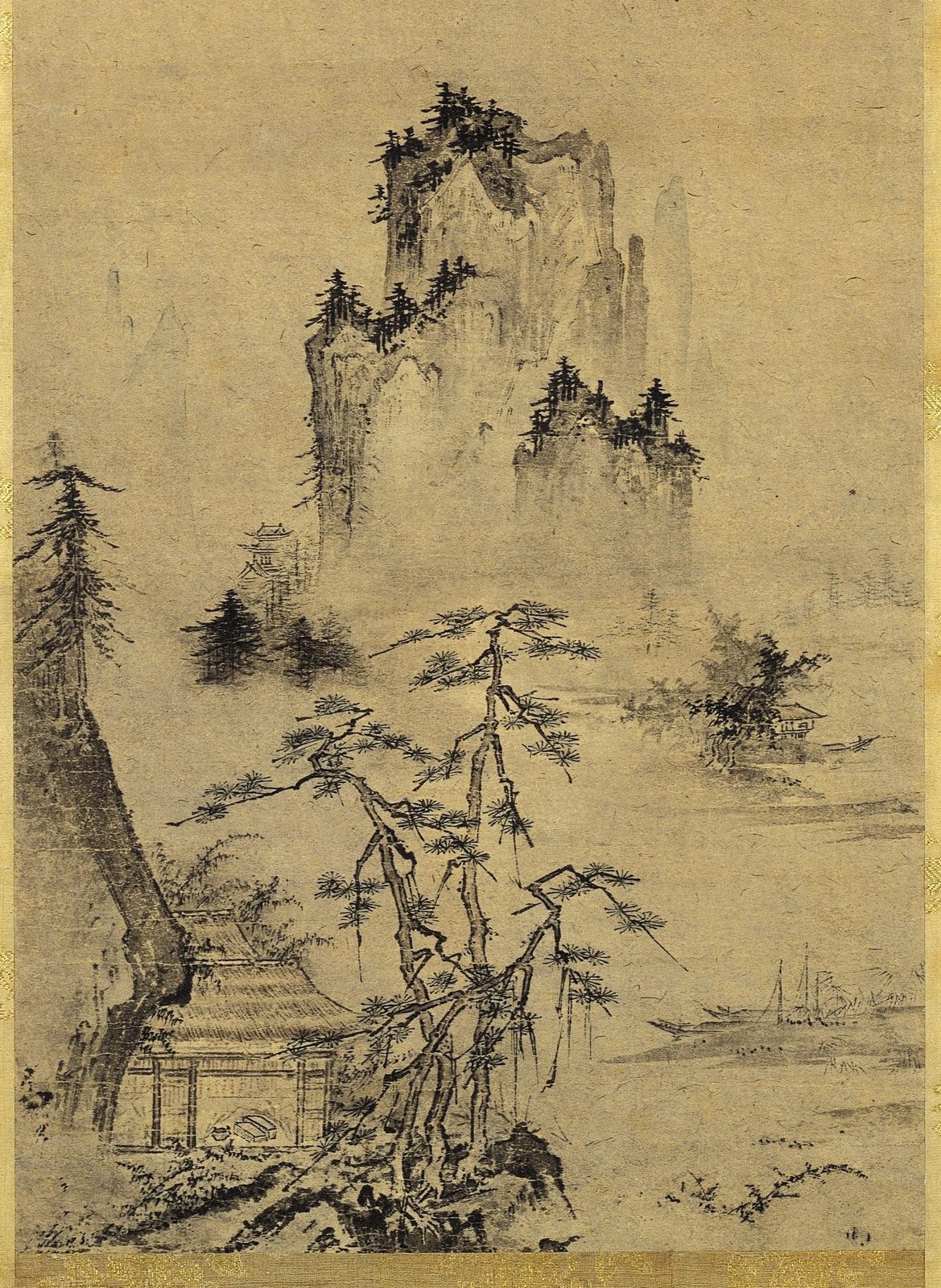
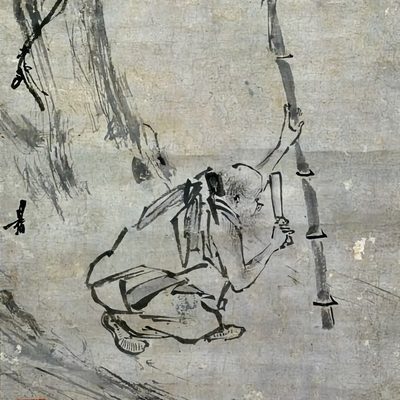
Landscape (紙本墨画淡彩山水図, shihon bokuga tansai sansuizu), hanging scroll, 108 cm x 32.7 cm, ink and light color on paper. Located in the Nara National Museum, Nara, Japan. Mountains and waters are central themes in East Asian art and culture, and they are especially important in the context of Zen Buddhism. This painting by Tenshō Shūbun (天章周文, 1414–1463) is a classic example of the sansui (山水, mountains and waters) genre, which was deeply influenced by Chinese landscape painting and Zen aesthetics. The painting captures the essence of the natural world with minimal brushstrokes and a monochromatic palette, evoking a sense of tranquility and timelessness that resonates with the themes of Dōgen’s Sansuikyō. Source: Wikimedia Commonsꜛ (license: public domain)
In this post, we examine why Dōgen calls mountains and waters a sutra, how their ‘movement’ and self-expression articulate the Dharma, and how the fascicle relates these examples to perception. We also situate Sansuikyō in relation to broader Buddhist topics such as emptiness, dependent arising, suchness, and the non-anthropocentric scope of Buddhist practice.
Introduction
Sansuikyō (山水經), often translated as The mountains and waters sutra, is one of the most striking fascicles of Eihei Dōgen’s Shōbōgenzō. It was presented in 1240 at Kannondōri-kōshō-hōrin-ji, the same year as Uji, and it belongs to the same broad period in which Dōgen developed some of his most radical interpretations of practice, time, body, mind, and the concrete world. The title itself is programmatic: Sansui means mountains and waters, kyō means sutra or scripture. Dōgen is therefore not merely writing about mountains and waters as poetic symbols, he treats them as a sutra, as a direct expression of the Dharma. Mountains and waters do not merely illustrate Buddhist truth, they preach it. They enact it. And, in Dōgen’s view, they are the living activity of the Buddha Way.
This makes Sansuikyō an important companion to Dōgen’s other central texts we have encountered so far. Genjō Kōan, for instance, shows how reality becomes manifest in ordinary perception and action. Uji argues that all being is time. Busshō interprets Buddha-nature as the whole of existence rather than as a hidden inner essence. Sansuikyō adds a decisive ecological and cosmological dimension: Mountains and waters are not passive scenery. They are active, practicing, expressing, and realizing the Dharma.
At first glance, the text may appear to be about nature. Yet Dōgen’s mountains and waters are neither romantic landscapes nor symbols of purity opposed to human society, and they are not metaphors for psychological states. They are concrete dharmas that enable him to question ordinary categories. Mountains move, waters see themselves, mountains flow, and water is not exhausted by wetness; different beings perceive water differently. The later claim that mountains belong to those who love them belongs to the same reconfiguration of relations between beings and places. Throughout the fascicle, mountains and waters serve as exemplary cases for a broader account in which all dharmas are free and abide nowhere, while each occupies its own Dharma-position.
The central problem of the text is therefore epistemological and practical at the same time. It concerns the status of mountains, waters, and other dharmas when they are apprehended through ordinary human categories, names, forms, and functions. Dōgen’s argument is that Buddhist practice transforms the conditions under which the world is perceived. His concluding formulation, “mountains are mountains, water is water”, does not endorse naive realism. It describes the realization of particular dharmas without reducing them to objects, symbols, or human-centered functions.
The structure of the text
Like other fascicles in the Shōbōgenzō, Sansuikyō is not a systematic treatise in the modern sense. It unfolds through several closely connected movements.
First, Dōgen introduces mountains and waters as the present realization of the words of the eternal Buddhas. Mountains and waters occupy their Dharma-position and complete all-inclusive virtues. This opening establishes the central claim: mountains and waters are not inert objects. They are living Dharma-activity.
Second, Dōgen analyzes the saying of Master Fuyō Dōkai:
The blue mountains are constantly moving. The stone woman gives birth to her child at night.
This becomes the basis for Dōgen’s most famous claim in the text: Mountains move. Their movement is not the movement of ordinary human beings, but it is real. To doubt the movement of mountains is, for Dōgen, to misunderstand one’s own movement.
Third, Dōgen discusses the statement of Yunmen:
The East Mountain walks over the water.
He defends this saying against those who dismiss such Zen statements as meaningless or irrational. Dōgen strongly criticizes this attitude, especially among certain Song-dynasty Chan monks. For him, Zen language is not meaningless speech. It must be studied and practiced.
Fourth, the text turns to water. Dōgen rejects ordinary assumptions that water is simply wet, flowing, or physically measurable. Water is neither strong nor weak, neither wet nor dry, neither moving nor still, neither existent nor non-existent. Water sees itself, practices itself, and expresses itself.
Fifth, Dōgen develops a perspectival analysis of water. Humans see water as water, but other beings may see it as jewels, flowers, flames, pus, blood, palaces, towers, trees, walls, Dharma-nature, or the true body of the human being. This passage is one of Dōgen’s most important reflections on conditioned perception.
Sixth, Dōgen examines the freedom and placelessness of all dharmas. He quotes the Buddha:
All dharmas are ultimately free and abide nowhere.
Yet this does not mean that dharmas are nowhere in a nihilistic sense. They are free, but they have their place. This is one of the key tensions of the fascicle: All things are unbound, but each thing fully occupies its own Dharma-position.
Seventh, Dōgen returns to mountains as places of practice and realization. Mountains are the dwelling of sages and Buddhas, but not because they are merely scenic or symbolic. They are beyond ordinary human control. They are loved by sages and love sages in return.
Eighth, the final section brings mountains and waters together. Water is not merely flowing, mountains are not merely still. If one understands the flowing and non-flowing of a single drop of water, one realizes the mastery of the ten thousand dharmas. The text ends with the famous saying:
Mountains are mountains, water is water.
This does not mean that conventional names are sufficient. It means that mountains must be realized as mountains, and water as water, without reducing them to concepts, symbols, objects, or human-centered functions.
Sansuikyō
To get a direct impression of the text, let us read it in full:
Sansuikyō
The mountains and waters of the present are the realization of the words of the eternal Buddhas. Both remain in their Dharma-position and complete all-inclusive virtues. Because they are life before the age of emptiness, they are powerful activity in the present. Because they are the self before the arising of things, they are realized freedom. Since the virtues of the mountains are vast and wide, the ethical purity that rides on the clouds is unfailingly realized through the mountains, and the wondrous activity that goes with the wind is certainly released through the mountains.
Master Fuyō Dōkai of Mount Tayō once taught before an assembly: “The blue mountains are constantly moving. The stone woman gives birth to her child at night”. The mountains possess all the qualities they should possess. Therefore they dwell continuously in stillness and are at the same time constantly in motion. You should investigate and experience the virtue of this motion in every detail. The motion of mountains must be like the motion of human beings. Never doubt that “the mountains move”, even if their movement is not like that of human beings. The statement of the Buddha-ancestor already points to this movement; it is his completion of the essential matter. You should investigate to the very bottom the teaching given before the assembly that “the mountains are constantly moving”. Precisely because they move, they are constant. The blue mountains move faster than the wind, but people in the mountains do not notice or recognize this. “Being in the mountains” is the opening of flowers in the real world. People outside the mountains do not notice or recognize this. Those who do not have the eyes to see mountains do not notice, recognize, see, or hear this fact. If you doubt the movement of the mountains, you do not yet know your own movement. Your own movement truly exists, but you do not yet know it and have not yet clarified it. When you recognize your own movement, you will certainly understand the movement of the blue mountains.
The blue mountains are neither sentient nor insentient. You yourselves are neither sentient nor insentient. You cannot doubt that the blue mountains are moving now. You do not know how many Dharma-worlds you should take as a standard in order to recognize the blue mountains. Therefore you should thoroughly investigate the movement of the mountains and your own movement, both when “taking a step back” and when investigating “the step back”. You should consider the fact that the movement of going forward and going backward has not stopped for a single moment since the arising of things and since beginningless past. If it had ever stopped, the Buddhas and ancestors could never have appeared. If movement had stopped at any point, the Buddha-Dharma would not have been transmitted to the present day. Going forward never ceases, and going backward never ends. The moment of going forward does not obstruct going backward, and the moment of going backward does not obstruct going forward. This virtue we call “the mountains flow” and “flowing mountains”.
Since the blue mountains themselves also experience and investigate their movement, and since the East Mountain also experiences and investigates how it “flows over the water”, this experiencing and investigating is the experiencing and investigating of mountains. Without ever changing their body and mind, their mountain-face and their mountain-eyes, the mountains undertake their journey of experiencing and investigating. Do not slander the blue mountains by saying that they do not move and that the East Mountain does not flow over the water. Because of their inaccurate vision, ordinary people doubt the statement that “the blue mountains move”. Because they lack real experience, they are astonished by the words “flowing mountains”. Since they have not yet fully understood the words “flowing water”, they remain trapped in their narrow view. Therefore they define the characteristics of mountains, give them form and name, and take these to be their lifeblood. But there is “movement” and there is “flowing”, and there is in fact the moment when the mountain gives birth to the mountain-child. Because the mountains become Buddhas and ancestors, the Buddhas and ancestors appear in this way.
Even if you have eyes that see mountains as the appearance of grasses, trees, earth, stones, hedges, and walls, you should not doubt or become disturbed: this is not the whole appearance of mountains. Even if there are moments when mountains appear to you adorned with the seven treasures, this is not the “true home”. Even if they appear to you as the realm of practice of the Buddha Way, you should not necessarily long for this. Even if some realize and know mountains as the inconceivable virtues of the Buddhas, the reality of mountains is more than this, because each of these appearances is only one moment of subject and object. Such appearances are not the practice and Way of the Buddhas and ancestors, but only one-sided and limited views. The great sage criticized changing circumstances and moving the mind. The Buddhas and ancestors did not approve of expressing mind and nature in words. Looking into their mind and nature is the activity of those outside the Buddha Way. Clinging to words and phrases is not the language of liberation. But there are words free from such conditions, namely: “the blue mountains are constantly moving” and “the East Mountain walks over the water”. You should experience and master them thoroughly.
In the words, “the stone woman gives birth to her child at night”, the time when the stone woman gives birth to her child is called “night”. In general, there are male stones and female stones, and there are stones that are neither male nor female, which support heaven and support earth. There are heavenly stones and earthly stones. Ordinary people speak of such things, but few understand them. You should grasp the facts of giving birth to a child. Are both parent and child transformed when the child is born? How could you only experience and investigate that the birth of the child is realized when parents become parents of a child? You should also experience and investigate to the bottom that it is the practice and experience of child-birth when the child becomes the child of the parents.
The great master Yunmen Kyōshin said: “The East Mountain walks over the water”. The meaning of these words is that all mountains are the East Mountain and that all these East Mountains walk over the water. Therefore the nine mountains of Sumeru appeared, and they all practice and experience the Buddha-Dharma. This we call the “East Mountain”. But how could Yunmen himself have freed himself from the skin, flesh, bones, and marrow of the East Mountains and from their life of practice and experience?
In today’s great Song dynasty, there is a group of unreliable people, now so numerous that the few truthful ones can no longer stand against them. They say that the statement about the East Mountain walking over the water, and stories like Nansen’s sickle, are incomprehensible speech. They think that a story in which thoughts are articulated cannot be a Zen statement of the Buddhas and ancestors; the statements of the Buddhas and ancestors, they say, are incomprehensible statements. Because they are difficult to understand and cannot be grasped by logic, they regard Ōbaku’s blows with the staff and Rinzai’s katsu-shouts as the great awakening before the arising of things. They say that the reason many masters of the past used phrases to untie the knots of confusion in their students was precisely that these phrases were logically incomprehensible.
Those who speak in this way have never met a true teacher, they do not have the eye of experiencing and investigating, and they are only little dogs not worth mentioning. In the last two or three hundred years, there have been many such demons and so-called monks in the land of Song, resembling the six bad disciples of the Buddha. It is regrettable that the great truth of the Buddhas and ancestors has decayed. The understanding of such so-called monks does not even reach that of the hearers of the small vehicle. They are more foolish than people outside the Way. They are neither laypeople nor monks, neither humans nor gods, and more limited than animals who study the Buddha Way. What such so-called monks call “incomprehensible statements” is incomprehensible only to them, not to the Buddhas and ancestors. Even if you yourselves do not understand these statements, you must by no means fail to learn and practice the ways of understanding of the Buddhas and ancestors. Even if all Zen statements were ultimately incomprehensible, your understanding of this would be false. People who speak in this way exist in all corners of Song China. I have heard them and seen them with my own eyes. They are to be pitied. They do not know that thoughts are also words, and they do not know that words are free from thoughts. When I was in China, I laughed at them, but they never gave me an explanation and had no view of their own. They only had this false idea of so-called “incomprehensibility”. Who taught them this? They do not take nature as their teacher, but make the non-Buddhist view of naturalists their own. Remember that the statement “the East Mountain walks over the water” is the bones and marrow of the Buddhas and ancestors. All waters realize themselves at the foot of the East Mountain. Therefore the mountains rise up to the clouds and wander in the sky. The mountains are the heads of all waters, which always move back and forth “on the water”. Because the feet of the mountains can flow over many kinds of water and make the waters dance, they move freely through the whole universe, and it is not that their practice and experience do not exist.
Water is neither strong nor weak, neither wet nor dry, neither moving nor still, neither cold nor warm, neither existent nor non-existent; it is neither delusion nor awakening. When frozen, it is harder than diamond; who could break it? When melted, it is softer than diluted milk; who could break it? Therefore no one can doubt the virtues that water possesses. At present you should experience and investigate the moments when you can see the water of the whole universe with the eyes of the whole universe. This does not mean only experiencing and investigating the moment when humans and gods see water. It means experiencing and investigating the moment when water sees itself. And because water practices itself and experiences itself, there is the experience and mastery of water expressing itself as water. In this way you should realize the path on which you yourself meet the self of the whole universe. Strive forward and backward, and leap from the powerful Way of practice into the world that experiences itself to the very bottom.
In general, how mountains and waters are seen differs according to the kind of being. There are beings who see what we call water as a string of pearls. This does not mean that they see a string of pearls as water. Probably they see their water in a form that we see as something entirely different. We see their string of pearls as water. There are beings who see water as beautiful blossoms. This does not mean that they use blossoms as water. Demons see water as consuming flames, as pus, and as blood. Dragons and fish see it as a palace or a tower. Some see it as the seven treasures or as jewel. Others see it as trees and forests, hedges and walls. Some see it as pure and free Dharma-nature. Others see it as the true body of the human being. Still others see it as the unity of bodily form and mental essence. Human beings see water as water and as the original cause and condition of death and life. Thus what is seen truly differs according to the kind of being that sees it.
Let us now consider this more closely. Is it the case that one and the same thing can be seen in different ways? Or is it an error when we take the different appearances to be one and the same thing? At the farthest limit of effort, you must make still further effort. If the above is so, there could not be only one or two kinds of practice and experience and striving for the truth. The highest realization could have thousands of kinds and tens of thousands of variations. If we reflect on this principle, it seems that despite the many kinds of water, originally there is no water as we understand it, and there are also not the many kinds of water that we perceive with the senses. At the same time, the many kinds of water connected with all beings do not rest on mind or on matter. They do not arise from karma, nor do they rely on themselves or on something else. Rather, they rest on the all-pervading, free water-reality itself.
Therefore water is beyond earth, water, fire, wind, space, consciousness, and so on. Therefore water is not blue, yellow, red, white, or black, and water has no form, sound, smell, taste, sensation, or property. And yet water naturally realizes itself as earth, as water, as fire, as wind, as space, and so on. Because the lands and palaces of this world are also like this in the present moment, it may be difficult to understand clearly through what and in what they were created. If we claimed that they hang in the wheel of space or air, this would be untrue to ourselves and to others. Then we would speculate and conjecture from a narrow view. Some make such claims because they think that dharmas could not remain unless they hung somewhere.
The Buddha says: “All dharmas are ultimately free and abide nowhere”. Remember that all dharmas have their place, even though they are free and without bonds. Nevertheless, when human beings see water, they have only one possibility, namely to regard it as constantly flowing. This flowing can happen in many forms, and each of them corresponds to a human view. Water flows over the earth, it flows through the sky, it flows upward, and it flows downward. It flows in a single winding brook, and it flows in the nine great streams of China. It rises and forms clouds. It falls down and forms lakes. In the Daoist Wenzi it says: “It is the nature of water to rise to heaven in order to form clouds and dew, and to fall to the earth in order to form rivers and streams”. These are the words of an ordinary person. How shameful it would be if those who call themselves descendants of the Buddhas and ancestors were more foolish than ordinary people. Ultimately, we can say that the reality of water goes far beyond what we understand by it, and yet water can actually flow. The reality of water also goes far beyond what we do not understand by it, and yet water can actually flow.
In the Wenzi it says: “It rises to heaven and forms clouds and dew”. Remember that water rises very high into the sky when it forms clouds and dew. Clouds and dew differ according to the diversity of worlds. Thus it is the teaching of the śrāvakas of the small vehicle and the false view of people outside the Buddha Way to say that there are places water cannot reach. Water reaches into the inside of flame, reaches into mind and its images, reaches into thought and into distinctions, and reaches into the realization of Buddha-nature.
“Water falls on the earth and forms rivers and streams”. Remember that water forms rivers and streams when it falls to the earth. The life-force of rivers and streams can make human beings into sages. Today, limited people believe that water exists only in rivers, streams, and seas. But this is not correct. Rivers and seas realize themselves “in water”. Thus water also exists in places that do not belong to rivers and seas. When water falls on the earth, rivers and seas simply reveal themselves. You also must not understand it as if the social world or the Buddha-lands could not be where water has formed rivers and seas. Countless Buddha-lands realize themselves even in a single drop of dew. This means neither that water is inside the Buddha-lands nor that the Buddha-lands are inside water. The place where water is already lies beyond the three times and beyond the Dharma-world, and yet the universe itself is the place where water realizes itself. Wherever the Buddhas and ancestors go, there water goes; and wherever water goes, the Buddhas and ancestors appear. For this reason, the Buddhas and ancestors make water their body and mind and their thinking when they use it. Because this is so, the statement that water rises has never been denied in any text, whether inside or outside the Buddha-teaching.
It is the Way of water to unfold vertically and horizontally, from above to below. On the other hand, the Buddhist sutras say that “fire and wind rise upward, and earth and water are below”. But with this “above” and “below” there is something to experience and investigate. You must learn what “above” and “below” mean in the Buddha-Dharma. We think of the place where earth and water are as below. But this below is only thought by us and is not the true place where earth and water are. Above is the place where fire and wind go. But the Dharma-world should not necessarily depend on above and below or on the four directions. And yet the four, five, and six elements, earth, water, fire, air, space, and consciousness, rely on concrete places toward which they move, and for a short moment they create the four corners of the concrete Dharma-world. You should not think that the heaven of non-thinking is above and the never-ending hell below, for the never-ending hell is the whole Dharma-world, and non-thinking is the whole Dharma-world. When dragons and fish see water as a palace, they may be like people who see a palace and cannot recognize at all that it is flowing. If a third person explained to them that their palace is flowing water, dragons and fish would be just as surprised as we are when someone claims to us that mountains flow. Why should it not be possible, then, to accept such an explanation also for the railings, stairs, and pillars of your own palaces? You should consider this reason calmly and again and again.
If you do not learn to free yourselves from the limitations of fixed ways of thinking, you have not yet freed yourselves from the body and mind of ordinary people. Then you have not fully realized either the land of the Buddhas and ancestors or the world of ordinary people. Human beings are now convinced that water is the essence of rivers and seas, but because of this they still do not know how dragons, fish, and other beings see water and use water. Do not be so limited as to believe that all kinds of living beings use what we see as water as water. If someone who studies the Buddha-Dharma today wants to investigate and learn water truly, they should not do this only from the limited human view, but should go one step further and experience water on the Way of the Buddhas. You must experience and investigate how we see the water that the Buddhas and ancestors use. Furthermore, you should experience and investigate whether there is water in the houses of the Buddhas and ancestors or not.
Since beginningless time, great sages have lived in the mountains. All sages and saints made the mountains their inner sanctuary, made the mountains their body and mind. The mountains realize themselves here and now thanks to these sages and saints. In general, we think that many wise and holy people are present in the mountains, but when we come into the mountains, we meet no one anywhere. The mountains reveal only their powerful activity, nothing else. Not even the traces of our entering remain. The moment when we see the mountains from the ordinary worldly view differs fundamentally in knowledge and perception from the moment when we meet the mountains “in the mountains”. When we imagine and perceive that mountains do not flow, this may not resemble the perception of dragons and fish. While humans and gods live in their own world as their element, there are other living beings who doubt this view, and still others who perhaps do not doubt it. Therefore you should study and investigate the statement that “the mountains flow” according to the Buddhas and ancestors, and allow no doubt about what they teach. One-time doing is “flowing”, and one-time doing is “not-flowing”; one moment is “flowing”, and one moment is “not-flowing”. Without investigating and practicing this yourselves, it is not the Dharma-wheel of the Tathāgata.
An eternal Buddha said: “If you do not want to load yourselves with boundless karma, do not slander the true Dharma-wheel of the Tathāgata”. These words should be brought deeply into your skin, flesh, bones, and marrow. You should imprint them in body and mind, in subject and object. You should imprint them in formlessness and in form. These words have already been written into trees and rocks, fields and villages.
Although we say that mountains belong to a country, in truth they belong to the people who love them. When the mountains love their inhabitants, sages and saints unfailingly go into the mountains. When sages and saints live in the mountains, and because the mountains belong to them, trees and stones grow and flourish, and birds and animals reveal their supernatural being. The reason is that sages and saints cover them with the pure mantle of their virtue. You must recognize the fact that mountains take joy in sages and saints.
There are excellent examples from past and present of emperors going into the mountains in order to pay homage to wise people and to ask great sages for instruction. The emperors honored the sages of that time with the proper forms of courtesy due to them, not with worldly norms. Imperial power could exert no compulsion over mountain-sages, because the mountains are beyond the ordinary world.
Long ago, in the legendary realm of Kahō, the Yellow Emperor visited Kōsei on Mount Kōdo. He knelt before him and bowed his head to Kōsei’s feet. Sakyamuni Buddha left his father’s palace in order to go into the mountains, but his father, the king, was not angry at the mountains. The royal father did not distrust the sages in the mountains who were to instruct the prince. The Dharma-king spent the twelve years of his training mainly in the mountains, and his mission as a teacher of human beings was also revealed to him in the mountains. Not even wheel-turning kings could subdue the mountains. You must know that the mountains are beyond the limits of the human world and the heaven arching over it. The mountains cannot be grasped by the human intellect. Who could ever doubt the flowing and non-flowing of the mountains and their other activities, even if their flowing is not comparable to flowing in the human world?
Since remote antiquity, there have been sages and saints who settled by the water. They lived by the water and fished for fish; or they fished for human beings, or fished for the truth. Each of them stands in the tradition of those who live by the water. Going one step further, there may be those who fish themselves, who fish fishing, who are fished by fishing, and who are fished by the truth. Long ago, when Master Tokujō suddenly left Mount Yaku in order to settle in the spirit of the river, he was able to fish the wise saint of the river Katei. Did he not fish fish? Did he not fish human beings? Did he not fish water? Did he not fish himself? Because a human being is able to meet Tokujō, he is Tokujō, and when Tokujō senses this human being, he meets him.
There is not only water in the world. There are also worlds in the water-world, and such worlds do not exist only in water. There are worlds of sentient beings in the clouds, there are worlds of sentient beings in the wind, there are worlds of sentient beings in fire, there are worlds of sentient beings in earth, there are worlds of sentient beings in the Dharma-world, there are worlds of sentient beings in a blade of grass, and there are worlds of sentient beings in a walking stick. Wherever the worlds of sentient beings are, there is unfailingly the world of the Buddhas and ancestors. You should thoroughly experience and investigate such a truth.
Therefore water is the palace of the true dragon, and it is beyond flowing and falling. If we regard it only as flowing, you insult the water. It is as if you forced “non-flowing” upon it. But water is only the true form of water, just as it is. Water is simply the virtue of water itself; it does not “flow”. If you master the flowing and non-flowing of a single drop of water, the complete mastery of the ten thousand dharmas is realized in a single moment. The same applies to the mountains. There are mountains hidden in a treasure, mountains hidden in a swamp, mountains hidden in empty space, and there are mountains hidden in mountains. There is an experiencing and investigating of mountains hidden in hiddenness.
An old Buddha said: “Mountains are mountains, water is water”. These words do not mean that mountains are so-called “mountains”, but that mountains are simply mountains. Therefore you should experience and investigate these mountains. When you experience and investigate them in this way, you make your efforts “in the mountains”. And such mountains and waters naturally bring forth sages and saints.
Shōbōgenzō Sansui gyō
Presented before an assembly at Kannondōri-kōshō-hōrin-ji on the eighteenth day of the tenth lunar month in the first year of Ninji, 1240.
In-depth analysis of the text
The following analysis does not attempt to explain every line of Sansuikyō. Dōgen’s texts are deliberately dense and often work by overturning ordinary assumptions. It reconstructs one philosophical and religious reading of the fascicle: How Dōgen uses mountains and waters as exemplary dharmas, how he relates them to perception and practice, and how these examples bear on his account of the Dharma. Our interpretation tries not to treat the fascicle’s claims as self-evident metaphysical descriptions; we want to identify the conceptual work these claims perform within Dōgen’s Zen Buddhism.
Mountains and waters as the words of the eternal Buddhas
Dōgen opens with a striking claim:
The mountains and waters of the present are the realization of the words of the eternal Buddhas. Both remain in their Dharma-position and complete all-inclusive virtues.
Mountains and waters are not described as signs pointing to the Dharma. Within the fascicle, they realize the words of the eternal Buddhas. This shifts the argument away from symbolism: They do not merely represent Buddhist teaching, but are presented as its enactment. The phrase “Dharma-position” is central here. A mountain need not become something else in order to express the Dharma, and water need not be translated into doctrine before it has significance. Each remains in its own position and, precisely there, completes its virtues. This recalls the logic of Genjō Kōan, where firewood is fully firewood and ash fully ash. In Sansuikyō, mountains and waters perform the same argumentative function as exemplary dharmas.
Because they are life before the age of emptiness, they are powerful activity in the present. Because they are the self before the arising of things, they are realized freedom.
This is not a claim about chronological antiquity. Within Dōgen’s idiom, “before the age of emptiness” and “before the arising of things” indicate a register prior to conceptual separation. Mountains and waters are not first constituted as objects and only subsequently interpreted as Dharma. The passage presents their activity as preceding the dualisms of self and object, nature and doctrine, and stillness and motion. Its designation of them as “powerful activity in the present” therefore contests their treatment as passive objects in space.
The blue mountains are constantly moving
The first major saying that Dōgen analyzes is:
The blue mountains are constantly moving. The stone woman gives birth to her child at night.
The ‘movement’ of mountains is one of the most famous claims in Sansuikyō. Dōgen writes:
The mountains possess all the qualities they should possess. Therefore they dwell continuously in stillness and are at the same time constantly in motion.
Dōgen does not deny the apparent stillness of mountains, nor does he claim that they move in the same way as animals or human beings. Rather, he refuses to make immobility their definitive predicate. Geological change, weathering, or erosion can illustrate why a mountain need not be conceived as static, but they do not exhaust or explain Dōgen’s claim. His concern is the conceptual opposition of motion and stillness and the assumption that human movement provides its standard. He insists:
Never doubt that “the mountains move”, even if their movement is not like that of human beings.
The argument is epistemological. Human beings commonly define movement according to their own scale, perception, and bodily experience. What does not move like a person is then classified as still. Dōgen challenges this anthropocentric measure by attributing a distinct mode of movement to mountains. The passage consequently redirects the question from whether mountains meet a human definition of motion to the limits of the definition itself. Dōgen then extends the critique to human self-understanding:
If you doubt the movement of the mountains, you do not yet know your own movement. Your own movement truly exists, but you do not yet know it and have not yet clarified it.
This reverses a familiar assumption: Human movement is usually treated as self-evident, while the movement of massive or slow-moving objects is doubted. Dōgen makes doubt about the mountain evidence that the human subject has not understood its own movement either. Human movement is, on this account, conditioned by karma, habit, perception, embodiment, aging, thought, and time. The passage thus displaces the image of a fixed observer confronting a static world with an account of both observer and object as dynamic processes.
Movement and stillness are not opposites
Dōgen writes:
Precisely because they move, they are constant.
This sentence condenses a key claim of the fascicle: Constancy is not opposed to movement. The mountains are constant because they move as mountains. Their constancy is not frozen immobility but the continuity of their activity. This parallels Dōgen’s account of practice and realization, in which practice is not merely movement toward a later realization but its ongoing enactment. The same structure appears in the passage on forward and backward movement:
Going forward never ceases, and going backward never ends. The moment of going forward does not obstruct going backward, and the moment of going backward does not obstruct going forward. This virtue we call “the mountains flow” and “flowing mountains”.
Forward and backward are not treated as mutually exclusive in an absolute sense. Each has its own moment, and neither obstructs the other. This resembles Dōgen’s treatment of temporal positions in Uji, where one moment does not obstruct another. Movement is therefore not presented as a single linear progression, but as a field of distinct and non-obstructing activities. “Flowing mountains” destabilizes the conventional pairing of mountain with solidity and stillness and water with motion and flow. The examples thereby show that dharmas cannot be fixed by the categories ordinarily assigned to them.
Mountains are neither sentient nor insentient
Dōgen states:
The blue mountains are neither sentient nor insentient. You yourselves are neither sentient nor insentient.
Here, Dōgen is not claiming that mountains are secretly sentient beings in a human sense, nor that they are merely dead matter. Instead, the passage renders the distinction between sentient and insentient inadequate to its subject matter. Mountains are not adequately captured by either pole of this binary. This formulation connects with Dōgen’s account of Buddha-nature in Busshō, where grasses, trees, lands, walls, tiles, and pebbles also enter the field of Buddha-nature. In both fascicles, the extension is not an anthropomorphization of things, it dislodges human categories from their role as final ontological measures.
When Dōgen adds that human beings are also neither sentient nor insentient, the critique turns back onto the human subject. In his account, the category “sentient being” does not fully describe the self either, which is understood as a conditioned, temporal, embodied process rather than a fixed entity possessing consciousness. The human being and the mountain are therefore both more complex than the binary suggests.
The journey of the mountains
Dōgen writes:
Without ever changing their body and mind, their mountain-face and their mountain-eyes, the mountains undertake their journey of experiencing and investigating.
This sentence illustrates Dōgen’s non-symbolic use of language. By attributing body and mind, face and eyes to mountains, he is not simply personifying a natural object or presenting mountains as humans in disguise. Rather, he describes them as active dharmas through the vocabulary of “experiencing and investigating”, a vocabulary he otherwise uses for Buddhist practice. The transfer is consequential, as it expands the semantic field of practice, realization, and investigation beyond exclusively human subjectivity. Mountains do not practice as monks would. Within the text, they are said to enact practice as mountains. The passage thereby presents the world itself as dynamic Dharma-activity rather than as a passive setting for human religious activity.
Against one-sided appearances
Dōgen warns that even elevated visions of mountains are limited:
Even if there are moments when mountains appear to you adorned with the seven treasures, this is not the “true home”. Even if they appear to you as the realm of practice of the Buddha Way, you should not necessarily long for this.
This passage refuses to privilege either ordinary or visionary perception. Seeing mountains as grasses, trees, earth, stones, hedges, and walls does not constitute their whole appearance. Neither does seeing them adorned with treasures or as a realm of Buddhist practice. The target of the critique is attachment to any single appearance. Even a sacred or elevated vision remains one-sided when it is made definitive. Mountains are thus not exhausted by ordinary, aesthetic, religious, or metaphysical interpretation. Dōgen uses the example to criticize the stabilization of dharmas into concepts, names, forms, or spiritual meanings.
This also supplies a methodological caution for interpreting Sansuikyō. The fascicle does not simply substitute a symbolic Buddhist reading for a materialist one. Its claim is that no single conceptual frame, including a religious one, exhausts the mountain as dharma.
Words that are free from clinging
Dōgen writes:
Clinging to words and phrases is not the language of liberation. But there are words free from such conditions, namely: “the blue mountains are constantly moving” and “the East Mountain walks over the water”.
This sentence elucidates Dōgen’s view of language. He does not reject words as such, but clinging to words. Some utterances bind and others release. The issue is not speech itself, but its use. This is particularly important because the fascicle later rejects the dismissal of Zen statements as merely “incomprehensible”. For Dōgen, a phrase such as “the East Mountain walks over the water” is not nonsense but a Dharma-expression that calls for study and practice within a Zen tradition.
Dōgen’s language often works by disrupting ordinary categories, but this disruption is not equivalent to irrationality. It functions as a method for loosening fixed assumptions. “The blue mountains are constantly moving” is therefore not a riddle with a concealed solution. It is a statement whose implications must be worked out through the textual and practical framework of Zen.
The stone woman gives birth
The second half of Fuyō Dōkai’s saying is:
The stone woman gives birth to her child at night.
Dōgen treats the saying as a serious proposition. He asks what it means for a ‘stone’ woman to give birth, for a child to become a child of parents, and for parents to become parents through birth. The passage extends the analysis of mountains by unsettling the category “stone”, not by making a geological assertion. Its deeper concern is relational becoming: Parent and child acquire their relational identities together, so birth is not a one-sided event. This is structurally consistent with dependent arising, in which things are not self-contained essences but arise through relations.
The East Mountain walks over the water
Yunmen’s saying becomes the second major axis of the text:
The East Mountain walks over the water.
Dōgen writes:
The meaning of these words is that all mountains are the East Mountain and that all these East Mountains walk over the water.
This is not presented as an isolated paradox. In Dōgen’s reading, the East Mountain designates all mountains, and all these mountains walk over water. Mountains and waters are therefore not separate inert objects placed beside each other. The text describes them as participating in one another’s activity. The conventional opposition of mountain and water thereby loses its explanatory force. Dōgen writes:
The mountains are the heads of all waters, which always move back and forth “on the water”. Because the feet of the mountains can flow over many kinds of water and make the waters dance, they move freely through the whole universe.
The imagery is deliberately difficult, but it constructs mountains and waters as mutually active rather than hierarchically arranged. A mountain is not simply above water and water not simply below mountain. Each is described through the activity of the other. This connects the passage with interdependence. The point is not a physical model of landscape, but a challenge to the treatment of dharmas as isolated objects.
Against the cult of incomprehensibility
One of the most polemical sections of Sansuikyō is Dōgen’s criticism of certain Song-dynasty Chan monks. He writes that some people say statements such as “the East Mountain walks over the water” are incomprehensible speech and that true Zen statements are irrational or beyond thought in the sense of being meaningless. Dōgen rejects this sharply:
What such so-called monks call “incomprehensible statements” is incomprehensible only to them, not to the Buddhas and ancestors.
This polemic is an important corrective to interpretations of Zen as programmed irrationality. Dōgen does not value Zen statements because they are meaningless. Rather, he holds that they must be understood within the modes of study and practice associated with Buddhas and ancestors. Their apparent unintelligibility is thus attributed to the reader’s limited framework rather than to a principled absence of meaning. He adds:
They do not know that thoughts are also words, and they do not know that words are free from thoughts.
This sentence refuses a simple opposition between words and direct experience. Words are not necessarily conceptual traps, thought is not outside language, and language may be free from discursive fixation. This position is consistent with Dōgen’s own dense and difficult writing, where language functions as a medium of practice rather than a mere obstacle to it.
Dōgen’s criticism also clarifies his difference from an interpretation of kōan practice that treats disruption as an end in itself. He does not reject kōans or sharp Zen expressions. He rejects the view that their significance consists in mere irrationality. Zen speech requires study, experience, and mastery, rather than functioning as a license for obscurity.
Water beyond ordinary categories
Dōgen then turns to water:
Water is neither strong nor weak, neither wet nor dry, neither moving nor still, neither cold nor warm, neither existent nor non-existent; it is neither delusion nor awakening.
This list dismantles ordinary definitions. Water may seem obviously wet, flowing, and fluid, but Dōgen treats these as one human mode of apprehension rather than exhaustive predicates. His examples of frozen and melted water show that a fixed description cannot account for the range of properties conventionally attributed to water.
The passage does not deny empirical qualities. Water can be wet, cold, fluid, frozen, soft, or hard, but none of these predicates exhausts it. Dōgen’s argument is not that water lacks qualities, but that it cannot be confined to a fixed conceptual identity.
The argument has broader Buddhist implications. A dharma is not treated as a substance with permanent qualities, but as appearing through conditions. Water is consequently presented not as an unchanging essence, but as realizing itself through multiple conditions, forms, and perspectives.
Water sees itself
Dōgen writes:
This does not mean only experiencing and investigating the moment when humans and gods see water. It means experiencing and investigating the moment when water sees itself. And because water practices itself and experiences itself, there is the experience and mastery of water expressing itself as water.
This is one of the most radical passages in the text. Dōgen writes that water sees, practices, experiences, and expresses itself. These formulations should not be reduced to personification or to the attribution of human consciousness to water. Instead, they deny that human subjectivity is the exclusive measure of experience or expression. “Water’s self-expression” names water’s own functioning as water, rather than a mental image formed by a human observer.
This formulation connects with the logic of Busshō, where Buddha-nature is not hidden behind phenomena but appears as phenomena. Water is therefore not an object awaiting human cognition. It realizes itself as water. Within Dōgen’s Buddhist framework, studying water means attending to this self-expression rather than reducing water to human use or conceptual classification.
The perspectival plurality of water
Dōgen then gives a striking catalogue of how different beings see water:
There are beings who see what we call water as a string of pearls.
There are beings who see water as beautiful blossoms.
Demons see water as consuming flames, as pus, and as blood.
Dragons and fish see it as a palace or a tower.
Some see it as pure and free Dharma-nature.
Others see it as the true body of the human being.
This passage is one of Dōgen’s clearest analyses of conditioned perception. What appears as water to humans may appear as something else to other beings. This is not simply relativism. Dōgen does not say that water is whatever anyone imagines. He asks a more difficult question:
Is it the case that one and the same thing can be seen in different ways? Or is it an error when we take the different appearances to be one and the same thing?
The question is philosophically consequential: If different beings perceive “water” in radically different ways, is there one underlying thing that appears differently, or is that assumption itself a human construction? Dōgen does not resolve the issue by choosing one side. Rather, the passage dislodges the assumption that human perception reveals a final form of reality.
This argument can be related to emptiness. Water does not have a fixed essence simply identical across all perspectives, but the text does not infer that it is unreal. Instead, water is construed as a relational, conditioned, self-expressing Dharma: Not reducible to human perception, yet not separate from appearances.
Free water-reality
Dōgen writes:
The many kinds of water connected with all beings do not rest on mind or on matter. They do not arise from karma, nor do they rely on themselves or on something else. Rather, they rest on the all-pervading, free water-reality itself.
This difficult passage appears to deny several explanatory categories: Mind, matter, karma, self, and other. Dōgen’s argument is not that these categories are always useless, but that water cannot be reduced to any one of them. It is neither merely mental nor merely material, neither karmic projection nor self- or other-produced. “Water-reality” is close to Dōgen’s account of suchness: Water is not hidden behind appearances, but no single appearance exhausts it. It is “free” because it does not abide in fixed definitions, yet it remains concrete water rather than abstract emptiness.
Dōgen continues:
Therefore water is beyond earth, water, fire, wind, space, consciousness, and so on. Therefore water is not blue, yellow, red, white, or black, and water has no form, sound, smell, taste, sensation, or property. And yet water naturally realizes itself as earth, as water, as fire, as wind, as space, and so on.
This is another example of Dōgen’s refusal of fixed categories. Water is beyond the elements, yet it realizes itself as the elements. It has no fixed color, form, taste, or property, yet it appears in concrete forms. This is the logic of emptiness and form: Not a denial of form, but a refusal to turn form into essence.
All dharmas are free and abide nowhere
All dharmas are ultimately free and abide nowhere.
This is one of the central doctrinal statements of the fascicle. All dharmas are free. They do not abide in fixed places, fixed identities, fixed categories, or fixed meanings. Yet Dōgen immediately adds:
Remember that all dharmas have their place, even though they are free and without bonds.
In this context, freedom does not mean placelessness in a nihilistic sense. Each dharma has its Dharma-position: Water is free, yet water is water; mountains are free, yet mountains are mountains. This tension is central to Dōgen’s thought. Dharmas are empty of fixed essence without becoming vague or dissolved into abstraction. They retain position, activity, and concrete identity. The concluding statement, “mountains are mountains, water is water”, therefore does not negate emptiness, but articulates it concretely.
Water reaches everywhere
Dōgen rejects the idea that there are places water cannot reach:
Water reaches into the inside of flame, reaches into mind and its images, reaches into thought and into distinctions, and reaches into the realization of Buddha-nature.
This sentence expands water beyond physical liquid. Water is not merely a substance located in rivers, lakes, and oceans. It reaches into flame, thought, mind, distinctions, and Buddha-nature. The passage does not support a crude physicalist reading, because Dōgen is speaking of water-reality rather than material water alone. He also writes:
Rivers and seas realize themselves “in water”. Thus water also exists in places that do not belong to rivers and seas.
This reverses conventional thought, which locates water in rivers and seas. Dōgen instead says that rivers and seas realize themselves in water. Water is not contained by them. They are expressions of water. The same logic applies to Buddha-lands:
Countless Buddha-lands realize themselves even in a single drop of dew.
The drop is not merely small. It is a full Dharma-position. Countless Buddha-lands can be realized in it because size and container are not final categories. This connects Sansuikyō with interpenetration: The whole can appear in the part without abolishing the part.
Above and below are not fixed
Dōgen examines the Buddhist cosmological statement that fire and wind rise upward while earth and water are below. He does not deny the conventional statement, but he questions what “above” and “below” mean in the Dharma:
We think of the place where earth and water are as below. But this below is only thought by us and is not the true place where earth and water are.
Above and below are perspectival categories: useful, but not ultimate. Dōgen argues that the Dharma-world cannot be made dependent on above, below, and the four directions, even though the elements still move in concrete directions and create a temporary Dharma-world. He gives a striking example:
You should not think that the heaven of non-thinking is above and the never-ending hell below, for the never-ending hell is the whole Dharma-world, and non-thinking is the whole Dharma-world.
This overturns spatialized religious imagination. Heaven is not simply above, hell not simply below. Each is the whole Dharma-world from its own position. This again echoes Uji: Each moment is the whole of time. Here, each realm is the whole Dharma-world.
Dragons, fish, and human palaces
Dōgen writes:
When dragons and fish see water as a palace, they may be like people who see a palace and cannot recognize at all that it is flowing.
This is a perspectival reversal. The apparently implausible claim that dragons and fish see water as a palace is used to question human confidence in the apparent stability of palaces, railings, stairs, and pillars. What humans classify as stable may, within the logic of the text, be flowing in a way they do not perceive. Dōgen asks:
Why should it not be possible, then, to accept such an explanation also for the railings, stairs, and pillars of your own palaces?
This repeats the intellectual movement of “flowing mountains”. What is conventionally classified as stable, static, or object-like may be active Dharma-process. The argument is not a plea for fantasy, but a critique of the limits of a particular perceptual standpoint.
Freeing oneself from fixed views
Dōgen states:
If you do not learn to free yourselves from the limitations of fixed ways of thinking, you have not yet freed yourselves from the body and mind of ordinary people.
This sentence makes clear that Dōgen’s claims about flowing mountains and self-seeing water are not decorative paradoxes. Within the fascicle, they are directed against fixed patterns of perception: Mountain is still, water flows, humans perceive, objects are perceived, above is above, and below is below. Buddhist practice, as Dōgen presents it, investigates and loosens these assumptions. This does not require rejecting ordinary perception altogether. Humans see water as water, which remains valid within human experience. The problem arises when this view is universalized. Dōgen therefore says:
If someone who studies the Buddha-Dharma today wants to investigate and learn water truly, they should not do this only from the limited human view, but should go one step further and experience water on the Way of the Buddhas.
This is the core practice instruction of the water section. In Dōgen’s framework, studying water requires a movement beyond an exclusively human-centered perspective toward the mode in which Buddhas and ancestors are said to use water.
Mountains as sanctuaries of practice
The later part of the text returns to mountains as places of practice:
Since beginningless time, great sages have lived in the mountains. All sages and saints made the mountains their inner sanctuary, made the mountains their body and mind.
Mountains are not merely places where sages happen to live. The passage describes a reciprocal relationship in which sages make mountains their body and mind and mountains realize themselves through sages. Dōgen even says:
Although we say that mountains belong to a country, in truth they belong to the people who love them. When the mountains love their inhabitants, sages and saints unfailingly go into the mountains.
This language is relational rather than possessive. In the passage, mountains belong to those who love them and love their inhabitants in return. The claim does not offer a modern legal theory of land ownership. It places political possession in tension with affinity, practice, and reverence. It also explains why imperial power cannot compel mountain sages: Mountains are represented as lying beyond ordinary worldly authority.
The passage has an ethical dimension because it resists the reduction of mountains to resource or territory. It should not be equated with modern environmentalism: Dōgen’s language is shaped by Buddhist cosmology, monastic practice, and medieval political relations. Nevertheless, it permits a limited ecological reading insofar as it contests an exclusively instrumental relation to mountains.
Water as the palace of the true dragon
Dōgen writes near the end:
Therefore water is the palace of the true dragon, and it is beyond flowing and falling.
The “true dragon” identifies a being that belongs to water in a way ordinary humans do not. Water is therefore not merely a substance that dragons inhabit, but their palace. Dōgen then warns against reducing water to flow:
If we regard it only as flowing, you insult the water. It is as if you forced “non-flowing” upon it. But water is only the true form of water, just as it is.
This is one of the central statements in the fascicle. Dōgen treats the definition of water as only flowing as an imposition of non-flowing upon it. The apparent paradox makes a precise point: Any fixed definition, including one derived from water’s visible flow, restricts water. Water is not adequately described as flowing in opposition to not-flowing. It is water.
He concludes:
If you master the flowing and non-flowing of a single drop of water, the complete mastery of the ten thousand dharmas is realized in a single moment.
The single drop is not a trivial example. It condenses the problem of all dharmas. Within the fascicle’s logic, mastery of flowing and non-flowing without reifying either amounts to mastery of the ten thousand dharmas. This is why water is presented as a sutra: It directly articulates the Dharma.
Mountains are mountains, water is water
The text ends with the saying:
Mountains are mountains, water is water.
Dōgen immediately clarifies:
These words do not mean that mountains are so-called “mountains”, but that mountains are simply mountains.
“Mountains are mountains” does not mean that ordinary naming is sufficient or that common sense has already secured the truth. It names the result, in Dōgen’s account, of examining mountains beyond fixed views, symbolic projections, sacred fantasies, and ordinary categories. The same applies to water: It is not merely the object named by humans, a liquid, a flow, wetness, or an object of use. Water is water when realized in its full Dharma-position. This conclusion resembles the familiar Zen pattern often summarized as:
before practice, mountains are mountains and waters are waters; during practice, mountains are not mountains and waters are not waters; after realization, mountains are again mountains and waters are again waters.
Dōgen’s point is not a return to naive perception. Rather, the ordinary is reconfigured without being replaced by a hidden object or a metaphorical referent. Mountains need not become symbols, and waters need not become metaphors. Their suchness is presented as the Dharma.
Sansuikyō in a nutshell
The central aspects of Sansuikyō can be summarized as follows:
- Mountains and waters function as a sutra.
Dōgen presents them not as symbols of the Dharma, but as exemplary dharmas that express and enact it. - Mountains move.
Their movement is not human movement. The claim challenges the use of human-scale motion as the standard for describing dharmas. - Movement and stillness are not opposites.
The mountains are constant precisely because they move. Flowing and non-flowing are both Dharma-positions. - Mountains are neither sentient nor insentient.
Dōgen refuses both anthropomorphism and materialist reduction. - Mountains practice and investigate.
Dōgen extends the vocabulary of practice and investigation to mountains without making them human subjects. - Zen statements are not meaningless.
Phrases such as “the East Mountain walks over the water” require study and practice within Dōgen’s tradition; they are not valued as arbitrary irrationality. - Water is beyond fixed properties.
It is neither wet nor dry, moving nor still, strong nor weak, existent nor non-existent. - Water sees and expresses itself.
Dōgen refuses to make human subjectivity the final measure of water or of dharmic activity more generally. - Different beings see water differently.
Humans see water as water, dragons as palaces, demons as flames or blood, others as jewels or Dharma-nature. These analogies reveal the conditioned nature of perception. - All dharmas are free and abide nowhere.
Yet each dharma has its place. Freedom does not dissolve concrete suchness. - A single drop of water contains the ten thousand dharmas.
In the logic of the fascicle, flowing and non-flowing in one drop exemplify the structure of reality. - Mountains are mountains, water is water.
This is not naive realism. It is the realization of things in their full suchness.
Sansuikyō and core Buddhist concepts
Sansuikyō is one of Dōgen’s clearest expressions of the Buddha-Dharma as the activity of the concrete world:
- Suchness (tathatā)
“Mountains are mountains, water is water” expresses Dōgen’s account of things in their full suchness, beyond fixed concepts and symbolic reduction. - Emptiness (śūnyatā)
Mountains and waters are empty of fixed essence. Water is not reducible to wetness, flow, color, form, or human perception. Mountains are not reducible to stillness or objecthood. - Dependent arising (paṭicca-samuppāda)
Water appears differently according to the beings who encounter it. Mountain and water express each other. The world is relational, not composed of isolated substances. - Non-self (anattā)
The fascicle decentrally situates the human observer: Human perception is one conditioned perspective among many, and the self that sees mountains and waters is itself subject to investigation by Dōgen. - Impermanence (anicca)
Mountains move and waters change. But impermanence is not only loss. It is the activity through which mountains and waters realize themselves. - Buddha-nature (tathāgatagarbha)
Water reaches into the realization of Buddha-nature, and mountains become Buddhas and ancestors. Buddha-nature is not hidden behind nature; it is enacted as mountains and waters. - Practice-realization
By attributing practice and experience to mountains and waters, Dōgen presents human practice as inseparable from the wider activity of dharmas. - Interpenetration
Countless Buddha-lands can be realized in a single drop of dew. Worlds exist in clouds, wind, fire, earth, grass, and walking sticks. Part and whole interpenetrate. - Middle Way
Dōgen avoids both naive realism and abstract idealism. Mountains and waters are neither merely physical objects nor merely symbols. They are concrete Dharma-activity.
Philosophical implications
Sansuikyō develops one of Dōgen’s most radical challenges to human-centered perception. It begins from the familiar configuration in which mountains and waters appear as objects before a human subject: Mountains are still, water flows, humans perceive, and nature stands outside. Dōgen destabilizes each element of this configuration. Mountains move, water sees itself, and different beings inhabit different water-worlds. His use of such statements does not imply that perception is simply false. Human beings do see water as water, but this perspective is neither neutral nor exhaustive. The catalogue of dragons, fish, demons, gods, and Buddhas exposes perception as conditioned by the kind of being, its situation, and its world. The fascicle therefore does not identify a single appearance as the reality behind all others. It questions whether reality can be exhausted by any one perspective.
The fascicle also revises the category of nature. Mountains and waters are not a separate natural realm outside practice or a scenic background for human awakening. They participate in the Dharma as active dharmas: Mountains become Buddhas and ancestors, water practices itself, and a drop of dew can realize countless Buddha-lands. This undermines strict separations between nature and practice, world and scripture, and object and subject. At the same time, Dōgen does not offer a romantic cult of nature. Mountains and waters are neither pure symbols opposed to human corruption nor transparent objects of ordinary perception. They are difficult dharmas whose activity exceeds the categories through which they are conventionally apprehended.
The critique of “incomprehensible Zen” is equally important. Dōgen’s unusual statements are neither irrational slogans nor puzzles with a merely intellectual solution. They must be studied in relation to the practices, lineages, and Buddhist concepts that make them intelligible. This reflects a broader feature of his method: Language can reinforce fixed distinctions, but it can also reconfigure them. “Mountains flow” is therefore a practice-statement, in the sense that it reorganizes the conditions of perception and thought. It is not a declaration of nonsense.
For this reason, Sansuikyō has been attractive for ecological readings. It does not formulate an environmental ethic in modern terms, and it should not be used to make Dōgen a modern environmental theorist. Nevertheless, the fascicle removes mountains and waters from the status of mere objects, resources, or human utilities. Its language of mutual belonging, non-human worlds, and water as the palace of the true dragon provides a historically specific, non-anthropocentric challenge to instrumental conceptions of the world.
Conclusion
Sansuikyō is central to understanding how Dōgen presents the Dharma as concrete activity. Mountains and waters are not decorative images, natural metaphors, or merely poetic symbols. They are the fascicle’s principal examples of dharmas that function as a sutra, realize the words of the eternal Buddhas, and occupy their own Dharma-position. The text’s central claim is not simply that mountains move or water sees itself. These propositions expose the limits of ordinary human categories and make mountains and waters exemplary cases for the conditioned, perspectival, and self-expressing activity of dharmas in general.
The fascicle is closely connected to Dōgen’s wider thought. Like Uji, it rejects the image of things as static entities placed in an external framework. Like Busshō, it extends Dharma-activity to mountains, rivers, grasses, walls, and ordinary forms. Like Genjō Kōan, it resists reducing reality to the observer’s categories and emphasizes the Dharma-position of particular dharmas.
The concluding statement, “mountains are mountains, water is water”, clarifies what seeing things “as they are” means in this context. It is not a return to naive realism, nor does it make conventional naming sufficient. Rather, it describes the realization of mountains and water beyond fixed views, symbolic projections, and human-centered assumptions. Suchness is thus presented as concrete, active, and self-expressing.
Ultimately, Sansuikyō presents the Dharma as an activity that does not depend on human interpretation in order to be meaningful. Mountains move, waters see and practice themselves, and the ten thousand things express their own suchness. The fascicle therefore relocates human perception within a wider field of relations, perspectives, and activities. Mountains and waters are not silent matter awaiting spiritual interpretation. In Dōgen’s account, their movement, flowing, stillness, and self-expression are themselves the living sutra of the world.
References and further reading
- Dogen Zenji, Shobogenzo – Die Schatzkammer des wahren Dharma-Auges, 4 Bände, 2013, Verlage: Kristkeitz Werner, Übersetzung: Ritsunen Gabriele Linnebach, Gudo Wafu Nishijima, ISBN: 9783921508909


comments